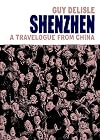
Shenzhen
by Guy Delisle
On This Page
Description
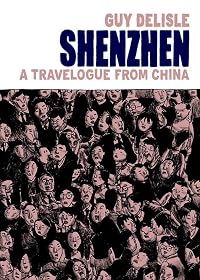
Presents the author's observations, in graphic novel format, of life in a cold city in southern China that is sealed off by electric fences and armed guards from the rest of the country.Tags
Recommendations





















Member Recommendations


Claire5555 Briiliant Book
Member Reviews
I enjoyed Delisle's earlier drawing style and this travelogue had a much deeper dive into the profession of animation. Even boredom and discomfort are made into art in this piece.
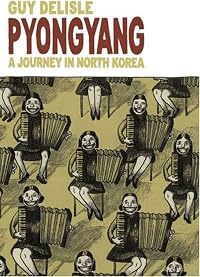
Guy Delisle's Shenzhen is another of his chronicles of his travels in East Asia as an animator working with a production company that has outsourced a project. This time, he's in China, in a city not far from Hong Kong. As he did in Pyangyong, he does an amazing job of describing his feelings of alienation in a different culture. He's clearly respectful of Chinese culture, but very much feels himself to be an outsider. He conveys the loneliness and longing for contact with other human beings. His connections with other westerners are pretty infrequent and when he does connect, he's inevitably disappointed and the contact in brief and unsatisfying.
The book is pretty downbeat and the illustrations are very dark. Nonetheless, there are show more plenty of humorous moments in the Shenzhen -- from the student in Canton trying to practice his English to his trip out to celebrate Christmas in the middle of nowhere. While the people he portrays are clearly alien to Delisle, they are very very human and he always gives a sense that the disconnect between himself and the Chinese is entirely cultural. He holds no grudge against Chinese traditions and customs, but he just doesn't "get" China. Having been in similar situations in Spain, I think this is a very respectful and honest piece of travel literature.
Apparently some critics have compared Shenzhen unfavorably to Pyongyang. I don't think that assessment holds up, however. The two books are trying to communicate two very different places and Deslisle's sense of otherness as a Westerner in East Asia. It may be that the city of Pyongyang, a sort-of Stalinist living history museum, is more exotic than Shenzhen, which comes across as an industrial backwater. As such, Pyonhyang may be more inherently "exotic" than Shenzhen. If you read Shenzhen, please do so with an open mind and realize that the two places are different. In fact, I'd say that Shenzhen is a better piece of reflective literature. show less
The book is pretty downbeat and the illustrations are very dark. Nonetheless, there are show more plenty of humorous moments in the Shenzhen -- from the student in Canton trying to practice his English to his trip out to celebrate Christmas in the middle of nowhere. While the people he portrays are clearly alien to Delisle, they are very very human and he always gives a sense that the disconnect between himself and the Chinese is entirely cultural. He holds no grudge against Chinese traditions and customs, but he just doesn't "get" China. Having been in similar situations in Spain, I think this is a very respectful and honest piece of travel literature.
Apparently some critics have compared Shenzhen unfavorably to Pyongyang. I don't think that assessment holds up, however. The two books are trying to communicate two very different places and Deslisle's sense of otherness as a Westerner in East Asia. It may be that the city of Pyongyang, a sort-of Stalinist living history museum, is more exotic than Shenzhen, which comes across as an industrial backwater. As such, Pyonhyang may be more inherently "exotic" than Shenzhen. If you read Shenzhen, please do so with an open mind and realize that the two places are different. In fact, I'd say that Shenzhen is a better piece of reflective literature. show less
This book captures the author's experience working in Shenzhen, China for a period of three months in 1997-1998. While I have never been to Shenzhen, I did spend about a week touring other parts of China (with a group of American tourists) in the mid-1990s, so I was curious to see how his experience compared with mine. I knew that it would be different, since we went to different places and he was there to work while I was there to vacation, but I was curious to compare my vacation experience to this graphic travelogue.
I was sadly disappointed. While I understand that my experience was by definition going to be very different from Delisle's (work vs. play at a minimum), the only thing we agreed upon was that the food we ate in China was show more overall very tasty.
Several of the pages show almost mocking responses to Chinese people practicing their English when talking to Delisle, and that really rubbed me the wrong way. There were multiple other references to cultural differences that felt similarly dismissive. I enjoyed the concept of a graphic travelogue (and I liked the art enough that I'm willing to try another one of Delisle's books) but this particular book was a big overall disappointment to me. show less
I was sadly disappointed. While I understand that my experience was by definition going to be very different from Delisle's (work vs. play at a minimum), the only thing we agreed upon was that the food we ate in China was show more overall very tasty.
Several of the pages show almost mocking responses to Chinese people practicing their English when talking to Delisle, and that really rubbed me the wrong way. There were multiple other references to cultural differences that felt similarly dismissive. I enjoyed the concept of a graphic travelogue (and I liked the art enough that I'm willing to try another one of Delisle's books) but this particular book was a big overall disappointment to me. show less
The inside sleeve:
‘Guy Delisle’s work for a French animation studio requires him to oversee production at various Asian studios on the grim frontiers of free trade. His employer puts him up for months at a time in ‘cold and soulless’ hotel rooms where he suffers the usual deprivations of a man very far from home. After Pyongyang, his book about the strange society that is North Korea, Delisle has turned his attention to Shenzhen, the cold, urban city in Southern China that is sealed off with electric fences and armed guards from the rest of the country. The result is another brilliant graphic novel – funny, scary, utterly original and illuminating.’
________________________________________
Guy Delisle finds himself in an show more unusual position to spend time in a relatively unknown corner of the world; Shenzhen, a city north of Hong Kong. He documents the three months he is there in striking sketches and many captivating insights held within the pages of Shenzhen, A travelogue from China. Delisle’s easy style brings you instantly into his world; in a mere six panels and three lines of text you are transported to China, experiencing the sights and the smells as though you had been there yourself.
Delisle’s time in China was not altogether happy; he went through great loneliness and times of boredom, predominately borne out of the lack of a common language with the populous. These experiences however are still interesting to read about. I found it quite intriguing how he chose to occupy his mind in the absence of companionship; from talking to himself to seeking company in language students who can barely put two English words together. Not to mention how he coped with navigating basic requirements such as what to eat, without the privilege of reading the menu or talking to the waiter. I’m not so sure how I would have survived in the same situation.
On top of his personal challenges, the book offers some wonderful insights into Chinese culture. It is the subtle differences between the people of the World that I am most interested in and he captures these beautifully. The differences in infrastructure, freedom of movement from place to place and of day to day living are also explored. Should I ever travel to China I now feel a little more prepared for the culture shock that awaits. His later novel, Pyongyang, offers more in the way of cultural and political insight, but I personally feel that this is predominately due to the unique obscurity of North Korea. Shenzhen is a lovely book to own, and I will dip into it often on my armchair travels. show less
‘Guy Delisle’s work for a French animation studio requires him to oversee production at various Asian studios on the grim frontiers of free trade. His employer puts him up for months at a time in ‘cold and soulless’ hotel rooms where he suffers the usual deprivations of a man very far from home. After Pyongyang, his book about the strange society that is North Korea, Delisle has turned his attention to Shenzhen, the cold, urban city in Southern China that is sealed off with electric fences and armed guards from the rest of the country. The result is another brilliant graphic novel – funny, scary, utterly original and illuminating.’
________________________________________
Guy Delisle finds himself in an show more unusual position to spend time in a relatively unknown corner of the world; Shenzhen, a city north of Hong Kong. He documents the three months he is there in striking sketches and many captivating insights held within the pages of Shenzhen, A travelogue from China. Delisle’s easy style brings you instantly into his world; in a mere six panels and three lines of text you are transported to China, experiencing the sights and the smells as though you had been there yourself.
Delisle’s time in China was not altogether happy; he went through great loneliness and times of boredom, predominately borne out of the lack of a common language with the populous. These experiences however are still interesting to read about. I found it quite intriguing how he chose to occupy his mind in the absence of companionship; from talking to himself to seeking company in language students who can barely put two English words together. Not to mention how he coped with navigating basic requirements such as what to eat, without the privilege of reading the menu or talking to the waiter. I’m not so sure how I would have survived in the same situation.
On top of his personal challenges, the book offers some wonderful insights into Chinese culture. It is the subtle differences between the people of the World that I am most interested in and he captures these beautifully. The differences in infrastructure, freedom of movement from place to place and of day to day living are also explored. Should I ever travel to China I now feel a little more prepared for the culture shock that awaits. His later novel, Pyongyang, offers more in the way of cultural and political insight, but I personally feel that this is predominately due to the unique obscurity of North Korea. Shenzhen is a lovely book to own, and I will dip into it often on my armchair travels. show less
Yeah, the anecdotes don't grab the attention. Delisle acknowledges this himself early on when he's all "damn guy who's writing HIS graphic novel about struggling to make it in New York while I write mine about living high on the hog in industrial-hellhole China." You don't have any brilliant experiences, you just don't have any brilliant experiences, and that's why not everyone should write a travelogue. Moderately banal.
I was expecting more from this one.
The art isn't great, to my taste: very rough strokes, little detail, and too much ink everywhere (it seems to me), which makes panels very dark and at times inscrutable. There are several pages consisting of a single panel taking all space, but the picture doesn't seem to merit so much room: it's usually made of broad strokes, and it's difficult to find interesting details in it.
The story itself is merely a random collection of anecdotes, of varying interest. There are the typical awkward moments, culture clashes and feelings of alienation that everyone who has lived in Asia can relate to. There are small observations and musings (of little interest to me). There are short digressions that have little show more to do with Shenzhen or with China (about the animation industry, memories of the author of other times and places, Canadian idiosyncrasies).
I didn't realise this is almost twenty years old. Delisle lived in Shenzhen between the end of 1997 and the beginning of 1998. I actually wanted to start reading Pyongyang (that's how I got to know about this author a few years ago). Perhaps that one's better…
At least the book communicates an accurate feeling of the atmosphere in Shenzhen, 1998. It has probably changed significantly in these last twenty years, given the crazy pace of urbanisation and growth. But I can imagine what Delisle felt, and he does a good job at conveying his feelings of boredom, delight, boredom, disgust, boredom, awe, and boredom. show less
The art isn't great, to my taste: very rough strokes, little detail, and too much ink everywhere (it seems to me), which makes panels very dark and at times inscrutable. There are several pages consisting of a single panel taking all space, but the picture doesn't seem to merit so much room: it's usually made of broad strokes, and it's difficult to find interesting details in it.
The story itself is merely a random collection of anecdotes, of varying interest. There are the typical awkward moments, culture clashes and feelings of alienation that everyone who has lived in Asia can relate to. There are small observations and musings (of little interest to me). There are short digressions that have little show more to do with Shenzhen or with China (about the animation industry, memories of the author of other times and places, Canadian idiosyncrasies).
I didn't realise this is almost twenty years old. Delisle lived in Shenzhen between the end of 1997 and the beginning of 1998. I actually wanted to start reading Pyongyang (that's how I got to know about this author a few years ago). Perhaps that one's better…
At least the book communicates an accurate feeling of the atmosphere in Shenzhen, 1998. It has probably changed significantly in these last twenty years, given the crazy pace of urbanisation and growth. But I can imagine what Delisle felt, and he does a good job at conveying his feelings of boredom, delight, boredom, disgust, boredom, awe, and boredom. show less
I love it. It's instructive, visceral, and very funny. He leaves few stones unturned.
I really liked Delisle's treatment of merging into traffic, trying to personalize with his animators, his travels to the more fun Canton and to Hong Kong (Tintin-esque), and the "food."
"The markets sell just about everything that moves ... cats, for instance. 'Ha ha ha.' Passing by a fancy restaurant, I see an ostrich in the kitchen."
I really liked Delisle's treatment of merging into traffic, trying to personalize with his animators, his travels to the more fun Canton and to Hong Kong (Tintin-esque), and the "food."
"The markets sell just about everything that moves ... cats, for instance. 'Ha ha ha.' Passing by a fancy restaurant, I see an ostrich in the kitchen."
Members
- Recently Added By
Published Reviews
ThingScore 75
Delisle’s European drawing style applies a humorous veneer to what might otherwise be a rather grim tale. But it’s so clearly hand-drawn — the lines of the buildings, for example, aren’t quite straight — that it takes on a cartoony feel, providing the reader some distance.
added by lampbane
Author Information

32+ Works 6,044 Members
Some Editions
Awards and Honors
Series
Belongs to Publisher Series
Common Knowledge
- Canonical title
- Shenzhen
- Original title
- Shenzhen
- Alternate titles
- Shenzhen: A Travelogue from China
- People/Characters
- Guy Delisle
- Important places
- Shenzhen, China; China; Hong Kong; Canton, China; Canada
- First words
- Shenzhen, December 1997...I'm back in China, in the South this time.
- Last words
- (Click to show. Warning: May contain spoilers.)There! Three months of good and faithful service.
- Original language
- French
Classifications
- Genre
- Graphic Novels & Comics
- DDC/MDS
- 741.5971 — Arts & recreation Drawing & decorative arts Drawing Comic books, graphic novels, fotonovelas, cartoons, caricatures, comic strips History, geographic treatment, biography North American Canada
- LCC
- PN6733 .D44 .S5413 — Language and Literature Literature (General) Literature (General) Collections of general literature Comic books, strips, etc.
- BISAC
Statistics
- Members
- 853
- Popularity
- 32,142
- Reviews
- 35
- Rating
- (3.66)
- Languages
- 12 — Czech, Dutch, English, Finnish, French, German, Italian, Polish, Portuguese (Brazil), Portuguese (Portugal), Spanish, Turkish
- Media
- Paper, Ebook
- ISBNs
- 21
- ASINs
- 4