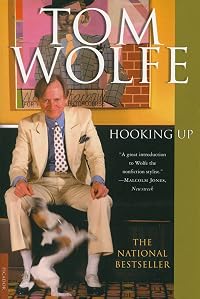
Hooking Up
by Tom Wolfe
On This Page
Description
From the Publisher: In Hooking Up, Tom Wolfe ranges from coast to coast observing 'the lurid carnival actually taking place in the mightiest country on earth in the year 2000.' From teenage sexual manners and mores to fundamental changes in the way human beings now regard themselves thanks to the hot new fields of genetics and neuroscience; from his legendary profile of William Shawn, editor of The New Yorker (first published in 1965), to a remarkable portrait of Bob Noyce, the man who show more invented Silicon Valley, Tom Wolfe the master of reportage and satire returns in vintage form. show lessTags
Recommendations





















Member Reviews
Tom Wolfe may dress up like Mark Twain, but Tom Wolfe’s a sheep in Twain’s clothing.
That said, Tom Wolfe — in Hooking Up — gives a riotous performance. From Silicon Valley to the halls of the hallowed “New Yorker” Magazine, Wolfe sheds light: much-needed and much-appreciated light. There are gems in this book, but you’ve got to know how to spot them.
Wolfe’s prose is edgy, amusing, straightforward — and a joy to read. He just ain’t Twain, Huck. (But then, nobody is except Samuel Clemens himself.)
RRB
04/16/11
Brooklyn, NY, USA
That said, Tom Wolfe — in Hooking Up — gives a riotous performance. From Silicon Valley to the halls of the hallowed “New Yorker” Magazine, Wolfe sheds light: much-needed and much-appreciated light. There are gems in this book, but you’ve got to know how to spot them.
Wolfe’s prose is edgy, amusing, straightforward — and a joy to read. He just ain’t Twain, Huck. (But then, nobody is except Samuel Clemens himself.)
RRB
04/16/11
Brooklyn, NY, USA
"Hooking Up" was written in the year 2000 and offers a group of abstract essays and one Novella - all bearing the common theme of how the United States changed in the second half of the 20th century. It touches on the cultural norms of education, the media, business, theology, and relationships.
One scathing essay is about "The New Yorker" magazine and William Shawn, it’s editor for over 30 years. The story is witty, entertaining, and informative.
The novella "Ambush at Fort Bragg" is a story about the murder of a gay soldier in the mens-room of a topless bar. The point of interest is how the media handled the coverage. But the most memorable detail is the vivid and articulate character development.
Some of the material in the book is show more a bit dated, but the essay "In the Land of Rococo Marxists" is not only current… it’s even more relevant today. This little essay in itself makes the entire book a worthwhile purchase. It involves Tom Wolfe’s theory about why our great country is so absorbed in a new conformity of mediocrity which is leading to declining educational standards, economic deterioration, and almost non-existent morals… all under the watchful eye of self appointed “elitists” who espouse political correctness and equal opportunity. It is post-modernism or deconstruction - whichever label you prefer.
In the same way the mass media has culturally conditioned us to think being sexy equates staying young - and staying young should be everyone’s ultimate goal - the “self appointed intellectuals” are trying to brainwash us into thinking that “political incorrectness” equates with being uneducated. In their eyes all “educated” people strive to be politically correct... regardless if that means forgoing truth, justice, personal integrity and/or high moral standards. And the category of issues considered “politically incorrect” keeps growing and widening to cover an unending list to the point where voicing a rational opinion on just about anything and everything has become risky.
However, in an attempt to stay aloof and superior, these so called elitist intellectuals have unwittingly become part of the mediocre masses. Meanwhile, a select few of the real intellectuals refuse to buckle under and conform - politically correct or not.
Looking at it from a totally objective point of view, it takes on all the eerie distortion of a Kafka novel, like some kind of grotesque joke. Wolfe is a genius! He could have written an entire book on this subject.
One other point of interest about "Hooking Up" - Tom Wolfe has a way of inadvertently sparking an interest in reading other authors works of fiction and philosophy. His references to Nietzsche regarding the social climate of our society today are intriguing and provocative. show less
One scathing essay is about "The New Yorker" magazine and William Shawn, it’s editor for over 30 years. The story is witty, entertaining, and informative.
The novella "Ambush at Fort Bragg" is a story about the murder of a gay soldier in the mens-room of a topless bar. The point of interest is how the media handled the coverage. But the most memorable detail is the vivid and articulate character development.
Some of the material in the book is show more a bit dated, but the essay "In the Land of Rococo Marxists" is not only current… it’s even more relevant today. This little essay in itself makes the entire book a worthwhile purchase. It involves Tom Wolfe’s theory about why our great country is so absorbed in a new conformity of mediocrity which is leading to declining educational standards, economic deterioration, and almost non-existent morals… all under the watchful eye of self appointed “elitists” who espouse political correctness and equal opportunity. It is post-modernism or deconstruction - whichever label you prefer.
In the same way the mass media has culturally conditioned us to think being sexy equates staying young - and staying young should be everyone’s ultimate goal - the “self appointed intellectuals” are trying to brainwash us into thinking that “political incorrectness” equates with being uneducated. In their eyes all “educated” people strive to be politically correct... regardless if that means forgoing truth, justice, personal integrity and/or high moral standards. And the category of issues considered “politically incorrect” keeps growing and widening to cover an unending list to the point where voicing a rational opinion on just about anything and everything has become risky.
However, in an attempt to stay aloof and superior, these so called elitist intellectuals have unwittingly become part of the mediocre masses. Meanwhile, a select few of the real intellectuals refuse to buckle under and conform - politically correct or not.
Looking at it from a totally objective point of view, it takes on all the eerie distortion of a Kafka novel, like some kind of grotesque joke. Wolfe is a genius! He could have written an entire book on this subject.
One other point of interest about "Hooking Up" - Tom Wolfe has a way of inadvertently sparking an interest in reading other authors works of fiction and philosophy. His references to Nietzsche regarding the social climate of our society today are intriguing and provocative. show less
This was my first Wolfe anything. I had seen several of his works lying around collecting dust on friends bookshelves, and had often wondered,"Who is this man with the ostentatious covers and 90s charisma?" Turns out he is somewhat of a relic and somewhat of a genius.
Like most carnal 20-somethings, I picked this one up because I was engaged by the prospect of an explanation of the process of temporary sexual desire. Instead, I got a narrative that weaved in and out of the cybertropolis of Y2K leftovers and Jerry Springer hangovers. It's not that Hooking Up is bad, in fact, it's quite good, it's just...dusty, fantastically 90s writing. Wolfe starts out strong telling the tale of Silicon Valley via a midwestern states dowsing of homespun show more Americana. The comparison to Josiah Grinnell, the coiner of the sternum lifting "Go West, young man," to Intel's brilliant business/physicist Robert Joyce is a tired cliche at best. Wolfe makes the argument that the success of the tech industry was based on the lingering residue of "Dissenting Protestantism" fighting against the elitist stigma of the Eastern United States. But, Wolfe's biting diction and playful tone allow for the insurgence of the technical age amidst all the limp-wrist elitists hanging around in Humanities departments (I am one by the way).
For all of his modern American apparatus drum-banging, Wolfe goes wildly off base by suggesting that the "ivory tower" fields of history, sociology, english, etc. are all boiling in a stew of remnant Marxism. Come on, there's plenty of capitalism here, what with all the competing and throat crunching for some sort of subject that hasn't been written about. Ok, so the Humanities is sinking under the weight of its own libraries, but there is a freshness in the air that is moving the tweed mildew out of our crumbling marble buildings. Surprise to Wolfe, however, the movement is not flamboyant or cutting edge. Good history today is patient, human-centered, and rich in overlapping methodologies. By lumping all of the liberal arts into a block of deconstruction, Wolfe failed to see what was coming as an attache to the estrangement caused by our technical enterprise: a quest for identity. And I would argue, most emphatically, that the past has the most to say about that one. Cue: ivory tower.
"Ambush at Fort Bragg" was a giant disappointment for me. It seemed like Wolfe was trying to hold some sort of pep rally for primetime journalism that no one really gave a shit about in the 90s. A whole short story about a murder of a gay person in the military by two erstwhile "skinhead" rednecks? Ughickphargh!!!! The whole plot was so Ricki Lake in the worst sort of 90s way, and still, this was to be the example of the great opportunity of current American journalism at the turn of the millenium? We got it all in "Ambush": nudey porno half asians, gay murders, big busted middle-aged female anchors, a sweaty palmed, emasculated whiner, and a giant criticism of the American military. I'll give Wolfe some credit because this was written in 2000, but I remember that year I was entranced by the emerging internet apparatus governed by Napster, AIM, and ebay. What Wolfe gave us was a last ditch pilot for the Jerry Springer show.
Wolfe's other autobiography about laying out William Shawn to the triumph of the 1960s journalistic world was an equal match of tedious brazenness. Wolfe let us know full well how awesome he USED to be, back then, you know, when newspapers were cool and such, and people cared about editors. Talk about "tiny mummies," Wolfe became one as soon as he published this in Hooking Up. Sure, it's an interesting story about bringing The New Yorker to its knees, and it's actually quite funny at parts, but I don't see any real purpose in it being in this volume other than to prop Wolfe up as some bare-knuckel bad-ass with a real life typewriter!
Anyways, this book is good for one reason only: Wolfe is an unbelievably good writer, and actually, he's a pretty sweet bad-ass too. Hooking Up seems to try too hard to make those points, but after all of the "Hey guys, I'm Tom Wolfe, and I'm really good, have been for awhile," one is convinced that this eccentric, pompous man, is a magician with words. So, I'll read other stuff by him-maybe even a novel, but I suppose from here on out I will be looking over my shoulder to guard against an Icabod Crane in the form of Wolfe who's lost his head because it exploded from egotism.
61 Respectable show less
Like most carnal 20-somethings, I picked this one up because I was engaged by the prospect of an explanation of the process of temporary sexual desire. Instead, I got a narrative that weaved in and out of the cybertropolis of Y2K leftovers and Jerry Springer hangovers. It's not that Hooking Up is bad, in fact, it's quite good, it's just...dusty, fantastically 90s writing. Wolfe starts out strong telling the tale of Silicon Valley via a midwestern states dowsing of homespun show more Americana. The comparison to Josiah Grinnell, the coiner of the sternum lifting "Go West, young man," to Intel's brilliant business/physicist Robert Joyce is a tired cliche at best. Wolfe makes the argument that the success of the tech industry was based on the lingering residue of "Dissenting Protestantism" fighting against the elitist stigma of the Eastern United States. But, Wolfe's biting diction and playful tone allow for the insurgence of the technical age amidst all the limp-wrist elitists hanging around in Humanities departments (I am one by the way).
For all of his modern American apparatus drum-banging, Wolfe goes wildly off base by suggesting that the "ivory tower" fields of history, sociology, english, etc. are all boiling in a stew of remnant Marxism. Come on, there's plenty of capitalism here, what with all the competing and throat crunching for some sort of subject that hasn't been written about. Ok, so the Humanities is sinking under the weight of its own libraries, but there is a freshness in the air that is moving the tweed mildew out of our crumbling marble buildings. Surprise to Wolfe, however, the movement is not flamboyant or cutting edge. Good history today is patient, human-centered, and rich in overlapping methodologies. By lumping all of the liberal arts into a block of deconstruction, Wolfe failed to see what was coming as an attache to the estrangement caused by our technical enterprise: a quest for identity. And I would argue, most emphatically, that the past has the most to say about that one. Cue: ivory tower.
"Ambush at Fort Bragg" was a giant disappointment for me. It seemed like Wolfe was trying to hold some sort of pep rally for primetime journalism that no one really gave a shit about in the 90s. A whole short story about a murder of a gay person in the military by two erstwhile "skinhead" rednecks? Ughickphargh!!!! The whole plot was so Ricki Lake in the worst sort of 90s way, and still, this was to be the example of the great opportunity of current American journalism at the turn of the millenium? We got it all in "Ambush": nudey porno half asians, gay murders, big busted middle-aged female anchors, a sweaty palmed, emasculated whiner, and a giant criticism of the American military. I'll give Wolfe some credit because this was written in 2000, but I remember that year I was entranced by the emerging internet apparatus governed by Napster, AIM, and ebay. What Wolfe gave us was a last ditch pilot for the Jerry Springer show.
Wolfe's other autobiography about laying out William Shawn to the triumph of the 1960s journalistic world was an equal match of tedious brazenness. Wolfe let us know full well how awesome he USED to be, back then, you know, when newspapers were cool and such, and people cared about editors. Talk about "tiny mummies," Wolfe became one as soon as he published this in Hooking Up. Sure, it's an interesting story about bringing The New Yorker to its knees, and it's actually quite funny at parts, but I don't see any real purpose in it being in this volume other than to prop Wolfe up as some bare-knuckel bad-ass with a real life typewriter!
Anyways, this book is good for one reason only: Wolfe is an unbelievably good writer, and actually, he's a pretty sweet bad-ass too. Hooking Up seems to try too hard to make those points, but after all of the "Hey guys, I'm Tom Wolfe, and I'm really good, have been for awhile," one is convinced that this eccentric, pompous man, is a magician with words. So, I'll read other stuff by him-maybe even a novel, but I suppose from here on out I will be looking over my shoulder to guard against an Icabod Crane in the form of Wolfe who's lost his head because it exploded from egotism.
61 Respectable show less
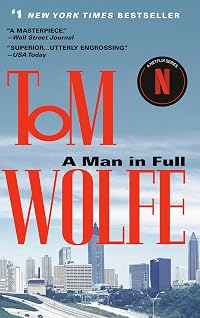
Scraps thrown together is one term that comes to mind. Wolfe titled the book after being surprised by the sexual habits of today's youth but the book does little to address this. It does however print many old stories Wolfe has had lying around for quite some time. The one highlight is the short story, "Ambush at Fort Bragg" which was cut from "A Man in Full". This short story shows Wolfe at his storytelling best and alone is worth the cost of the book.
We know that Wolfe has his own style of writing but thankfully he remains a journalist and writes without the pretensions of an artist. He sees and understands a lot, and he expresses well what he sees and understands, and you could hardly ask anything more of a journalist. In fact, as a journalist he goes one better: you find yourself enjoying subjects you wouldn't expect to enjoy.
Fun though not my favorite Wolfe. A bit of a mix of some of his good and his just okay essays. Still worth a read if you're a fan [as I am].
Full of vintage Wolfe, although a big chunk of the book is taken up by the novella 'Ambush at Fort Bragg', an interesting piece that doesn't go much of anywhere. This volume also includes a full recounting of Wolfe's battles with the New Yorker, which are wonderfully funny.
Members
- Recently Added By
Author Information

40+ Works 39,917 Members
Thomas Kennerly Wolfe Jr. was born in Richmond, Virginia on March 2, 1930. He received bachelor's degree in English from Washington and Lee University in 1951 and a Ph.D in American studies from Yale University in 1957. He started his journalism career as a general-assignment reporter at The Springfield Union. While he was working for The show more Washington Post, he was assigned to cover Latin America and won the Washington Newspaper Guild's foreign news prize for a series on Cuba in 1961. In 1962, he became a reporter for the New York Herald Tribune and a staff writer for New York magazine. His work also appeared in Harper's and Esquire. His first book, a collection of articles about the flamboyant Sixties written for New York and Esquire entitled The Kandy-Kolored Tangerine-Flake Streamline Baby, was published in 1968. His other collections included Radical Chic and Mau-Mauing the Flak Catchers and Hooking Up. His non-fiction works included The Pump House Gang; The Electric Kool-Aid Acid Test; The Painted Word; Mauve Gloves and Madmen, Clutter and Vine; In Our Time; and From Bauhaus to Our House. The Right Stuff won the American Book Award for nonfiction, the National Institute of Arts and Letters Harold Vursell Award for prose style, and the Columbia Journalism Award. It was adapted into a film in 1983. His fiction books included The Bonfire of the Vanities, Ambush at Fort Bragg, A Man in Full, The Kingdom of Speech, I Am Charlotte Simmons, and Back to Blood. He was also a contributing artist at Harper's from 1978 to 1981. Many of his illustrations were collected in In Our Time. He died on May 14, 2018 at the age of 88. (Bowker Author Biography) show less
Some Editions
Awards and Honors
Distinctions
Work Relationships
Contains
Common Knowledge
- Canonical title
- Hooking Up
- Original title
- Hooking Up
- Original publication date
- 2000
- First words
- By the year 2000, the term "working class" had fallen into disuse in the United States, and "proletariat" was so obsolete it was known only to a few bitter old Marxist academics with wire hair sprouting out of their ears.
- Last words
- (Click to show. Warning: May contain spoilers.)Pat pat pat pat pat pat pat.
(Click to show. Warning: May contain spoilers.)What else did she think "tiny mummies" and "the land of the walking dead" were supposed to mean? (Afterword)
Classifications
Statistics
- Members
- 1,121
- Popularity
- 22,708
- Reviews
- 15
- Rating
- (3.26)
- Languages
- 9 — Catalan, Dutch, English, Finnish, French, German, Italian, Portuguese, Spanish
- Media
- Paper, Audiobook, Ebook
- ISBNs
- 23
- ASINs
- 15