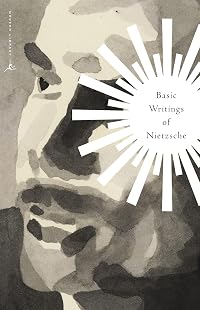
Basic Writings of Nietzsche
by Friedrich Nietzsche 
On This Page
Description
Introduction by Peter Gay Translated and edited by Walter Kaufmann Commentary by Martin Heidegger, Albert Camus, and Gilles Deleuze One hundred years after his death, Friedrich Nietzsche remains the most influential philosopher of the modern era. Basic Writings of Nietzsche gathers the complete texts of five of Nietzsche's most important works, from his first book to his last: The Birth of Tragedy, Beyond Good and Evil, On the Genealogy of Morals, The Case of Wagner, and Ecce Homo. Edited show more and translated by the great Nietzsche scholar Walter Kaufmann, this volume also features seventy-five aphorisms, selections from Nietzsche's correspondence, and variants from drafts for Ecce Homo. It is a definitive guide to the full range of Nietzsche's thought. Includes a Modern Library Reading Group Guide show lessTags
Recommendations










Member Recommendations
detroitleprechaun Same great translator with full versions of more of Nietzsche's works
Member Reviews
Notoriously prone to misinterpretation, Nietzsche has never been so well served by any editor as by Walter Kaufmann. As a translator, Kaufmann is helpful and honest, forthcoming about specific difficulties presented by the text during translation. Yet his greatest virtue is as a Nietzsche scholar. Without him, I suspect Nietzsche would still be suffering under the shadow of Nazi Germany, an undeserved association. This edition is careful to emphasize the biographical and historical contexts of the author, helping to dispel the misconception of Nietzsche as proto-Nazi. At the same time, Kaufmann unambiguously addresses his misogyny and complicated antisemitism.
The selections are a superb foundation for a new reader, or a hearty addition show more to an established Nietzsche library. I recommend this and any text edited by Kaufmann. show less
The selections are a superb foundation for a new reader, or a hearty addition show more to an established Nietzsche library. I recommend this and any text edited by Kaufmann. show less
A great edition of Nietzsche - curious how much the Tea Party COULD use some of these comments, but that would raise the level of discourse,and they would need to read the entire text (unlikely) to extract those few citations. Oh, Gingrich might!
This was a fantastic and enlightening book. Of course I had heard of Nietzsche, who hasn't in this day and age, but I have not had the pleasure of reading his works. Now I had heard of the Nazis, the nationalist whatever, the overarching philosophy of Nietzsche being the Will to Power, the Blond Beast and all of that, but I really wanted to see that sort of thing in context, which is what brought me to take this out of my local library.
Kaufmann's translation does quite the service to Nietzsche, allowing for his little puns and other play on words to come through, even though it has to be explained. This particular book contains five full works of Nietzsche and they are as follows:
The Birth of Tragedy,
Beyond Good and Evil,
On the show more Genealogy of Morals,
The Case of Wagner,
Ecce Homo.
Along with these full works are some aphorisms, selections from Nietzsche's correspondence and variants of drafts for Ecce Homo. Overall, even this book isn't enough to get the whole portion of Nietzsche's philosophy and I will probably have to read even more of him to 'get' it. Even so, what I did read, I enjoyed and I look forward to more. show less
Kaufmann's translation does quite the service to Nietzsche, allowing for his little puns and other play on words to come through, even though it has to be explained. This particular book contains five full works of Nietzsche and they are as follows:
The Birth of Tragedy,
Beyond Good and Evil,
On the show more Genealogy of Morals,
The Case of Wagner,
Ecce Homo.
Along with these full works are some aphorisms, selections from Nietzsche's correspondence and variants of drafts for Ecce Homo. Overall, even this book isn't enough to get the whole portion of Nietzsche's philosophy and I will probably have to read even more of him to 'get' it. Even so, what I did read, I enjoyed and I look forward to more. show less
It would be impossible to give an actual review to this book. The profundity of all that it contains simply defies any attempt at a concise interpretation. Therefore, I will simply make a minor comment on the edition itself.
This project of this book is invaluable. The scope, depth, and insight provided by the editors and Kaufmann himself are of inestimable importance. It is easy to get lost, even the most robust of readers, in such a compendium, and I thank the editors of this volume for providing that.
Thus the criticism. I feel that a two volume set of ALL of Nietzsche's work should have been attempted. With the possible exception of Zarathustra, I feel that it is more than justified to have in toto the five volumes that this book show more excerpts from in its section entitled "Seventy-five Aphorisms from Five Volumes." Were one to include these in one volume, and then conclude the second volume with "Twilight of the Idols" and "The Antichrist," I feel they would have provided an even greater contribution to Nietzsche scholarship. It may seem cumbersome to have so much in such little space, but when it comes to translations and editions, consistency of translation and commentary is very beneficial. Even more so, those five volumes excerpted here are not easy to come by, and are often horribly translated.
Nevertheless, a full 5 stars. Whether you hate him or love him, you must read him (which - as Kaufmann points out - most people, even those with heated opinions of him, have not). show less
This project of this book is invaluable. The scope, depth, and insight provided by the editors and Kaufmann himself are of inestimable importance. It is easy to get lost, even the most robust of readers, in such a compendium, and I thank the editors of this volume for providing that.
Thus the criticism. I feel that a two volume set of ALL of Nietzsche's work should have been attempted. With the possible exception of Zarathustra, I feel that it is more than justified to have in toto the five volumes that this book show more excerpts from in its section entitled "Seventy-five Aphorisms from Five Volumes." Were one to include these in one volume, and then conclude the second volume with "Twilight of the Idols" and "The Antichrist," I feel they would have provided an even greater contribution to Nietzsche scholarship. It may seem cumbersome to have so much in such little space, but when it comes to translations and editions, consistency of translation and commentary is very beneficial. Even more so, those five volumes excerpted here are not easy to come by, and are often horribly translated.
Nevertheless, a full 5 stars. Whether you hate him or love him, you must read him (which - as Kaufmann points out - most people, even those with heated opinions of him, have not). show less
A great Niezsche sampler. His aphoristic style does lend itself better than most for collections such as this, but the editors have still done a very good job of choosing those aphorisms which are representative of Nietzsche's style but still accessible to those new to his thought.
A good introduction to Nietzsche with plenty of notes.
I've only read "The Birth of Tragedy" in this collection, but it was good.
Members
- Recently Added By
Lists

GreatBooks Worldview Academy Lists
133 works; 4 members

Rory Gilmore Reading Challenge
34 works; 2 members
The Complete Rory Gilmore Reading List
506 works; 5 members
Author Information

1,375+ Works 78,142 Members
The son of a Lutheran pastor, Friedrich Wilhelm Nietzsche was born in 1844 in Roecken, Prussia, and studied classical philology at the Universities of Bonn and Leipzig. While at Leipzig he read the works of Schopenhauer, which greatly impressed him. He also became a disciple of the composer Richard Wagner. At the very early age of 25, Nietzsche show more was appointed professor at the University of Basel in Switzerland. In 1870, during the Franco-Prussian War, Nietzsche served in the medical corps of the Prussian army. While treating soldiers he contracted diphtheria and dysentery; he was never physically healthy afterward. Nietzsche's first book, The Birth of Tragedy Out of the Spirit of Music (1872), was a radical reinterpretation of Greek art and culture from a Schopenhaurian and Wagnerian standpoint. By 1874 Nietzsche had to retire from his university post for reasons of health. He was diagnosed at this time with a serious nervous disorder. He lived the next 15 years on his small university pension, dividing his time between Italy and Switzerland and writing constantly. He is best known for the works he produced after 1880, especially The Gay Science (1882), Thus Spake Zarathustra (1883-85), Beyond Good and Evil (1886), On the Genealogy of Morals (1887), The Antichrist (1888), and Twilight of the Idols (1888). In January 1889, Nietzsche suffered a sudden mental collapse; he lived the last 10 years of his life in a condition of insanity. After his death, his sister published many of his papers under the title The Will to Power. Nietzsche was a radical questioner who often wrote polemically with deliberate obscurity, intending to perplex, shock, and offend his readers. He attacked the entire metaphysical tradition in Western philosophy, especially Christianity and Christian morality, which he thought had reached its final and most decadent form in modern scientific humanism, with its ideals of liberalism and democracy. It has become increasingly clear that his writings are among the deepest and most prescient sources we have for acquiring a philosophical understanding of the roots of 20th-century culture. (Bowker Author Biography) show less
Friedrich Nietzsche has a Legacy Library. Legacy libraries are the personal libraries of famous readers, entered by LibraryThing members from the Legacy Libraries group.
All Editions
Series
Belongs to Publisher Series
Work Relationships
Common Knowledge
- Canonical title
- Basic Writings of Nietzsche
- Original publication date
- 1872 (The Birth of Tragedy) (The Birth of Tragedy); 1886 (Beyond Good and Evil) (Beyond Good and Evil); 1887 (On the Genealogy of Morality) (On the Genealogy of Morality); 1888 (The Case of Wagner) (The Case of Wagner); 1888 (Ecce Homo) (Ecce Homo)
- Related movies
- When Nietzsche Wept (2007 | IMDb)
- First words
- Whatever may be at the bottom of this questionable book, it must have been an exceptionally significant and fascinating question, and deeply personal at that: the time in which it was written, in spite of which it was written... (show all), bears witness to that—the exciting time of the Franco-Prussian War of 1870/71.
- Last words
- (Click to show. Warning: May contain spoilers.)Dionysus versus the Crucified.
- Blurbers
- Kaufmann, Walter
- Original language
- German
- Canonical LCC
- B3312.E52K22
Classifications
Statistics
- Members
- 2,650
- Popularity
- 7,037
- Reviews
- 9
- Rating
- (4.15)
- Languages
- English, French
- Media
- Paper, Ebook
- ISBNs
- 9
- ASINs
- 17