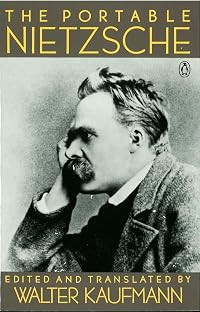
The Portable Nietzsche
by Friedrich Nietzsche 
On This Page
Description
Selections from the books, notes, and letters of this 19th century philosopher.Tags
Recommendations
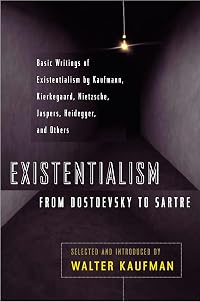
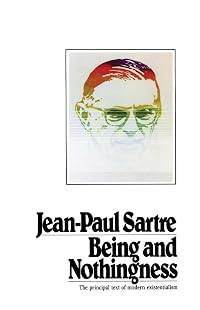
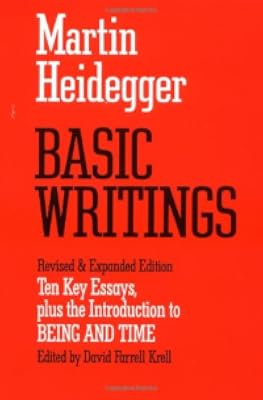
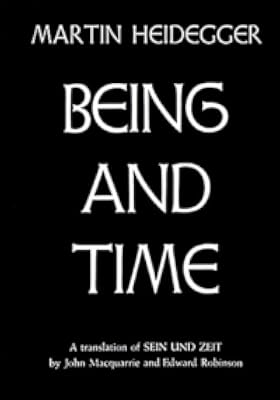












Member Recommendations
detroitleprechaun Same great translator with full versions of more of Nietzsche's works
Member Reviews
This is the third time I have read this anthology. That last time was around 1990. It is worth reading again. But now the cover is gone, and the first pages have drifted away. Over the years I have, of course, I have read other Nietzsche in other editions, but nothing has ever risen to the level of translator and editor Kaufmann’s insights, notes, and arrangement. Even this could be improved by me. I would like more help as I read and Nietzsche refers to contemporary events and personages like David Strauss, etc. Also, this particular collection is Thus Spoke Zarathustra with assorted other works. I think that 1883 could have been trimmed down in the excerpt and a few more letters and aphorisms thrown in and that would be better. show more Speaking of the “aphoristic” (learned that adjective from Kaufmann) over the years I have been moving away from the radical provocations of Thus Spoke Zarathustra and The Antichrist to these insightful, witty aphorisms that I see as a middle period. Those two works I see in the third act with the curtain opening on the Wagner love and the Greek scholar’s dichotomy of the Apollonian and Dionysian.
They are a bit more clearly aimed, while the latter works are not exactly Nostradamus in perplexing obscurity. All that hallucinogenic metaphor probably explains how Nazi theorists and other anti-Semite thinkers believe there is some basis for their worldview here. Kaufmann points out some spots that are quicksand for the deluded despite Nietzsche being overtly anti-anti-Semite (he actually respects Jews for Spinoza and more), anti-party, and anti-nationalistic as in this note:
Being nationalistic in the sense in which it is now demanded by public opinion would, it seems to me, be for us who are more spiritual not mere insipidity but dishonesty, a deliberate deadening of our better will and conscience.
Of course, if his sister had predeceased him, maybe none of that association would have come about:
Essentially, Nietzsche is furiously individual with warnings for all that fear the individual:
Or, put more succinctly:
Really eternal recurrence and even ressentiment I find more interesting than profound. The whole beyond good and evil idea I find more worth mulling on, as is alluded to here:
and
Then we go onto this meat to chew on:
And then this which intrigues me as Buddhism has since I was a teen:
The miscellany of Notes and Letters are intriguing insights into Nietzsche the individual. For one thing, while he did eventually go instance, he comes across “off stage” much more collected than his later zany published works. I would like more of this type of insight, as his reading habits:
In a lot of this, I couldn’t help but think of Nietzsche alive today as a cable news pundit and with a Twitter account (first three from Twilight of the Idols, 1888):
and
and
And, boy oh boy:
They are a bit more clearly aimed, while the latter works are not exactly Nostradamus in perplexing obscurity. All that hallucinogenic metaphor probably explains how Nazi theorists and other anti-Semite thinkers believe there is some basis for their worldview here. Kaufmann points out some spots that are quicksand for the deluded despite Nietzsche being overtly anti-anti-Semite (he actually respects Jews for Spinoza and more), anti-party, and anti-nationalistic as in this note:
Being nationalistic in the sense in which it is now demanded by public opinion would, it seems to me, be for us who are more spiritual not mere insipidity but dishonesty, a deliberate deadening of our better will and conscience.
Of course, if his sister had predeceased him, maybe none of that association would have come about:
LETTER TO HIS SISTER
Christmas 1887
…You have committed one of the greatest stupidities- for yourself and for me! Your association with an anti-Semitic chief expresses a foreignness to my whole way of life which fills me again and again with ire or melancholy… It is a matter of honor with me to be absolutely clean and unequivocal in relation to AntiSemitism, namely, opposed to it, as I am in my writings. I have recently been persecuted with letters and AntiSemitic Correspondence Sheets. My disgust with this party (which would like the benefit of my name only too well!) is as pronounced as possible…
I am unable to do anything against it, that the name of Zarathustra is used in every Anti-Semitic Correspondence Sheet, has almost made me sick several times…
Essentially, Nietzsche is furiously individual with warnings for all that fear the individual:
The eulogists of work. Behind the glorification of "work" and the tireless talk of the "blessings of work" I find the same thought as behind the praise of impersonal activity for the public benefit: the fear of everything individual. At bottom, one now feels when confronted with work-and what is invariably meant is relentless industry from early till late-that such work is the best police, that it keeps everybody in harness and powerfully obstructs the development of reason, of covetousness, of the desire for independence. For it uses up a tremendous amount of nervous energy and takes it away from reflection, brooding, dreaming, worry, love, and hatred; it always sets a small goal before one's eyes and permits easy and regular satisfactions. In that way a society in which the members continually work hard will have more security: and security is now adored as the supreme goddess. And now horrors! it is precisely the "worker" who has become dangerous. "Dangerous individuals are swarming all around. And behind them, the danger of dangers: the individual.
- The Dawn (1881)
Or, put more succinctly:
The surest way to corrupt a youth is to instruct him to hold in higher esteem those who think alike than those who think differently.
- The Dawn (1881)
Really eternal recurrence and even ressentiment I find more interesting than profound. The whole beyond good and evil idea I find more worth mulling on, as is alluded to here:
Of all evil I deem you capable: therefore I want the good from you. Verily, I have often laughed at the weaklings who thought themselves good because they had no claws.
- Thus Spoke Zarathustra (1883)
and
What is done out of love always occurs beyond good and evil.
- Beyond Good and Evil (1886)
Then we go onto this meat to chew on:
My demand upon the philosopher is known, that he take his stand beyond good and evil and leave the illusion of moral judgment beneath himself. This demand follows from an insight which I was the first to formulate: that there are altogether no moral facts. Moral judgments agree with religious ones in believing in realities which are no realities. Morality is merely an interpretation of certain phenomena-more precisely, a misinterpretation. Moral judgments, like religious ones, belong to a stage of ignorance at which the very concept of the real and the distinction between what is real and imaginary, are still lacking; thus "truth," at this stage, designates all sorts of things which we today call "imaginings." Moral judgments are therefore never to be taken literally: so understood, they always contain mere absurdity. Semeiotically, however, they remain invaluable: they reveal, at least for those who know, the most valuable realities of cultures and inwardnesses which did not know enough to "understand" themselves. Morality is mere sign language, mere symptomatology: one must know what it is all about to be able to profit from it.
- Twilight of the Idols (1888)
And then this which intrigues me as Buddhism has since I was a teen:
That the strong races of northern Europe did not reject the Christian God certainly does no credit to their religious genius-not to speak of their taste. There is no excuse whatever for their failure to dispose of such a sickly and senile product of decadence. But a curse lies upon them for this failure: they have absorbed sickness, old age, and contradiction into all their instincts and since then they have not created another god. Almost two thousand years-and not a single new god! But still, as if his existence were justified, as if he represented the ultimate and the maximum of the god-creating power, of the creator spiritus in man, this pitiful god of Christian monotono-theism! …
I hope that my condemnation of Christianity has not involved me in any injustice to a related religion with an even larger number of adherents: Buddhism. Both belong together as nihilistic religions-they are religions of decadence-but they differ most remarkably. For being in a position now to compare them, the critic of Christianity is profoundly grateful to the students of India.
Buddhism is a hundred times more realistic than Christianity: posing problems objectively and coolly is part of its inheritance, for Buddhism comes after a philosophic movement which spanned centuries. The concept of "God" had long been disposed of when it arrived. Buddhism is the only genuinely positivistic religion in history. This applies even to its theory of knowledge (a strict phenomenalism): it no longer says "struggle against sin" but, duly respectful of reality. "struggle against suffering." Buddhism is profoundly distinguished from Christianity by the fact that the self-deception of the moral concepts lies far behind it. In my terms, it stands beyond good and evil.
- The Antichrist (1888)
The miscellany of Notes and Letters are intriguing insights into Nietzsche the individual. For one thing, while he did eventually go instance, he comes across “off stage” much more collected than his later zany published works. I would like more of this type of insight, as his reading habits:
LETIER TO OVERBECK
Nizza, February 23, 1887
…I did not even know the name of Dostoevsky just a few weeks ago-uneducated person that I am, not reading any journals. An accidental reach of the arm in a bookstore brought to my attention L' esprit souterrain, a work just translated into French. (It was a similar accident with Schopenhauer in my 21st year and with Stendhal in my 35th.) The instinct of kinship (or how should I name it?) spoke up immediately; my joy was extraordinary…
In a lot of this, I couldn’t help but think of Nietzsche alive today as a cable news pundit and with a Twitter account (first three from Twilight of the Idols, 1888):
The sick man is a parasite of society. In a certain state it is indecent to live longer. To go on vegetating in cowardly dependence on physicians and machinations, after the meaning of life, the right to life, has been lost, that ought to prompt a profound contempt in society. The physicians, in turn, would have to be the mediators of this contempt-not prescriptions, but every day a new dose of nausea with their patients. To create a new responsibility, that of the physician, for all cases in which the highest interest of life, of ascending life, demands the most inconsiderate pushing down and aside of degenerating life-for example, for the right of procreation, for the right to be born, for the right to live. To die proudly when it is no longer possible to live proudly. Death freely chosen, death at the right time, brightly and cheerfully accomplished…
and
The value of a thing sometimes does not lie in that which one attains by it, but in what one pays for it-what it costs us. I shall give an example. Liberal institutions cease to be liberal as soon as they are attained: later on, there are no worse and no more thorough injurers of freedom than liberal institutions. Their effects are known well enough: they undermine the will to power; they level mountain and valley, and call that morality; they make men small, cowardly, and hedonistic-every time it is the herd animal that triumphs with them. Liberalism: in other words, herd-animalization.
and
Our institutions are no good any more: on that there is universal agreement. However, it is not their fault but ours. Once we have lost all the instincts out of which institutions grow, we lose institutions altogether because we are no longer good for them. Democracy has ever been the form of decline in organizing power…
And, boy oh boy:
One need only read any Christian agitator, St. Augustine, for example, to comprehend, to smell, what an unclean lot had thus come to the top. One would deceive oneself utterly if one presupposed any lack of intelligence among the leaders of the Christian movement: oh, they are clever, clever to the point of holiness, these good church fathers! What they lack is something quite different. Nature has neglected them-she forgot to give them a modest dowry of respectable, of decent, of clean instincts. Among ourselves, they are not even men. Islam is a thousand times right in despising Christianity: Islam presupposes men.show less
Christianity has cheated us out of the harvest of ancient culture; later it cheated us again, out of the harvest of the culture of Islam. The wonderful world of the Moorish culture of Spain, really more closely related to us, more congenial to our senses and tastes than Rome and Greece, was trampled down (I do not say by what kind of feet). Why? Because it owed its origin to noble, to male instincts, because it said Yes to life even with the rare and refined luxuries of Moorish life.
- The Antichrist (1888)
my main observation: Nietzsche's philosophy is extremely difficult to encapsulate. i definitely know what people mean now when they say he has no system, although i saw ever-so-many teasing hints at one!
other thoughts:
*eternal recurrence?! what's up with that?
*my reservations about his antipathy toward "equality" and his embrace of hierarchy were never completely resolved, but, based on Zarathustra, i'm relatively sure that they are primarily intended as motivational devices with benevolent intent. i have an especially hard time sympathizing with his fawning admiration of the ancient Greeks, which is at odds with his equally strong dislike of "convictions". this utopian anti-egalitarian current rubs me the wrong way but doesn't show more completely turn me off. i'll reserve judgment for the moment.
*i found the Antichrist to be a relatively accessible critique of Christianity that is far more interesting than Dawkinsian (apologies) arguments. culture is just more interesting than science. show less
other thoughts:
*eternal recurrence?! what's up with that?
*my reservations about his antipathy toward "equality" and his embrace of hierarchy were never completely resolved, but, based on Zarathustra, i'm relatively sure that they are primarily intended as motivational devices with benevolent intent. i have an especially hard time sympathizing with his fawning admiration of the ancient Greeks, which is at odds with his equally strong dislike of "convictions". this utopian anti-egalitarian current rubs me the wrong way but doesn't show more completely turn me off. i'll reserve judgment for the moment.
*i found the Antichrist to be a relatively accessible critique of Christianity that is far more interesting than Dawkinsian (apologies) arguments. culture is just more interesting than science. show less
This is a very good anthology of selections from Nietzsche by his best English translator. Never a systematic philosopher, Nietzsche is easily misunderstood and easy to appropriate dishonestly. He also happens to be one of the finer German prose stylists, so representing him well in English is a tough assignment. Walter Kaufman does a very good job.
This volume includes Thus Spake Zarathustra and the single most well-known, if not the most important, selection from Nietzsche, his famous "God is Dead" scene. Also sprach Zarathustra: Ein Buch für Alle und Keinen is a philosophical novel and is most unusual in topic, arrangement, and experimental style. Although this may be off-putting to some, in the hands of this master it is superb. The four parts includes Nietzsche's famous "death of God" parable but also some well-known passages such as the "eternal recurrence of the same," and the "prophecy" of the Overman, which were first introduced in The Gay Science.
"God is dead" (Gott ist tot) is widely-quoted. It first appears in Die fröhliche Wissenschaft, section 108 (New Struggles), show more in section 125 (The Madman), and for a third time in section 343 (The Meaning of our Cheerfulness). However, Zarathustra is most responsible for popularizing the phrase. The idea is stated in "The Madman" as follows:
God is dead. God remains dead. And we have killed him. How shall we comfort ourselves, the murderers of all murderers? What was holiest and mightiest of all that the world has yet owned has bled to death under our knives: who will wipe this blood off us? What water is there for us to clean ourselves? What festivals of atonement, what sacred games shall we have to invent? Is not the greatness of this deed too great for us? Must we ourselves not become gods simply to appear worthy of it?
"God is dead" does not appear for Nietzsche to mean disbelieving in a literal God. He does not seem to even be addressing a popular misunderstanding of his literal words. He seems rather to be speculating on worthy ideas and who or what to rely on. In this sense, then, the European Protestant Christian God was certainly dead. Even more importantly, Nietzsche is not gloating and he recognizes the profound crisis into which the death of God plunges individuals and humanity. He states: "When one gives up the Christian faith, one pulls the right to Christian morality out from under one's feet. This morality is by no means self-evident." In light of Nietzsche's clarity, what guide to morality can be reliable during such a crisis? "The Madman" then must realize that individuals must create a self-sufficient system of values in the absence of a divine known or revealed order. We are truly alone which Nietzsche appreciates is a frightening predicament.
The death of God for Nietzsche will lead to a rejection of absolute values themselves--to the rejection of belief in an objective and universal moral law, binding upon all individuals. In this manner, the loss of an absolute basis for morality leads to nihilism. This nihilism is what Nietzsche worked to find a solution for by re-evaluating the foundations of human values. This meant, to Nietzsche, looking for foundations that went deeper than Christian values. He would find a basis in the "will to power" that he described as "the essence of reality." This foundation could only be an individual creative personal work. Most people are not up to the task.
Nietzsche believed that the majority of people did not recognize (or refused to acknowledge) this death out of the deepest-seated fear, avoidance, or angst. Therefore, when the death of God began to be widely acknowledged, people would despair and nihilism would become rampant. Nietzsche saw himself as a historical figure like Zarathustra, Socrates, or Jesus, providing only the general orientation to individuals who could overcome the impending European nihilism. show less
"God is dead" (Gott ist tot) is widely-quoted. It first appears in Die fröhliche Wissenschaft, section 108 (New Struggles), show more in section 125 (The Madman), and for a third time in section 343 (The Meaning of our Cheerfulness). However, Zarathustra is most responsible for popularizing the phrase. The idea is stated in "The Madman" as follows:
God is dead. God remains dead. And we have killed him. How shall we comfort ourselves, the murderers of all murderers? What was holiest and mightiest of all that the world has yet owned has bled to death under our knives: who will wipe this blood off us? What water is there for us to clean ourselves? What festivals of atonement, what sacred games shall we have to invent? Is not the greatness of this deed too great for us? Must we ourselves not become gods simply to appear worthy of it?
"God is dead" does not appear for Nietzsche to mean disbelieving in a literal God. He does not seem to even be addressing a popular misunderstanding of his literal words. He seems rather to be speculating on worthy ideas and who or what to rely on. In this sense, then, the European Protestant Christian God was certainly dead. Even more importantly, Nietzsche is not gloating and he recognizes the profound crisis into which the death of God plunges individuals and humanity. He states: "When one gives up the Christian faith, one pulls the right to Christian morality out from under one's feet. This morality is by no means self-evident." In light of Nietzsche's clarity, what guide to morality can be reliable during such a crisis? "The Madman" then must realize that individuals must create a self-sufficient system of values in the absence of a divine known or revealed order. We are truly alone which Nietzsche appreciates is a frightening predicament.
The death of God for Nietzsche will lead to a rejection of absolute values themselves--to the rejection of belief in an objective and universal moral law, binding upon all individuals. In this manner, the loss of an absolute basis for morality leads to nihilism. This nihilism is what Nietzsche worked to find a solution for by re-evaluating the foundations of human values. This meant, to Nietzsche, looking for foundations that went deeper than Christian values. He would find a basis in the "will to power" that he described as "the essence of reality." This foundation could only be an individual creative personal work. Most people are not up to the task.
Nietzsche believed that the majority of people did not recognize (or refused to acknowledge) this death out of the deepest-seated fear, avoidance, or angst. Therefore, when the death of God began to be widely acknowledged, people would despair and nihilism would become rampant. Nietzsche saw himself as a historical figure like Zarathustra, Socrates, or Jesus, providing only the general orientation to individuals who could overcome the impending European nihilism. show less
Many of Friedrich Nietzsche's most significant works are included in this useful compilation. It contains a number of finished works as well as notes and letters. Additionally, Walter Kaufmann's translations are superb.
Started w Thomas Common version of Thus Spake Zarathustra and quickly switched to my old copy Portable Nietzsche for my reread. Much more readable and understandable. Also using a web site called Lit Charts that gives some perspective
Just started 3d book and getting accustomed to the writing style and pace
Reading some essays off Academia.com which give great background info. Just so much going on w TSZ. Esp to be mindful of who he is talking to at any given time.
The recurring loop of life quite interesting, basically has lived these lives before and will live again- eternal recurrence?
Paul Loeb gives good commentary on Academia.com, Zarathustra written in Old Testament language to maintain attention of average reader in 1880's, because show more they were familiar w that style from bible. Other FN books written in a more intellectual/ philosophical style show less
Just started 3d book and getting accustomed to the writing style and pace
Reading some essays off Academia.com which give great background info. Just so much going on w TSZ. Esp to be mindful of who he is talking to at any given time.
The recurring loop of life quite interesting, basically has lived these lives before and will live again- eternal recurrence?
Paul Loeb gives good commentary on Academia.com, Zarathustra written in Old Testament language to maintain attention of average reader in 1880's, because show more they were familiar w that style from bible. Other FN books written in a more intellectual/ philosophical style show less
Perhaps the most valuable part of this book is his crazed letters at the end.
Members
- Recently Added By
Lists

Fake Top 100 Nonfiction
79 works; 3 members

German Literature
518 works; 56 members

Literary Works Read in College
316 works; 15 members

Tom's Bookstore
346 works; 2 members

Shaykh Hamza's Book Recommendations
439 works; 3 members

New Lifetime Reading Plan by Fadiman and Major
225 works; 5 members

Junky Paperbacks
15 works; 1 member

The Complete Rory Gilmore Reading List
506 works; 5 members

Maybe This Year? Books to Look Forward To
412 works; 9 members
Author Information

1,397+ Works 78,543 Members
The son of a Lutheran pastor, Friedrich Wilhelm Nietzsche was born in 1844 in Roecken, Prussia, and studied classical philology at the Universities of Bonn and Leipzig. While at Leipzig he read the works of Schopenhauer, which greatly impressed him. He also became a disciple of the composer Richard Wagner. At the very early age of 25, Nietzsche show more was appointed professor at the University of Basel in Switzerland. In 1870, during the Franco-Prussian War, Nietzsche served in the medical corps of the Prussian army. While treating soldiers he contracted diphtheria and dysentery; he was never physically healthy afterward. Nietzsche's first book, The Birth of Tragedy Out of the Spirit of Music (1872), was a radical reinterpretation of Greek art and culture from a Schopenhaurian and Wagnerian standpoint. By 1874 Nietzsche had to retire from his university post for reasons of health. He was diagnosed at this time with a serious nervous disorder. He lived the next 15 years on his small university pension, dividing his time between Italy and Switzerland and writing constantly. He is best known for the works he produced after 1880, especially The Gay Science (1882), Thus Spake Zarathustra (1883-85), Beyond Good and Evil (1886), On the Genealogy of Morals (1887), The Antichrist (1888), and Twilight of the Idols (1888). In January 1889, Nietzsche suffered a sudden mental collapse; he lived the last 10 years of his life in a condition of insanity. After his death, his sister published many of his papers under the title The Will to Power. Nietzsche was a radical questioner who often wrote polemically with deliberate obscurity, intending to perplex, shock, and offend his readers. He attacked the entire metaphysical tradition in Western philosophy, especially Christianity and Christian morality, which he thought had reached its final and most decadent form in modern scientific humanism, with its ideals of liberalism and democracy. It has become increasingly clear that his writings are among the deepest and most prescient sources we have for acquiring a philosophical understanding of the roots of 20th-century culture. (Bowker Author Biography) show less
Friedrich Nietzsche has a Legacy Library. Legacy libraries are the personal libraries of famous readers, entered by LibraryThing members from the Legacy Libraries group.
Some Editions
Series
Belongs to Publisher Series
Work Relationships
Common Knowledge
- Canonical title
- The Portable Nietzsche
- Original publication date
- 1954
- People/Characters
- Nietzsche, Friedrich Wilhelm, 1844-1900
- Epigraph
- Wenn's etwas gibt, gewalt'ger als das Schicksal,
So ist's der Mut, der's unerschüttert trägt.
—Geibel - Dedication
- To Edith Kaufmann
- First words
- (Introduction by Walter Kaufmann): There are philosophers who can write and philosophers who cannot.
... as for your principle that truth is always on the side of the more difficult, I admit this in part. - Last words
- (Click to show. Warning: May contain spoilers.)I am just having all anti-Semites shot.
- Original language
- German
Classifications
Statistics
- Members
- 3,723
- Popularity
- 4,338
- Reviews
- 10
- Rating
- (4.15)
- Languages
- Dutch, English, Indonesian, Spanish
- Media
- Paper, Ebook
- ISBNs
- 18
- ASINs
- 41