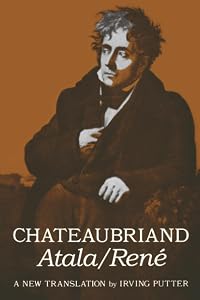
Atala / René
by François-René de Chateaubriand
On This Page
Description
Tells the passionate and tragic love story of a young Indian couple wandering in the wilderness, enthralled by the beauties of nature, drawn to a revivified Christianity by its esthetic charm and consoling beneficence, and finally succumbing to the cruelty of fate.Tags
Recommendations













































Member Reviews
Atala by Chateaubriand was published in 1801 and René in 1802. Both novellas well received at the time due to the “exotic” locations (the US and native individuals) and the virtues of Christianity. The summary indicates they “helped shape European romantic archetypes which would resonate throughout the 19th century and profoundly mark literature and art.”
The writing (translation by Rayner Heppenstall) was good, but I couldn’t connect to the characters.
The objectifying of Native Americans and liberal use of the word “savages” (hard to buy the “wise” Chactas thinking of himself as “Savage”) is off putting, so it has to be read as a book of its time.
The writing (translation by Rayner Heppenstall) was good, but I couldn’t connect to the characters.
The objectifying of Native Americans and liberal use of the word “savages” (hard to buy the “wise” Chactas thinking of himself as “Savage”) is off putting, so it has to be read as a book of its time.
This is a review of Rene, perhaps some other time I’ll read Atala.
I came to this book through reading Nabokov’s commentary to Eugene Onegin. Nabokov called Rene “a work of genius by the greatest French writer of his time. . . this admirable short novel whose art and charme veloute only Senacour’s Oberman can approach . . . The rhythm and richness of phrasing are admirable. Flaubert could not have done better.” Even the title page of the larger work, Genie du Christianisme, of which Rene is a part, is judged sonorous by Nabokov.
Not much to say after that.
I am lucky to have a comfortable UC library just across town where undeservedly obscure books like this can be easily found. The story is but 29 pages long, its title show more character a forerunner of the Byronic hero. The book beautifully expresses a romantic spirit and there are several reasons for that. The turmoil of Rene’s heart leading him to solitude. The search for what life has to offer. The tender love between brother and sister. Of course there’s Chateaubriand’s use of apostrophe, “With what reverent and poetic awe I wandered through those vast edifices consecrated to religion by the arts! . . . How beautiful are the echoes circling round those domes like rolling waves in the ocean, like the murmur of winds in the forest or the voice of God in his temple!” And there is the framing of the scene in nature like Rene telling his secret, the story of his heart, from under the bright green leaves of a sassafras tree where he can see the grandeur of both the Mississippi River and the Appalachians (poetic geographic license). If only I knew French then I could hear the sound of romance too and then be able to judge this a prose poem for myself. Alas, life is too short. show less
I came to this book through reading Nabokov’s commentary to Eugene Onegin. Nabokov called Rene “a work of genius by the greatest French writer of his time. . . this admirable short novel whose art and charme veloute only Senacour’s Oberman can approach . . . The rhythm and richness of phrasing are admirable. Flaubert could not have done better.” Even the title page of the larger work, Genie du Christianisme, of which Rene is a part, is judged sonorous by Nabokov.
Not much to say after that.
I am lucky to have a comfortable UC library just across town where undeservedly obscure books like this can be easily found. The story is but 29 pages long, its title show more character a forerunner of the Byronic hero. The book beautifully expresses a romantic spirit and there are several reasons for that. The turmoil of Rene’s heart leading him to solitude. The search for what life has to offer. The tender love between brother and sister. Of course there’s Chateaubriand’s use of apostrophe, “With what reverent and poetic awe I wandered through those vast edifices consecrated to religion by the arts! . . . How beautiful are the echoes circling round those domes like rolling waves in the ocean, like the murmur of winds in the forest or the voice of God in his temple!” And there is the framing of the scene in nature like Rene telling his secret, the story of his heart, from under the bright green leaves of a sassafras tree where he can see the grandeur of both the Mississippi River and the Appalachians (poetic geographic license). If only I knew French then I could hear the sound of romance too and then be able to judge this a prose poem for myself. Alas, life is too short. show less
1146 Atala Rene, by Francois Rene de Chateaubriand (read 1 Jan 1972) I found these stories entrancing. All the prose is poetry! I really like the style. Like this: "In the midst of these thoughts, the hour began tolling in measured cadence from the tower of the Gothic cathedral, and its message was taken up from church to church in a wide range of times and distances. Alas! Every hour in society lays open a grave and draws fresh tears." That is from Rene. Or this, from, I think, Atala: "How sweet. but how fleeting, are those moments spent together by brothers and sisters in their younger years under the wing of their aged parents! The family of man endures but a day, and then God's breath scatters it away like smoke. The son barely show more knows the father or the father the son, the brother the sister or the sister the brother! The oak sees its acorns take root all around it; it is not so with the children of men!" show less
Le prologue évoque la Louisiane française, le fleuve Mississippi. "Atala" est l'histoire d'un indien Natchez qui va raconter son amour tragique pour une indienne chrétienne de Floride. "René", le jeune homme de bonne famille échoué parmi les indiens, contera lui sa vie en France et ce qui l'a amené à se réfugier dans une contrée si lointaine, en Louisiane.
Aug 27, 2014French
Busken Huet (1875, 1883; blz. 1-53 beschrijft op prachtige wijze de inhoud van deze boeken en vergelijkt deze met o.a. Werther. Een genot om te lezen in het Nederlands maar ik wil het ook nog in het Frans lezen.
Dec 24, 2023Dutch
Ratings
Members
- Recently Added By
Lists

Short and Sweet
246 works; 24 members

Harold Bloom - The Western Canon: C. The Democratic Age
336 works; 15 members
Author Information

465+ Works 3,349 Members
The work of Francois-Rene de Chateaubriand, writer and statesman, is a remarkable early example of romanticism in France. In his Essai Historique, Politique et Moral sur les Revolutions (1797), he took a stand as a mediator between royalist and revolutionary ideas and as a Rousseauistic freethinker in religion. Atala, ou les Amours de Deux show more Sauvages dans le Desert (1801) is memorable for its lush descriptions of nature and of the United States. The poetic Genie du Christianisme, ou les Beautes de la Religion Chretienne (1802), appeals to the emotions rather than to reason and tries to show that all progress and goodness stemmed from the Christian religion. Rene, a short novel that is largely autobiographical, is taken from this work. Chateaubriand's autobiographical Memoires d'Outre-tombe (Memoirs from Beyond the Grave) posthumously published in 1849 is considered by many critics to be his masterpiece. A selection under the title Memoirs of Chateaubriand was translated and edited by Robert Baldick in 1961 but is currently out of print. (Bowker Author Biography) show less
Some Editions
Series
Belongs to Publisher Series
Work Relationships
Is contained in
Common Knowledge
- Canonical title
- Atala / René
- Original title
- Atala, ou les Amours de deux sauvages dans le désert (1st novella) (1st novella); René (2nd novella) (2nd novella)
- Original publication date
- 1801-04-02 (12 germinal IX) (12 germinal IX); 1801-1802; 1801 (Atala) (Atala); 1802 (René) (René)
- People/Characters
- René; Céluta; Chactas; Simagan; Atala; Père Aubry
- Important places
- North America
- First words
- RENE -
Upon arrival in the Natchez tribe, Rene was required to take a wife, to conform to Indian customs; but he did not live with her. - Last words
- (Click to show. Warning: May contain spoilers.)RENE - A rock is still pointed out where he went to have a seat at the setting sun.
Classifications
Statistics
- Members
- 512
- Popularity
- 58,752
- Reviews
- 5
- Rating
- (3.33)
- Languages
- 12 — Czech, Dutch, English, Finnish, French, German, Italian, Lithuanian, Norwegian (Bokmål), Polish, Spanish, Swedish
- Media
- Paper, Ebook
- ISBNs
- 37
- ASINs
- 16