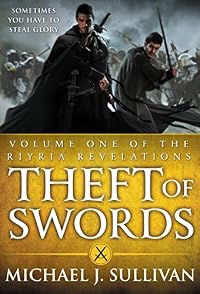
Theft of Swords
by Michael J. Sullivan 
Riyria Universe (Collections and Selections — 01-02), The Riyria Revelations (Collections and Selections — 1-2), The Riyria Universe - Chronological (11)
On This Page
Description
Acclaimed author Michael J. Sullivan created instant best-sellers with his spellbinding Riyria Revelations series. This first volume introduces Royce Melborn and Hadrian Blackwater, two enterprising thieves who end up running for their lives when they're framed for the death of the king. Trapped in a conspiracy bigger than they can imagine, their only hope is unraveling an ancient mystery-before it's too late.Tags
Recommendations




Member Reviews
I would highly recommend this entire series to anyone. This is an exceptional fantasy series that is not only ridiculously fun and addictive, but also stands out above the crowd for multiple reasons: first are the strong female characters who all feature prominently, are not simply damsels in distress for the heroes to rescue and actually have their own character arcs that differ greatly from each other. Written by a male author no less! Second, while the general idea of elves, dwarves and humans has been repeated in fantasy over and over, this is still a fresh take on an old trope that manages to surprise. Third, it is wonderful to find a fantasy tale that does not rely on heroic battles and wars to fill chapters. Instead there is show more exciting plot, rich history and great banter. I recommend reading the Riyria Revelations first and then the Chronicles (publication order) as there are a lot of Easter eggs in the newer books that you can only really appreciate if you read the Revelations. show less
This originally appeared at The Irresponsible Reader.
---
FIRST THINGS FIRST
Back in Down the TBR Hole (18 of 24+) (January 2021), I removed a form of this book from my "Want-To-Read" list, despite everyone I'd ever talked to about Sullivan being a fan. In response, Bookstooge did offer a pretty convincing counter-argument, "BECAUSE I SAID SO!!!!" I should have listened. Sorry, Bookstooge! Thankfully, Micah recommended this for the 12 Books Challenge, so my compounded errors (not reading it as soon as I put it on my "Want-To-Read" shelf, removing it from my list, and then ignoring that Bookstooge) were corrected.
It's pretty obvious already, but let me officially spoil the conclusion of this post: I heartily encourage picking up this show more book.
WHAT'S THEFT OF SWORDS ABOUT?
The Riyria are thieves—so proficient, so renowned that they might not actually exist. They may be the Fantasy World equivalent of Urban Legends. Except they really do exist—they are Hadrian Blackwater a mercenary fighter who's about as skilled a swordsman as you're going to find, and Royce Meborn, a thief who's probably better at that than Hadrian is with a sword. Together they can steal just about anything. Hadrian has a strong impulse to do the heroic action, he wants to help. Royce is a misanthrope who is only interested in helping himself and a few friends and acquaintances. Except when he's not.
This book is about two jobs they should not have taken but do. And then all the things they have to do after taking those jobs. At the core, each job is about stealing a sword. That's pretty much where the similarities end.
The first has them hired to steal a sword from the King's castle (it doesn't belong to any member of the royal family, but someone who is visiting there). This job lands them in prison, in the middle of an investigation into the murder of a royal, in an effort to save two other royals, and freeing another prisoner or two.
The second involves them helping a damsel in distress and her family—and it's Royce's call to take this job for far less than it's going to cost them to carry it out. That job lands them in the battle to save a small village, in the middle of a conspiracy to wrest power from the rightful possessor, and in danger of being eaten by a magical lizard.
What will see them through is a very strange assortment of allies and each other. And a whole lot of luck—much of which they have to manufacture or steal from themselves. In the end, it will put the pair on a path that may lead to changes in the broken empire they live in—very unbeknownst to them (or they'd probably run screaming in the other direction).
THE DIALOGUE
As a genre, Fantasy isn't well-known for having snappy and witty dialogue. Of course, there are exceptions—and I can point to a number of them on my own shelves, you don't need to point out all the ways I'm wrong. But come on, let's be real here—from Tolkein on, it's rare that you read dialogue that really grabs you outside of a line or two. It's what the characters are and do that attracts you, it's the stories, it's the settings, etc.
Put the Riyria Revelations down as one of those exceptions. I was pretty sure of this on page three, and the 646 following pages didn't change my mind. It's strongest between Royce and Hadrian—they're the veterans who've seen enough that they can have a wry detachment from danger and drama to joke their way through it. But there's plenty to get a kick out of in the conversation of others.
The narrative voice that shows us what the characters are thinking and not saying is good, possibly better.
THE POLITICS
In addition to your nobles of various ranks and importance of land-holdings vying for prominence against each other, there are three political movements running around this world—I'm not going to describe them much because I'm afraid I'm going to miss a nuance or two and give a skewed description given my space constraints. I'm not accustomed to seeing something like this in Fantasy—seeing two competing political philosophies/contingents within one Empire/Kingdom, sure—but the way it's set up here (and we really have only scratched the surface up to this point) seems pretty novel.
On top of that, there are some ecclesiastical machinations and divided camps within the same religion (or one religion with two divergent streams...I'm not one hundred percent sure the fairest way to describe this)—a mix of conviction and connivance for political power. There are a lot of earnest believers within the clergy, some that may believe, but are more convinced they're right when it comes to affairs of this world, and some that are really good at using the belief of others to get their way.
Adding the ecclesiastical politics into the mix with the wholly secular stuff? Sullivan's really given us a treat here. In this particular book, it's largely (but not wholly) a backdrop to the main action—but I doubt it's going to stay that way for long.
Then there are the relations between races like Dwarves and Elves marked by prejudice and distrust all around. I can't wait to see how some of this plays out.
THE WIZARD
There's a Gandalf/Allanon/Bayaz-ish wizard in the middle of all of this. I really want to like him, and think I do. I really want to distrust him deeply. And I definitely do.
Is he Gandalf or is he Saruman? I'm not sure. He may be a little of both. He may be neither. Don't know. Don't care (at least for now). He's a fantastic character to watch at work.
In retrospect, I guess that makes him more like Bayaz than the rest of the names I've tossed around. But Bayaz might be more trustworthy.
SO, WHAT DID I THINK ABOUT THEFT OF SWORDS?
I've enjoyed being exposed to works I probably/definitely wouldn't have gotten around to because of this challenge. Personally, Micah's recommendation has solidified a lesson I will definitely learn from. He's now recommended the DI Eva Harris series, the DC Smith/Kings Lake Investigation series, and this one. I need to start following his recommendations blindly.
Okay, that personal note out of the way, let's focus on the book—by mid-way through the opening scene, I was hooked—and had basically signed up for the trilogy. While not really being the same kind of scene, it evoked the same kind of feel as the opening of "Our Mrs. Reynolds" (the "if your hand touches metal, I swear, by my pretty floral bonnet, I will end you." scene). That feeling continued to grow through the first book. I don't think it deepened in the second book, but it didn't falter.
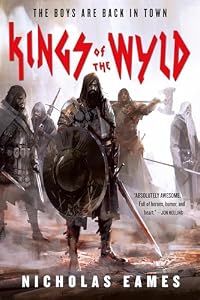
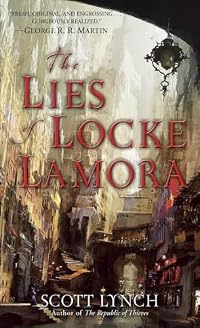
I've already invoked Firefly, and this hit the pleasure center in the brain as that show did—also Kings of the Wyld and The Lies of Locke Lamora. I think the storytelling of this is more straightforward than Lynch's, but there's a similar vibe. The relationship between Royce and Hadrian is as tight as you're going to find in the aforementioned works—they might as well be brothers (they're closer than, say, the twins Caramon and Rastlin Majere). But they're quick to add others as friends and allies—or even to their "family" group. Remarkably, this also extends to those they'd planned on killing at the first opportunity. This gives the whole book this warm glow of camaraderie that just augments the likability of all the characters—and the novel as a whole. I fully expect this to continue throughout the series.
The action is great, I loved the sword fights, in particular. We get character deaths that might as well be punches to the gut (when you don't want to cheer them). The imagination showed in the magic system, the magical creatures, and the politics—between races, within the remnants of the human empire, and the ecclesiastical politics—are really well conceived and effectively portrayed. On that last point, I really want to stress how nicely (not perfectly, but good enough) Sullivan catches us up on hundreds of years of history and backstory without making the infodumps painful and/or dull. These villains are truly foul, and yes, it's typically pretty clear who's a White Hat and who's a Black Hat from the initial meeting—but Sullivan also gives us some characters that could easily go either way before this series ends—possibly bouncing back and forth, too. I relish a good combination like that.
In a very real sense, there's almost nothing that someone who's read/watched a handful of fantasy series hasn't been exposed to before. It's the way that Sullivan has assembled these tried and true elements that is going to make you happy—that and the characters. Not just Hadrian and Royce, but especially Hadrian and Royce. Their banter alone would be enough to sign me up for two more books.
I think I'm in danger of just finding new ways to say that I really dug this work without adding anything worth reading, so I'm going to cut myself off. If you haven't read this yet, and you enjoy a good fantasy adventure—this is me adding my voice to your friends who have probably already told you to read this. If you don't have any friends who've given you that advice already, I'll loan you a couple of mine. show less
---
FIRST THINGS FIRST
Back in Down the TBR Hole (18 of 24+) (January 2021), I removed a form of this book from my "Want-To-Read" list, despite everyone I'd ever talked to about Sullivan being a fan. In response, Bookstooge did offer a pretty convincing counter-argument, "BECAUSE I SAID SO!!!!" I should have listened. Sorry, Bookstooge! Thankfully, Micah recommended this for the 12 Books Challenge, so my compounded errors (not reading it as soon as I put it on my "Want-To-Read" shelf, removing it from my list, and then ignoring that Bookstooge) were corrected.
It's pretty obvious already, but let me officially spoil the conclusion of this post: I heartily encourage picking up this show more book.
WHAT'S THEFT OF SWORDS ABOUT?
The Riyria are thieves—so proficient, so renowned that they might not actually exist. They may be the Fantasy World equivalent of Urban Legends. Except they really do exist—they are Hadrian Blackwater a mercenary fighter who's about as skilled a swordsman as you're going to find, and Royce Meborn, a thief who's probably better at that than Hadrian is with a sword. Together they can steal just about anything. Hadrian has a strong impulse to do the heroic action, he wants to help. Royce is a misanthrope who is only interested in helping himself and a few friends and acquaintances. Except when he's not.
This book is about two jobs they should not have taken but do. And then all the things they have to do after taking those jobs. At the core, each job is about stealing a sword. That's pretty much where the similarities end.
The first has them hired to steal a sword from the King's castle (it doesn't belong to any member of the royal family, but someone who is visiting there). This job lands them in prison, in the middle of an investigation into the murder of a royal, in an effort to save two other royals, and freeing another prisoner or two.
The second involves them helping a damsel in distress and her family—and it's Royce's call to take this job for far less than it's going to cost them to carry it out. That job lands them in the battle to save a small village, in the middle of a conspiracy to wrest power from the rightful possessor, and in danger of being eaten by a magical lizard.
What will see them through is a very strange assortment of allies and each other. And a whole lot of luck—much of which they have to manufacture or steal from themselves. In the end, it will put the pair on a path that may lead to changes in the broken empire they live in—very unbeknownst to them (or they'd probably run screaming in the other direction).
THE DIALOGUE
As a genre, Fantasy isn't well-known for having snappy and witty dialogue. Of course, there are exceptions—and I can point to a number of them on my own shelves, you don't need to point out all the ways I'm wrong. But come on, let's be real here—from Tolkein on, it's rare that you read dialogue that really grabs you outside of a line or two. It's what the characters are and do that attracts you, it's the stories, it's the settings, etc.
Put the Riyria Revelations down as one of those exceptions. I was pretty sure of this on page three, and the 646 following pages didn't change my mind. It's strongest between Royce and Hadrian—they're the veterans who've seen enough that they can have a wry detachment from danger and drama to joke their way through it. But there's plenty to get a kick out of in the conversation of others.
The narrative voice that shows us what the characters are thinking and not saying is good, possibly better.
THE POLITICS
In addition to your nobles of various ranks and importance of land-holdings vying for prominence against each other, there are three political movements running around this world—I'm not going to describe them much because I'm afraid I'm going to miss a nuance or two and give a skewed description given my space constraints. I'm not accustomed to seeing something like this in Fantasy—seeing two competing political philosophies/contingents within one Empire/Kingdom, sure—but the way it's set up here (and we really have only scratched the surface up to this point) seems pretty novel.
On top of that, there are some ecclesiastical machinations and divided camps within the same religion (or one religion with two divergent streams...I'm not one hundred percent sure the fairest way to describe this)—a mix of conviction and connivance for political power. There are a lot of earnest believers within the clergy, some that may believe, but are more convinced they're right when it comes to affairs of this world, and some that are really good at using the belief of others to get their way.
Adding the ecclesiastical politics into the mix with the wholly secular stuff? Sullivan's really given us a treat here. In this particular book, it's largely (but not wholly) a backdrop to the main action—but I doubt it's going to stay that way for long.
Then there are the relations between races like Dwarves and Elves marked by prejudice and distrust all around. I can't wait to see how some of this plays out.
THE WIZARD
There's a Gandalf/Allanon/Bayaz-ish wizard in the middle of all of this. I really want to like him, and think I do. I really want to distrust him deeply. And I definitely do.
Is he Gandalf or is he Saruman? I'm not sure. He may be a little of both. He may be neither. Don't know. Don't care (at least for now). He's a fantastic character to watch at work.
In retrospect, I guess that makes him more like Bayaz than the rest of the names I've tossed around. But Bayaz might be more trustworthy.
SO, WHAT DID I THINK ABOUT THEFT OF SWORDS?
I've enjoyed being exposed to works I probably/definitely wouldn't have gotten around to because of this challenge. Personally, Micah's recommendation has solidified a lesson I will definitely learn from. He's now recommended the DI Eva Harris series, the DC Smith/Kings Lake Investigation series, and this one. I need to start following his recommendations blindly.
Okay, that personal note out of the way, let's focus on the book—by mid-way through the opening scene, I was hooked—and had basically signed up for the trilogy. While not really being the same kind of scene, it evoked the same kind of feel as the opening of "Our Mrs. Reynolds" (the "if your hand touches metal, I swear, by my pretty floral bonnet, I will end you." scene). That feeling continued to grow through the first book. I don't think it deepened in the second book, but it didn't falter.
I've already invoked Firefly, and this hit the pleasure center in the brain as that show did—also Kings of the Wyld and The Lies of Locke Lamora. I think the storytelling of this is more straightforward than Lynch's, but there's a similar vibe. The relationship between Royce and Hadrian is as tight as you're going to find in the aforementioned works—they might as well be brothers (they're closer than, say, the twins Caramon and Rastlin Majere). But they're quick to add others as friends and allies—or even to their "family" group. Remarkably, this also extends to those they'd planned on killing at the first opportunity. This gives the whole book this warm glow of camaraderie that just augments the likability of all the characters—and the novel as a whole. I fully expect this to continue throughout the series.
The action is great, I loved the sword fights, in particular. We get character deaths that might as well be punches to the gut (when you don't want to cheer them). The imagination showed in the magic system, the magical creatures, and the politics—between races, within the remnants of the human empire, and the ecclesiastical politics—are really well conceived and effectively portrayed. On that last point, I really want to stress how nicely (not perfectly, but good enough) Sullivan catches us up on hundreds of years of history and backstory without making the infodumps painful and/or dull. These villains are truly foul, and yes, it's typically pretty clear who's a White Hat and who's a Black Hat from the initial meeting—but Sullivan also gives us some characters that could easily go either way before this series ends—possibly bouncing back and forth, too. I relish a good combination like that.
In a very real sense, there's almost nothing that someone who's read/watched a handful of fantasy series hasn't been exposed to before. It's the way that Sullivan has assembled these tried and true elements that is going to make you happy—that and the characters. Not just Hadrian and Royce, but especially Hadrian and Royce. Their banter alone would be enough to sign me up for two more books.
I think I'm in danger of just finding new ways to say that I really dug this work without adding anything worth reading, so I'm going to cut myself off. If you haven't read this yet, and you enjoy a good fantasy adventure—this is me adding my voice to your friends who have probably already told you to read this. If you don't have any friends who've given you that advice already, I'll loan you a couple of mine. show less
What an enjoyable book to listen to. I don't know if I can say anything better about Michael J. Sullivan's first volume in the Riyria Revelations series. This audiobook grabbed me within the first ten minutes of the book and wouldn't let me go! Actually, it still has not as I can't wait to get in to the next volume Rise of Empire.
The reader in an audiobook is always what gives the first impression, for weal or woe. In this case Tim Gerard Reynolds reads his ass off and, for me, just knocks it out of the park. His different voices for each character seem to fit perfectly. When he has to voice women, which can trip up the best of narrators, he doesn't miss a beat and pulls it off with flying colors.
This is kind of burying the lead in a show more sense. Mr. Sullivan has written nothing short of a fantastic series that introduces us to Royce Melborn and Hadrian Blackwater. The classic duo of unlikely heroes, whose adventures, banter and wit kept me coming back for more in this story of swords, religion, magic, and intrigue, woods and farms, elves and men and dwarves.
This series was recommended to me by a friend who knew I enjoyed a good story. Boy am I glad I listened to him. As this is one that I cannot recommend highly enough whether in book form or in the audiobook version. While there are flaws and it is not perfect, nothing is, I give it a 4.5 out of 5. I just love it when I am done and hunger for more. I think just about anyone who enjoys a good story will as well. show less
The reader in an audiobook is always what gives the first impression, for weal or woe. In this case Tim Gerard Reynolds reads his ass off and, for me, just knocks it out of the park. His different voices for each character seem to fit perfectly. When he has to voice women, which can trip up the best of narrators, he doesn't miss a beat and pulls it off with flying colors.
This is kind of burying the lead in a show more sense. Mr. Sullivan has written nothing short of a fantastic series that introduces us to Royce Melborn and Hadrian Blackwater. The classic duo of unlikely heroes, whose adventures, banter and wit kept me coming back for more in this story of swords, religion, magic, and intrigue, woods and farms, elves and men and dwarves.
This series was recommended to me by a friend who knew I enjoyed a good story. Boy am I glad I listened to him. As this is one that I cannot recommend highly enough whether in book form or in the audiobook version. While there are flaws and it is not perfect, nothing is, I give it a 4.5 out of 5. I just love it when I am done and hunger for more. I think just about anyone who enjoys a good story will as well. show less
Gave up at page 364, 50 pages into the second book. I'll come clean from the outset: I do not read fantasy for swordfights or quests or derring-do. I do not like DnD-session-adventure tales. And I really don't like generic fantasy settings.
This is terribly generic. Euro-blur, one-of-those-centuries-in-there-somewhere, gods in conflict that reflecteth on the world of men, castles and elves and dwarves oh my. (Note: the only place he gets a spark of interest from me is the fact that elves have been enslaved for centuries and are considered dirty, lazy, etc. Nice deviation. Shame I couldn't stick around long enough for it to go somewhere, but after a book and a quarter, you've done your dash.)
In fact, it's so generic I actually went and show more looked up some things in [b:The Tough Guide to Fantasyland|47510|The Tough Guide to Fantasyland|Diana Wynne Jones|http://photo.goodreads.com/books/1170347648s/47510.jpg|1044747]. The entry on monasteries, for instance? CHECK. And the author clearly believes the whole purpose of a pommel on a sword is the easy, worry-free and surefire rendering of people unconscious.
The plot is linear, the timeline farfetched (they muster an army in a day, but no one can be bothered informing the nobility of the king's demise for, oh, a week), the villains ridiculous and prone to soliloquising. Then again, they're not alone in that, as everyone takes every convenient (and remarkably inconvenient) chance to educate their companions, the surrounds and the readers on the intricate details of society, history and anything else that might be handy. The characters never act naturally enough to be considered sympathetic or un - they're just roles, not people - so my emotional involvement from go to whoa was precisely zero. (Except for how I was hoping Royce's ancestry would lead somewhere. Which it didn't, and I can't be bothered sticking around longer for just that one tiny point of interest.)
What do I read fantasy for? Imagination. Breathtaking conceptual scope. Characters that burn in my brain and have amazing stories (not who do amazing things; things are just things unless there's emotional resonance).
Two stars (instead of the one I normally give something I didn't finish) because this is perfectly serviceable in its own way. It's just the caravan-food of fantasy fiction. show less
This is terribly generic. Euro-blur, one-of-those-centuries-in-there-somewhere, gods in conflict that reflecteth on the world of men, castles and elves and dwarves oh my. (Note: the only place he gets a spark of interest from me is the fact that elves have been enslaved for centuries and are considered dirty, lazy, etc. Nice deviation. Shame I couldn't stick around long enough for it to go somewhere, but after a book and a quarter, you've done your dash.)
In fact, it's so generic I actually went and show more looked up some things in [b:The Tough Guide to Fantasyland|47510|The Tough Guide to Fantasyland|Diana Wynne Jones|http://photo.goodreads.com/books/1170347648s/47510.jpg|1044747]. The entry on monasteries, for instance? CHECK. And the author clearly believes the whole purpose of a pommel on a sword is the easy, worry-free and surefire rendering of people unconscious.
The plot is linear, the timeline farfetched (they muster an army in a day, but no one can be bothered informing the nobility of the king's demise for, oh, a week), the villains ridiculous and prone to soliloquising. Then again, they're not alone in that, as everyone takes every convenient (and remarkably inconvenient) chance to educate their companions, the surrounds and the readers on the intricate details of society, history and anything else that might be handy. The characters never act naturally enough to be considered sympathetic or un - they're just roles, not people - so my emotional involvement from go to whoa was precisely zero. (Except for how I was hoping Royce's ancestry would lead somewhere. Which it didn't, and I can't be bothered sticking around longer for just that one tiny point of interest.)
What do I read fantasy for? Imagination. Breathtaking conceptual scope. Characters that burn in my brain and have amazing stories (not who do amazing things; things are just things unless there's emotional resonance).
Two stars (instead of the one I normally give something I didn't finish) because this is perfectly serviceable in its own way. It's just the caravan-food of fantasy fiction. show less
It's somewhat embarrassing to admit that I had ample opportunities to read this book when it was in two parts, independently published - and failed to do so until it was bought up by Orbit and reprinted.
That was a mistake.
Originally published separately, readers can see the divide between the events and repercussions of the first book (Crown Conspiracy) that lead into the second book (Avempartha), and how together they form the chapters of a much larger tapestry. Sullivan sites the story arcs of Babylon 5 as one of his inspirations, and in reading the novel you can see that play out as he gives the reader a simple, straightforward collection of fantasy tropes building up our expectations that this story is going in one direction, only show more to flip it at the climax and offer a resolution that both fits the story so far, and yet defies what we anticipated.
The curious thing about Sullivan's book is that he uses light strokes to paint a picture. He doesn't labor over info dumping, choosing instead to give us a who's who and a what's what at the start of the book, and a few short dumps initially to fill in the gaps. Nor does he rely on the shock that grittier fantasy authors have brought us lately; this book is very much a homage o the simple, well written adventure story. While its most basic elements are a variation of the quest and heist motifs, there are deeper motivations at play than just greed. The real strength in Sullivan's writing, though, is in his dialog, the repertoire and voice of his characters making them distinct enough to stand out from the backdrop. No, not all of the characters are well rounded personas with depth, but the characters with whom the story revolves live and breathe in the mind's eye even after you set the book down.
Theft of Swords is not high literature, with flowing, flowery passages evoking a deep sense of wonder. What it is is wonderfully entertaining. Case in point, I sat down and read the last 40% of the book in one day because I just couldn't put it down. Highly recommended to fans of epic fantasy, especially if you enjoy the "lighter" side such as a Brandon Sanderson or Daniel Abraham novel, you will enjoy this. show less
That was a mistake.
Originally published separately, readers can see the divide between the events and repercussions of the first book (Crown Conspiracy) that lead into the second book (Avempartha), and how together they form the chapters of a much larger tapestry. Sullivan sites the story arcs of Babylon 5 as one of his inspirations, and in reading the novel you can see that play out as he gives the reader a simple, straightforward collection of fantasy tropes building up our expectations that this story is going in one direction, only show more to flip it at the climax and offer a resolution that both fits the story so far, and yet defies what we anticipated.
The curious thing about Sullivan's book is that he uses light strokes to paint a picture. He doesn't labor over info dumping, choosing instead to give us a who's who and a what's what at the start of the book, and a few short dumps initially to fill in the gaps. Nor does he rely on the shock that grittier fantasy authors have brought us lately; this book is very much a homage o the simple, well written adventure story. While its most basic elements are a variation of the quest and heist motifs, there are deeper motivations at play than just greed. The real strength in Sullivan's writing, though, is in his dialog, the repertoire and voice of his characters making them distinct enough to stand out from the backdrop. No, not all of the characters are well rounded personas with depth, but the characters with whom the story revolves live and breathe in the mind's eye even after you set the book down.
Theft of Swords is not high literature, with flowing, flowery passages evoking a deep sense of wonder. What it is is wonderfully entertaining. Case in point, I sat down and read the last 40% of the book in one day because I just couldn't put it down. Highly recommended to fans of epic fantasy, especially if you enjoy the "lighter" side such as a Brandon Sanderson or Daniel Abraham novel, you will enjoy this. show less
This epic fantasy includes a little breaking and entering, plenty of snarky insults, political intrigue, magical beasts, and a chaotic neutral maimed mage. For me, the tale started off fun but not particularly special. It wasn’t until about a quarter of the way through the book that the tale grabbed me. Royce and Hadrian are a lot of fun. They’ve known each other for years and each is well into their adult years. This was a nice break from all those epic fantasy adventures that feature teen/young adults bumbling through their first adventures.
Royce was my favorite because we have the same dark sense of humor and have to sometimes be talked into doing the right thing. Hadrian is an enthusiastic believer in honor and all things good. show more It’s a very good thing these two have each other to balance things out. Each has a history veiled in questions and half truths. I look forward to Book 2 revealing more on this note.
The one weakness to this tale is the ladies. It’s not all bad, but for the most part they are comforters and romantic interests and need to be rescued. Arista shows promise with her wit and ability to grasp politics. Also young Thrace has a shining moment at the end of the novel. The ladies aren’t the worst I’ve seen in epic fantasy but I did want just a bit more from them.
There’s a big fat mystery with the elves. Ancient conflict and truces are eluded to and I expect that will become a big deal later in this series. There are a few elvish slaves in some areas of the human realms, but no elves roam free… or if they do, they can pass for human. The maimed mage Esra provides most of what we know about the elves. He’s ancient and was imprisoned for perhaps 900 years (if I recall correctly). Esra is a big enigma. I don’t know what he wants and he might not know either. He has to keep his head down as he’s still a wanted criminal.
Then there’s Myron. I adored this character because of his wide eyed wonder of the bigger world. He grew up in a monastery and had never been off the grounds. He had seen a few horse but never rode one and he’s never seen a woman. As he gets swept up into the adventure, he provides several chuckles. I too wish there were blue horses.
By the end, I had fallen in love with the main characters. I really look forward to adventuring further with Royce and Hadrian. 4/5 stars.
The Narration: Tim Gerard Reynolds gave a great performance for this book. He had distinct voices for all the characters and his female voices were believable. He sounded like he had a lot of fun narrating this story too. I did notice a few short repeats but there were no other technical issues with the recording. I loved his voice for Myron (always full of wonder), his skeptical voice for Royce, and his honorable voice for Hadrian. 4.75/5 stars. show less
Royce was my favorite because we have the same dark sense of humor and have to sometimes be talked into doing the right thing. Hadrian is an enthusiastic believer in honor and all things good. show more It’s a very good thing these two have each other to balance things out. Each has a history veiled in questions and half truths. I look forward to Book 2 revealing more on this note.
The one weakness to this tale is the ladies. It’s not all bad, but for the most part they are comforters and romantic interests and need to be rescued. Arista shows promise with her wit and ability to grasp politics. Also young Thrace has a shining moment at the end of the novel. The ladies aren’t the worst I’ve seen in epic fantasy but I did want just a bit more from them.
There’s a big fat mystery with the elves. Ancient conflict and truces are eluded to and I expect that will become a big deal later in this series. There are a few elvish slaves in some areas of the human realms, but no elves roam free… or if they do, they can pass for human. The maimed mage Esra provides most of what we know about the elves. He’s ancient and was imprisoned for perhaps 900 years (if I recall correctly). Esra is a big enigma. I don’t know what he wants and he might not know either. He has to keep his head down as he’s still a wanted criminal.
Then there’s Myron. I adored this character because of his wide eyed wonder of the bigger world. He grew up in a monastery and had never been off the grounds. He had seen a few horse but never rode one and he’s never seen a woman. As he gets swept up into the adventure, he provides several chuckles. I too wish there were blue horses.
By the end, I had fallen in love with the main characters. I really look forward to adventuring further with Royce and Hadrian. 4/5 stars.
The Narration: Tim Gerard Reynolds gave a great performance for this book. He had distinct voices for all the characters and his female voices were believable. He sounded like he had a lot of fun narrating this story too. I did notice a few short repeats but there were no other technical issues with the recording. I loved his voice for Myron (always full of wonder), his skeptical voice for Royce, and his honorable voice for Hadrian. 4.75/5 stars. show less
This is a trilogy of swashbuckling epic awesomeness. I'm a critical reader and hard to win over; so many fantasy books end up being forgettable and mediocre to me. When I started this one, I was instantly turned off by the banter, and I wasn't thrilled to be introduced to main characters who had a ton of history together. Great, I thought. It's going to be bogged down with backstory and cheesy banter.
I almost stopped reading, but these books have tons of glowing reviews, so I kept going, ready to stop if it didn't improve soon. And bit by bit, I got drawn in. This series is all banter and cheesiness on the surface, but it has epic scope and depths. It's not just about two thieves. There's adventure, there's romance, there's magic, and show more it's all excellent. Some of the main characters look cliche at first, but then you get to know them, and it turns out they're not the usual spoiled prince or big dumb thug. They have hidden depths, and they're memorable.
I grew to love the characters of Hadrian and Arista. I never warmed to Royce, but I'm not sure the reader is supposed to warm to him--and the rest of the cast more than makes up for him. I finished THEFT OF SWORDS wanting the next book. The rest of this trilogy blew me away, so I recommend it with a full five stars. It's well worth reading. show less
I almost stopped reading, but these books have tons of glowing reviews, so I kept going, ready to stop if it didn't improve soon. And bit by bit, I got drawn in. This series is all banter and cheesiness on the surface, but it has epic scope and depths. It's not just about two thieves. There's adventure, there's romance, there's magic, and show more it's all excellent. Some of the main characters look cliche at first, but then you get to know them, and it turns out they're not the usual spoiled prince or big dumb thug. They have hidden depths, and they're memorable.
I grew to love the characters of Hadrian and Arista. I never warmed to Royce, but I'm not sure the reader is supposed to warm to him--and the rest of the cast more than makes up for him. I finished THEFT OF SWORDS wanting the next book. The rest of this trilogy blew me away, so I recommend it with a full five stars. It's well worth reading. show less
Members
- Recently Added By
Lists

Sarah's Wish List
48 works; 1 member

Books Read in 2018
4,360 works; 110 members

Recommend Fantasy Books
100 works; 1 member

SciFi/Fantasy Without Romance!
37 works; 1 member
Author Information

58+ Works 15,317 Members
Michael J. Sullivan is a LibraryThing Author, an author who lists their personal library on LibraryThing.
Some Editions
Awards and Honors
Awards
Series


Work Relationships
Is contained in
Contains
Has the adaptation
Common Knowledge
- Canonical title
- Theft of Swords
- Original title
- The Crown Conspiracy; Avempartha
- Original publication date
- 2011-11-23
- People/Characters
- Royce Melborn; Hadrian Blackwater; Thrace Wood; Theron Wood; Arista Essenden; Esrahaddon (show all 11); Alric Essenden; Percy Braga; Mauvin Pickering; Fanen Pickering; Wyatt Deminthall
- Dedication
- To my wife, Robin, my partner in life and in the adventure of making this series, whose hard work and dedication made it all possible.
To my daughter Sarah, who would not read the story until it was published.
... (show all)To Steve Gilllick for his feedback, and Pete DeBrule, who started this whole thing
And to the members of Dragonchow, my original fan club - First words
- Hadrian could see little in the darkness, but he could hear them -- the sanpping of twigs, the crush of leaves, and the brush of grass.
- Disambiguation notice
- Includes The Crown Conspiracy (first published Oct. 1, 2008) and Avempartha (first published Mar 31, 2009).
Classifications
Statistics
- Members
- 2,288
- Popularity
- 8,663
- Reviews
- 90
- Rating
- (4.01)
- Languages
- 5 — English, French, German, Italian, Portuguese
- Media
- Paper, Audiobook, Ebook
- ISBNs
- 26
- ASINs
- 18