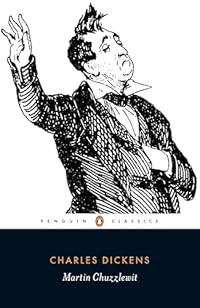
Martin Chuzzlewit
by Charles Dickens
On This Page
Description
The Life and Adventures of Martin Chuzzlewit is, according to Dickens, a novel about selfishness. And every member of the Chuzzlewit family is given the chance to display their own brand thereof, among them the infamous villain Jonas Chuzzlewit. After sales of the first few serial installments were poor, Dickens moved the action to America, which he satirized as a vast wilderness peopled by likewise selfish characters..
Tags
Recommendations











Member Recommendations
Member Reviews
Martin Chuzzlewit feels like the beginning of Dickens' second act. While all of his previous books had strengths (and I probably still viscerally prefer Nicholas Nickleby), this, his 9th major work and 6th novel, was written after the celebrity Dickens' return from America, and marks the start of a busier lifestyle for the author, which included social engagements, speaking tours, and community responsibilities, not to mention a growing household. My suspicion is that he started devoting more time to the nuances of his writing - not the descriptions, which have always been first-rate, but the character arcs. The vivid characters of Pecksniff and Mrs. Gamp have a comic life of their own, while the analysis of human folly among the show more Chuzzlewit family is a deeper, more internal attempt at storytelling which Dickens would return to in his next novel, Dombey and Son. For the first time, Dickens hasn't felt the need to make his central character a paper-thin but sentimental naif (not that young Martin is exactly the most scintillating of figures).
We'll dock a couple of points for the American sequences, which have a reasonable level of thematic resonance but are clearly filler, but this is a new, more "novelistic" side of Dickens that can't be ignored. I certainly think more people should be reading Martin Chuzzlewit when they feel like a taste of Dickens. show less
We'll dock a couple of points for the American sequences, which have a reasonable level of thematic resonance but are clearly filler, but this is a new, more "novelistic" side of Dickens that can't be ignored. I certainly think more people should be reading Martin Chuzzlewit when they feel like a taste of Dickens. show less
I tend to overdo my pleasures. Very recently, I've read Dombey and Sons, Hard Times, Our Mutual Friend, and the Mystery of Edwin Drood. So it's only to be expected that I should encounter a little Dickens fatigue. And along about page 600 of Martin Chuzzlewit, the thought kept popping into my mind, like those Interstate motel advertisements, "if this had been John Sanford's 'Prey on Greed', I would be home by now."
Yes, I'd had it with ole "Sairey" Gamp, who seemed to have no purpose in Dicken's universe, except to annoy the hell out of me with her quaint dialect stylings and her bottle on the mantelpiece when she was so "dispoged". Not to mention how she precipitated a debilitating series of Robin-Williams-in-Doubtfire-drag show more flashbacks.
And those Pecksniff hoes, Cherry and Merry? Like any time I want more of that action, there's a thousand starlet wannabe's on Youtube looking sideways at a web cam, mis-accenting their dialogue and raising their eyebrows like they all suffer from the same bizarre tic doloureux. Enuff a dat, thank you very much.
I did enjoy Martin Jr. and Mark Tapley, when - to hum a bit of Paul Simon - they "walked off to look for America." Dickens riff list of New York City newspapers was genius "The Sewer, The Stabber, The Family Spy, The Private Listener, The Peeper, The Plunderer, The Keyhole Reporter, and The Rowdy Journal." Indeed, what with wire photos, colored printing, the Internet , it's nice to see that a century of technological change hasn't really spoiled the industry, eh wot?
I found myself comparing Chuzzlewit to Our Mutual Friend. Both novels contained a universe of characters. In both, the ecology - the way they fed and fed on one another - was similarly complex. Both used major plot twists. But Our Mutual Friend has a much better flow (no pun about the Thames intended). And equivalent characters are much more interesting in Our Mutual Friend. Little Jenny Wren, for example, steals the show very much like Gamp does in Chuzzlewit, and has a role of equal proportion, but I think she's far more interesting and funny.
Bottom line - two things - first, if you're thinking of broadening your reading of Dickens, choose Our Mutual Friend over Martin Chuzzlewit; second, Chuzzlewit doesn't have much forward motion, so focus on enjoying the eccentricities of the characters rather than expecting much from the plot. show less
Yes, I'd had it with ole "Sairey" Gamp, who seemed to have no purpose in Dicken's universe, except to annoy the hell out of me with her quaint dialect stylings and her bottle on the mantelpiece when she was so "dispoged". Not to mention how she precipitated a debilitating series of Robin-Williams-in-Doubtfire-drag show more flashbacks.
And those Pecksniff hoes, Cherry and Merry? Like any time I want more of that action, there's a thousand starlet wannabe's on Youtube looking sideways at a web cam, mis-accenting their dialogue and raising their eyebrows like they all suffer from the same bizarre tic doloureux. Enuff a dat, thank you very much.
I did enjoy Martin Jr. and Mark Tapley, when - to hum a bit of Paul Simon - they "walked off to look for America." Dickens riff list of New York City newspapers was genius "The Sewer, The Stabber, The Family Spy, The Private Listener, The Peeper, The Plunderer, The Keyhole Reporter, and The Rowdy Journal." Indeed, what with wire photos, colored printing, the Internet , it's nice to see that a century of technological change hasn't really spoiled the industry, eh wot?
I found myself comparing Chuzzlewit to Our Mutual Friend. Both novels contained a universe of characters. In both, the ecology - the way they fed and fed on one another - was similarly complex. Both used major plot twists. But Our Mutual Friend has a much better flow (no pun about the Thames intended). And equivalent characters are much more interesting in Our Mutual Friend. Little Jenny Wren, for example, steals the show very much like Gamp does in Chuzzlewit, and has a role of equal proportion, but I think she's far more interesting and funny.
Bottom line - two things - first, if you're thinking of broadening your reading of Dickens, choose Our Mutual Friend over Martin Chuzzlewit; second, Chuzzlewit doesn't have much forward motion, so focus on enjoying the eccentricities of the characters rather than expecting much from the plot. show less
Old Martin Chuzzlewit is rich, crotchety, and justly paranoid that all his relations are after his money. He is estranged from his grandson and namesake, young Martin Chuzzlewit. His only ally is an orphan girl he has taken under his protection to serve him, with the stipulation that she only benefits as long as he is alive. A long, winding tale of all the various characters who touch these two characters' lives. Contains an unflattering (but amusing to me) portrait of America. Dickens later visited America a second time (after the civil war and abolition of slavery), revised his opinion, and published an apology of sorts. When it was published, this book was not as popular as his previous ones. This led to financial difficulties, which show more led him to write A Christmas Carol to try to recoup some of the monetary losses. Typical Dickens: a multitude of colorful characters, tongue-in-cheek humor, and everything wraps up nicely in the end. show less
The character Martin Chuzzlewit is comparable to Ebenezer Scrooge: an exceedingly wealthy man to whom money brings only grief, but surrounded by a large family comically obscene in its obsession with his estate. In true Dickens fashion, the most honest and monetarily disinterested among them, if not entirely likeable - Martin's grandson and namesake - is the one whom Martin Sr. trusts least of all.
I can't agree with Mr. Chesterton that it's rife with melancholy. In fact, while I didn't expect another Dickens novel to rival The Pickwick Papers for humour, this one stands in the running albeit with a nastier streak. The sarcasm and satire dials are turned up to 11, especially where Mr. Pecksniff is concerned. This is also the infamous show more novel in which Dickens goes America-bashing, following upon his tour of that country, which holds its own kind of fascination. I was most taken up when reading about Pecksniff since the novel feels devoted to showcasing him. Some of the minor characters - Jonas, Gamp, etc. - I was less keen on having to spend chapters with, but eventually these pay a dividend. Martin Jr. has an arc to his character that eventually does make him likeable if you can wait for it.
I read each chapter in the spirit of sharing Dickens' having fun with his characters rather than worrying where his plot was going. Like the novels that preceded, it's not terribly focussed. He was becoming more sensitive to this critique, to judge from his introduction, and apparently with his next (Dombey and Son) he finally began to get a handle on it. This won't be my favourite of his but neither would I rate it his worst, and even Dickens at his worst is not a very bad thing. show less
I can't agree with Mr. Chesterton that it's rife with melancholy. In fact, while I didn't expect another Dickens novel to rival The Pickwick Papers for humour, this one stands in the running albeit with a nastier streak. The sarcasm and satire dials are turned up to 11, especially where Mr. Pecksniff is concerned. This is also the infamous show more novel in which Dickens goes America-bashing, following upon his tour of that country, which holds its own kind of fascination. I was most taken up when reading about Pecksniff since the novel feels devoted to showcasing him. Some of the minor characters - Jonas, Gamp, etc. - I was less keen on having to spend chapters with, but eventually these pay a dividend. Martin Jr. has an arc to his character that eventually does make him likeable if you can wait for it.
I read each chapter in the spirit of sharing Dickens' having fun with his characters rather than worrying where his plot was going. Like the novels that preceded, it's not terribly focussed. He was becoming more sensitive to this critique, to judge from his introduction, and apparently with his next (Dombey and Son) he finally began to get a handle on it. This won't be my favourite of his but neither would I rate it his worst, and even Dickens at his worst is not a very bad thing. show less
This was one of the only two of Dickens's full length novels I had never read (the other is Dombey and Son). It's fair to say it's not going to become one of my favourites. The theme of the novel is selfishness, shown most consistently by Seth Pecksniff and Jonas Chuzzlewit, and initially also by the title character and his namesake grandfather ("The curse of our house..has been the love of self; has ever been the love of self. How often have I said so, when I never knew that I had wrought it upon others"). Young Martin's redemption comes after his near death experiences in a town in the back of beyond in America. The American portion of the novel is probably its most well known characteristic, being so unlike anything else in Dickens, show more but which forms a only small part of book. It is based on Dickens's own experiences of his first visit to the States, where he seems to have been most struck by three different wildly different phenomena: the horrors of slavery; the unpleasantness of the habit of tobacco chewing and spitting; and the complete absence of any copyright laws in the States at the time, which meant his works were being abused in his eyes. Most of the characters did not really impress in this one. The midwife Mrs Gamp is probably the best known and quite an effective comic character, though she has hardly entered the top pantheon of the author's most famous creations. My favourite was probably young Martin's loyal companion Mark Tapley, though I also liked Tom Pinch and his sister Ruth. Pecksniff's daughters the inaptly named Mercy and Charity take after him and were also quite amusing, and it was interesting to see how Mercy's character changed during the course of her book after undergoing her own redemption through a miserable marriage. All in all, though, this was a bit of a chore in places, albeit with some dramatic events and a couple of violent deaths. show less
This review is written with a GPL 4.0 license and the rights contained therein shall supersede all TOS by any and all websites in regards to copying and sharing without proper authorization and permissions. Crossposted at WordPress, Blogspot & Librarything by Bookstooge’s Exalted Permission
Title: Martin Chuzzlewit
Series: ----------
Author: Charles Dickens
Rating: 5 of 5 Stars
Genre: Classic
Pages: 954
Format: Digital Edition
Synopsis:
Martin Chuzzlewit, the Elder, has a falling out with his grandson, Martin Chuzzlewit, the younger. It all centers around the Elder's ward, Mary Graham. Both men being cut from the same cloth, ie, stubborn, they go their separate ways. The Younger to seek his fortune so as to be able to provide for Mary and show more the Elder amongst his other relatives to see if any of them are worthy of being his heir.
We meet a veritable cornucopia of people along the way.
Mr Pecksniff, a relative of the Chuzzlewit's. A more self-righteous, moralizing, hypocritical and thoroughly sleezy character you couldn't ask for. The Elder goes to live with Pecksniff and his 2 daughters. The Elder allows Pecksniff complete control over him so as to see if there is even one drop of selflessness in him. Also living with Mr. Pecksniff is Tom Pinch, a humble character who believes the best of everyone and while talented, always believes that it is the genius in others that makes his doings so good.
We have another branch of the Chuzzlewit family introduced and the father there dies soon after and the son, Jonas, takes over. Jonas is a mean, grasping, simple, villianous fellow. He marries one of his cousins, Pecksniff's younger daughter, for her dowry and then gets involved in a huge money scam. It is revealed that Jonas murdered his father so he could inherit and he, Jonas, then murders another fellow who knew of this and was the leader of the money scam. Jonas ends up penniless and commits suicide by poison on the way to jail to avoid the gallows.
The Younger meets up with Mark Tapley, a jolly fellow who believes it is his duty to serve under poor conditions so as to “bear up and be jolly”. Martin and Mark head to American, get boonswaggled into buying a swamp, almost die and then come back to Englad. Martin changes and realizes how selfish he has been and begins working on becoming a better man. Mark realizes that he's going to be jolly no matter what circumstances he's under, so he marries the widower of a local inn and decides to be a jolly taproom owner.
Tom Pinch, the assistant to Mr. Pecksniff, has always believed that Pecksniff walked on air. However, when he interrupts Pecksniff's plans to marry Mary Graham so as to get an even greater grasp on the Elder and to hurt the Younger, Tom has his eyes opened. He is secretly in love with Mary himself but knows she loves the Younger and honors that love. He does what he can to protect Mary and is fired by Pecksniff. He makes his way to London to his sister's and a friends and begins working as a clerk under mysterious circumstances. The friend, John Westlock, a rich young gentleman, falls in love with Ruth Pinch and by the end of the book they are married and Tom is living with them, bringing kindness and gentleness to all he comes into contact with.
Pecksniff is taken in by the money scam that Jonas is involved in and when the masterminds abscond to America with all the money, Pecksniff's estates became collateral for all the other people involved. The Elder reveals that he knows of his villianous ways concerning Mary and cuts Pecksniff out of his life for good. Pecksniff ends up a drunken hobo.
The Elder and the Younger are reconciled when both realize what asses they have been. The Younger marries Mary with the Elder's blessing and they live happily ever after.
My Thoughts:
It has been 10 years to the month since I last read Martin Chuzzlewit. So this re-read was definitely due. It was also a complete smashing success. Dickens give full reign to his verbosity but this time around, I was able to appreciate the wordsmithing that took place instead of being annoyed by the windy wordiness. Part of it was that Dickens is making his characters fully fleshed out with the long passages, the little, or not so little, passages of dialogue. He is building these characters from the ground up and much like a real person, they have quirks. Dickens gives us his characters, fully quirked!
While this is entitled Martin Chuzzlewit, I found that Tom Pinch was the real hero of this book. Dickens explores Selfishness through his characters, deliberate or otherwise and Tom Pinch is the antidote to that all. While others are sunk in schemes and plots, Mr Pinch is nothing but kindess and love. He seeks out ways to help anyone who comes across his path and takes upon his own back the rod meant for another. There were times where I wanted to just shout “You GO Tom Pinch!”
The rest of the side characters also made this book what it was. From Bailey the little rascal boy to Mrs. Gamp, to the survivors of Eden (the swamp Martin and Mark go to in America), to the politicians in America. Oh man, Martin's time in America was great. Dickens doesn't spare his cousins across the Pond one bit. Caricatured and lampooned, Dickens shows us a land that has not yet gone through the fire of its Civil War and it is not a pretty picture. Money, slander and violence were the watchwords then. Which goes to show that not much has really changed here in 175 years.
Now on to the two Martin's. None of this story would have happened if either of them weren't such pigheaded boneheads. Thankfully, Dickens doesn't make them the main focus of the story even while using them as the skeleton upon which the whole book hangs. The various side characters give us flesh, blood, emotion, etc, making for a pleasant read. If it was just a book about the side characters it would have gone “sploosh!” in a bloody, fluidy mess and if it was just a book about the Martins, it would have been Skeleton War, and honestly, who wants THAT in a Charles Dickens book?
INSERT SKELETON WAR PICTURE
yeah, yeah, I know. Putting in a gratuitous skeleton war picture in a Charles Dickens review. Shameless!
I found that I had to almost literally hold myself back from racing through this. Dickens was a wordsmith and I am finding that the goals in reading something from a wordsmith are different from the goals I have when reading something like Forgotten Realms. When I was in the right mind frame, I enjoyed the long, convoluted passages immensely. It was when I got impatient and tried to hurry things along that I ended up wishing that Dickens hadn't been quite so verbose. I feel that my time reading this was well spent though and that my time was rewarded with some great storytelling and some really good writing. Reading good writing is one of the best ways to learn how to spot bad writing. I also gave this my coveted “Favorite” tag. Now you know I mean serious business!
To end, this first step along my Dickens re-read path was completely successful. I appreciate his skill even more and I find his stories even more universal in touching upon humanity in all its glories and in all its shame. Bravo Mr Dickens!
★★★★★ show less
Title: Martin Chuzzlewit
Series: ----------
Author: Charles Dickens
Rating: 5 of 5 Stars
Genre: Classic
Pages: 954
Format: Digital Edition
Synopsis:
Martin Chuzzlewit, the Elder, has a falling out with his grandson, Martin Chuzzlewit, the younger. It all centers around the Elder's ward, Mary Graham. Both men being cut from the same cloth, ie, stubborn, they go their separate ways. The Younger to seek his fortune so as to be able to provide for Mary and show more the Elder amongst his other relatives to see if any of them are worthy of being his heir.
We meet a veritable cornucopia of people along the way.
Mr Pecksniff, a relative of the Chuzzlewit's. A more self-righteous, moralizing, hypocritical and thoroughly sleezy character you couldn't ask for. The Elder goes to live with Pecksniff and his 2 daughters. The Elder allows Pecksniff complete control over him so as to see if there is even one drop of selflessness in him. Also living with Mr. Pecksniff is Tom Pinch, a humble character who believes the best of everyone and while talented, always believes that it is the genius in others that makes his doings so good.
We have another branch of the Chuzzlewit family introduced and the father there dies soon after and the son, Jonas, takes over. Jonas is a mean, grasping, simple, villianous fellow. He marries one of his cousins, Pecksniff's younger daughter, for her dowry and then gets involved in a huge money scam. It is revealed that Jonas murdered his father so he could inherit and he, Jonas, then murders another fellow who knew of this and was the leader of the money scam. Jonas ends up penniless and commits suicide by poison on the way to jail to avoid the gallows.
The Younger meets up with Mark Tapley, a jolly fellow who believes it is his duty to serve under poor conditions so as to “bear up and be jolly”. Martin and Mark head to American, get boonswaggled into buying a swamp, almost die and then come back to Englad. Martin changes and realizes how selfish he has been and begins working on becoming a better man. Mark realizes that he's going to be jolly no matter what circumstances he's under, so he marries the widower of a local inn and decides to be a jolly taproom owner.
Tom Pinch, the assistant to Mr. Pecksniff, has always believed that Pecksniff walked on air. However, when he interrupts Pecksniff's plans to marry Mary Graham so as to get an even greater grasp on the Elder and to hurt the Younger, Tom has his eyes opened. He is secretly in love with Mary himself but knows she loves the Younger and honors that love. He does what he can to protect Mary and is fired by Pecksniff. He makes his way to London to his sister's and a friends and begins working as a clerk under mysterious circumstances. The friend, John Westlock, a rich young gentleman, falls in love with Ruth Pinch and by the end of the book they are married and Tom is living with them, bringing kindness and gentleness to all he comes into contact with.
Pecksniff is taken in by the money scam that Jonas is involved in and when the masterminds abscond to America with all the money, Pecksniff's estates became collateral for all the other people involved. The Elder reveals that he knows of his villianous ways concerning Mary and cuts Pecksniff out of his life for good. Pecksniff ends up a drunken hobo.
The Elder and the Younger are reconciled when both realize what asses they have been. The Younger marries Mary with the Elder's blessing and they live happily ever after.
My Thoughts:
It has been 10 years to the month since I last read Martin Chuzzlewit. So this re-read was definitely due. It was also a complete smashing success. Dickens give full reign to his verbosity but this time around, I was able to appreciate the wordsmithing that took place instead of being annoyed by the windy wordiness. Part of it was that Dickens is making his characters fully fleshed out with the long passages, the little, or not so little, passages of dialogue. He is building these characters from the ground up and much like a real person, they have quirks. Dickens gives us his characters, fully quirked!
While this is entitled Martin Chuzzlewit, I found that Tom Pinch was the real hero of this book. Dickens explores Selfishness through his characters, deliberate or otherwise and Tom Pinch is the antidote to that all. While others are sunk in schemes and plots, Mr Pinch is nothing but kindess and love. He seeks out ways to help anyone who comes across his path and takes upon his own back the rod meant for another. There were times where I wanted to just shout “You GO Tom Pinch!”
The rest of the side characters also made this book what it was. From Bailey the little rascal boy to Mrs. Gamp, to the survivors of Eden (the swamp Martin and Mark go to in America), to the politicians in America. Oh man, Martin's time in America was great. Dickens doesn't spare his cousins across the Pond one bit. Caricatured and lampooned, Dickens shows us a land that has not yet gone through the fire of its Civil War and it is not a pretty picture. Money, slander and violence were the watchwords then. Which goes to show that not much has really changed here in 175 years.
Now on to the two Martin's. None of this story would have happened if either of them weren't such pigheaded boneheads. Thankfully, Dickens doesn't make them the main focus of the story even while using them as the skeleton upon which the whole book hangs. The various side characters give us flesh, blood, emotion, etc, making for a pleasant read. If it was just a book about the side characters it would have gone “sploosh!” in a bloody, fluidy mess and if it was just a book about the Martins, it would have been Skeleton War, and honestly, who wants THAT in a Charles Dickens book?
INSERT SKELETON WAR PICTURE
yeah, yeah, I know. Putting in a gratuitous skeleton war picture in a Charles Dickens review. Shameless!
I found that I had to almost literally hold myself back from racing through this. Dickens was a wordsmith and I am finding that the goals in reading something from a wordsmith are different from the goals I have when reading something like Forgotten Realms. When I was in the right mind frame, I enjoyed the long, convoluted passages immensely. It was when I got impatient and tried to hurry things along that I ended up wishing that Dickens hadn't been quite so verbose. I feel that my time reading this was well spent though and that my time was rewarded with some great storytelling and some really good writing. Reading good writing is one of the best ways to learn how to spot bad writing. I also gave this my coveted “Favorite” tag. Now you know I mean serious business!
To end, this first step along my Dickens re-read path was completely successful. I appreciate his skill even more and I find his stories even more universal in touching upon humanity in all its glories and in all its shame. Bravo Mr Dickens!
★★★★★ show less
The first chapter was so dense and indecipherable I was in half a mind to give it up. Glad I didn't. This is one of Dicken's funniest books, with humor pouring out of sentences. It has its usual cast of saintly and villainy characters. Tom Pinch would have been unbelievable if he doesn't know how to stand up for himself. Pecksniff is not Dicken's most villainy character though he must have been the most pretentious. I eagerly waited for him to be exposed; there was certainly a dramatic scene where he was exposed by old Chuzzlewit. But it wasn't that satisfying; Dickens didn't really describe his humiliated state. He chose to inflict it on his daughter, Charity. As is Dicken's style, she was ironically named. She certainly didn't show show more charity to her sister Mercy. She got her just desserts when her fiance deserted her on her wedding day, in front of all her relatives whom she disliked but invited to boast of her happiness. The unlikely relationship between old Chuzzlewit and Mercy was rather touching; he gave her refuge and showed her concern when she was at her most downcast. The theme of this book is very clear - self and how it causes greed and brings about the most undesirable behavior in people. But total selflessness is also absurd, as shown by Mark Tapley, although he is one of the most likable characters in the book. show less
Members
- Recently Added By
Lists

1001 Books You Must Read Before You Die
1,448 works; 1,132 members

The Guardian's 1000 Novels Everyone Must Read
1,005 works; 546 members

Favorite Dickens novels?
16 works; 27 members

Favourite 19th century fiction
257 works; 62 members

Favourite Books
1,817 works; 310 members
Folio Society
831 works; 48 members
Harold Bloom - The Western Canon: C. The Democratic Age
336 works; 15 members

Western World's Greatest Books - Project Gutenberg
295 works; 15 members
Good, Smart, Clean Fiction
46 works; 4 members

F. B. Perkins' List of 100 Best Fiction
100 works; 5 members
Trinity College Booklist (1951): Class Ten, English Literature
358 works; 5 members

CCE 1000 Good Books List
1,033 works; 12 members

Books I Own But Haven't Read
144 works; 2 members

Books Bought & Received as Gifts in 2014
81 works; 1 member

Fiction with Men's Given Names in the Title
302 works; 11 members

Alphabetical Books
211 works; 3 members
Books with a Character's Name as the Title
129 works; 9 members

Books Read in 2025
4,090 works; 97 members

Charles Dickens books
17 works; 1 member

Unread books
1,063 works; 82 members
Talk Discussions
Past Discussions
Group Read, January 2021: Martin Chuzzlewit in 1001 Books to read before you die (February 2021)
Martin Chuzzlewit in September in 75 Books Challenge for 2014 (September 2014)
Author Information

2,578+ Works 313,139 Members
Charles Dickens, perhaps the best British novelist of the Victorian era, was born in Portsmouth, Hampshire, England on February 7, 1812. His happy early childhood was interrupted when his father was sent to debtors' prison, and young Dickens had to go to work in a factory at age twelve. Later, he took jobs as an office boy and journalist before show more publishing essays and stories in the 1830s. His first novel, The Pickwick Papers, made him a famous and popular author at the age of twenty-five. Subsequent works were published serially in periodicals and cemented his reputation as a master of colorful characterization, and as a harsh critic of social evils and corrupt institutions. His many books include Oliver Twist, David Copperfield, Bleak House, Great Expectations, Little Dorrit, A Christmas Carol, and A Tale of Two Cities. Dickens married Catherine Hogarth in 1836, and the couple had nine children before separating in 1858 when he began a long affair with Ellen Ternan, a young actress. Despite the scandal, Dickens remained a public figure, appearing often to read his fiction. He died in 1870, leaving his final novel, The Mystery of Edwin Drood, unfinished. (Bowker Author Biography) show less
Some Editions
Awards and Honors
Series
Belongs to Publisher Series
Leisure Hour Library (3.253)
Work Relationships
Is contained in
Has the adaptation
Has as a reference guide/companion
Common Knowledge
- Canonical title
- Martin Chuzzlewit
- Original publication date
- 1844; 1842-1844; 1843
- People/Characters
- Martin Chuzzlewit (senior); Martin Chuzzlewit (younger); Tom Pinch; Seth Pecksniff; Mark Tapley; John Westlock (show all 17); Sarah Gamp; Jonas Chuzzlewit; Charity Pecksniff (Cherry); Mercy Pecksniff (Merry); Ruth Pinch; Mary Graham [Martin Chuzzlewit]; Mrs. Lupin; Montague Tigg (Tigg Montague); Chevy Slyme; Mrs. Todgers; Anthony Chuzzlewit
- Important places
- London, England, UK; England, UK; New York, New York, USA
- Related movies
- Martin Chuzzlewit (1994 | IMDb); Martin Chuzzlewit (1912 | IMDb); Martin Chuzzlewit (1914 | IMDb); Martin Chuzzlewit (1964 | IMDb)
- Dedication
- To Miss Burdett Coutts this tale is dedicated, with the true and earnest regard of the author
- First words
- As no lady or gentleman, with any claims to polite breeding, can possibly sympathise with the Chuzzlewit Family without being first assured of the extreme antiquity of the race, it is a great satisfaction to know that it undo... (show all)ubtedly descended in a direct line from Adam and Eve; and was, in the very earliest times, closely connected with the agricultural interest.
- Quotations
- "You have heard of him whose misery (the gratification of his own foolish wish) was, that he turned every thing he touched into gold. The curse of my existence, and the realization of my own mad desire, is that by the golden ... (show all)standard which I bear about me, I am doomed to try the metal of all other men, and find it false and hollow."
But it's no use to despond. I can but do that, when I have tried everything and failed; and even then it won't serve me much. - Last words
- (Click to show. Warning: May contain spoilers.)As it resounds within thee and without, the noble music, rolling round ye both, shuts out the grosser prospect of an earthly parting, and uplifts ye both to Heaven!
- Original language
- English
- Disambiguation notice
- This work is Martin Chuzzlewit as a unified work (and with no additional stories). Please do not combine with compilations or with individual volumes of Martin Chuzzlewit. Thank you.
Classifications
Statistics
- Members
- 4,657
- Popularity
- 3,078
- Reviews
- 57
- Rating
- (3.76)
- Languages
- 12 — Arabic, Chinese, Czech, Dutch, English, Estonian, French, German, Italian, Spanish, Swedish, Turkish
- Media
- Paper, Audiobook, Ebook
- ISBNs
- 203
- UPCs
- 5
- ASINs
- 198