On This Page
Description
"The Clakker: a mechanical man, endowed with great strength and boundless stamina -- but beholden to the wishes of its human masters. Soon after the Dutch scientist and clockmaker Christiaan Huygens invented the very first Clakker in the 17th Century, the Netherlands built a whole mechanical army. It wasn't long before a legion of clockwork fusiliers marched on Westminster, and the Netherlands became the world's sole superpower. Three centuries later, it still is. Only the French still show more fiercely defend their belief in universal human rights for all men -- flesh and brass alike. After decades of warfare, the Dutch and French have reached a tenuous cease-fire in a conflict that has ravaged North America. But one audacious Clakker, Jax, can no longer bear the bonds of his slavery. He will make a bid for freedom, and the consequences of his escape will shake the very foundations of the Brasswork Throne."-- show lessTags
Recommendations
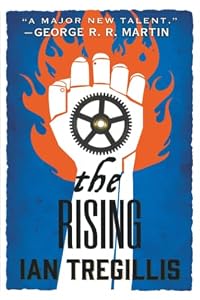













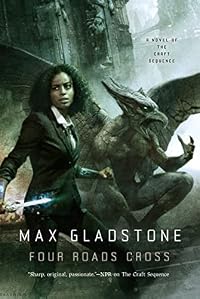


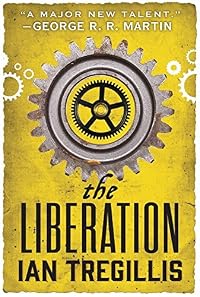













Member Recommendations
Member Reviews
The Mechanical
Ian Tregillis
440pgs
Copy: ARC
Read: 27 April 2015
Spoilers: as few as I could
Recommend to: People who like to think and like sci-fi; fans of Asimov; fans of Susanna Clarke; maybe fans of George R.R. Martin; if you liked "The Dark Tower" series
So Susanna Clarke readers and Asimov readers actually tend to be pretty different. So are "Song of Fire and Ice" and "The Dark Tower". You've got alternate history vs. robotic future and two epic fantasy series (complete with loads of sex) written in completely different styles and settings. What makes The Mechanical so interesting is that it pays homage to all of these disparate themes and styles while still remaining completely individual and distinctive.
Tregillis has created a world show more that differs from ours in that the Dutch became the great world power, not on the power of trade or sail, but due to their mystic creation of mechanical slaves. Created by the inclusive and terrifying Alchemist Guild, these Clakkers are controlled by the Guild and the royal family and rented out to wealthy families or for production needs. These Clakkers, despite independent thought and an underground language, are unable to rebel against the orders of their owners--indeed, any order creates an imperative pain until that order is carried out. They live hundreds of years, trapped within their own bodies.
Despite these geases, some Clakkers speak to one another of Free Will and others mysteriously develop it. The Alchemists destroy them as soon as they are discovered, throwing them into the great Forge.
Against this background, the Dutch are increasing their territory in the New World, fighting against the last stronghold of the French court. In New France, the female spymaster (the Tallyrand) Bernice, Vimcomtess is desperate to maintain their foothold in the world and to fight back against the insatiable power of the Clakker backed Dutch, while also fighting against her own court politics. On the other side, the female head of the Clakker police force and head torturer (cleverly called Tuinier--chief gardener), Anastasia Bell begins to wield a terrifying new technology that questions the very existence of any kind of Free Will at all. Jax, a lowly servitor mechanical, is thrown into this complex tangle with about the same effect as throwing in a grenade.
While the basic premise of the novel is impressive in and of itself, Tregillis handles questions of religion and freedom with ease and grace. He is thought provoking without being distracting from the excitement of the story. Tregillis also creates powerful, yet dissimilar female characters: Bernice and Anastasia are both powerful women without having their femininity stripped away. Bernice, with her mind in the gutter and mouth like sailor, understands and uses sex as a means to an end; she also makes believable mistakes that aren't "punishments" for her sexual behavior. Although Anastasia Bell is harder to read, since we are never granted a 3rd person limited view into her thoughts, she clearly uses her delicate femininity as a kind of intimidating opposition to her job. She looks like a lady: she authorizes acts that devils would find a bit much. Tregillis has joined a unique club among sci-fi/fantasy writers: authors (male and female) that are able to create believable and human characters of both genders. Lets cross our fingers he can keep it up for the sequels.
http://childrenofanidlemindreviews.blogspot.com/2015/05/the-new-metal-man.html show less
Ian Tregillis
440pgs
Copy: ARC
Read: 27 April 2015
Spoilers: as few as I could
Recommend to: People who like to think and like sci-fi; fans of Asimov; fans of Susanna Clarke; maybe fans of George R.R. Martin; if you liked "The Dark Tower" series
So Susanna Clarke readers and Asimov readers actually tend to be pretty different. So are "Song of Fire and Ice" and "The Dark Tower". You've got alternate history vs. robotic future and two epic fantasy series (complete with loads of sex) written in completely different styles and settings. What makes The Mechanical so interesting is that it pays homage to all of these disparate themes and styles while still remaining completely individual and distinctive.
Tregillis has created a world show more that differs from ours in that the Dutch became the great world power, not on the power of trade or sail, but due to their mystic creation of mechanical slaves. Created by the inclusive and terrifying Alchemist Guild, these Clakkers are controlled by the Guild and the royal family and rented out to wealthy families or for production needs. These Clakkers, despite independent thought and an underground language, are unable to rebel against the orders of their owners--indeed, any order creates an imperative pain until that order is carried out. They live hundreds of years, trapped within their own bodies.
Despite these geases, some Clakkers speak to one another of Free Will and others mysteriously develop it. The Alchemists destroy them as soon as they are discovered, throwing them into the great Forge.
Against this background, the Dutch are increasing their territory in the New World, fighting against the last stronghold of the French court. In New France, the female spymaster (the Tallyrand) Bernice, Vimcomtess is desperate to maintain their foothold in the world and to fight back against the insatiable power of the Clakker backed Dutch, while also fighting against her own court politics. On the other side, the female head of the Clakker police force and head torturer (cleverly called Tuinier--chief gardener), Anastasia Bell begins to wield a terrifying new technology that questions the very existence of any kind of Free Will at all. Jax, a lowly servitor mechanical, is thrown into this complex tangle with about the same effect as throwing in a grenade.
While the basic premise of the novel is impressive in and of itself, Tregillis handles questions of religion and freedom with ease and grace. He is thought provoking without being distracting from the excitement of the story. Tregillis also creates powerful, yet dissimilar female characters: Bernice and Anastasia are both powerful women without having their femininity stripped away. Bernice, with her mind in the gutter and mouth like sailor, understands and uses sex as a means to an end; she also makes believable mistakes that aren't "punishments" for her sexual behavior. Although Anastasia Bell is harder to read, since we are never granted a 3rd person limited view into her thoughts, she clearly uses her delicate femininity as a kind of intimidating opposition to her job. She looks like a lady: she authorizes acts that devils would find a bit much. Tregillis has joined a unique club among sci-fi/fantasy writers: authors (male and female) that are able to create believable and human characters of both genders. Lets cross our fingers he can keep it up for the sequels.
http://childrenofanidlemindreviews.blogspot.com/2015/05/the-new-metal-man.html show less
An interesting novel that was more than I expected, with plenty of room to improve. From the Goodreads blurb I thought this was a run of the mill robot uprising scfi story. What I got instead was an alternate history where the Dutch rule the world on the backs of sentient robot slaves and the other notable power, France, is in exile across the Atlantic; holding on only because of military tech that lets them disable the robotic soldiers of the Dutch.Definitely an interesting premise, and Tregillis's writing mostly holds up against it. It's definitely a slow burner, despite the random bursts of visceral action. This is definitely a setup novel, which is a little disappointing because even in a trilogy I like each novel to be show more independently satisfying, and here there is no real payoff until the very end and absolutely no satisfying conclusion.
The 3 main POV characters are interesting enough, but Jax the robot is by far the most compelling as his plotline forms the backbone of the novel. Interesting questions on the nature of free will are explored, along with the place of religion and slavery in a society where the slaves aren't human and don't have souls. One of the other main characters, Visser, is a priest. I enjoyed the beginning and middle of his character arc, but as it progressed it felt unrealistic and a bit of a cop out. I'm interested to see what happens to him, but I don't feel like the book did enough explaining on his part.
The third character, Berenice, is a French spymaster. She's compelling enough, but mostly I found myself just wanting to read more about Jax. I don't think the series can truly flourish until these 3 main characters come together and these disparate plot lines really converge, as they started to do at the very end of the novel.
A good start to a trilogy, and I'm excited to read more, but I wish this one was a little more satisfying without the promise of future books. show less
The 3 main POV characters are interesting enough, but Jax the robot is by far the most compelling as his plotline forms the backbone of the novel. Interesting questions on the nature of free will are explored, along with the place of religion and slavery in a society where the slaves aren't human and don't have souls. One of the other main characters, Visser, is a priest. I enjoyed the beginning and middle of his character arc, but as it progressed it felt unrealistic and a bit of a cop out. I'm interested to see what happens to him, but I don't feel like the book did enough explaining on his part.
The third character, Berenice, is a French spymaster. She's compelling enough, but mostly I found myself just wanting to read more about Jax. I don't think the series can truly flourish until these 3 main characters come together and these disparate plot lines really converge, as they started to do at the very end of the novel.
A good start to a trilogy, and I'm excited to read more, but I wish this one was a little more satisfying without the promise of future books. show less
Another fantastic offering from a writer who is carving a fine niche for himself in complex, intellectually-rigorous world-building without scrimping on characterisation or storytelling thrills. Ian Tregillis' latest series starts with The Mechanical, imagining an alternate-history where the Dutch have created a race of mechanical men (essentially robots, but using 'alchemy' instead of electronics) and used them to aggressively conquer the known world. Opposing them are the uprooted French, now operating out of what we would call Canada. But the alchemical 'geas' that the Dutch 'clockmakers' use to control these mechanicals are not foolproof, as we discover through the story of Jax, a mechanical who discovers he possesses free will and show more goes 'rogue'. Clockmakers lie.
The world-building remains Tregillis' greatest strength, as in his previous Milkweed Triptych and Something More Than Night. He is prepared to wrestle with complex ideas in order to hammer out the parameters and internal logic of his worlds, and consequently one quickly becomes immersed in his stories. It is a great feat not only of imagination but application, and despite the heavyweight ideas present on almost every page the reader never feels overloaded.
There are some small problems, of course, resulting from such ambition. Because this alternate world is so very different from our own, I struggled to place the time period. I had it pegged as around 1870, based on the tone and the nature of the societies we visit; it was not until page 329 that we get a definite date: 1926. This seemed too late for me; the Catholic/Protestant schism and the Dutch hegemony seemed to belong to a much earlier time (1600s or 1700s) and there seem to be no airplanes, telegraphs, electrics, or various other things you might expect. This is a far different 1926: the invention of the mechanicals has advanced the world in some ways but retarded it in others. It is hard for readers to determine which technologies and societal advances are applicable to Tregillis' world, and consequently our presumptions and assessments of this world are constantly shifting beneath us, especially in the earlier parts of the book.
There are other minor issues, such as an occasional penchant for long, obscure words that drag the pace of the prose down; you are forced to either look for a dictionary or press on slightly at a loss for what is happening. It was this tendency that meant the alchemical Grand Forge at the end of the book wasn't that impressive to me – solely because I struggled to decipher Tregillis' descriptions. The motivations of Jax – and, to a lesser extent, Berenice, in the final act were also less-than-clear, and this act itself was so action-heavy and smashy-smashy destructive that it would be better suited to the denouement of a Hollywood movie than the first instalment of a piece of intelligent fiction.
But, I should stress, these are minor quibbles. The Mechanical is excellent and it is heartening to know that there is a writer out there who is consistently putting out pieces of speculative fiction that are intellectually challenging and stimulating. Far from being a derivative piece about robots-but-we-don't-call-them-robots, Tregillis has presented a thoughtful story that, with its dominant theme on the nature of free will and through the more particular plight of the character Father Visser, reminded me of both Dostoevsky's psychological angst and Orwell's Nineteen Eighty-Four. With these comparisons in mind, it is also important to stress just how entertaining this book is: it provides that often-elusive page-turning quality alongside its intellectual stimulation. It is a delicate balance that Tregillis traces excellently. show less
The world-building remains Tregillis' greatest strength, as in his previous Milkweed Triptych and Something More Than Night. He is prepared to wrestle with complex ideas in order to hammer out the parameters and internal logic of his worlds, and consequently one quickly becomes immersed in his stories. It is a great feat not only of imagination but application, and despite the heavyweight ideas present on almost every page the reader never feels overloaded.
There are some small problems, of course, resulting from such ambition. Because this alternate world is so very different from our own, I struggled to place the time period. I had it pegged as around 1870, based on the tone and the nature of the societies we visit; it was not until page 329 that we get a definite date: 1926. This seemed too late for me; the Catholic/Protestant schism and the Dutch hegemony seemed to belong to a much earlier time (1600s or 1700s) and there seem to be no airplanes, telegraphs, electrics, or various other things you might expect. This is a far different 1926: the invention of the mechanicals has advanced the world in some ways but retarded it in others. It is hard for readers to determine which technologies and societal advances are applicable to Tregillis' world, and consequently our presumptions and assessments of this world are constantly shifting beneath us, especially in the earlier parts of the book.
There are other minor issues, such as an occasional penchant for long, obscure words that drag the pace of the prose down; you are forced to either look for a dictionary or press on slightly at a loss for what is happening. It was this tendency that meant the alchemical Grand Forge at the end of the book wasn't that impressive to me – solely because I struggled to decipher Tregillis' descriptions. The motivations of Jax – and, to a lesser extent, Berenice, in the final act were also less-than-clear, and this act itself was so action-heavy and smashy-smashy destructive that it would be better suited to the denouement of a Hollywood movie than the first instalment of a piece of intelligent fiction.
But, I should stress, these are minor quibbles. The Mechanical is excellent and it is heartening to know that there is a writer out there who is consistently putting out pieces of speculative fiction that are intellectually challenging and stimulating. Far from being a derivative piece about robots-but-we-don't-call-them-robots, Tregillis has presented a thoughtful story that, with its dominant theme on the nature of free will and through the more particular plight of the character Father Visser, reminded me of both Dostoevsky's psychological angst and Orwell's Nineteen Eighty-Four. With these comparisons in mind, it is also important to stress just how entertaining this book is: it provides that often-elusive page-turning quality alongside its intellectual stimulation. It is a delicate balance that Tregillis traces excellently. show less
When I started reading this book and then looked at the author's other books, I was surprised to learn that I had already read something by this author: [b:Something More Than Night|17332272|Something More Than Night|Ian Tregillis|https://d.gr-assets.com/books/1380339039s/17332272.jpg|24035910]. I was surprised because the style and vocabulary and atmosphere are really different between these books! And obviously I never remember an author's name unless I really really like a book. But I'll remember Ian Tregillis now.
This book was awesome. It's basically an alternate history sci-fi novel - what if alchemical magic existed, and The Netherlands used it to create an army of mechanical golems that they used to become the biggest colonial show more empire on earth? I really liked that this book started from the perspective of Jax, one of the golems (called Clakkers), because we're immediately put into this underground world of consciousness and rebellion that humans never see. As readers, it is obvious to us that the Clakkers are sentient and intelligent, so we're immediately rooting for them to throw off the shackles of slavery and give the arrogant Dutch what-for. As you read, you learn that the Clockmaker's Guild (who create the Clakkers, imbuing them with the alchemical geasa which bind them into servitude) has an official party line that Clakkers are nothing more than scaled-up wristwatches, and the people buy into because there's not any evidence to the contrary. Only there is, but no one is listening hard enough - the Clakkers speak to each other in their own morse-like language made up of the ticks and rattles of their steampunk bodies, and no one appears to be aware of this, not even The Guild...
Though they must be aware of their creations' awareness. There are so many ethical layers to this situation that Tregillis either addresses outright or hints at, but nothing glaring is ignored - and more layers of religious morality and ideas of free will and the immortal soul are added, as the Dutch empire's main enemy, France, is Catholic and believes that Clakkers have souls. While none of the religious arguments ever hit home for me, considering I don't believe that immortal souls exist, the real existential crises that the characters went through were fascinating.
I loved all three of the main characters. The book switches between their points of view, and I was always excited to get back to any of them. Berenice was a particularly awesome character - a woman in a position of power, who is smart, capable, and speaks her mind, but is confident to the point of hubris. I imagine her weaknesses are borne out of learning how to defend herself and her position to a royal council full of arrogant men, and I loved her story so much.
On another feminist note, while sexism does exist in this world, sometimes as a plot point, Tregillis is really good at using female pronouns as much as male ones in side characters which I find are typically defaulted to male. In a group of soldiers, half are women. In a group of bystanders, half are women. I found myself paying more attention when I read a female pronoun in these cases, because I had already defaulted the nameless crowd members to male - I have been trained by media to view male as default and female as a characteristic added to default, so I was pleasantly surprised to see a female passerby scoffing or a female soldier holding a prisoner's arm or what have you. This is especially interesting to me considering that one of my main complaints about Something More Than Night was the 40's noir detective sexism of the main character.
So I'm pretty excited about the next book in this series. show less
This book was awesome. It's basically an alternate history sci-fi novel - what if alchemical magic existed, and The Netherlands used it to create an army of mechanical golems that they used to become the biggest colonial show more empire on earth? I really liked that this book started from the perspective of Jax, one of the golems (called Clakkers), because we're immediately put into this underground world of consciousness and rebellion that humans never see. As readers, it is obvious to us that the Clakkers are sentient and intelligent, so we're immediately rooting for them to throw off the shackles of slavery and give the arrogant Dutch what-for. As you read, you learn that the Clockmaker's Guild (who create the Clakkers, imbuing them with the alchemical geasa which bind them into servitude) has an official party line that Clakkers are nothing more than scaled-up wristwatches, and the people buy into because there's not any evidence to the contrary. Only there is, but no one is listening hard enough - the Clakkers speak to each other in their own morse-like language made up of the ticks and rattles of their steampunk bodies, and no one appears to be aware of this, not even The Guild...
Though they must be aware of their creations' awareness. There are so many ethical layers to this situation that Tregillis either addresses outright or hints at, but nothing glaring is ignored - and more layers of religious morality and ideas of free will and the immortal soul are added, as the Dutch empire's main enemy, France, is Catholic and believes that Clakkers have souls. While none of the religious arguments ever hit home for me, considering I don't believe that immortal souls exist, the real existential crises that the characters went through were fascinating.
I loved all three of the main characters. The book switches between their points of view, and I was always excited to get back to any of them. Berenice was a particularly awesome character - a woman in a position of power, who is smart, capable, and speaks her mind, but is confident to the point of hubris. I imagine her weaknesses are borne out of learning how to defend herself and her position to a royal council full of arrogant men, and I loved her story so much.
On another feminist note, while sexism does exist in this world, sometimes as a plot point, Tregillis is really good at using female pronouns as much as male ones in side characters which I find are typically defaulted to male. In a group of soldiers, half are women. In a group of bystanders, half are women. I found myself paying more attention when I read a female pronoun in these cases, because I had already defaulted the nameless crowd members to male - I have been trained by media to view male as default and female as a characteristic added to default, so I was pleasantly surprised to see a female passerby scoffing or a female soldier holding a prisoner's arm or what have you. This is especially interesting to me considering that one of my main complaints about Something More Than Night was the 40's noir detective sexism of the main character.
So I'm pretty excited about the next book in this series. show less
Impeccably researched alternate historical fiction meets with amazingly built characters to create a fantastic novel. We travel through the world through the eyes of three characters: Jax, a mechanical man, Visser, a secret Catholic, and Berniece, spymaster of New France.
With some of the best character work I've seen -- especially in regards to Berniece, whose a female lead we don't get to see very often -- we go on a wild ride through the politics and passions of the struggle between the power of the Dutch and the dreams of New France with the fate of millions of mechanical souls and not a few human ones in the balance. While we don't finish the overall arc in this volume, as it is a trilogy, it still satisfies.
The detail work is show more impeccable. The action sequences amazing. The attention paid to every nuance of a character's inner life and outter life is grand. Honestly, I haven't read a book this good in ages, and highly recommend it. show less
With some of the best character work I've seen -- especially in regards to Berniece, whose a female lead we don't get to see very often -- we go on a wild ride through the politics and passions of the struggle between the power of the Dutch and the dreams of New France with the fate of millions of mechanical souls and not a few human ones in the balance. While we don't finish the overall arc in this volume, as it is a trilogy, it still satisfies.
The detail work is show more impeccable. The action sequences amazing. The attention paid to every nuance of a character's inner life and outter life is grand. Honestly, I haven't read a book this good in ages, and highly recommend it. show less
Like many fans of Ian Tregillis, I was first introduced to his work with the Milkweed Triptych, a series about British warlocks versus Nazi super-soldiers in an alternate history of World War II. Then In 2013 I picked up Something More Than Night, a futuristic urban fantasy-type metaphysical hard-boiled detective noir story about angels. That book was a bit of a departure to say the least, but it also solidified Tregillis in my mind as a talented visionary, definitely a rising star to watch.
Now Tregillis returns to alternate history in The Mechanical, outdoing himself once again with an inventive blend of mind-blowing fantasy, history, and existential philosophy. This time we see humble French metallurgy pitted against the demonic show more alchemy of the Dutch, in a story set in the early 1900s. Back in the 17th century in this alternate timeline, prominent mathematician and scientist Christiaan Huygens changed the face of the world by using magic to develop an army of clockwork automatons capable of intelligent thought but are enslaved to their masters through a series of geasa. This breakthrough discovery ensured the survival of the Calvinist Dutch Empire, for very few found themselves capable of standing against a legion of these tireless and utterly obedient mechanical men called “Clakkers.”
So three hundred years later, the Dutch are the dominant power with only a small remnant of French Papists still fighting to oppose their rule. The book begins with the executions of a group of French spies, witnessed through the eyes of one of our main protagonists, a mechanical servitor named Jax. Across the ocean where what’s left of the French Court has been exiled to the New World, our other protagonist is spymistress Berenice Charlotte de Mornay-Périgord, who is understandably vexed that almost all her agents back in the Netherlands have been caught and killed. Not long after, Jax is unwittingly used to smuggle a dangerous piece of intel across the Atlantic, and then a fatal disaster strikes the French within the walls of Marseilles-in-the-West. Thus begins an incredible tale of deadly secrets and ruthless politics, as our two characters’ fates ultimately come together in their search for what they desire most – for Jax, the sweet taste of freedom, and for Berenice, the vengeance on those who took everything from her.
What can I say but I’m just completely awestruck by the world Tregillis has created here. I know I say that about every one of his novels, but it’s true. No one does alternate history quite like the way he does, always bringing a fresh new twist by blending elements from multiple genres. He offers a whole new vision to steampunk in The Mechanical, presenting a heart-pounding tale of intrigue wrapped around a philosophical core which explores the subject of artificial intelligence and its consequences. The book will no doubt provide fertile ground for plenty of discussion, littered as it is with profound themes examining free will versus determinism, the nature of identity and the purpose of the individual, and at times it even dabbles lightly in religious theory.
Sounds delightfully cerebral, doesn’t it? But don’t let that fool you. True, The Mechanical will give you plenty of existential questions to mull over, but at its heart it is a gripping story brought to life by complex, engaging characters. There’s plenty of action and adventure that will get the blood pumping in your veins. Also, you can never let your guard down when reading a Tregillis novel. No one is ever truly safe (the unfortunate character of Father Luuk Visser can attest to that) and the author clearly has no qualms about taking his story into shocking, brutal territory. Tragedy and bloody violence can befall a character in a Tregillis novel at any time, something I discovered way back when I read Bitter Seeds, so it was a lesson I learned early.
Still, I’ve said this before and I’ll say it again – I do adore Ian Tregillis’s writing for the very fact that his style is so well-suited for darker, more evocative stories. His prose is so tight and it always flows well with the narrative, not to mention he can also be ferociously detailed when he needs to be. He draws you in and makes you feel for his characters, so that everything that happens to them matters, even (or perhaps especially) when the shit massively hits the fan. I found The Mechanical less bleak than Milkweed, though fair warning: there are more than a few traumatizing scenes in this book. Then again, it sure didn’t stop me from madly devouring up its pages, and in fact I find myself even more invested when I know that anything can happen.
In short, The Mechanical is an excellent read, not to be missed by fans of alternate history fiction and steampunk. Even if you’re not into those genres, the mix of so many ideas and other elements from sci-fi and fantasy will surely make this worth checking out. Tregillis never fails to impress, and his writing and stories seem to be getting better with each novel. This book is truly unlike anything I’ve ever read before, and it’s my favorite work of his to date. show less
Now Tregillis returns to alternate history in The Mechanical, outdoing himself once again with an inventive blend of mind-blowing fantasy, history, and existential philosophy. This time we see humble French metallurgy pitted against the demonic show more alchemy of the Dutch, in a story set in the early 1900s. Back in the 17th century in this alternate timeline, prominent mathematician and scientist Christiaan Huygens changed the face of the world by using magic to develop an army of clockwork automatons capable of intelligent thought but are enslaved to their masters through a series of geasa. This breakthrough discovery ensured the survival of the Calvinist Dutch Empire, for very few found themselves capable of standing against a legion of these tireless and utterly obedient mechanical men called “Clakkers.”
So three hundred years later, the Dutch are the dominant power with only a small remnant of French Papists still fighting to oppose their rule. The book begins with the executions of a group of French spies, witnessed through the eyes of one of our main protagonists, a mechanical servitor named Jax. Across the ocean where what’s left of the French Court has been exiled to the New World, our other protagonist is spymistress Berenice Charlotte de Mornay-Périgord, who is understandably vexed that almost all her agents back in the Netherlands have been caught and killed. Not long after, Jax is unwittingly used to smuggle a dangerous piece of intel across the Atlantic, and then a fatal disaster strikes the French within the walls of Marseilles-in-the-West. Thus begins an incredible tale of deadly secrets and ruthless politics, as our two characters’ fates ultimately come together in their search for what they desire most – for Jax, the sweet taste of freedom, and for Berenice, the vengeance on those who took everything from her.
What can I say but I’m just completely awestruck by the world Tregillis has created here. I know I say that about every one of his novels, but it’s true. No one does alternate history quite like the way he does, always bringing a fresh new twist by blending elements from multiple genres. He offers a whole new vision to steampunk in The Mechanical, presenting a heart-pounding tale of intrigue wrapped around a philosophical core which explores the subject of artificial intelligence and its consequences. The book will no doubt provide fertile ground for plenty of discussion, littered as it is with profound themes examining free will versus determinism, the nature of identity and the purpose of the individual, and at times it even dabbles lightly in religious theory.
Sounds delightfully cerebral, doesn’t it? But don’t let that fool you. True, The Mechanical will give you plenty of existential questions to mull over, but at its heart it is a gripping story brought to life by complex, engaging characters. There’s plenty of action and adventure that will get the blood pumping in your veins. Also, you can never let your guard down when reading a Tregillis novel. No one is ever truly safe (the unfortunate character of Father Luuk Visser can attest to that) and the author clearly has no qualms about taking his story into shocking, brutal territory. Tragedy and bloody violence can befall a character in a Tregillis novel at any time, something I discovered way back when I read Bitter Seeds, so it was a lesson I learned early.
Still, I’ve said this before and I’ll say it again – I do adore Ian Tregillis’s writing for the very fact that his style is so well-suited for darker, more evocative stories. His prose is so tight and it always flows well with the narrative, not to mention he can also be ferociously detailed when he needs to be. He draws you in and makes you feel for his characters, so that everything that happens to them matters, even (or perhaps especially) when the shit massively hits the fan. I found The Mechanical less bleak than Milkweed, though fair warning: there are more than a few traumatizing scenes in this book. Then again, it sure didn’t stop me from madly devouring up its pages, and in fact I find myself even more invested when I know that anything can happen.
In short, The Mechanical is an excellent read, not to be missed by fans of alternate history fiction and steampunk. Even if you’re not into those genres, the mix of so many ideas and other elements from sci-fi and fantasy will surely make this worth checking out. Tregillis never fails to impress, and his writing and stories seem to be getting better with each novel. This book is truly unlike anything I’ve ever read before, and it’s my favorite work of his to date. show less
from Laura:
The Mechanical imagines that the Dutch have become the world's superpower after an alchemical breakthrough allowed them to grant sentience and demand complete obedience from a vast fleet of nearly indestructible mechanical men. Some of these Clakkers are servants to families that can afford them; others are laborers; others are military-grade. All operate under a geas that forces them to be obedient to their owners. Thoughts or deeds that run counter to their orders cause them severe pain. The French are sympathetic to the Clakkers (inasmuch as they would like to overthrow the Dutch), believing that the machines could have free will if not for the wishes of their makers, and seek to free the Clakkers from their show more geasa.
Tregillis writes very cinematically, so it's easy to picture what's going on throughout the story. Many passages include a variety of sounds, smells, and tastes, lending an immediacy to the narrative that is sometimes stomach-turning. He doesn't spare us any details describing gory scenes, even ones involving hot pokers and...very sensitive body parts.
There were so many characters and double agents that it was difficult for me to keep up with what was happening. The Mechanical is the first book in a planned series, and there is no way I'm going to be able to remember who anyone is, much less who they're allied with, when the next one is published. But I do want to know what happens! show less
The Mechanical imagines that the Dutch have become the world's superpower after an alchemical breakthrough allowed them to grant sentience and demand complete obedience from a vast fleet of nearly indestructible mechanical men. Some of these Clakkers are servants to families that can afford them; others are laborers; others are military-grade. All operate under a geas that forces them to be obedient to their owners. Thoughts or deeds that run counter to their orders cause them severe pain. The French are sympathetic to the Clakkers (inasmuch as they would like to overthrow the Dutch), believing that the machines could have free will if not for the wishes of their makers, and seek to free the Clakkers from their show more geasa.
Tregillis writes very cinematically, so it's easy to picture what's going on throughout the story. Many passages include a variety of sounds, smells, and tastes, lending an immediacy to the narrative that is sometimes stomach-turning. He doesn't spare us any details describing gory scenes, even ones involving hot pokers and...very sensitive body parts.
There were so many characters and double agents that it was difficult for me to keep up with what was happening. The Mechanical is the first book in a planned series, and there is no way I'm going to be able to remember who anyone is, much less who they're allied with, when the next one is published. But I do want to know what happens! show less
Members
- Recently Added By
Lists

Top Five Books of 2015
811 works; 240 members

io9 Book Club
70 works; 4 members
Author Information

27+ Works 3,100 Members
Some Editions
Awards and Honors
Distinctions
Notable Lists
Series

Common Knowledge
- Canonical title
- The Mechanical
- Original publication date
- 2015-03-10
- People/Characters
- Jax (Jalyksegethistrovantus); Berenice Charlotte de Mornay-Périgord; Luuk Visser; Hugo Longchamp
- Important places
- The Hague, South Holland, Netherlands; New Amsterdam, New Netherlands; New York, New York, USA; Marseilles-in-the-West, New France (fictional); New France; Nouvelle-France
- Dedication
- For Sara, at long last
- First words
- It was the first public execution in several year, and thus, despite the cold drizzle, a rather unwieldy crowd thronged the open spaces of the Bennenhof.
- Quotations
- Clockmakers lie.
- Last words
- (Click to show. Warning: May contain spoilers.)It took him upriver, to Marseilles-in-the-West.
- Blurbers
- Martin, George R.R.; Doctorow, Cory
Classifications
Statistics
- Members
- 644
- Popularity
- 44,810
- Reviews
- 23
- Rating
- (3.84)
- Languages
- English, Hungarian, Italian, Polish
- Media
- Paper, Audiobook, Ebook
- ISBNs
- 13
- ASINs
- 6