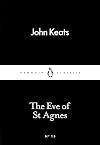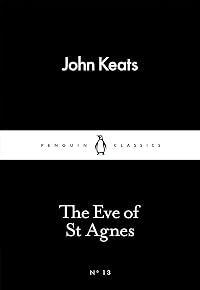
The Eve of St Agnes
by John Keats
On This Page
Description
'Hoodwink'd in faery fancy...'This volume contains a selection of Keats's greatest verse - including his gothic story in verse, 'The Eve of St Agnes', and the mysterious 'Lamia' - exploring themes of love, enchantment, myth and magic.Introducing Little Black Classics- 80 books for Penguin's 80th birthday. Little Black Classics celebrate the huge range and diversity of Penguin Classics, with books from around the world and across many centuries. They take us from a balloon ride over Victorian show more London to a garden of blossom in Japan, from Tierra del Fuego to 16th-century California and the Russian steppe. Here are stories lyrical and savage; poems epic and intimate; essays satirical and inspirational; and ideas that have shaped the lives of millions. show lessTags
Recommendations

Member Recommendations

Member Reviews
I generally do enjoy poetry by Keats, and this was a really good little collection.
He creates a vivid and rich image with his words, and despite the age of his poetry it is still quite easy to read and understand. I liked the way used myths, such as in Ode to Psyche; it was something that was fun and interesting for me.
He creates a vivid and rich image with his words, and despite the age of his poetry it is still quite easy to read and understand. I liked the way used myths, such as in Ode to Psyche; it was something that was fun and interesting for me.
I generally do enjoy poetry by Keats, and this was a really good little collection.
He creates a vivid and rich image with his words, and despite the age of his poetry it is still quite easy to read and understand. I liked the way used myths, such as in Ode to Psyche; it was something that was fun and interesting for me.
He creates a vivid and rich image with his words, and despite the age of his poetry it is still quite easy to read and understand. I liked the way used myths, such as in Ode to Psyche; it was something that was fun and interesting for me.
I liked the Eve of St Agnes but Lamia bored me brainless and the last left me indifferent. I felt this is another one that would benefit from some explainitary notes on historical / mythical references
A narrative poem about a girl who asks St. Agnes to give her a vision of her future husband and wakes to find her admirer Prothero, an enemy of her family, sitting by her bed ready to take her away.
Read all my reviews on http://urlphantomhive.booklikes.com
Having never read anything by Keats before, but having heard a lot of it, I was really looking forward to this collection of five of his poems.
The poem of the title is the longest and it is, as his other poems, very visual. It really tells a story, and while this is a nice change for the other poetry so far in the Little Black Classic collection, it also became slightly dull after a while. It is a long story, and my thought wandered after a while, wondering if it couldn't have been a bit shorter.
Nevertheless a nice introduction.
Little Black Classic #13
Having never read anything by Keats before, but having heard a lot of it, I was really looking forward to this collection of five of his poems.
The poem of the title is the longest and it is, as his other poems, very visual. It really tells a story, and while this is a nice change for the other poetry so far in the Little Black Classic collection, it also became slightly dull after a while. It is a long story, and my thought wandered after a while, wondering if it couldn't have been a bit shorter.
Nevertheless a nice introduction.
Little Black Classic #13
Not the most thrilling story I've read. Illustrations are marvelous. All B/W.
I will probably always enjoy Keats. I will always enjoy la belle dame sans merci as well.
Members
- Recently Added By
Published Reviews
ThingScore 100
Leigh Hunt shrewdly opined that ‘The Eve of St Agnes’ was the best poem Keats wrote, and modern criticism is just beginning uneasily to wonder if he may not have been right... And of course Keats turned against the poem, as he habitually did when he had done something marvelous...
He could not see how the incongruous factors in ‘St Agnes Eve’ nonetheless worked together to make it the show more kind of masterpiece adored by the Victorians. Porphyro, ‘brushing the cobwebs with his lofty plume’ in true ‘Mother Radcliffe’ style (yet who but Keats would have seen a helmet plume as brushing the cobwebs?), is a figure of complex human and poetic origins, a voyeur and would-be seducer who is also a rapt adoring lover longing to make Madeline his bride. Troilus, Iachimo and Romeo are present in him, but he is also very much his Keatsian self, like one of the ‘carvèd angels, ever eager-eyed’. show less
He could not see how the incongruous factors in ‘St Agnes Eve’ nonetheless worked together to make it the show more kind of masterpiece adored by the Victorians. Porphyro, ‘brushing the cobwebs with his lofty plume’ in true ‘Mother Radcliffe’ style (yet who but Keats would have seen a helmet plume as brushing the cobwebs?), is a figure of complex human and poetic origins, a voyeur and would-be seducer who is also a rapt adoring lover longing to make Madeline his bride. Troilus, Iachimo and Romeo are present in him, but he is also very much his Keatsian self, like one of the ‘carvèd angels, ever eager-eyed’. show less
added by SnootyBaronet
Lists

Recommended Reading : 600 Classics Reviewed, Editors of Salem Press, 2015
634 works; 6 members
Author Information

444+ Works 13,707 Members
John Keats was born in London, the oldest of four children, on October 31, 1795. His father, who was a livery-stable keeper, died when Keats was eight years old, and his mother died six years later. At age 15, he was apprenticed to an apothecary-surgeon. In 1815 he began studying medicine but soon gave up that career in favor of writing poetry. show more The critic Douglas Bush has said that, if one poet could be recalled to life to complete his career, the almost universal choice would be Keats, who now is regarded as one of the three or four supreme masters of the English language. His early work is badly flawed in both technique and critical judgment, but, from his casually written but brilliant letters, one can trace the development of a genius who, through fierce determination in the face of great odds, fashioned himself into an incomparable artist. In his tragically brief career, cut short at age 25 by tuberculosis, Keats constantly experimented, often with dazzling success, and always with steady progress over previous efforts. The unfinished Hyperion is the only English poem after Paradise Lost that is worthy to be called an epic, and it is breathtakingly superior to his early Endymion (1818), written just a few years before. Isabella is a fine narrative poem, but The Eve of St. Agnes (1819), written soon after, is peerless. In Lamia (1819) Keats revived the couplet form, long thought to be dead, in a gorgeous, romantic story. Above all it was in his development of the ode that Keats's supreme achievement lies. In just a few months, he wrote the odes "On a Grecian Urn" (1819), "To a Nightingale" (1819), "To Melancholy" (1819), and the marvelously serene "To Autumn" (1819). Keats is the only romantic poet whose reputation has steadily grown through all changes in critical fashion. Once patronized as a poet of beautiful images but no intellectual content, Keats is now appreciated for his powerful mind, profound grasp of poetic principles, and ceaseless quest for new forms and techniques. For many readers, old and young, Keats is a heroic figure. John Keats died in Rome on February 23, 1821 and was buried in the Protestant Cemetery, Rome. His last request was to be placed under a tombstone bearing no name or date, only the words, "Here lies One whose Name was writ in Water." (Bowker Author Biography) show less
Some Editions
Series
Belongs to Publisher Series
Work Relationships
Is contained in
Common Knowledge
- Canonical title
- The Eve of St Agnes
- Original publication date
- 1820
- Important events
- St. Agnes' Eve; Middle Ages
- Disambiguation notice
- This collection was issued by Penguin as part of their 80th anniversary Little Black Classics series. Please do not combine with the single poem or with other collections.
Classifications
Statistics
- Members
- 321
- Popularity
- 99,480
- Reviews
- 7
- Rating
- (3.81)
- Languages
- English, Greek
- Media
- Paper, Audiobook, Ebook
- ISBNs
- 11
- ASINs
- 12