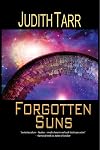
Forgotten Suns
by Judith Tarr
On This Page
Description
I am no one. I pass from dark into dark. I hunt a track gone cold as stone. For five thousand Earth years, the planet called Nevermore has been empty. Its cities are deserted, with every trace of their inhabitants erased. Only a handful of nomadic tribes remain, none of whom remember the ones who went before. An expedition from Earth has been excavating one of the planet's many ruins, and attempting without success to find the cause of its people's disappearance. Now the expedition is in show more trouble, its funding cut; unless it makes a major discovery, and soon, it will be shut down. Then the United Planets will invade Nevermore and strip it of its resources, and destroy its ancient and enigmatic treasures. Aisha, the daughter of the chief archaeologists, tries to save the expedition by opening a sealed tomb or treasury-and manages instead to destroy it. But one treasure survives, which may be the key to the planet's mystery. Khalida is a Military Intelligence officer with a quarter-million deaths on her conscience. She has retreated to the near-solitude of Nevermore to try to come to terms with what she has done, but her past will not let her go. The war she thought she had ended still rages, and is about to destroy one planet and spread chaos through a hundred more. Her superiors force her back into service, and dispatch her to a world that may also offer a clue to the mystery of Nevermore. With a mysterious stranger, the sentient starship he liberates from an unholy alliance of Military Intelligence and the Interstellar Institute for Psychic Research, and a crew of scientists, explorers, and renegades, Aisha and Khalida set off on a journey to the end of the universe and beyond. What they find will change not only the future of Nevermore, but that of all the United Planets. show lessTags
Recommendations



















Member Reviews
A royal sleeper who has missed six thousand years of humankind's corruption sets out to save his home planet after being awoken by an inadvertent explosion set off by a very technically aware budding archaeologist. She in turn wishes to save the planet from exploitation and her project (really her parents' research) from collapsing. The characters are engaging and compelling, the time and space travel equally so. I loved the expert convolutions that solve logistical problems, the mind-to-mind communication and the live ship. I like these characters . They are realistic enough to be .capable of independent thinking. I hope they compel the author to carry on and write more. A great escape. You will love Aisha, be impatient with Aunt show more Khalida and annoyed with but hopeful for and impressed by Rama. A great escape! show less
 This review was written for LibraryThing Early Reviewers.
Aisha Nasir is the thirteen-year-old daughter of archaeologists who've been working on the almost-abandoned planet of Nevermore for most of her life.
When Aisha, in an excess of enthusiasm, tries to blast open a hidden chamber in the mountain near their settlement, things go predictably wrong and she finds nothing useful--but a strange man turns up, apparently from nowhere.
He looks and sounds like the natives--but not exactly. He seems not to remember his name, and Vikram, one of senior staff of the expedition, dubs him Rama. He proves good with the horses, and Vikram hires him.
When their parents and others go off for annual offworld vacation, Aisha and her brother Jamal are left behind as the consequence for their unauthorized use of show more explosives, with Vikram and their Aunt Khalida to supervise.
There's a complex background here, that's not easy to summarize quickly without spoilers. Khalida is a Military Intelligence officer on leave after an assignment that ended traumatically. She's been "healed" mentally, except that it was a slapdash job, and another reason for her to distrust the already distrusted Psycorps. Meanwhile, with her official thirteenth birthday approaching, Aisha is awaiting her evaluation by Psycorps--which could result in her being involuntarily recruited into Psycorps, instead of being able to follow her parents into archaeology.
But neither Khalida, nor Aisha, nor even Psycorps knows what's really in wait for them. Rama is not just a wandering nomad. He's the Sleeper, an admired, worshiped, and finally dreaded king and emperor put in stasis and buried in a sealed fortress six thousand years ago. He's been sleeping ever since, and Aisha awakened him, unintentionally and for reasons that don't become clear till later. He's awake, he's a psi master beyond the imagination of Psycorps, and he has a mission foreseen dimly by the precogs of his time. It's time to face the danger his people fled, a thousand years after he was condemned to sleep until awakened.
Rama, Aisha, and Khalida are going to cross the galaxy and the barriers of space-time in an adventure in which the Psycorps Khalida hates and Aisha dreads is a minor obstacle on the path to the real enemy, and the secret of where Rama's people disappeared to. We have living ships, Psycorps agents as malevolent as Khalida thinks they are and Psycorp agents who really do mean well, and people on the edge of United Planets space who have their own agenda.
And there are the Gates, and the secret of where Rama's people went, and why.
It's a great adventure that I'm describing poorly.
In addition to the great adventure, this book has some interesting features. There's reason to think that the core of the story may have been written in the 1970s, when Tarr was trying to sell space opera and the publishers wanted fantasy from her. One of the things that becomes clear some ways into Forgotten Suns is that Tarr's 1980s Avaryon books are the pre-history of this story, tweaked to look like fantasy. This perhaps explains why I got a "seventies" vibe from the book, even while the basic social assumptions, including gender equality and same-sex relationships being taken for granted as just "how things are," are very much the social assumptions of the 21st century. And that's a bonus extra for me: the story-telling I loved about the seventies, without the sexism that frustrated me and the homophobia I was still learning to notice.
Highly recommended. show less
When Aisha, in an excess of enthusiasm, tries to blast open a hidden chamber in the mountain near their settlement, things go predictably wrong and she finds nothing useful--but a strange man turns up, apparently from nowhere.
He looks and sounds like the natives--but not exactly. He seems not to remember his name, and Vikram, one of senior staff of the expedition, dubs him Rama. He proves good with the horses, and Vikram hires him.
When their parents and others go off for annual offworld vacation, Aisha and her brother Jamal are left behind as the consequence for their unauthorized use of show more explosives, with Vikram and their Aunt Khalida to supervise.
There's a complex background here, that's not easy to summarize quickly without spoilers. Khalida is a Military Intelligence officer on leave after an assignment that ended traumatically. She's been "healed" mentally, except that it was a slapdash job, and another reason for her to distrust the already distrusted Psycorps. Meanwhile, with her official thirteenth birthday approaching, Aisha is awaiting her evaluation by Psycorps--which could result in her being involuntarily recruited into Psycorps, instead of being able to follow her parents into archaeology.
But neither Khalida, nor Aisha, nor even Psycorps knows what's really in wait for them. Rama is not just a wandering nomad. He's the Sleeper, an admired, worshiped, and finally dreaded king and emperor put in stasis and buried in a sealed fortress six thousand years ago. He's been sleeping ever since, and Aisha awakened him, unintentionally and for reasons that don't become clear till later. He's awake, he's a psi master beyond the imagination of Psycorps, and he has a mission foreseen dimly by the precogs of his time. It's time to face the danger his people fled, a thousand years after he was condemned to sleep until awakened.
Rama, Aisha, and Khalida are going to cross the galaxy and the barriers of space-time in an adventure in which the Psycorps Khalida hates and Aisha dreads is a minor obstacle on the path to the real enemy, and the secret of where Rama's people disappeared to. We have living ships, Psycorps agents as malevolent as Khalida thinks they are and Psycorp agents who really do mean well, and people on the edge of United Planets space who have their own agenda.
And there are the Gates, and the secret of where Rama's people went, and why.
It's a great adventure that I'm describing poorly.
In addition to the great adventure, this book has some interesting features. There's reason to think that the core of the story may have been written in the 1970s, when Tarr was trying to sell space opera and the publishers wanted fantasy from her. One of the things that becomes clear some ways into Forgotten Suns is that Tarr's 1980s Avaryon books are the pre-history of this story, tweaked to look like fantasy. This perhaps explains why I got a "seventies" vibe from the book, even while the basic social assumptions, including gender equality and same-sex relationships being taken for granted as just "how things are," are very much the social assumptions of the 21st century. And that's a bonus extra for me: the story-telling I loved about the seventies, without the sexism that frustrated me and the homophobia I was still learning to notice.
Highly recommended. show less
Mostly worked quite well, but the underlying premise was quite confused and took a while to be full explored creating a lot of confusion until the history was finally revealed.
We follow a young girl daughter of a family of archaeologists exploring an abandoned planet, attempting to discover what made it's inhabitants leave. They were not aliens, but human stock, diverged from the mainline sometime in the past as many planets have done. But despite only having bronze age technologies (weird in a space going culture) they left very suddenly leaving no traces or images of themselves, merely buildings and a few artefacts. Aisha opens the novel by blowing the roof off a cave (she only meant to crack it a little). Some days afterwards they show more discover a visitor unused to the world they're in, which gives them considerable surprise. For the planet is controlled access only, Aisha's parents have managed to obtain a cultural preservation order against such a world being exploited by the mega corporations that control human life. Even the fear psi-corps are not allowed to interfere. Aisha's aunt on relief from Military Intelligence can't find any more information about the stranger, but eventually the Aunt gets recalled to serve again and Aisha senses an opportunity to learn more about this mysterious man who's company is so alluring.
It is all too much too piled up upon another and never quite resolved. We have Aliens, psi, time travel, history, military solar politics, pirates, family, religion, preserved muslin cultures, mysterious strangers (yes more) etc etc all thrown in one after another. Each of those themes in it's own right could be a fulfilling and engaging novel, exploring various matters of contemporary society and 'what ifs', however all thrown into one melting pot nothing of consequence emerges and we just get a bit of a chase across the universes. Aisha just about works as a character. Nobody else gets a look in. While some of the dialogue was good there wasn't enough interplay between the characters an no chance of building any kind of rapport with them, and so I never really cared what happened to Aisha or the world.
Mostly interesting to see what the author was going to do next, very plot driven, lacking in world building and characterisation with a few continuity errors for good measure. show less
We follow a young girl daughter of a family of archaeologists exploring an abandoned planet, attempting to discover what made it's inhabitants leave. They were not aliens, but human stock, diverged from the mainline sometime in the past as many planets have done. But despite only having bronze age technologies (weird in a space going culture) they left very suddenly leaving no traces or images of themselves, merely buildings and a few artefacts. Aisha opens the novel by blowing the roof off a cave (she only meant to crack it a little). Some days afterwards they show more discover a visitor unused to the world they're in, which gives them considerable surprise. For the planet is controlled access only, Aisha's parents have managed to obtain a cultural preservation order against such a world being exploited by the mega corporations that control human life. Even the fear psi-corps are not allowed to interfere. Aisha's aunt on relief from Military Intelligence can't find any more information about the stranger, but eventually the Aunt gets recalled to serve again and Aisha senses an opportunity to learn more about this mysterious man who's company is so alluring.
It is all too much too piled up upon another and never quite resolved. We have Aliens, psi, time travel, history, military solar politics, pirates, family, religion, preserved muslin cultures, mysterious strangers (yes more) etc etc all thrown in one after another. Each of those themes in it's own right could be a fulfilling and engaging novel, exploring various matters of contemporary society and 'what ifs', however all thrown into one melting pot nothing of consequence emerges and we just get a bit of a chase across the universes. Aisha just about works as a character. Nobody else gets a look in. While some of the dialogue was good there wasn't enough interplay between the characters an no chance of building any kind of rapport with them, and so I never really cared what happened to Aisha or the world.
Mostly interesting to see what the author was going to do next, very plot driven, lacking in world building and characterisation with a few continuity errors for good measure. show less
This review was written for LibraryThing Early Reviewers.This is a fast-paced, ambitious novel that expands in scope swiftly, yet the attention to detail and rich characterization reward the reader and curb the pitfalls that can occur with so much action. As might be expected with a big, expansive novel, the ending, although tying up many loose ends, still leaves room for more books in a potential series and leaves the reader wanting more stories set in the story universe(s).
It's a rollicking, teeming extravaganza of a tale, with a sentient starship, multiple universes, a demigod, aliens, "psi" masters, and more. It seems like the author had fun writing this novel, and it's infectious. The mysterious, mostly abandoned world of Nevermore is a puzzle for Aisha's archaeologist family until an show more accidental explosion yields an even more mysterious stranger, who comes to live with Aisha, Khalida, Aisha's brother Jamal, and Vikram (sort of an administrative leader for the expedition). From there, Aisha, Khalida, and Rama sail through the stars and encounter progressively larger and more complex problems until finally returning to Nevermore at the end of the book.
The novel takes a turn and accelerates when the Ra-Harakhte is introduced. The living ship, one of many familiar SFF tropes or traditions in this tale, is crucial to the plot but also a peripheral character; It reminded this reviewer of Moya, from Farscape, and apparently the author is familiar with that character as well (according to John Scalzi's blog). The notion of "psi" goes back several decades in SFF, but it doesn't seem dated or out of place at all. Rather, it is integral to and fully integrated into the story's characters, plots, and settings. Tarr also fills her book with diversity, sure to curry favor with many modern critics, but the inclusion seems natural, never forced.
Many writers might get lost in the galloping pace and neglect to round out their protagonists, but that's fortunately not the case here. Great characterization is a hallmark of Forgotten Suns, especially Aisha, who is in many ways the main persona in this novel. Personal details—mostly of Aisha, the ancient king Rama, and Aisha's Aunt Khalida, the powerful triumvirate of adventurous travelers—are prudently peppered throughout the text. One gets to really know them only gradually, as one would get to know a friend or colleague in real life. Even the demigod Rama has a unique personality and his own peculiar proclivities and weaknesses; Tarr does not relegate him to a wooden stock type but rather fleshes him out and provides him with nuances.
Tarr's sentence structure often seems to mimic her characters' thought processes, notably the confusion, uncertainly, and excitement of teenagers. Her prose is a little more choppy with respect to Khalida, but that also reflects her personality and military training. Another minor quibble is the battle with the universe-endangering "eater": the resolution feels a bit rushed, vague, and not entirely convincing. It's a big idea to grapple with, though, and exploring the issue to a satisfactory degree would likely have added a great deal of unnecessary length to the book.
In contrast, Aisha's reunion dinner with her family back on Nevermore was fraught with emotion and astutely captured the mixed feelings of everyone involved. It's a small scene, but one of the most finely written in the novel.
Forgotten Suns is a little long, but nicely detailed and with a gripping pace: there are not many lulls, and it's nearly impossible to get bored with the story. If you're interested in space, psychology, archaeology, ancient Egypt, or mythology (to name just a few), it's an intriguing, exciting, and well-written read. show less
It's a rollicking, teeming extravaganza of a tale, with a sentient starship, multiple universes, a demigod, aliens, "psi" masters, and more. It seems like the author had fun writing this novel, and it's infectious. The mysterious, mostly abandoned world of Nevermore is a puzzle for Aisha's archaeologist family until an show more accidental explosion yields an even more mysterious stranger, who comes to live with Aisha, Khalida, Aisha's brother Jamal, and Vikram (sort of an administrative leader for the expedition). From there, Aisha, Khalida, and Rama sail through the stars and encounter progressively larger and more complex problems until finally returning to Nevermore at the end of the book.
The novel takes a turn and accelerates when the Ra-Harakhte is introduced. The living ship, one of many familiar SFF tropes or traditions in this tale, is crucial to the plot but also a peripheral character; It reminded this reviewer of Moya, from Farscape, and apparently the author is familiar with that character as well (according to John Scalzi's blog). The notion of "psi" goes back several decades in SFF, but it doesn't seem dated or out of place at all. Rather, it is integral to and fully integrated into the story's characters, plots, and settings. Tarr also fills her book with diversity, sure to curry favor with many modern critics, but the inclusion seems natural, never forced.
Many writers might get lost in the galloping pace and neglect to round out their protagonists, but that's fortunately not the case here. Great characterization is a hallmark of Forgotten Suns, especially Aisha, who is in many ways the main persona in this novel. Personal details—mostly of Aisha, the ancient king Rama, and Aisha's Aunt Khalida, the powerful triumvirate of adventurous travelers—are prudently peppered throughout the text. One gets to really know them only gradually, as one would get to know a friend or colleague in real life. Even the demigod Rama has a unique personality and his own peculiar proclivities and weaknesses; Tarr does not relegate him to a wooden stock type but rather fleshes him out and provides him with nuances.
Tarr's sentence structure often seems to mimic her characters' thought processes, notably the confusion, uncertainly, and excitement of teenagers. Her prose is a little more choppy with respect to Khalida, but that also reflects her personality and military training. Another minor quibble is the battle with the universe-endangering "eater": the resolution feels a bit rushed, vague, and not entirely convincing. It's a big idea to grapple with, though, and exploring the issue to a satisfactory degree would likely have added a great deal of unnecessary length to the book.
In contrast, Aisha's reunion dinner with her family back on Nevermore was fraught with emotion and astutely captured the mixed feelings of everyone involved. It's a small scene, but one of the most finely written in the novel.
Forgotten Suns is a little long, but nicely detailed and with a gripping pace: there are not many lulls, and it's nearly impossible to get bored with the story. If you're interested in space, psychology, archaeology, ancient Egypt, or mythology (to name just a few), it's an intriguing, exciting, and well-written read. show less
This review was written for LibraryThing Early Reviewers.When I read “Aisha, the daughter of the chief archaeologists, tries to save the expedition” in the book description, I was hooked. I knew that I just had to read this book.
I really liked Forgotten Suns and read through it as quickly as I could. One thing that made the book so outstanding for me was the attention paid to character development. With two point of view characters, both female, it could have devolved into a sameness, but instead the reader was given two well-differentiated characters.
First up, we meet Aisha, the almost thirteen year-old daughter of xenoarchaeologists exploring planet MEP 1403, otherwise known as Nevermore. Aisha was born on Nevermore and has only visited other planets for short periods. Although there show more are ruins indicating a highly advanced civilization, the planet is basically unpopulated except for a few nomadic tribes. And, after twenty years of exploration, the scientists still don't know what happened to the original occupants. Now, the research funding is at risk and developers are eager to gain control of the planet and open it for colonization. As if that weren't bad enough, Aisha must be examined by Psycorps immediately after her birthday. If she shows signs of psi talents, she'll be taken away by the Corps and she'd much rather study to be a xenoarchaeologist.
Next, we meet the second primary character, Khalida, aunt to Aisha and her brother Jamal. Khalida is an officer in Military Intelligence, come to Nevermore to continue her recovery from the trauma of putting down a rebellion on far-away Araceli. A mis-step resulted in the detonation of a nuclear device and the deaths of several million including all those on her team. Although Psycorp treated her and suppressed some of her memories, she refused further treatment and retreated to Nevermore.
The other main character around whom the action revolves is Rama, a man with either no past or a millenia-old past. Claiming to have been in stasis for thousands of years, he sets out to find what happened to the original inhabitants of Nevermore.
This was a thoroughly entertaining book. In addition to fully fleshed characters, the universe in which they live was magnificently developed. Judith Tarr has done a masterful job in weaving the stories of Rama, Aisha, Khalida, and others. Throughout, there was space travel, military forces, psi (or magic?), science, aliens, and more. I strongly recommend Forgotten Suns to all who love well-crafted science/space fiction.
Thanks to the publisher, Book View Cafe, and Library Thing Early Reviewers for providing a copy of the book in exchange for an honest review. show less
I really liked Forgotten Suns and read through it as quickly as I could. One thing that made the book so outstanding for me was the attention paid to character development. With two point of view characters, both female, it could have devolved into a sameness, but instead the reader was given two well-differentiated characters.
First up, we meet Aisha, the almost thirteen year-old daughter of xenoarchaeologists exploring planet MEP 1403, otherwise known as Nevermore. Aisha was born on Nevermore and has only visited other planets for short periods. Although there show more are ruins indicating a highly advanced civilization, the planet is basically unpopulated except for a few nomadic tribes. And, after twenty years of exploration, the scientists still don't know what happened to the original occupants. Now, the research funding is at risk and developers are eager to gain control of the planet and open it for colonization. As if that weren't bad enough, Aisha must be examined by Psycorps immediately after her birthday. If she shows signs of psi talents, she'll be taken away by the Corps and she'd much rather study to be a xenoarchaeologist.
Next, we meet the second primary character, Khalida, aunt to Aisha and her brother Jamal. Khalida is an officer in Military Intelligence, come to Nevermore to continue her recovery from the trauma of putting down a rebellion on far-away Araceli. A mis-step resulted in the detonation of a nuclear device and the deaths of several million including all those on her team. Although Psycorp treated her and suppressed some of her memories, she refused further treatment and retreated to Nevermore.
The other main character around whom the action revolves is Rama, a man with either no past or a millenia-old past. Claiming to have been in stasis for thousands of years, he sets out to find what happened to the original inhabitants of Nevermore.
This was a thoroughly entertaining book. In addition to fully fleshed characters, the universe in which they live was magnificently developed. Judith Tarr has done a masterful job in weaving the stories of Rama, Aisha, Khalida, and others. Throughout, there was space travel, military forces, psi (or magic?), science, aliens, and more. I strongly recommend Forgotten Suns to all who love well-crafted science/space fiction.
Thanks to the publisher, Book View Cafe, and Library Thing Early Reviewers for providing a copy of the book in exchange for an honest review. show less
This review was written for LibraryThing Early Reviewers.I read this in about ten sittings, yeah ten sittings in two days. I literally picked it up every spare minute I had. This book is AMAZING if you like timey wimey (Doctor Who saying) things.....
I really love fantasy and science fiction and this just hit all the right spots, all of them! It has magic, I mean sun god kind of magic. A sleeper who has slept for thousands of years, THOUSANDS!! There is even a ship that is alive god damn really alive...
A girl (Aisha) who is downright crazy... A guy (Rama) who is downright crazy.... And an Aunt (Khalida) who is downright crazy.... I love it. All of it. Every character was something else. Brilliant. I got into the book from the start. The girl blows up a cave in Nevermore (I want to live here), show more something is let loose. WHAT! YES!! This something is Rama. I love Rama, he is wild. Together they travel through worlds and eventually dimensions trying to find where his people are. Do they succeed? Hell yeah, with a big bang here and there..... I actually want there to be another book, which surprised me. I've read a lot of trilogies but mainly it's because I can't stand a book not completely finished. But this beauty, Judith Tarr please, please, please write more :D!! You should almost certainly read this. what ever genre your into. It is certainly something to think about. I like SOMETHING to think about. I love every 'what if?' that is ever written. Go and find yourself a copy of this right away. That is an order from the Corps.... Not that you will know who they are until you read, so make sure you do ;) show less
I really love fantasy and science fiction and this just hit all the right spots, all of them! It has magic, I mean sun god kind of magic. A sleeper who has slept for thousands of years, THOUSANDS!! There is even a ship that is alive god damn really alive...
A girl (Aisha) who is downright crazy... A guy (Rama) who is downright crazy.... And an Aunt (Khalida) who is downright crazy.... I love it. All of it. Every character was something else. Brilliant. I got into the book from the start. The girl blows up a cave in Nevermore (I want to live here), show more something is let loose. WHAT! YES!! This something is Rama. I love Rama, he is wild. Together they travel through worlds and eventually dimensions trying to find where his people are. Do they succeed? Hell yeah, with a big bang here and there..... I actually want there to be another book, which surprised me. I've read a lot of trilogies but mainly it's because I can't stand a book not completely finished. But this beauty, Judith Tarr please, please, please write more :D!! You should almost certainly read this. what ever genre your into. It is certainly something to think about. I like SOMETHING to think about. I love every 'what if?' that is ever written. Go and find yourself a copy of this right away. That is an order from the Corps.... Not that you will know who they are until you read, so make sure you do ;) show less
This review was written for LibraryThing Early Reviewers.I read Forgotten Suns like someone who thouroughly enjoys a family recipe at a family dinner. Most of the ingredients are known: the teenage focus character, the family mentor, the age-old hero, the evil government agency as an opponent. Many tropes flow through the book: the contact between psi and science, worldgates (hello Hyperion), the Thing From Below, psi-gifted humans finally breeding their own counterpower (K. Dick's Ubik, Dune), event the sentient Ship has an air of déjà-vu. And yet, I found the book very enjoyable.
The narratives include enough backstory to make thge universe credible, without taking any unecessary pain to show off own many different alien species ou strange words the author can imagine. Of course, there is show more also the twist of having female characters as focus (and of muslim culture at that) and a large female cast in usually male roles (military, science team lead and so on).
In short, this book brings a fresh cast to a classic frame. And this is no mean feat. show less
The narratives include enough backstory to make thge universe credible, without taking any unecessary pain to show off own many different alien species ou strange words the author can imagine. Of course, there is show more also the twist of having female characters as focus (and of muslim culture at that) and a large female cast in usually male roles (military, science team lead and so on).
In short, this book brings a fresh cast to a classic frame. And this is no mean feat. show less
This review was written for LibraryThing Early Reviewers.Members
- Recently Added By
Lists

2016 Hugo Eligible Novels
90 works; 32 members

Books Read in 2024
4,727 works; 128 members
Author Information

Judith Tarr was born in Augusta, Maine on January 30, 1955. She received a B.A. in Latin and English from Mount Holyoke College, an M.A. in Classics from Cambridge University, and an M.A. and a Ph.D. in Medieval studies from Yale University. She is the author of more than twenty novels including The Golden Horn, The Hound and the Falcon, Avaryan show more Rising, Alamut, The Daggar and the Cross, The Lord of Two Lands, Pillar of Fire, The Throne of Isis, White Mare's Daughter, Queen of Swords, Arrows of the Sun, and Spear of Heaven. She also wrote a juvenile book entitled His Majesty's Elephant. (Bowker Author Biography) show less
Common Knowledge
- Canonical title
- Forgotten Suns
- Original publication date
- 2015
- People/Characters*
- Aisha; Khalida; Mirain (as Rama); Zhao
- Important places*
- Nevermore
- Epigraph
- Help me to shatter this darkness,
To smash this night,
To break this shadow
Into a thousand lights of sun,
Into a thousand whirling dreams
—Langston Hughes - First words
- Aisha had blown the top off the cliff.
- Blurbers
- Smith, Sherwood
*Some information comes from Common Knowledge in other languages. Click "Edit" for more information.
Classifications
Statistics
- Members
- 130
- Popularity
- 251,926
- Reviews
- 37
- Rating
- (3.65)
- Languages
- English
- Media
- Paper, Ebook
- ISBNs
- 3
- ASINs
- 1