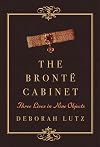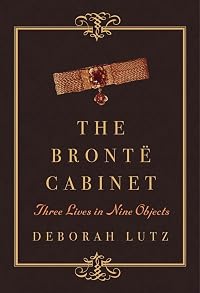
The Brontë Cabinet: Three Lives in Nine Objects
by Deborah Lutz
On This Page
Description
Victorian literature scholar Deborah Lutz illuminates the complex and fascinating lives of the Brontes through the things they wore, stitched, wrote on, and inscribed.Tags
Recommendations

















Member Reviews
I have been fascinated with the three Brontë sisters – Charlotte, Emily, and Anne – ever since I first read Jane Eyre in my high school days. Even then, my voracious appetite led me to read all of their novels. When I started an English degree in order to do graduate work, the first class was in the summer before the full semester started. The second class I took was on British Women Writers. The class was intense. We read everything by the Brontës, along with all of Jane Austen, George Elliot, and Elizabeth Gaskill. This reading regimen exactly fulfilled all I had hoped for in my new adventure. When I saw a review of a Brontë biography by Deborah Lutz, The Brontë Cabinet: Three Lives in Nine Objects, I put everything else I was show more reading aside. Deborah is a Professor of English at Long Island University, and she lives in Brooklyn, New York. She has written several books on the Victorian period.
Each of the nine chapters delves into the personal lives of the three sisters by way of examining a variety of objects they used every day. The chapters include “Tiny Books” – my favorite – “Keeper, Grasper, and Other Family Animals,” and “The Alchemy of Desks.” Along with detailed descriptions in the nine chapters, is an array of photographs of the objects.
In the “Preface,” Lutz writes, “The Brontës scribbled, doodled, and inscribed in their books – stuck plants, drawings, visiting cards in them – making their presence manifest. Some of these well-used volumes transmitted even more than evidence of reading; they had a certain secret to them, which seemed to my nose, a fleshy smell. I was lucky to be able to touch (often without gloves), turn over, bring close, and even sniff the things I handled in libraries and museums” (Preface xxii). Few things give me more pleasure than opening a new book and drinking in the wonderful aroma of paper and ink. In the “Tiny Books” chapter, Lutz adds, “The Brontës felt an intimacy with these closely handled books, made by their own limbs and clothed with materials familiar from the kitchen or the parlor. This closeness of the body and the book was an ordinary feature of daily life in the nineteenth century, a relationship no longer obvious today” (23). I blame e-readers for the loss of the tactile sensations when holding a finely made new book.
In the chapter on “Family Animals,” Lutz explains, ‘For Emily, animals weren’t pets so much as they were family” (105). I can visualize Emily talking to her beloved Keeper as he cocks his head to one side, as our beloved Lab often does. The chapter has a drawing which “Emily immortalized [Keeper] in an expressive pencil portrait she did in January 1834” (115). This pencil drawing is included, along with the color pictures of his collar and a watercolor, also by Emily, of Keeper without his collar.
Deborah Lutz has written a warm, lovely, and informative look into the secret lives of Anne, Emily, and Charlotte Brontë. The Brontës Cabinet: Three Lives in Nine Objects is a delicious and wonderful trip to Haworth Parsonage in the middle of the 19th century. Take a walk on the Yorkshire moors and feel their presence.
--Chiron, 6/5/16 show less
Each of the nine chapters delves into the personal lives of the three sisters by way of examining a variety of objects they used every day. The chapters include “Tiny Books” – my favorite – “Keeper, Grasper, and Other Family Animals,” and “The Alchemy of Desks.” Along with detailed descriptions in the nine chapters, is an array of photographs of the objects.
In the “Preface,” Lutz writes, “The Brontës scribbled, doodled, and inscribed in their books – stuck plants, drawings, visiting cards in them – making their presence manifest. Some of these well-used volumes transmitted even more than evidence of reading; they had a certain secret to them, which seemed to my nose, a fleshy smell. I was lucky to be able to touch (often without gloves), turn over, bring close, and even sniff the things I handled in libraries and museums” (Preface xxii). Few things give me more pleasure than opening a new book and drinking in the wonderful aroma of paper and ink. In the “Tiny Books” chapter, Lutz adds, “The Brontës felt an intimacy with these closely handled books, made by their own limbs and clothed with materials familiar from the kitchen or the parlor. This closeness of the body and the book was an ordinary feature of daily life in the nineteenth century, a relationship no longer obvious today” (23). I blame e-readers for the loss of the tactile sensations when holding a finely made new book.
In the chapter on “Family Animals,” Lutz explains, ‘For Emily, animals weren’t pets so much as they were family” (105). I can visualize Emily talking to her beloved Keeper as he cocks his head to one side, as our beloved Lab often does. The chapter has a drawing which “Emily immortalized [Keeper] in an expressive pencil portrait she did in January 1834” (115). This pencil drawing is included, along with the color pictures of his collar and a watercolor, also by Emily, of Keeper without his collar.
Deborah Lutz has written a warm, lovely, and informative look into the secret lives of Anne, Emily, and Charlotte Brontë. The Brontës Cabinet: Three Lives in Nine Objects is a delicious and wonderful trip to Haworth Parsonage in the middle of the 19th century. Take a walk on the Yorkshire moors and feel their presence.
--Chiron, 6/5/16 show less
Lutz shapes her biography of the Bronte sister (Charlotte, Emily, and Anne) around nine common objects that they owned, including a walking stick, tiny books they created as children, a silver dog collar, a lap desk, a collection of pressed ferns, and more. With some insight, some research, and a considerable amount of speculation, she connects the objects both to known events in their lives and to their novels and characters. The dog collar, for example, may have belonged to Emily's fierce companion, Keeper, but Lutz also connects it to the various dogs in Wuthering Heights: Cathy's favorite dog, Isabel's spaniel, and Heathcliffe's vicious guard dogs, among others. She also spends time discussing the role of dogs in Victorian society: show more which breeds were most popular, what kinds of dogs were owned by various famous persons, a notorious dognapping ring, etc. One might say that, like Emily wandering familiar territory (the moors), so Lutz wanders through each chapter, keeping her eye on the central object but often straying far afield. It's an interesting approach but might be frustrating to readers who were hoping for a well-researched and detailed biography or those already familiar with the Victorian era and its milieu. show less
By and large, a well written and absorbing account of the Brontë family told through various objects owned by family members. There were some odd moments (that Lutz was able to get a "fleshy" smell from volumes in the Brontë library seems to me rather unlikely indeed, and likewise that Brontë manuscripts bound in sugar papers "still smell sweet"), but generally I thought she did a very decent job.
A readable and intriguing exploration of Victorian material culture, from letters to "scrapbooks" to hair jewelry through the lives and possessions of the Bronte family.
An interesting twist on the usual biography, with tons of historical context beyond the Brontë family, as well as information about each of the Brontës which I didn't know before. A worthwhile, introspective read.
Oh man, I wanted to love this, but I kind of didn't. I think it was just too hindered by trying to connect the biographical information to the stuff. I think this would be a great read for a new entrant into the world of the Brontes, but obsessives won't really find any new scholarship.
This was a nice brief , accessible way to learn about the Brontes. Sometimes, I think the author was a bit overly speculative, but the objects were interesting and the research well done.
Members
- Recently Added By
Lists

Fiction: Classics, Literary, Short Stories
85 works; 1 member

On Books
70 works; 1 member
Author Information
6+ Works 366 Members
Deborah Lutz's books include Pleasure Bound: Victorian Sex Rebels and the New Eroticism and Relics of Death in Victorian Literature and Culture. She is the Thruston B. Morton Professor of English at the University of Louisville.
Awards and Honors
Common Knowledge
- Original publication date
- 2015
- People/Characters
- Charlotte Brontë; Emily Brontë; Anne Brontë; Branwell Brontë; Patrick Brontë; Elizabeth Gaskell (show all 7); Harriet Martineau
- Dedication
- For Tony and Pamela
- First words
- The strange bed in Emily Brontë's Wuthering Heights has always haunted me.
- Quotations
- Every spirit passing through the world fingers the tangible and mars the mutable, and finally has come to look and not to buy. As shoes are worn and hassocks are sat upon...finally everything is left where it was and the spir... (show all)it passes on.
- Marilynne Robinson, Housekeeping
The world is so full of a number of things
I'm sure we should all be as happy as kings.
- Robert Louis Stevenson, "Happy Thought"
I took my dingy volume by the scroop, and hurled it into the dog-kennel, vowing I hated a good book. Heathcliff kicked his to the same place.
- Emily Brontë, Wuthering Heights
Reading is my favourite occupation, when I have leisure for it and books to read.
- Anne Brontë, Agnes Grey
She by no means thought it waste of time to devote unnumbered hours to fine embroidery, sight-destroying lace-work, marvelous netting and knitting, and, above all, to most elaborate stocking-mending. She would give a day to t... (show all)he mending of two holes in a stocking any time, and think her "mission" nobly fulfilled when she had accomplished it.
- Charlotte Brontë, Shirley
Come, the wind may never again
Blow as it now blows for us.
- Emily Brontë, "D.G.C. to J.A."
Wood you need not frown on me
Spectral trees that so dolefully
Shake your heads in the dreary sky
- Emily Brontë, Untitled poem
The dog was throttled off; his huge, purple tongue hanging half a foot out of his mouth, and his pendent lips streaming with bloody slaver.
- Emily Brontë, Wuthering Heights
I began to study the outside of my treasure: it was some minutes before I could get over the direction and penetrate the seal; one does not take a strong place of this kind by instant storm - one sits down awhile before it, a... (show all)s beleaguers say... The seal was too beautiful to be broken, so I cut it round with my scissors.
- Charlotte Brontë, Villette
Graham would endeavor to seduce her attention by opening his desk and displaying its multifarious contents: seals, bright sticks of wax, pen-knives, with a miscellany of engravings...
- Charlotte Brontë, Villette
Long neglect has worn away
Half the sweet enchanting smile
Time has turned the bloom to grey
Mould and damp the face defile
But that lock of silky hair
Still beneath the picture twined
Tells what once th... (show all)ose features were
Paints their image on the mind.
- Emily Brontë, Untitled poem
The violet's eye might shyly flash
And young leaves shoot among the fern
- Emily Brontë, Untitled poem
Our hills only confess the coming of summer by growing green with young fern and moss in secret little hollows.
- Charlotte Brontë, in a May 1851 letter
Arranging long-locked drawers and shelves
Of cabinets, shut up for years,
What a strange task we've set ourselves!
How still the lonely room appears!
How strange this mass of ancient treasures,
Mementos of past... (show all) pain and pleasures;
These volumes, clasped with costly stone,
With print all faded, gilding gone;
These fans of leaves, from Indian trees -
These crimson shells, from Indian seas -
These tiny portraits, set in rings -
Once, doubtless, deemed such precious things;
Keepsakes bestowed by Love on Faith,
And worn till the receiver's death,
Now stored with cameos, china, shells,
In this old closet's dusty cells.
- Charlotte Brontë, "Mementos" - Last words
- (Click to show. Warning: May contain spoilers.)Is there a better place to look to find heroines on which to model one's life?
Classifications
Statistics
- Members
- 182
- Popularity
- 178,403
- Reviews
- 8
- Rating
- (3.72)
- Languages
- English, Spanish
- Media
- Paper, Ebook
- ISBNs
- 5
- ASINs
- 5