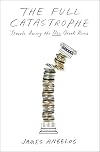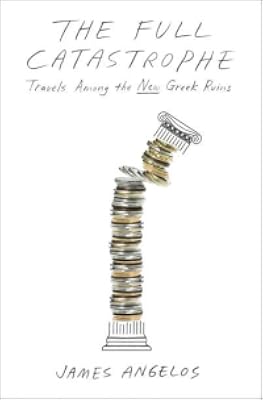
The Full Catastrophe: Travels Among the New Greek Ruins
by James Angelos
On This Page
Description
"A transporting, good-humored, and revealing account of Greece's dire troubles, reported from the mountain villages, idyllic islands, and hardscrabble streets that define the country today In recent years, small Greece, often associated with ancient philosophers and marble ruins, whitewashed villages and cerulean seas, has been at the center of a debt crisis that has sown economic and social ruin, spurred panic in international markets, and tested Europe's decades-old project of forging a show more closer union. In The Full Catastrophe, James Angelos makes sense of contrasting images of Greece, a nation both romanticized for its classical past and castigated for its dysfunctional present. With vivid character-driven narratives and engaging reporting that offers an immersive sense of place, he brings to life some of the causes of the country's financial collapse, and examines the changes, some hopeful and others deeply worrisome, emerging in its aftermath. A small rebellion against tax authorities breaks out on a normally serene Aegean island. A mayor from a bucolic, northern Greek village is gunned down by the municipal treasurer. An aging, leftist hero of the Second World War fights to win compensation from Germany for the wartime occupation. A once marginal group of neo-Nazis rises to political prominence out of a ramshackle Athens neighborhood. The Full Catastrophe goes beyond the transient coverage in the daily headlines to deliver an enduring and absorbing portrait of modern Greece"-- show lessTags
Recommendations















Member Recommendations
akblanchard Journalists return to their ancestral lands to understand current conditions.

Artymedon This literary fiction about a man who has become the quintessential Greek, Zorba, gives its title to the journalistic account of the present Greek economic crisis written by Greek American James Angelos.

Artymedon Manolis Glezos appears in 2014 in Angelos' Book asking German President Joachim Gauck for 162 billion euros for pain and suffering of the Greek people during German occupation.
kswolff Baltimore's institutional corruption is a mirror for Greece's civil and corporate corruption, inefficiency, and greed.
Member Reviews
This journalistic account of the author's travels through post-crisis Greece is an eye-opener, and does a good job of blending personal level interviews with the big picture of the current state of Greece. The introduction, by itself, is worth the price of the book, being an excellent long-read summary of how the current Greek crisis developed and how it is playing out. The succeeding seven chapters connect individual stories to this big picture, providing a close up look at the widespread corruption of Greek state and society, the immigration crisis, and the rise of the neo-Nazi Golden Dawn party. If there's a weak spot it is that Angelos did not spend enough time with Syriza party officials, though their major role in the Greek crisis show more took center stage immediately following the publication of the book.
Angelos, the son of Greek immigrants to America, is willing to be a sympathetic ear to the Greeks, but the facts of the case, so to speak, usually leave him, and the reader, shaking their heads in dismay. It is clear that Greece never should have been allowed to enter the Euro, but for two facts: one, European sentimentality about Greece as the birthplace of European civilization (though Germany, it should be noted, was always skeptical), and secondly, the outright fabrication and fraud of the Greek government to make their economy appear to meet the requirements of Euro membership.
Once in the Euro, the Greek government found much joy in taking the money that European banks were only to happy to lend it and, in local parlance, eating it. Corrupt government officials throughout the land became rich, but they also spread the money around. Greece has a high percentage of its workforce on the state books, thanks to a Constitution that makes it almost impossible to fire government workers, and a tradition of winning politicians giving jobs to supporters. The result is way more bureaucrats than are needed, many of whom are in fact incompetent. With the influx of Euros, the government massively increased their salaries and pensions, which became impossible to sustain once the crisis hit and the creditor nations took a look at the books.
When the easy loans stopped, the government was hamstrung by rampant tax evasion. Sure, tax evasion is an issue everywhere, but Greece takes it to an Olympic level. When the government tried to collect missing tax revenue, it ran into the corruption issue. Auditors, when they found money owed, relied on a 40-40-20 formula: 40% of the amount owed the citizen was allowed to keep, 40% of the amount owed went to the auditor, and 20% went to the government.
Germany, that paragon of responsible virtue, reacted with unsympathetic rage to the financial predicament Greece quickly found itself in. Angelos finds evidence to support the view that Germany intended to punish Greece with terms as harsh as possible in exchange for its assistance.
Angelos, the son of Greek immigrants to America, is willing to be a sympathetic ear to the Greeks, but the facts of the case, so to speak, usually leave him, and the reader, shaking their heads in dismay. It is clear that Greece never should have been allowed to enter the Euro, but for two facts: one, European sentimentality about Greece as the birthplace of European civilization (though Germany, it should be noted, was always skeptical), and secondly, the outright fabrication and fraud of the Greek government to make their economy appear to meet the requirements of Euro membership.
Once in the Euro, the Greek government found much joy in taking the money that European banks were only to happy to lend it and, in local parlance, eating it. Corrupt government officials throughout the land became rich, but they also spread the money around. Greece has a high percentage of its workforce on the state books, thanks to a Constitution that makes it almost impossible to fire government workers, and a tradition of winning politicians giving jobs to supporters. The result is way more bureaucrats than are needed, many of whom are in fact incompetent. With the influx of Euros, the government massively increased their salaries and pensions, which became impossible to sustain once the crisis hit and the creditor nations took a look at the books.
When the easy loans stopped, the government was hamstrung by rampant tax evasion. Sure, tax evasion is an issue everywhere, but Greece takes it to an Olympic level. When the government tried to collect missing tax revenue, it ran into the corruption issue. Auditors, when they found money owed, relied on a 40-40-20 formula: 40% of the amount owed the citizen was allowed to keep, 40% of the amount owed went to the auditor, and 20% went to the government.
Germany, that paragon of responsible virtue, reacted with unsympathetic rage to the financial predicament Greece quickly found itself in. Angelos finds evidence to support the view that Germany intended to punish Greece with terms as harsh as possible in exchange for its assistance.
The punitive nature of the initial bailout agreement - the bringing out of the bats, in other words - somewhat quieted the German electorate's misgivings about helping the Greeks. German chancellor Angela Merkel made sure to emphasize the toughness of the agreement to her voters, assuring them the Greeks were being adequately chastened, that moral hazard was being avoided. Other eurozone countries would "do all they can to avoid this themselves," Merkel told the German newspaper Bild am Sonntag.While this book makes clear that Greece has no room to argue that it does not deserve harsh consequences, despite its attempts to do just that, the wisdom of Germany and other eurozone countries making them more harsh than perhaps necessary is certainly open to question. As the final chapter impicitly suggests, an unintended consequence might be the rise to power of a fascist, neo-Nazi party. show less
Angelos puts a human face on the complex economic situation in Greece. A Greek-American, his knowledge of the language and culture allows him to understand the situation. He allows Greeks (and immigrants) to explain in their own words why they feel and act as they do. One example is the widely-reported case of a Greek civil servant continuing to receive half-salary while serving a sentence for murder. While this outraged German public opinion, in Greece, this was seen as a way to keep his family off welfare, which would also have cost the state. This book will help you understand a complex situation better.
The Full Catastrophe: Travels Among the New Greek Ruins
By James Angelos
Crown
Reviewed by Karl Wolff
A recent essay in The New York Review of Books was ominously titled "Is Europe Disintegrating?" The essay focused on Brexit, Turkey's slide into authoritarianism, and the sulfurous fumes of nationalism spreading across Europe like a gritty remake of the ramp up to the Second World War. Suffice to say, the mainstream media has shown a recent increase in apocalyptic hysteria. Then again, that's how one would act when they treated the American election like a joke. To borrow a one-liner from the world of retail, "Your lack of planning is not my emergency." Others saw the storm clouds way before the mainstream media, although not being bound show more to ratings and the 24-hour news cycle made them immune to reporting on every utterance of a certain reality TV star. Which brings us to Greece.
Greece's role in the Euro fiasco is not news. During the Great Recession, Greece played an instrumental role in European fragmentation and international tension. It is also a nation subject to the rest of Europe's contradictory stereotyping of it. French President Valery Giscard d'Estaing has called Greece "the mother of all democracies," but changed his tune in 2012 when he said, "To be perfectly frank, it was a mistake to accept Greece. Greece simply wasn't ready. Greece is basically an Oriental country." James Angelos, a freelance journalist and former reporter for the Wall Street Journal added, "When Europeans use the term "Oriental," in this context, it's not meant as a compliment. The Greeks were other, Middle Eastern, backwards when compared to noble, loftier Europeans." The Full Catastrophe: Travels Among the New Greek Ruins Angelos brings together investigative journalism, travelogue, and personal commentary to give a human face to Greece in the throes of the present financial crisis.
Is Greece the bastion of democracy, philosophy, and the West? Or is it a backward and corrupt regime dominated by inefficient bureaucrats, political extremists, and greedy opportunists? The answer is Yes. (Then again, I'm from the United States. Who am I to chide them for corruption and extremism? In the United States, we've turned those two things into art forms.) Angelos tours the Greece he knew as a child and encountered a country devastated by internal and external forces. He visits "The Island of the Blind," questioning citizens, medical professionals, and civil servants. He tried to understand how the island of Zakynthos pulled off such a large-scale con on the Greek government. He also interviews members of the civil service in relation to a notorious murder case. Despite committing murder, two members of the Greek civil service continued to get paid even while in jail. When questioned, supporters came back with the old saw, "Think about the children!"
The Full Catastrophe also reveals external fault lines in Greek life. When Chancellor Angela Merkel - also head of Germany's conservative Christian Democratic Union - organized the bail-out program for Greece, it included draconian austerity measures. (In fairness, Greece's government bureaucracy was a bloated, inefficient behemoth.) The austerity measures opened old wounds. Since Greece owed billions, a populist reaction rose up against the draconian measures. Greeks started demanding war reparations from Germany, since the German occupation led to starvation, oppression, and terror.
James Angelos weaves together heart-wrenching human stories with a dark comedy. While he remains proud of his Greek heritage, he doesn't hide his outrage and contempt for the long-held tradition of corruption, graft, and outright thievery present in Greek corporations and Greece's civil service bureaucracy. Greece has long been in need of massive civil and corporate reforms. When a nation is on the verge of economic collapse, austerity measures usually aren't the best solution. What better advice to tell a starving person than not to eat? The Full Catastrophe was a highly satisfying read, playing out like a Greek version of The Wire, David Simon's group portrait of universal institutional corruption of the Baltimore area.
Out of 10/9.0
http://www.cclapcenter.com/2017/01/book_review_the_full_catastrop.html show less
By James Angelos
Crown
Reviewed by Karl Wolff
A recent essay in The New York Review of Books was ominously titled "Is Europe Disintegrating?" The essay focused on Brexit, Turkey's slide into authoritarianism, and the sulfurous fumes of nationalism spreading across Europe like a gritty remake of the ramp up to the Second World War. Suffice to say, the mainstream media has shown a recent increase in apocalyptic hysteria. Then again, that's how one would act when they treated the American election like a joke. To borrow a one-liner from the world of retail, "Your lack of planning is not my emergency." Others saw the storm clouds way before the mainstream media, although not being bound show more to ratings and the 24-hour news cycle made them immune to reporting on every utterance of a certain reality TV star. Which brings us to Greece.
Greece's role in the Euro fiasco is not news. During the Great Recession, Greece played an instrumental role in European fragmentation and international tension. It is also a nation subject to the rest of Europe's contradictory stereotyping of it. French President Valery Giscard d'Estaing has called Greece "the mother of all democracies," but changed his tune in 2012 when he said, "To be perfectly frank, it was a mistake to accept Greece. Greece simply wasn't ready. Greece is basically an Oriental country." James Angelos, a freelance journalist and former reporter for the Wall Street Journal added, "When Europeans use the term "Oriental," in this context, it's not meant as a compliment. The Greeks were other, Middle Eastern, backwards when compared to noble, loftier Europeans." The Full Catastrophe: Travels Among the New Greek Ruins Angelos brings together investigative journalism, travelogue, and personal commentary to give a human face to Greece in the throes of the present financial crisis.
Is Greece the bastion of democracy, philosophy, and the West? Or is it a backward and corrupt regime dominated by inefficient bureaucrats, political extremists, and greedy opportunists? The answer is Yes. (Then again, I'm from the United States. Who am I to chide them for corruption and extremism? In the United States, we've turned those two things into art forms.) Angelos tours the Greece he knew as a child and encountered a country devastated by internal and external forces. He visits "The Island of the Blind," questioning citizens, medical professionals, and civil servants. He tried to understand how the island of Zakynthos pulled off such a large-scale con on the Greek government. He also interviews members of the civil service in relation to a notorious murder case. Despite committing murder, two members of the Greek civil service continued to get paid even while in jail. When questioned, supporters came back with the old saw, "Think about the children!"
The Full Catastrophe also reveals external fault lines in Greek life. When Chancellor Angela Merkel - also head of Germany's conservative Christian Democratic Union - organized the bail-out program for Greece, it included draconian austerity measures. (In fairness, Greece's government bureaucracy was a bloated, inefficient behemoth.) The austerity measures opened old wounds. Since Greece owed billions, a populist reaction rose up against the draconian measures. Greeks started demanding war reparations from Germany, since the German occupation led to starvation, oppression, and terror.
James Angelos weaves together heart-wrenching human stories with a dark comedy. While he remains proud of his Greek heritage, he doesn't hide his outrage and contempt for the long-held tradition of corruption, graft, and outright thievery present in Greek corporations and Greece's civil service bureaucracy. Greece has long been in need of massive civil and corporate reforms. When a nation is on the verge of economic collapse, austerity measures usually aren't the best solution. What better advice to tell a starving person than not to eat? The Full Catastrophe was a highly satisfying read, playing out like a Greek version of The Wire, David Simon's group portrait of universal institutional corruption of the Baltimore area.
Out of 10/9.0
http://www.cclapcenter.com/2017/01/book_review_the_full_catastrop.html show less
 This review was written for LibraryThing Early Reviewers.
"The Full Catastrophe" is a combination of economic current events book, travelogue, and Greek Politics and Culture 101. The author's interest in and passion for his subject matter has been infused into every page. Even if you know nothing about Greece other than "it's famous for Aristotle and the Parthenon", you should not have any serious problems reading and understanding this book.
It starts by discussing small-town crookedness and crime and ends up by discussing Golden Dawn, the neo-Nazi group currently facing a passel of criminal charges and other legal stuff in Greece at the time of this writing. There's a long list of things that are covered in this book of which I was totally unaware before reading it. Greece's recent history of show more militocracy, the demand for reparations from Germany for damages related to WWII, and the apparent existence of political parties covering every conceivable part of the spectrum are just a few of those things. show less
It starts by discussing small-town crookedness and crime and ends up by discussing Golden Dawn, the neo-Nazi group currently facing a passel of criminal charges and other legal stuff in Greece at the time of this writing. There's a long list of things that are covered in this book of which I was totally unaware before reading it. Greece's recent history of show more militocracy, the demand for reparations from Germany for damages related to WWII, and the apparent existence of political parties covering every conceivable part of the spectrum are just a few of those things. show less
This review was written for LibraryThing Early Reviewers.For a small country, Greece is often in the news. Unfortunately, most of the news coming out of Greece these days is not good. Whether the issue is conflict within the European Union, imminent loan defaults, poor treatment of asylum-seekers and migrant workers, or the rise of neo-fascist groups such as the Golden Dawn, Greek society seems to be in a state of disrepair. In The Full Catastrophe James Angelos, an American-born son of Greek immigrants, seeks to understand why his parents' once-glorious homeland, the very cradle of Western civilization, has so many intractable problems. The Greeks Angelos encounters in his travels believe that their birthright has been stolen from them by a dangerous combination of foreign interference and show more widespread corruption at home. The people endure poverty and joblessness while the rest of Europe benefits from their suffering. The Greeks have a phrase for it; they call their country the "basement of Europe".
I wanted to like this book more than I did. Angelos' writing style features long sentences packed with extraneous details that are probably meant to add to the narrative's vividness, but, in my opinion, they make the book seem longer than it actually is. Nonetheless, if you are looking to understand the current situation in Greece, this book is a good place to begin. show less
I wanted to like this book more than I did. Angelos' writing style features long sentences packed with extraneous details that are probably meant to add to the narrative's vividness, but, in my opinion, they make the book seem longer than it actually is. Nonetheless, if you are looking to understand the current situation in Greece, this book is a good place to begin. show less
This review was written for LibraryThing Early Reviewers.A snapshot of Greece during the economic crisis from 2008 to the present, with in depth discussions of Greek attitudes about everything from religion and language to immigration and politics. The overwhelming feeling I get from reading this is that Greece is a world apart from the rest of Europe and never should have joined the Euro (and possibly not even the EU), and I'll have to admit that the country comes across as full of laggards, whiners, and fantacists. The author is Greek American, so he is able to interview his many subjects in Greek and follow the media closely; his analyses are thorough and entertaining. It is also extremely well-written. Highly recommended for those who want to know what has been happening in Greece the show more past seven years and how the country relates to its European neighbors. show less
This review was written for LibraryThing Early Reviewers.The Full Catastrophe: Travels Among the New Greek Ruins by James Angelos travels Greece seeking the answers to the questions of why Greece is in financial ruin. James Angelos, a Greek American free-lance journalist went to Greece and interviewed many Greeks and tells their stories with the background of Greek history and mythology. Some are dramatic, some very puzzling, some frustrating. But because of his background, he is able to explain why so many people on the island of Zakynthos claiming benefits for the blind when they are not. Who are Okaying the benefits? What is the small envelope in government, how does it influence what gets done?
What did the long history of Turkish rule over Greece do to the present day feelings and show more attitude of the Greeks towards their government, not towards their government but their country? What was the Greek's experience with Germany during WWII and why that is not forgiven? Who do the Greeks blame for their financial mess? How are immigrants thought of?
Those are just a few of the many questions that the author explored and answered. This book was not textbook like but much more personal with the interviews. It was fascinating reading and I feel I have a much greater understanding of the why of the situation.
I have learned so very much from this book. I could not have learned it as a tourist. I would have had to know Greek, to be much more familiar with the culture and I would have probably needed to be Greek to get the real stories.
I selected this book from Amazon Vine but receiving it free did not influence my review in any way. show less
What did the long history of Turkish rule over Greece do to the present day feelings and show more attitude of the Greeks towards their government, not towards their government but their country? What was the Greek's experience with Germany during WWII and why that is not forgiven? Who do the Greeks blame for their financial mess? How are immigrants thought of?
Those are just a few of the many questions that the author explored and answered. This book was not textbook like but much more personal with the interviews. It was fascinating reading and I feel I have a much greater understanding of the why of the situation.
I have learned so very much from this book. I could not have learned it as a tourist. I would have had to know Greek, to be much more familiar with the culture and I would have probably needed to be Greek to get the real stories.
I selected this book from Amazon Vine but receiving it free did not influence my review in any way. show less
Members
- Recently Added By
Author Information
2 Works 80 Members
Common Knowledge
- Original title
- The Full Catastrophe:Travels Among the New Greek Ruins
- Original publication date
- 2015
- Important places
- Athens, Greece, The Hellenic Republic
- Epigraph
- We are all Greeks, Percy Bysshe Shelley
- Dedication
- For my parents and grandfather, who have known Xenitia
- First words
- On March 25, 2014, Greeks marked the 193rd anniversary of the start of their war of independence against the Ottoman Empire.
- Quotations
- The famously spirited Zorba-who, to the point of cliché, came to be thought of as a quintessentially Greek character, prompting many foreign tourists to try to find him among the locals-sees catastrophe both as something to ... (show all)be mourned and a beginning to be embraced.
Classifications
- Genres
- Economics, Nonfiction, General Nonfiction, Travel, Business, Politics and Government, History
- DDC/MDS
- 949.507 — History & geography History of Europe Greece, Albania, Yugoslavia, Serbia, Romania, Bulgaria Greece and the Byzantine Empire Byzantine Empire -- 323-1453 History from 1830
- LCC
- DF854 .A55 — History of Europe, Asia, Africa and Oceania Greece History of Greece Modern Greece History By period 20th century
- BISAC
Statistics
- Members
- 79
- Popularity
- 401,633
- Reviews
- 17
- Rating
- (4.08)
- Languages
- English, Estonian
- Media
- Paper, Audiobook, Ebook
- ISBNs
- 10
- ASINs
- 1