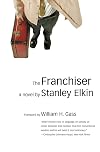
The franchiser
by Stanley Elkin
On This Page
Description
The comic story of a man's obsessive quest to build a fast food empire across America For the better part of the 1970s, entrepreneur Ben Flesh could expand his business kingdom with the snap of his fingers. His fast food restaurants and electronics stores were all a part of his rapidly growing domain, remaking America one enterprise at a time. But when a series of personal and professional catastrophes strike unexpectedly, Ben finds himself on the verge of losing it all. Hailed as one of show more Stanley Elkin's greatest works, The Franchiser is a biting satire of American consumerism and the story of one man's all-consuming determination to create his lasting legacy, one business at a time. This ebook features rare photos and never-before-seen documents from the author's estate and from the Stanley Elkin archives at Washington University in St. Louis. show lessTags
Recommendations











































Member Reviews
A few lines are spoken deep in the Franchiser where the course of events suddenly shift, the novel’s focus jolts away towards being more than just a self-conscious, slightly corny satire of the golden-arch homogenization of small-town-big-city America. Ben Flesh, Elkin’s hero and franchisee, is suddenly faced with an impending multiply-sclerotic powerlessness that bounds back and forth, grows and subsides through the rest of the novel—the scope of the novel no longer space wasted on been-there-done-that social commentary but deliriously depressing and impacting tragicomedy, well worth its place on McCaffery’s 20th-century best-of.
[N.B. This review includes images, and was formatted for my site, dendrobibliography -- located show more here.]
Ben Flesh’s anxious breakdown shifts between surreal comedy and genuine heartbreak. The twins, the triplets, all their bizarre health disorders, humourous but fucking damning and you know it. Between all the silly ha-has we get from the uncontrollably prejudiced (“It’s like a disease.”), the chronically constipated, &c., we’re still left waiting for the page they begin dropping like flies. And Flesh’s life takes a turn following a retrobulbar optic neuritis and an accompanying suggestion—an experience shared in dangerous detail to the reader as it was felt by Elkin himself outside of his writing—his Everyman Walt Disney is, in the flesh, powerless, and it’s pretty heartbreaking at times, especially having witnessed this struggle with a similarly-crippling disease affecting a loved one, the powerlessness derived just as crushing both personally and socially.
Standing out: It’s impossible to forget the surreality of the imposter Colonel Sanders (“finger-lickin’ good!”—DUH! wudyooespect?), the dropping of those beloved flies interspersed too casually with Ben Flesh’s failing Travel Inn—his final franchise!—, the discovery of sexual deviancy sweeping the nation—honestly, the whole ending, the last 50 pages in their entirety: Brilliant. Delivery made comedy upsetting; it’s, like, uhm, too deadpan and matter-of-fact when things get absurd and poetically rich and then, ahh! there’s more failure in the Flesh and—seriously?—excruciating descriptions of hotel room furnishings. Dang. It hurts, it had too much an impact, a physical punch to them there guts, and it came with such a buildup! from slow and steady (and maybe—an aside—a little bit tiring-slash-boring) to rock-‘em-friggin'-sock’em.
From what I’ve read, powerlessness and its impacts are Elkin’s forte; coming close to death but never quite reaching it, it’s always impending, threatening and real for his heroes and heroines. Keeps me interested, and I’ll be checking out more from Elkin in the future, starting with the sickly Magic Kingdom. Ahh, ahh!
[94] show less
[N.B. This review includes images, and was formatted for my site, dendrobibliography -- located show more here.]
Ben Flesh’s anxious breakdown shifts between surreal comedy and genuine heartbreak. The twins, the triplets, all their bizarre health disorders, humourous but fucking damning and you know it. Between all the silly ha-has we get from the uncontrollably prejudiced (“It’s like a disease.”), the chronically constipated, &c., we’re still left waiting for the page they begin dropping like flies. And Flesh’s life takes a turn following a retrobulbar optic neuritis and an accompanying suggestion—an experience shared in dangerous detail to the reader as it was felt by Elkin himself outside of his writing—his Everyman Walt Disney is, in the flesh, powerless, and it’s pretty heartbreaking at times, especially having witnessed this struggle with a similarly-crippling disease affecting a loved one, the powerlessness derived just as crushing both personally and socially.
Standing out: It’s impossible to forget the surreality of the imposter Colonel Sanders (“finger-lickin’ good!”—DUH! wudyooespect?), the dropping of those beloved flies interspersed too casually with Ben Flesh’s failing Travel Inn—his final franchise!—, the discovery of sexual deviancy sweeping the nation—honestly, the whole ending, the last 50 pages in their entirety: Brilliant. Delivery made comedy upsetting; it’s, like, uhm, too deadpan and matter-of-fact when things get absurd and poetically rich and then, ahh! there’s more failure in the Flesh and—seriously?—excruciating descriptions of hotel room furnishings. Dang. It hurts, it had too much an impact, a physical punch to them there guts, and it came with such a buildup! from slow and steady (and maybe—an aside—a little bit tiring-slash-boring) to rock-‘em-friggin'-sock’em.
From what I’ve read, powerlessness and its impacts are Elkin’s forte; coming close to death but never quite reaching it, it’s always impending, threatening and real for his heroes and heroines. Keeps me interested, and I’ll be checking out more from Elkin in the future, starting with the sickly Magic Kingdom. Ahh, ahh!
[94] show less
Verbal diarhea in some parts, but a stunning example of what can be done with the English language in others.
I guess I don't need to read about another 1%er who helped make the united states the messed-up place it is today.
Ratings
Members
- Recently Added By
Lists

Larry McCaffery's 20th Century Greatest Hits: 100 English-Language Books
103 works; 12 members
Author Information

34+ Works 2,650 Members
Stanley Elkin was an American Jewish novelist, short story writer, and essayist. He was born on May 11, 1930. Elkin steadily and quietly worked his way into the higher ranks of contemporary American novelists. He was born in Brooklyn, New York, but grew up in Chicago and has spent most of his life since in the Midwest, receiving his Ph.D. in show more English from the University of Illinois with a dissertation on William Faulkner. He was a member of the English faculty at Washington University in St. Louis from 1960 until his death, and battled multiple sclerosis for most of his adult life. Reviewers found Elkin's first novel, Boswell: A Modern Comedy (1964), the story of an uninhibited modern-day counterpart of the eighteenth-century biographer, hilarious and promising, while the stories in Criers and Kibitzers, Kibitzers and Criers (1966) established Elkin as a writer capable of writing short stories of textbook-anthology quality. The ironically entitled A Bad Man (1967) is about a Jewish department store magnate who deliberately arranges to have himself convicted of several misdeeds so that he can experience the real world of a prison and carry on his own war with the warden in what takes on the dimensions of a burlesque existential allegory. The Dick Gibson Show (1971) uses the host of a radio talk show as a way of showing fancifully what it means to live "at sound barrier," and both Searchers and Seizures (1973) and The Living End (1979) are triptychs of related stories verging on surrealism. The Franchiser (1976), generally considered Elkin's best novel before George Mills, uses the story of a traveling salesman of franchises to show the flattening homogenization of American life. But as usual, what happens in this Elkin novel is less important than the way in which the story is told. Elkin won the National Book Critics Circle Award on two occasions: for George Mills in 1982 and for Mrs. Ted Bliss, his last novel, in 1995. The MacGuffin was a finalist for the 1991 National Book Award for Fiction. Although he enjoyed high critical praise, his books never enjoyed popular success. Elkin died May 31, 1995 of a heart attack. His manuscripts and correspondence are archived in Olin Library at Washington University in St. Louis. (Bowker Author Biography) show less
Some Editions
Awards and Honors
Notable Lists
Series
Belongs to Publisher Series
Common Knowledge
- Canonical title
- The franchiser
- Original publication date
- 1976
- People/Characters
- Ben Flesh; Colonel Sanders; Nate Lace
- Important places
- Kansas City, Missouri, USA; New York, New York, USA; Columbus, Nebraska, USA
Classifications
Statistics
- Members
- 189
- Popularity
- 173,634
- Reviews
- 3
- Rating
- (3.88)
- Languages
- English
- Media
- Paper, Ebook
- ISBNs
- 6
- ASINs
- 8