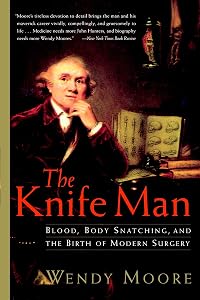
The Knife Man: Blood, Body Snatching, and the Birth of Modern Surgery
by Wendy Moore
On This Page
Description
Biography & Autobiography. History. Science. Nonfiction. HTML:When Robert Louis Stevenson wrote his gothic horror story of Dr. Jekyll and Mr. Hyde, he based the house of the genial doctor-turned-fiend on the home of John Hunter. The choice was understandable, for Hunter was both widely acclaimed and greatly feared.From humble origins, John Hunter rose to become the most famous anatomist and surgeon of the eighteenth century. In an age when operations were crude, extremely painful, and show more often fatal, he rejected medieval traditions to forge a revolution in surgery founded on pioneering scientific experiments. Using the knowledge he gained from countless human dissections, Hunter worked to improve medical care for both the poorest and the best-known figures of the era—including Sir Joshua Reynolds and the young Lord Byron.
An insatiable student of all life-forms, Hunter was also an expert naturalist. He kept exotic creatures in his country menagerie and dissected the first animals brought back by Captain Cook from Australia. Ultimately his research led him to expound highly controversial views on the age of the earth, as well as equally heretical beliefs on the origins of life more than sixty years before Darwin published his famous theory.
Although a central figure of the Enlightenment, Hunter’s tireless quest for human corpses immersed him deep in the sinister world of body snatching. He paid exorbitant sums for stolen cadavers and even plotted successfully to steal the body of Charles Byrne, famous in his day as the “Irish giant.”
In The Knife Man, Wendy Moore unveils John Hunter’s murky and macabre world—a world characterized by public hangings, secret expeditions to dank churchyards, and gruesome human dissections in pungent attic rooms. This is a fascinating portrait of a remarkable pioneer and his determined struggle to haul surgery out of the realms of meaningless superstitious ritual and into the dawn of modern medicine. show less
Tags
Recommendations









Member Reviews
Fascinating, and frequently gruesome, story of the man who more or less singlehandedly revolutionized surgery and medicine. John Hunter refused to accept the traditional style of surgery, which was apparently to cut while reading the instructions from classical medical men - Galen and Hippocrates, both of whom worked on theory more than fact. Hunter insisted on observing what was actually going on in the body - which meant graverobbing to get corpses to autopsy, among other things. He also dissected every type of animal he could get his hands on, including many exotics brought back by explorers or out of various (mostly private) zoos. According to Wendy Moore, he perceived the same relationships among animals (including Man) that Darwin show more did some sixty years later - but a combination of religious limitations on publication and the actions of his assistant, who took all his papers and apparently destroyed a good many, kept his discoveries from being known. It's a biography, so it has a sad ending; in this case, the ending is also really annoying, as said assistant did his best to wreck everything Hunter had created. It's an illuminating look at a person and a situation I knew little about. I hope Moore has written and will write more books. show less
A thoroughly readable, meticulously detailed biography of a crucial figure in the development of modern medicine who remains relatively unknown outside the medical profession. While Moore makes a strong case that Hunter's contributions to surgery, anatomy, biology, and paleontology were under-appreciated both in his time and ours, his lack of name recognition might also be blamed on the fact that his career, unlike those of, say, Pasteur or Jenner, cannot be summed by a single invention or idea. Moore gets around this problem by painting a fascinating picture of the social and medical scene that Hunter worked in. In "The Knife Man," we learn a great deal about dissection lectures, body snatching, medical politics, and the primitive, show more painful, and gruesome state of medicine in the eighteenth century. This isn't a book for the squeamish, and, in its forthright descriptions of surgeries performed without anesthetics or antiseptics will probably be too much for some readers. Meanwhile, its descriptions what might be politely termed the anatomical supply industry tips Moore's subject into the surreal – the fight for the bones of Charles Byrne, an eighteenth century oddity known as "the Irish Giant," seems right out of a Hollywood farce. In this sense, "The Knife Man" makes an interesting companion volume to Mary Roach's "Stiff," the important difference being that most of cadavers that Roach met with had agreed to donate their bodies to science while alive.
Moore also does an excellent job of bringing John Hunter himself to life in the pages of "The Knife Man." He comes across as an enormous personality – difficult, tireless, endlessly curious, and always on the lookout for another preserved body part or worthwhile experiment. The engaging portrait of Hunter that Moore paints in "The Knife Man" is all the more remarkable for the fact that most of his personal papers seem to have been destroyed after his death. In a sense, In a sense, it's Hunter's spirit that might be his greatest contribution to modern medicine. He loved to experiment, to teach, and to collect, but while many of contemporaries owned "cabinets of curiosities," his collecting seemed to be driven not by a taste for the lurid and unusual but for a genuine appreciation of life in all of its forms and varieties. For this, Moore names him one of Darwin's precursors. I don't know enough about any of this to comment on that, but in "The Knife Man," she convinced me that John Hunter read the "book of nature" as well as, and as enthusiastically as, any scientist who ever lived. show less
Moore also does an excellent job of bringing John Hunter himself to life in the pages of "The Knife Man." He comes across as an enormous personality – difficult, tireless, endlessly curious, and always on the lookout for another preserved body part or worthwhile experiment. The engaging portrait of Hunter that Moore paints in "The Knife Man" is all the more remarkable for the fact that most of his personal papers seem to have been destroyed after his death. In a sense, In a sense, it's Hunter's spirit that might be his greatest contribution to modern medicine. He loved to experiment, to teach, and to collect, but while many of contemporaries owned "cabinets of curiosities," his collecting seemed to be driven not by a taste for the lurid and unusual but for a genuine appreciation of life in all of its forms and varieties. For this, Moore names him one of Darwin's precursors. I don't know enough about any of this to comment on that, but in "The Knife Man," she convinced me that John Hunter read the "book of nature" as well as, and as enthusiastically as, any scientist who ever lived. show less
What a character! I truly enjoyed discovering the biography of such a man as, his accomplishments and insights into so many medical fields are absolutely amazing. I still can't believe one man alone could be such an astounding forerunner -from anatomy to surgery, dentistry and else!
What's more, John Hunter's curiosity, bizarre interests and incredible ability to think outside the box led him, not only to blaze paths in many medical fields but, also, to foresee evolution as a Darwin would later describe it (well, nearly!)! About, the pages dedicated here to his collection (the now fascinating Hunterian Museum in London) are a marvel, Wendy Moore managing to convey beautifully in words the ideas, bold and dangerous at the time, that show more Hunter wanted to convey through the very particular display of his items -skulls of humans and monkeys put side by side, freaks of nature showing an innate ability for organisms to mutate, striking similarities between different species of animals and plants hinting at common ancestors etc. You picture it: Hunter's way of thinking, coupled with his morbid and strange interests, was so far ahead it's amazing!
More, this biography is not only a fascinating read for its subject -an hard working, original, incredible and eccentric genius- but, for the whole picture the author brings to us. It is indeed a great snapshot of Georgian society, its ethic and moral, from the teaching of medicine and, social inequalities and their impact on medical practices, to the Resurectionits and their dirty but useful and necessary deeds.
It also manages to put each topic in perspective -for instance by retelling the history of the sicknesses and medical fields discussed, in a simple but very relevant and straightforward way. Thus, beyond the life of a brilliant and colourful man, we have here the beautiful portrait of a time where science in its practice (and medicine in particular) was at a crucial crossroad. Linking it all in such a manner (John Hunter, his time and how he changed so many things) Wendy Moore has done a fantastic job. The whole is a great read, broad and instructive, from beginning to end.
A stunning page-turner. show less
What's more, John Hunter's curiosity, bizarre interests and incredible ability to think outside the box led him, not only to blaze paths in many medical fields but, also, to foresee evolution as a Darwin would later describe it (well, nearly!)! About, the pages dedicated here to his collection (the now fascinating Hunterian Museum in London) are a marvel, Wendy Moore managing to convey beautifully in words the ideas, bold and dangerous at the time, that show more Hunter wanted to convey through the very particular display of his items -skulls of humans and monkeys put side by side, freaks of nature showing an innate ability for organisms to mutate, striking similarities between different species of animals and plants hinting at common ancestors etc. You picture it: Hunter's way of thinking, coupled with his morbid and strange interests, was so far ahead it's amazing!
More, this biography is not only a fascinating read for its subject -an hard working, original, incredible and eccentric genius- but, for the whole picture the author brings to us. It is indeed a great snapshot of Georgian society, its ethic and moral, from the teaching of medicine and, social inequalities and their impact on medical practices, to the Resurectionits and their dirty but useful and necessary deeds.
It also manages to put each topic in perspective -for instance by retelling the history of the sicknesses and medical fields discussed, in a simple but very relevant and straightforward way. Thus, beyond the life of a brilliant and colourful man, we have here the beautiful portrait of a time where science in its practice (and medicine in particular) was at a crucial crossroad. Linking it all in such a manner (John Hunter, his time and how he changed so many things) Wendy Moore has done a fantastic job. The whole is a great read, broad and instructive, from beginning to end.
A stunning page-turner. show less
John Hunter rose from a poor Scottish farming family to become one of the leading men of science and medicine. His courage (he inserted a knife's point covered in pus into his urethra to see if syphilis and gonorrhea were the same disease! omg!), his lack of hypocrisy (in an age when even surgeons, who relied on dissections, refused to let their bodies be disturbed, he actually requested an autopsy), and his clear-sighted reliance on evidence instead of assumptions and tradition helped him transform surgery and natural sciences. From a farm boy with an unfashionable accent he became the chosen surgeon of such luminaries as Lord Byron, Benjamin Franklin, and William Pitt the Younger. Unfortunately, he poured all his money into creating show more an incredible natural history museum, so upon his death his family was left destitute. Additionally, his brother-in-law stole his papers in order to steal his ideas and ensure that Home, not Hunter, got the glory of the discoveries.
Moore weaves together the zeitgeist and scientific theories of the time with the facts of Hunter's extraordinary life. His story is fascinating, and her writing is lucid and energetic. show less
Moore weaves together the zeitgeist and scientific theories of the time with the facts of Hunter's extraordinary life. His story is fascinating, and her writing is lucid and energetic. show less
In the middle of the 18th century, surgery was still a gruesome practice. Bloodletting and induced vomiting were standard procedures for all manners of ailments. But, like in all the sciences, one practitioner decided to upend convention and actually study the field from the ground up, asking basic questions and looking for observable phenomena. Wendy Moore’s The Knife Man chronicles the life of John Hunter, a doctor from rural Scotland who would almost single-handedly set right the world of surgery and change medicine for the better.
Hunter’s life (1728 – 1793) was full of fun and fantastical experiences. When most people just took the teachings of Galen at face value, he studied the anatomy of corpses dug from graveyards (a crime show more in those days) to further his understanding. He prepared his own specimens (which his brother then profited from) for teaching classes. His laboratory inspired the famous tale of Dr. Jekyll and Mr. Hyde. He even acquired the skeleton of the seven-foot-seven Irish giant Charles Byrne to learn more about it. He worked with Edward Jenner (inventor of the small pox vaccine), compiled the first study of the human fetal development, and woefully used himself as a guinea pig for research on venereal diseases. Needless to say, the man did a lot to contribute to his field.
Moore’s writing is breezy, filled with fun anecdotes, and interesting to boot. The book may seem daunting when you first pick it up, but it reads quickly. She includes a fair amount of background history and science to flesh out the biography. Hunter seems very deserving of his statue in Leicester Square after reading this one. A thick but delightful book. show less
Hunter’s life (1728 – 1793) was full of fun and fantastical experiences. When most people just took the teachings of Galen at face value, he studied the anatomy of corpses dug from graveyards (a crime show more in those days) to further his understanding. He prepared his own specimens (which his brother then profited from) for teaching classes. His laboratory inspired the famous tale of Dr. Jekyll and Mr. Hyde. He even acquired the skeleton of the seven-foot-seven Irish giant Charles Byrne to learn more about it. He worked with Edward Jenner (inventor of the small pox vaccine), compiled the first study of the human fetal development, and woefully used himself as a guinea pig for research on venereal diseases. Needless to say, the man did a lot to contribute to his field.
Moore’s writing is breezy, filled with fun anecdotes, and interesting to boot. The book may seem daunting when you first pick it up, but it reads quickly. She includes a fair amount of background history and science to flesh out the biography. Hunter seems very deserving of his statue in Leicester Square after reading this one. A thick but delightful book. show less
I am not a fan of biographies but I was completely captivated by this book from page one. A fellow Scot like myself, John Hunter created modern medicine and surgery as we know it, as well as being the inspiration for the next generation of artists (Joshua Reynolds), composers (Haydn), writers (Samuel Johnson, Lord Byron and many others) and of course doctors (Lister and Jenner in particular) plus Hunter would be credited with being the inspiration for Dr Doolittle and his house would inspire Stevenson's "Dr Jekyll and Mr Hyde". He would later found the Royal College of Surgeons as well as the Royal Vetinary College. His museum of body parts and skeletons still exists to this very day. He would become Surgeon-Extraordinary to King George show more III and Surgeon-General of the British Army.
But despite all this, Hunter would be despised in his lifetime for his progressive and forward-thinking theories. With his colleagues still practising medicine and surgery from the Dark Ages, Hunter would be cutting up dead bodies, examining the anatomy of the body and discovering how things worked. He would do the same with animals from dogs to elephants to zebras. He would then give lectures to an army of adoring medical students while his scheming brother would steal the body parts for his own private collection.
Hunter would eventually become the premier surgeon in London, treating rich and poor with his modern ideas. He was the first to do autopsies on dead people, he invented methods which basically invented defibrillation of the heart (electric shocks) and artificial insemination to help a woman conceive. He would work for free with poor people while buying their dead bodies from the graveyard later. He was obsessed with immortality and whether it was possible to obtain it.
This book is extremely fascinating. Hunter basically started what we consider today as day-to-day straight forward common surgery. If it wasn't for John Hunter, surgeons today would still be doing blood-letting and induced vomiting!!! The book is very graphic and blood-thirsty and makes you realise the horrors of falling ill in 18th Century Britain.
Get this book. Read it then read it again. Keep it on your bookshelf and keep reading it time and time again. Next time you're successfully cured by your doctor, thank John Hunter. show less
But despite all this, Hunter would be despised in his lifetime for his progressive and forward-thinking theories. With his colleagues still practising medicine and surgery from the Dark Ages, Hunter would be cutting up dead bodies, examining the anatomy of the body and discovering how things worked. He would do the same with animals from dogs to elephants to zebras. He would then give lectures to an army of adoring medical students while his scheming brother would steal the body parts for his own private collection.
Hunter would eventually become the premier surgeon in London, treating rich and poor with his modern ideas. He was the first to do autopsies on dead people, he invented methods which basically invented defibrillation of the heart (electric shocks) and artificial insemination to help a woman conceive. He would work for free with poor people while buying their dead bodies from the graveyard later. He was obsessed with immortality and whether it was possible to obtain it.
This book is extremely fascinating. Hunter basically started what we consider today as day-to-day straight forward common surgery. If it wasn't for John Hunter, surgeons today would still be doing blood-letting and induced vomiting!!! The book is very graphic and blood-thirsty and makes you realise the horrors of falling ill in 18th Century Britain.
Get this book. Read it then read it again. Keep it on your bookshelf and keep reading it time and time again. Next time you're successfully cured by your doctor, thank John Hunter. show less
When other people make mistakes, it’s because they’re morons who should’ve listened to John Hunter. When John Hunter makes a mistake, it’s normal, that’s just what people were like then, they didn’t know any better, it’s okay let’s jus get over it and go back to insulting the other idiots.
Moore is extra reverent of her subject, almost insinuating that he can Do No Wrong! Even so, this book is full of a bunch of Cool Things. I almost wish I was John Hunter, except for the part where I intentionally inject myself with a chronic and fatal disease with no known cure.
According to this book, John Hunter was as influential as Forrest Gump. The most surprising thing is that he made it to the end of the book, even though he show more actually tastes body fluids in the dissecting room. show less
Moore is extra reverent of her subject, almost insinuating that he can Do No Wrong! Even so, this book is full of a bunch of Cool Things. I almost wish I was John Hunter, except for the part where I intentionally inject myself with a chronic and fatal disease with no known cure.
According to this book, John Hunter was as influential as Forrest Gump. The most surprising thing is that he made it to the end of the book, even though he show more actually tastes body fluids in the dissecting room. show less
Members
- Recently Added By
Published Reviews
Definitely not for the squeamish, Moore's visceral portrait of this complex and brilliant man offers a wonderful insight into sickness, suffering and surgery in the 18th century.
added by John_Vaughan
Lists

medical memoirs
24 works; 3 members

To Read - Medicine
18 works; 1 member

Club Read's Recommended Nonfiction Written by Women
618 works; 30 members
Author Information

6 Works 1,778 Members
Wendy Moore is a journalist and author of four previous books. Her writing has appeared in the Times, the Guardian, the Observer, and the Sunday Telegraph. She lives in London.
Awards and Honors
Common Knowledge
- Original title
- The Knife Man: Blood, Body Snatching, and the Birth of Modern Surgery
- Original publication date
- 2005
- People/Characters
- John "Jack" Hunter FRS, Surgeon; William Hunter FRS, Anatomist; William Cheselden; George III, King of the United Kingdom; Astley Cooper; Joseph Lister (show all 25); Edward Jenner; Matthew Baillie; Jan van Rymsdyk; Alexander Monro, Jr.; Claudius Galen; Charles Byrne; Józef Boruwłaski (as Count Josef Boruwlaski); Sir Joshua Reynolds; Joseph Haydn; William Harvey; Tobias Smollett; Percival Pott; Samuel Johnson; William Shippen; Anne Hunter nee Home; Jesse Foot; William Clift; Everard Home; Philip Syng Physick
- Important places
- Royal College of Surgeons, London, England, UK; St. George's Hospital, Hyde Park Corner, London, England, UK; Royal Hospital Chelsea, Chelsea, London, England, UK; Covent Garden, London, England, UK; Castle Street, London, England, UK
- Important events
- Murder Act of 1751; Voyage of the HMS Endeavor (1769-1771); Doctor's Riot, 1788
- Epigraph
I have made candles of infants fat
The Sextons have been my slaves,
I have bottled babes unborn, and dried
Hears and livers from rifled graves
From "The Surgeon's Warning,"
Robert Sou... (show all)they, Poems, 1799- Dedication
- For Peter, Sam, and Susie
- First words
- The patient faced an agonizing choice. Above the cries and moans of fellow sufferers on the fetid ward, he listened as the surgeon outlined the dilemma.
- Last words
- (Click to show. Warning: May contain spoilers.)He seemed to me to have lived before his time and to have died before he was sufficiently understood.
- Blurbers
- Sanders, Lisa; Eisenberg, Mickey
Classifications
Statistics
- Members
- 797
- Popularity
- 34,872
- Reviews
- 27
- Rating
- (4.11)
- Languages
- English
- Media
- Paper, Audiobook, Ebook
- ISBNs
- 7
- ASINs
- 4