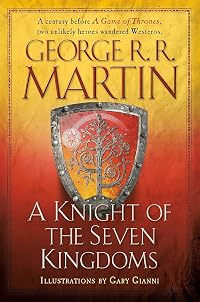
A Knight of the Seven Kingdoms
by George R. R. Martin
A Song of Ice and Fire (Prequel Novels — Prequel 2)
On This Page
Description
Taking place nearly a century before the events of A Game of Thrones, A Knight of the Seven Kingdoms compiles the first three official prequel novellas to George R.R. Martin's ongoing masterwork, A Song of Ice and Fire. These adventures recount an age when the Targaryen line still holds the Iron Throne, and the memory of the last dragon has not yet passed from living consciousness. Before Tyrion Lannister and Podrick Payne, there was Dunk and Egg. A young, naïve but ultimately courageous show more hedge knight, Ser Duncan the Tall towers above his rivals -- in stature if not experience. Tagging along is his diminutive squire, a boy called Egg -- whose true name is hidden from all he and Dunk encounter. Though more improbable heroes may not be found in all of Westeros, great destinies lay ahead for these two ... as do powerful foes, royal intrigue, and outrageous exploits. show lessTags
Recommendations


Member Recommendations

Member Reviews
It's going to be a little while yet before the next ASOIAF book, and longer still before I even consider rereading the series (only after A Song Of Spring is clutched in my cold deathless hands, at the earliest) but I do like to revisit Westeros with Martin's wonderful muscular storytelling and living, breathing worldbuilding, so finally here's the three extant Dink and Egg stories to sate the appetite. Dunk the Lunk, or Duncan the tall, is a hedge knight, lowest of the low, but with high ideals and muscles to spare. On his way to a tourney where he hopes to win some manner of renown and maybe a bit of gold, he finds himself dogged by a young boy who offers to squire for him. Paying forward the favour his old master did for him, Dunk show more takes him on, and as the tourney unfolds and the royalty of Westeros buzz about, falls afoul of a foul prince.
The first story is a rousing and exciting tale of heroism, honour, glory, and knightly chivalry, albeit with a trademark Martin sting in the tale. The other two stories feature further adventures either in service to a minor lord who becomes ensnared in a poisonous squabble over water, or attending a wedding tournament and stumbling into a deadly plot. Dunk and Egg are a fantastic pair, and their journeys are wonderful and also short and they each have a definite conclusion, so even though Martin promises more, they are satisfying in and of themselves. So hurry up and finish ASOIAF, Mr Martin, ser. I want more Dunk and Egg. show less
The first story is a rousing and exciting tale of heroism, honour, glory, and knightly chivalry, albeit with a trademark Martin sting in the tale. The other two stories feature further adventures either in service to a minor lord who becomes ensnared in a poisonous squabble over water, or attending a wedding tournament and stumbling into a deadly plot. Dunk and Egg are a fantastic pair, and their journeys are wonderful and also short and they each have a definite conclusion, so even though Martin promises more, they are satisfying in and of themselves. So hurry up and finish ASOIAF, Mr Martin, ser. I want more Dunk and Egg. show less
The hedge knight, the bald prince, and the oath that mattered.
A century before the red comet painted the sky two wanderers walked the muddy roads of Westeros. One was seven feet of calloused muscle and self-doubt, carrying a shield he had no right to bear. The other was nine years old, bald as an egg, and hiding a crown under a leather cap. They had no army, no gold, no castle. Just each other, a dubious horse, and a stubborn belief that a hedge knight's oath still meant something.
I first discovered this collection during university holidays, when the weight of epic fantasy felt exhausting. I was burned out on wars and prophecies and ten-page battle descriptions. Someone handed me A Knight of the Seven Kingdoms and said, "It's short. show more Just try it." I stayed up until dawn. Then I read it again.
What it is:
Three novellas gathered into one volume: The Hedge Knight (1998), The Sworn Sword (2003), and The Mystery Knight (2010). They follow Ser Duncan the Tall, called Dunk, a squire who buries his dying master, dons a dead man's armor, and pretends to be a knight he has no right to be. His only companion is a sharp-eyed boy named Egg, who turns out to be a Targaryen prince hiding from his own family. Together, they stumble through tournaments, rebellions, droughts, and conspiracies, solving problems not with cunning or violence, but with a giant's fists and a child's terrifying honesty.
The first story takes them to Ashford Meadow, where Dunk enters a jousting tournament and promptly punches a Targaryen prince in the face. The second finds them caught between two feuding lords over a dried-up stream. The third plunges them into a secret rebellion brewing in the shadows. Each is a standalone adventure, but together they form something rarer: a portrait of friendship forged in mud and blood and shared poverty.
Why it works (and why it surprised me):
1. The tone is Martin without the despair. The main series presents honor as a fatal disease. Ned Stark is honorable; Ned Stark dies. Here, Martin allows himself something he never permits in A Song of Ice and Fire: a hero who is decent, and whose decency actually works. Dunk wins not because he is the best swordsman; he is not. He wins because he keeps his word, defends the helpless, and refuses to bow to cruelty. It is not a happy world. People die. Good knights lose. But the story does not punish you for hoping.
2. Dunk is the anti-hero of his own body. He is monstrously tall, nearly seven feet but he is not graceful. He is not clever. He is not even certain of his own knighthood, because he suspects Ser Arlan never actually knighted him. His internal voice is a chronicle of doubt: "You're not a knight. You're just a tall boy with a dead man's horse." Watching him bluff, stumble, and somehow still win is deeply satisfying. He earns nothing easily. But he earns everything.
3. Egg is everything Joffrey was not. A Targaryen prince who shaves his head to hide his silver hair, Egg is the voice of honesty in a world of lies. He scolds Dunk for mumbling, corrects his grammar, and reminds him that knights are supposed to protect the innocent. When a foolish lord mocks the poor, Egg responds with a fury that reveals the dragon hiding in the boy. Their friendship is the backbone of the collection. You watch a giant and a child learn to trust each other, and by the third story, you would follow them anywhere.
4. The world feels smaller, and that is a gift. No White Walkers. No dragons (yet). No continent-spanning wars. Just a hedge knight looking for work, a boy needing a bath, and a series of local lords who are petty, cruel, or just tired. Martin shows you the peasant's view of Westeros – the mud, the hunger, the casual violence of nobles who see smallfolk as tools. But he also shows you mercy: a lord who pays his debts, a septon who shelters the lost, a tournament crowd that cheers for the underdog.
5. The prose is Martin at his most economical. These were written as novellas for anthologies, so there is no room for feast descriptions that run ten pages or genealogies that blur into noise. The language is leaner, the pacing faster. And yet, the famous "Sanderlanche" style still arrives; the final trial by combat in The Hedge Knight is as gripping as anything in the main series. You will not skip chapters. You will not skim.
Where it might leave you wanting (honest, but affectionate):
1. It is unfinished. Martin has promised more Dunk and Egg stories – "The She-Wolves of Winterfell," "The Village Hero," others. They have not appeared. The collection ends on a note of cautious hope, not resolution. If you are the kind of reader who needs a complete saga, this will frustrate you. But the three existing novellas work as a trilogy. They have arcs. They satisfy.
2. The plots are simple. A tournament. A drought. A conspiracy. These are not the tangled webs of A Storm of Swords. You will solve the mystery in The Mystery Knight before Dunk does. That is not a flaw. It is a feature. The joy is watching Dunk figure it out: slowly, clumsily, but inevitably.
3. The illustrations by Gary Gianni are gorgeous. This is not a complaint. It is a warning. You will spend more time staring at the ink drawings than you expect. They capture the shambling grace of Dunk and the quiet intensity of Egg. If you buy the physical edition, clear an evening just for the art.
Who should read this:
Anyone who loved A Song of Ice and Fire but needs a break from its cruelty.
Readers who think Martin can only write grimdark and betrayal (he can also write tenderness).
Fans of classic adventure duos: Don Quixote and Sancho, Holmes and Watson, Sam and Frodo.
Those who want to understand why the Targaryens were not all mad – some were just bald and stubborn.
Who might skip it:
If you require sprawling epics with dozens of POVs.
If you dislike "small" stories without world-altering stakes.
If unfinished series cause you genuine distress.
Final verdict:
A Knight of the Seven Kingdoms is the book I press into the hands of friends who gave up on Martin after the Red Wedding. It says: Look. He can write hope. He can write friendship. He can write a hero who is not doomed by his own honor. Dunk is not clever. He is not skilled. He is not even certain he is a real knight. But he keeps his oath. He defends a puppeteer from a prince's cruelty. He stands in the mud when he could walk away. And the world, for once, does not punish him for it.
Five stars. For the oath. For the boy with the shaved head. For the giant who learned that a hedge knight's word is the only armor that does not rust. show less
A century before the red comet painted the sky two wanderers walked the muddy roads of Westeros. One was seven feet of calloused muscle and self-doubt, carrying a shield he had no right to bear. The other was nine years old, bald as an egg, and hiding a crown under a leather cap. They had no army, no gold, no castle. Just each other, a dubious horse, and a stubborn belief that a hedge knight's oath still meant something.
I first discovered this collection during university holidays, when the weight of epic fantasy felt exhausting. I was burned out on wars and prophecies and ten-page battle descriptions. Someone handed me A Knight of the Seven Kingdoms and said, "It's short. show more Just try it." I stayed up until dawn. Then I read it again.
What it is:
Three novellas gathered into one volume: The Hedge Knight (1998), The Sworn Sword (2003), and The Mystery Knight (2010). They follow Ser Duncan the Tall, called Dunk, a squire who buries his dying master, dons a dead man's armor, and pretends to be a knight he has no right to be. His only companion is a sharp-eyed boy named Egg, who turns out to be a Targaryen prince hiding from his own family. Together, they stumble through tournaments, rebellions, droughts, and conspiracies, solving problems not with cunning or violence, but with a giant's fists and a child's terrifying honesty.
The first story takes them to Ashford Meadow, where Dunk enters a jousting tournament and promptly punches a Targaryen prince in the face. The second finds them caught between two feuding lords over a dried-up stream. The third plunges them into a secret rebellion brewing in the shadows. Each is a standalone adventure, but together they form something rarer: a portrait of friendship forged in mud and blood and shared poverty.
Why it works (and why it surprised me):
1. The tone is Martin without the despair. The main series presents honor as a fatal disease. Ned Stark is honorable; Ned Stark dies. Here, Martin allows himself something he never permits in A Song of Ice and Fire: a hero who is decent, and whose decency actually works. Dunk wins not because he is the best swordsman; he is not. He wins because he keeps his word, defends the helpless, and refuses to bow to cruelty. It is not a happy world. People die. Good knights lose. But the story does not punish you for hoping.
2. Dunk is the anti-hero of his own body. He is monstrously tall, nearly seven feet but he is not graceful. He is not clever. He is not even certain of his own knighthood, because he suspects Ser Arlan never actually knighted him. His internal voice is a chronicle of doubt: "You're not a knight. You're just a tall boy with a dead man's horse." Watching him bluff, stumble, and somehow still win is deeply satisfying. He earns nothing easily. But he earns everything.
3. Egg is everything Joffrey was not. A Targaryen prince who shaves his head to hide his silver hair, Egg is the voice of honesty in a world of lies. He scolds Dunk for mumbling, corrects his grammar, and reminds him that knights are supposed to protect the innocent. When a foolish lord mocks the poor, Egg responds with a fury that reveals the dragon hiding in the boy. Their friendship is the backbone of the collection. You watch a giant and a child learn to trust each other, and by the third story, you would follow them anywhere.
4. The world feels smaller, and that is a gift. No White Walkers. No dragons (yet). No continent-spanning wars. Just a hedge knight looking for work, a boy needing a bath, and a series of local lords who are petty, cruel, or just tired. Martin shows you the peasant's view of Westeros – the mud, the hunger, the casual violence of nobles who see smallfolk as tools. But he also shows you mercy: a lord who pays his debts, a septon who shelters the lost, a tournament crowd that cheers for the underdog.
5. The prose is Martin at his most economical. These were written as novellas for anthologies, so there is no room for feast descriptions that run ten pages or genealogies that blur into noise. The language is leaner, the pacing faster. And yet, the famous "Sanderlanche" style still arrives; the final trial by combat in The Hedge Knight is as gripping as anything in the main series. You will not skip chapters. You will not skim.
Where it might leave you wanting (honest, but affectionate):
1. It is unfinished. Martin has promised more Dunk and Egg stories – "The She-Wolves of Winterfell," "The Village Hero," others. They have not appeared. The collection ends on a note of cautious hope, not resolution. If you are the kind of reader who needs a complete saga, this will frustrate you. But the three existing novellas work as a trilogy. They have arcs. They satisfy.
2. The plots are simple. A tournament. A drought. A conspiracy. These are not the tangled webs of A Storm of Swords. You will solve the mystery in The Mystery Knight before Dunk does. That is not a flaw. It is a feature. The joy is watching Dunk figure it out: slowly, clumsily, but inevitably.
3. The illustrations by Gary Gianni are gorgeous. This is not a complaint. It is a warning. You will spend more time staring at the ink drawings than you expect. They capture the shambling grace of Dunk and the quiet intensity of Egg. If you buy the physical edition, clear an evening just for the art.
Who should read this:
Anyone who loved A Song of Ice and Fire but needs a break from its cruelty.
Readers who think Martin can only write grimdark and betrayal (he can also write tenderness).
Fans of classic adventure duos: Don Quixote and Sancho, Holmes and Watson, Sam and Frodo.
Those who want to understand why the Targaryens were not all mad – some were just bald and stubborn.
Who might skip it:
If you require sprawling epics with dozens of POVs.
If you dislike "small" stories without world-altering stakes.
If unfinished series cause you genuine distress.
Final verdict:
A Knight of the Seven Kingdoms is the book I press into the hands of friends who gave up on Martin after the Red Wedding. It says: Look. He can write hope. He can write friendship. He can write a hero who is not doomed by his own honor. Dunk is not clever. He is not skilled. He is not even certain he is a real knight. But he keeps his oath. He defends a puppeteer from a prince's cruelty. He stands in the mud when he could walk away. And the world, for once, does not punish him for it.
Five stars. For the oath. For the boy with the shaved head. For the giant who learned that a hedge knight's word is the only armor that does not rust. show less
This is collection of three novellas set in the Westeros universe 100 years before the Fire and Ice series. They contain all the hallmarks of Martin's writing: interesting complicated characters, a myriad of supporting characters with complicated heraldry (where my eyes glaze over), twisty politics, dragons (both metaphorical and literal), and battles. I loved the featured hedge knight, Sir Duncan the Tall (one inch short of seven feet) the sweet giant who is a true knight compared to many of the more noble born knights he meets in his travels. Known at "Dunk the lunk, thick as a castle wall," he has more smarts than his mild manner indicates. He's squired by a bald boy known as Egg with a mysterious past and an encyclopedic knowledge show more of the knights that Dunk meets in his various and disastrous tourney efforts.
This was a satisfying read on its own and whet my appetite for the next in the Ice and Fire series. show less
This was a satisfying read on its own and whet my appetite for the next in the Ice and Fire series. show less
Las tres historias recopiladas en ‘El caballero de los Siete Reinos’, de George R.R. Martin, transcurren unos noventa años antes de los hechos que se nos cuentan en Canción de Hielo y Fuego. Los protagonistas son ser Duncan el Alto, o Dunk el Tocho, un joven caballero errante, noble y valiente, y el pequeño Egg, su escudero, tras el que se esconde un gran secreto. Los relatos tienen mucho de medieval, con torneos, justas y banquetes, y todo lo que les rodea, caballos, armaduras, etc., así como nobles, blasones y nombres varios, magníficamente descrito por Martin. Estamos ante unas aventuras con tintes heroicos, que si bien pueden leerse de manera independiente, y mucho mejor leerlas en el orden que vienen en el libro.
Estos son show more los tres relatos largos incluidos en ‘El caballero de los Siete Reinos’, con una presentación de Corominas, el ilustrador de la portada, en plan entrevista satírica, la mar de jugosa:
El caballero errante. Donde Dunk y Egg se conocen. Dunk el joven escudero del recientemente fallecido Ser Arlan, pasa a convertirse en caballero, y decide participar en el torneo de Vado Ceniza. Magnífico relato largo, o novela corta, narrado con gran dinamismo, y cargado de emoción y aventura. Mi favorito de la antología.
La espada leal. Dunk y Egg pasan a servir al anciano ser Eustace Osgrey, sin saber que al poco se verá envuelto en una disputa por el agua La Viuda Roja, Señora de Fosofrío. Muy buena historia.
El caballero misterioso. Dunk y Egg, mientras viajan hacia El Muro, deciden acudir a Murosblancos, donde con motivo de una boda, se va a celebrar también un torneo. Estupendo relato, plagado de intrigas palaciegas, política y traición. show less
Estos son show more los tres relatos largos incluidos en ‘El caballero de los Siete Reinos’, con una presentación de Corominas, el ilustrador de la portada, en plan entrevista satírica, la mar de jugosa:
El caballero errante. Donde Dunk y Egg se conocen. Dunk el joven escudero del recientemente fallecido Ser Arlan, pasa a convertirse en caballero, y decide participar en el torneo de Vado Ceniza. Magnífico relato largo, o novela corta, narrado con gran dinamismo, y cargado de emoción y aventura. Mi favorito de la antología.
La espada leal. Dunk y Egg pasan a servir al anciano ser Eustace Osgrey, sin saber que al poco se verá envuelto en una disputa por el agua La Viuda Roja, Señora de Fosofrío. Muy buena historia.
El caballero misterioso. Dunk y Egg, mientras viajan hacia El Muro, deciden acudir a Murosblancos, donde con motivo de una boda, se va a celebrar también un torneo. Estupendo relato, plagado de intrigas palaciegas, política y traición. show less
A surprisingly excellent collection of three novellas by George R. R. Martin, set in the same fantasy world of Westeros as his A Song of Ice and Fire series (but about 100 years earlier). All three have previously been published in various collections ('The Hedge Knight' in 1998, 'The Sworn Sword' in 2003 and 'The Mystery Knight' in 2010) but never before in a single edition. A Knight in the Seven Kingdoms is that edition, with extensive new illustrations by Gary Gianni.
At first I was sceptical about the merits of an illustrated edition, which so often translates as 'cash grab' (particularly given the success of Game of Thrones), but Gianni's work was excellent. His pieces really add to the mood of the stories, and reminded me of the show more sort of wholesome fantasy stories I read as a kid (without bringing Martin's stories down to that simplistic level). The stories themselves – the 'Tales of Dunk and Egg' – tell us of the scrappy and yet noble adventures of a young hedge knight called Sir Duncan the Tall and his squire, Egg, who unbeknownst to those who cross their path is actually Aegon of the ruling House Targaryen.
The double-act works (more in a father-son way than a bromance – Egg is only about ten years old) and the stories themselves are more light-hearted and heart-warming than I would have expected from any story set in Westeros. Whilst perhaps only the first story, 'The Hedge Knight', would be suitable for younger readers, on the whole the tales don't have the bleakness or cynicism of the main Song of Ice and Fire storyline. In these novellas, Dunk is a genuinely noble knight, but unlike the noble characters in Game of Thrones he actually wins through. The good guys win here, though not always cleanly or comprehensively, and the stories are closer to classic lords-and-knights-and-castles fantasy than Martin's more famous series.
This is fine, even for those who are looking for a Game of Thrones-style fix. Martin's writing will be familiar to those who have read any of A Song of Ice and Fire, and in true GRRM fashion you'll inevitably lose track of all the noblemen's names and lineages and sigils (two of the novellas take place during jousting tournaments). The tales themselves are reminiscent of the Brienne/Podrick plotlines from the main books. It's retro; just good old fantasy well-told. It also makes you realise that the Westeros we know from the War of the Five Kings wasn't always that messed up; once upon a time (100 years earlier, in fact) there were some knights who did not forget their vows and the realm was largely stable with a sane Targaryen on the Iron Throne. It wasn't a Garden of Eden, and the Tales of Dunk and Egg show some of this darker side, but it was much more pleasant than what the current rulers have concocted.
A Knight of the Seven Kingdoms not only does readers a convenience in bringing these stories together for the first time, but also does us a service by doing it so well (with the illustrations and all). It's great retro fantasy with just enough of the characteristic GRRM cynicism, another great outing to Westeros with more humour and a sense of snugness than you'd ever get in A Song of Ice and Fire. Whilst I'd suggest only 'The Hedge Knight' is absolutely essential reading, all three stories are excellent and will soothe fans jonesing for their next Westeros fix. As Egg himself might have said, Get it, get it, it's right there! show less
At first I was sceptical about the merits of an illustrated edition, which so often translates as 'cash grab' (particularly given the success of Game of Thrones), but Gianni's work was excellent. His pieces really add to the mood of the stories, and reminded me of the show more sort of wholesome fantasy stories I read as a kid (without bringing Martin's stories down to that simplistic level). The stories themselves – the 'Tales of Dunk and Egg' – tell us of the scrappy and yet noble adventures of a young hedge knight called Sir Duncan the Tall and his squire, Egg, who unbeknownst to those who cross their path is actually Aegon of the ruling House Targaryen.
The double-act works (more in a father-son way than a bromance – Egg is only about ten years old) and the stories themselves are more light-hearted and heart-warming than I would have expected from any story set in Westeros. Whilst perhaps only the first story, 'The Hedge Knight', would be suitable for younger readers, on the whole the tales don't have the bleakness or cynicism of the main Song of Ice and Fire storyline. In these novellas, Dunk is a genuinely noble knight, but unlike the noble characters in Game of Thrones he actually wins through. The good guys win here, though not always cleanly or comprehensively, and the stories are closer to classic lords-and-knights-and-castles fantasy than Martin's more famous series.
This is fine, even for those who are looking for a Game of Thrones-style fix. Martin's writing will be familiar to those who have read any of A Song of Ice and Fire, and in true GRRM fashion you'll inevitably lose track of all the noblemen's names and lineages and sigils (two of the novellas take place during jousting tournaments). The tales themselves are reminiscent of the Brienne/Podrick plotlines from the main books. It's retro; just good old fantasy well-told. It also makes you realise that the Westeros we know from the War of the Five Kings wasn't always that messed up; once upon a time (100 years earlier, in fact) there were some knights who did not forget their vows and the realm was largely stable with a sane Targaryen on the Iron Throne. It wasn't a Garden of Eden, and the Tales of Dunk and Egg show some of this darker side, but it was much more pleasant than what the current rulers have concocted.
A Knight of the Seven Kingdoms not only does readers a convenience in bringing these stories together for the first time, but also does us a service by doing it so well (with the illustrations and all). It's great retro fantasy with just enough of the characteristic GRRM cynicism, another great outing to Westeros with more humour and a sense of snugness than you'd ever get in A Song of Ice and Fire. Whilst I'd suggest only 'The Hedge Knight' is absolutely essential reading, all three stories are excellent and will soothe fans jonesing for their next Westeros fix. As Egg himself might have said, Get it, get it, it's right there! show less
2025 reread for obvious reasons. Dunk & Egg is such a simple story compared to ASOIAF, using a classic mismatched pairing (the Lone Wolf and Cub style older man and ward, or the dumb one/smart one, or the simple/aristocratic, all rolled into one) to tell adventure stories. At the same time GURM lets the bumbling doofus adventures intersect his serious world so that we both get an outsider perspective and insider perspective. It's a fine line to ride to not devolve into an outright comedic Forrest Gump style narrative of an idiot finding himself the center of history. While it is more comedic than ASOIAF, Dunk suffers enough slings and arrows (and violent enough) to not quite end up there.
The end notes about the "further adventures" to show more come seem less and less likely however. show less
The end notes about the "further adventures" to show more come seem less and less likely however. show less
I started reading this collection of three Dunk & Egg novellas to coincide with the screening of A Knight of the Seven Kingdoms, after my son said I would get on better with these stories than A Song of Ice and Fire. In short, I loved the first one and liked the third, but the second one really dragged and I almost gave up a couple of times.
The first novella, 'The Hedge Knight', does a wonderful job of establishing the world of Westeros and the characters of Dunk and Egg, as well as their close and often touching relationship.
The second story, 'The Sword Sword', has a very long build-up for little reward. The only thing worth mentioning is the inclusion of a recap of the Blackfyre Rebellion, which marks a decisive (and divisive) point show more in Westerosi history.
And the third novella, 'The Mystery Knight', despite another long build-up, is worth sticking with because of theconspiracy by the majority of the wedding guests that leads to the failed Second Blackfyre Rebellion. Egg is unmasked and at the end appears as a prince of the realm and nephew of the king, with the Targaryen ring no longer in his boot but proudly displayed on his finger . What consequences will this have for any future Dunk & Egg stories, if any are forthcoming? show less
The first novella, 'The Hedge Knight', does a wonderful job of establishing the world of Westeros and the characters of Dunk and Egg, as well as their close and often touching relationship.
The second story, 'The Sword Sword', has a very long build-up for little reward. The only thing worth mentioning is the inclusion of a recap of the Blackfyre Rebellion, which marks a decisive (and divisive) point show more in Westerosi history.
And the third novella, 'The Mystery Knight', despite another long build-up, is worth sticking with because of the
Members
- Recently Added By
Lists

LGBTQ+ Speculative Fiction
821 works; 51 members

Books Read in 2015
3,299 works; 129 members
Books Read in 2016
4,666 works; 199 members

Books Read in 2026
1,936 works; 66 members
Author Information

721+ Works 243,825 Members
George R. R. Martin was born on September 20, 1948 in Bayonne, New Jersey. He began writing at an early age, selling monster stories for pennies to neighborhood children. He received B.S. and M.S. degrees in Journalism from Northwestern University. In 1986, he worked as a story editor for the CBS series The Twilight Zone. He was also an executive show more story consultant, producer and co-supervising producer for CBS's Beauty and the Beast. In 1970, he sold the story The Hero to Galaxy magazine. Since becoming a full-time writer in 1979, he has written many novels, stories, and series including A Song for Lya, Portraits of His Children, The Pear-Shaped Man, and the Song of Ice and Fire series. He has won numerous awards including five Locus Awards, three Hugo Awards and two Nebula awards. In 2013 he made The New York Times Best Seller List with his titles A Dance with Dragons and A Game of Thrones: a Clash of Kings, a Storm of Swords, a Feast for Crows. His title's Rogues and The Ice Dragon made the New York Times List in 2014. Martin's title, A Knight of Seven Kingdoms, A Song of Fire and Ice novel, made the New York Times bestseller list in 2015. He is number 4 on the Hollywood Reporter's '25 Most Powerful Authors' 2016 list. (Bowker Author Biography) show less
Some Editions
Awards and Honors
Distinctions
Notable Lists
Series

Work Relationships
Common Knowledge
- Canonical title
- A Knight of the Seven Kingdoms
- Original title
- The Tales of Dunk and Egg
- Original publication date
- 2013
- People/Characters
- Dunk; Egg
- Important places
- Westeros
- Related movies
- A Knight of the Seven Kingdoms (2026 | IMDb)
- Dedication
- To Rayna Golden,
for the cheerful smiles and pretty pictures
-GRRM
For the noble cause and the Ser Dunk in all of us
- GG - First words
- The spring rains had softened the ground, so Dunk had no trouble digging the grave.
- Publisher's editor
- Groell, Anne Lesley; Johnson, Jane
- Original language
- English
- Disambiguation notice
- Important notice: ISBN-10 8580449731 / ISBN-13 9788580449730 is a compilation of the three tales of Dunk & Egg, published by Leya in February 2014 (see http://geral.leya.com.br/pt/literatura-fantastica/o-ca... (show all)valeiro-dos-sete-reinos/ )
It seems that a similar title has been used for a Portuguese edition of GRRM's RRetrospective, which is a completely different book even if both happen to include "The Hedge Knight".
ISBN 9896374163 is a completely different book by Saída de Emergência, with ten tales in all, most of them from Dreamsongs I / RRetrospective
Classifications
Statistics
- Members
- 4,093
- Popularity
- 3,783
- Reviews
- 87
- Rating
- (4.08)
- Languages
- 18 — Chinese, Czech, Danish, Dutch, English, Estonian, Finnish, French, German, Hungarian, Italian, Korean, Norwegian (Bokmål), Polish, Romanian, Spanish, Swedish, Portuguese (Portugal)
- Media
- Paper, Audiobook, Ebook
- ISBNs
- 87
- ASINs
- 22