
On This Page
Description
A miner on the planet Zarathustra crosses paths with an adorable fuzzy creature -- and soon realizes that the little guy may possess human-like intelligence. This realization may throw the social and political balance of the planet into question, and several different groups are soon engaged in a heated race to gauge the smarts of the small fuzzy fellows..
Tags
Recommendations

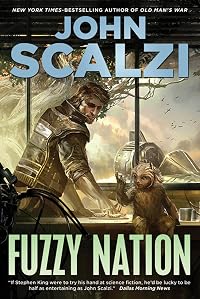





















Member Recommendations

Member Reviews
Another allegedly classic sf novel, which was nominated for the Hugo in 1963. Dick’s The Man in the High Castle won that year, and was easily the best of the shortlisted novels. Little Fuzzy, on the other hand, is slight, not in the least bit plausible, and opens from a position of such comprehensive US hegemony its story is pretty much unrecoverable.
The title refers to the indigenous race on Zarathustra, waist-high cute-looking furry creatures with an average intelligence comparable to that of small children. Humans have been on the world for several decades before the first “Fuzzy” appears, and the corporation which owns the planet quickly realises that a native race invalidates their ownership of the world and all its show more resources. So they play dirty in an effort to prove the Fuzzies either non-existent or not intelligent. A situation which comes to a head when a company bigwig stamps on a Fuzzy, killing it, and a company bodyguard is shot and killed in self-defence.
Like a lot of American sf of the period, this is resolved by people coming together, some homespun legal wizardry, a general distrust of the government (and governing corporation), and a handful of native backwoods cunning from several of the cast. While the local governor is corrupt, the local Navy base is packed to the gills with upright honest officers and personnel. The corrupt mayor is a cliché, but so too is the valorisation of military probity - at least in 1962, before the Vietnam War. There are entire Hollywood movies from the 1930s through to the 1950s which use any one of those tropes on which to hang a plot. And each one is as hokey as the next.
If anything, Little Fuzzy multiplies the hokiness. It’s a novel with far more mouthpiece characters than it needs or the reader deserves. The Fuzzies may be intelligent enough to determine their own destiny, but the humans on their side seem to treat them chiefly as precocious pets. There are many arguments to be made about the European invasion of continental North America, but this novel doesn’t even come within spitting distance of them. It’s the colonisers defending the colonised against the colonisers’ own kind, for reasons that are best not examined too deeply. show less
The title refers to the indigenous race on Zarathustra, waist-high cute-looking furry creatures with an average intelligence comparable to that of small children. Humans have been on the world for several decades before the first “Fuzzy” appears, and the corporation which owns the planet quickly realises that a native race invalidates their ownership of the world and all its show more resources. So they play dirty in an effort to prove the Fuzzies either non-existent or not intelligent. A situation which comes to a head when a company bigwig stamps on a Fuzzy, killing it, and a company bodyguard is shot and killed in self-defence.
Like a lot of American sf of the period, this is resolved by people coming together, some homespun legal wizardry, a general distrust of the government (and governing corporation), and a handful of native backwoods cunning from several of the cast. While the local governor is corrupt, the local Navy base is packed to the gills with upright honest officers and personnel. The corrupt mayor is a cliché, but so too is the valorisation of military probity - at least in 1962, before the Vietnam War. There are entire Hollywood movies from the 1930s through to the 1950s which use any one of those tropes on which to hang a plot. And each one is as hokey as the next.
If anything, Little Fuzzy multiplies the hokiness. It’s a novel with far more mouthpiece characters than it needs or the reader deserves. The Fuzzies may be intelligent enough to determine their own destiny, but the humans on their side seem to treat them chiefly as precocious pets. There are many arguments to be made about the European invasion of continental North America, but this novel doesn’t even come within spitting distance of them. It’s the colonisers defending the colonised against the colonisers’ own kind, for reasons that are best not examined too deeply. show less
Re-read in order to compare with Scalzi's [b:Fuzzy Nation|9647532|Fuzzy Nation|John Scalzi|http://d.gr-assets.com/books/1316132345s/9647532.jpg|18280046]. I read Little Fuzzy sometime in my adolescence, and it's funny to see my highlighted paragraphs (all of which concern language as evidence for sapience). I enjoyed re-reading it, though as an adult reader I am somewhat chilled by the happy colonialism of the ending, which is presented uncritically as a good thing and not presented ironically or as a cautionary parallel to slavery or colonial practices. Though the Fuzzies are declared to be sapient, the protagonist and others are "adopting" Fuzzies "of their own," moving them out of the forest and into their houses, and generally show more improving them (in the colonial sense). The Fuzzies are described as cognitively similar to a preadolescent, and as indigenous in the positive-sounding language often used in racist and colonial descriptions of primitive (sic) races (sic). And they're so happy! (Gosh, I've learned a lot from the noble savage!) For their part, the Fuzzies are glad to move into the wonderful big house and become domesticated, so that's okay, right? The flavor of the text hovers between Fuzzy-as-pet and Fuzzy-as-indigene who requires benevolent protection from the civilized overlords. Protected from what, since until the book's action they were a successful sapient, language-using, tool-creating species? Why, protected from the bad colonizers, as opposed to "Pappy Jack" and the good colonizers.
4.5 / 5.0
So at least some of the high rating is due to low expectations. I mean, c'mon, the title is 'Little Fuzzy'. I was expecting something like teletubbies in space, or some such nonsense. But, thankfully, I decided to look past the title and check it out.
Wow! It's really, really good. Awesome actually.
And it incorporates tragedy and humor and drama and a fair amount of philosophy on sentience and what it means to be a self aware being. And, yes, it's got an awful lot of cute going on as well.
Sidenote. If you're into audiobooks, this book is in the pubic domain and I quite enjoyed the free reading over at Librivox: https://librivox.org/little-fuzzy-by-h-beam-piper/
So at least some of the high rating is due to low expectations. I mean, c'mon, the title is 'Little Fuzzy'. I was expecting something like teletubbies in space, or some such nonsense. But, thankfully, I decided to look past the title and check it out.
Wow! It's really, really good. Awesome actually.
And it incorporates tragedy and humor and drama and a fair amount of philosophy on sentience and what it means to be a self aware being. And, yes, it's got an awful lot of cute going on as well.
Sidenote. If you're into audiobooks, this book is in the pubic domain and I quite enjoyed the free reading over at Librivox: https://librivox.org/little-fuzzy-by-h-beam-piper/
When John Scalzi mentioned this book on his blog, I knew it would be classic and quaint. But I expected it to be a little more timeless. I look forward to seeing what Mr. Scalzi does to update it.
In the meantime, I listened to the audiobook to see what the hubbub was about. Wow. Piper wrote a future that is just like our present, except we have travel to other worlds, contra-gravity, and verdicators (advanced lie detectors). I think I would like to have air cars, but only in rural settings like those in which the initial chapters of the book take place. Anything more urban and you just multiply the current traffic problems by a third dimension.
I would also not like to live in a world where every witness was subjected to verdicators. I show more don't think that any society would long endure that sort of mental fascism.
Overall, the story was interesting enough and pleasant enough. However, I found the writing fairly clunky, based on the examples above, plus space commodore, atomic age, constant discussion of sapience and mentation, and sun stones. I suppose they fit the view of the future seen from the early 1960s. But as I previously noted, they are pretty dated. I also disliked some stereotypical characters and a bit of deus ex machina at the end. Nevertheless it was enjoyable. Let's see what Scalzi has done with it. show less
In the meantime, I listened to the audiobook to see what the hubbub was about. Wow. Piper wrote a future that is just like our present, except we have travel to other worlds, contra-gravity, and verdicators (advanced lie detectors). I think I would like to have air cars, but only in rural settings like those in which the initial chapters of the book take place. Anything more urban and you just multiply the current traffic problems by a third dimension.
I would also not like to live in a world where every witness was subjected to verdicators. I show more don't think that any society would long endure that sort of mental fascism.
Overall, the story was interesting enough and pleasant enough. However, I found the writing fairly clunky, based on the examples above, plus space commodore, atomic age, constant discussion of sapience and mentation, and sun stones. I suppose they fit the view of the future seen from the early 1960s. But as I previously noted, they are pretty dated. I also disliked some stereotypical characters and a bit of deus ex machina at the end. Nevertheless it was enjoyable. Let's see what Scalzi has done with it. show less
review of
H. Beam Piper's Little Fuzzy
by tENTATIVELY, a cONVENIENCE - November 1, 2020
This was great, something that wd appeal to 'animal rights' folks, wch is more or less what I am even though I eat meat. It's from 1962 so it even predates John Brunner's (admittedly greater) ecological novel The Sheep Look Up (1972) (see my review here: https://www.goodreads.com/story/show/344636-a-review-of-john-brunner-s-ecologica... ) wch means it deserves a special place in my small pantheon of environmentally sensitive SF.
In this day & age of the PANDEMIC PANIC so much of what I read speaks to me about the extraordinary delusions I feel increasingly suffocated by. To me, the following describes a typical QUARANTINIAC.
""If you don't like the show more facts, you ignore them, and if you need facts, dream up some you do like," she said. "That's typical rejection of reality. Not psychotic, not even psychoneurotic. But certainly not sane."" - p 15
Of course, BELIEVERS, might find that descriptive of me instead of of themselves.
On a planet that's being exploited by big business unfettered by any concern for life there because there supposedly is no intelligent life there a prospector discovers a little creature that he calls a "fuzzy" & the more he's around sd creature the more he realizes that it's very intelligent indeed.
"Then holding it where Little Fuzzy could watch, he uncrewed the cap and then screwed it on again.
""There, now. You try it."
"Little Fuzzy looked up inquiringly, then took the bottle, sitting down and holding it between his knees. Unfortunately, he tried twisting it the wrong way and only screwed the cap on tighter. He yeeked plaintively.
""No, go ahead. You can do it."
"Little Fuzzy look[ed] at the bottle again. Then he tried twisting the cap the other way, and it loosened. He gave a yeek that couldn't possibly be anything but "Eureka!" and promptly took it off, holding it up. After being commended, he examined both the bottle and the cap, feeling the threads, and then screwed the cap back on again.
""You know, you're a smart Little Fuzzy."" - p 20
I wonder if that wd work w/ a raccoon.
As Little Fuzzy becomes more accustomed to Papa Jack's good intentions his family moves in w/ them, including a baby.
"Baby Fuzzy was clinging to her fur with one hand and holding a slice of pool-ball fruit, on which he was munching, with the other. He crammed what was left of the fruit into his mouth, climbed up on Jack and sat down on his head again. Have to do something to break him of that. One of these days, he'd be getting too big for it." - p 30
A gesture takes place across screens that wd be right at home in today's socially distanced world.
"They shook their own hands at one another in the ancient Terran-Chinese gesture that was used on communication screens" - p 42
The big business that's exploiting the planet will have its interests dramatically damaged if the Fuzzies turn out to be thinking beings b/c the planet will be reclassified as protected. This is the crux of the struggle.
"Leonard Kellogg looked pained. "What I was about to say, Victor, is that both Rainsford and this man Holloway seem convinced that these things they call Fuzzies aren't animals at all. They believe them to be sapient beings."
""Well, that's—" He bit them off short as the significance of what Kellogg had just said hit him. "Good God, Leonard! I beg your pardon abjectly; I don't blame you for taking it seriously. Why that would make Zarathustra a Class-IV inhabited planet."" - p 44
SO, the managers of the big business proceed to try to prevent any classification of the fuzzies as anything but animals.
""Holloway spoke, on the tape, of their soft and silky fur."
""Good. Emphasize that in your report. As soon as it's published, the Company will offer two thousand sols apiece for Fuzzy pelts. By the time Rainford's report brings anybody here from Terra, we may have them all trapped out."
"Kellogg brgan to look worried.
""But, Victor, that's genocide!"
""Nonsense! Genocide is defined as the extermination of a race of sapient beings. These are fur-bearing animals. It's up to you and Ernst Mallin to prove that."" - p 47
Hence, the race to prove or disprove sapience is on.
"Riebeck said, "If they're working together on a common project, they must be communicating somehow."
""It isn't communication, it's symbolization. You simply can't think sapiently except in verbal symbols. Try it. Not something like chnaging the spools on a recorder or field-stripping a pistol; they're just learned tricks. I mean ideas."
""How about Helen Keller?" Rainsford asked. "Mean to say she only started thinking sapiently after Anna Sulivan taught her what words were?"
""No, of course not. She thought sapiently—And she only thought in sense-imagery limited to feeling." She looked at Rainsford reproachfully; he'd knocked a breach in one of her fundamental postulates. "Of course, she had inherited the cerebroneural equipment for sapient thinking." She let that trail off, before somebody asked her how she knew the Fuzzies hadn't.
""I'll suggest, just to keep the argument going, that speech couldn't have been invented without pre-existing sapience," Jack said." - p 53
That's an interesting discussion, don't you think? I'm preoccupied w/ the idea of what I call "pre-linguistic thinking": in other words what happens in the mind before something comes out of it in language. Some might argue that until the language is formed it's not thought — but what about what's being kicked about here in relation to Helen Keller? Or in relation to a pre-lingual child? If what's going on in their mind is non-lingual & it's not thought than what is it?
""Wait a minute," Jack interrupted. "Before we go any deeper, let's agree on a definition of sapience."
"Van Riebeek laughed. "Ever try to get a definition of life from a biologist?" he asked. "Or a definition of number from a mathematician?"
""That's about it," Ruth looked at the Fuzzies, who were looking at their colored-ball construction as though wondering if they could add anything more without spoiling the design. "I'd say: a level of mentation qualitatively different from nonsapience in that it includes ability to symbolize ideas and store and transmit them, ability to generalize and ability to form abstract ideas. There; I didn't say a word about talk-and-build-a-fire, did I?"" - p 54
145 pages later someone's actually testifying on the subject in court! Whatever happened in that time?! The testimony is given into a lie detector of sorts so that any naughty business is caught right quick.
""what, in you professional opinion, is the difference between sapient and nonsapient mentation?"
""The ability ot think consciously," he stated. The globe stayed blue.
""Do you mean that nonsapient animals aren't conscious, or do you mean they don't think?"
""Well, neither. Any life form with a central nervous system has some consciousness—awareness of existence and of its surroundings. And anything having a brain thinks, to use the term at its loosest. What I meant was that only the sapient mind thinks and knows that it is thinking."
"He was perfectly safe so far. He talked about sensory stimuli and responses, and about conditioned reflexes. He went back to the first century Pre-Atomic, and Pavlov and Korzybski and Freud. The globe never flickered." - p 159
In other words, he hadn't gotten to lying about the Fuzzies yet.
Well, it doesn't turn out too good for the bad guys, a key corporate player gets sentenced to death. He beats them to the Kool-Aid.
""At twenty-two thirty, the prisoner went to bed, still wearing his shirt. He pulled the blankets up over his head. The deputy observing him thought nothing of that; many prisoners do that, on account of the light. He tossed about for a while, and then appeared to fall asleep.
""When a guard went in to rouse him this morning, the cot, under the blanket, was found saturated with blood. Kellogg had cut his throat, by sawing the zipper track of his shirt back and forth till he severed his jugular vein. He was dead."" - p 163
That resonated with me. I was put in jail once b/c I'm such an evil demon & must be put down (& also b/c a rather unscrupulous person arranged this) & I hunkered under the too-short blanket in the pretty cold cell on the concrete bed & thought about sawing my arm arteries w/ my zipper pull b/c that was the sharpest thing I had at my disposal. I'm sure the world is very thankful that I didn't b/c now my bk Unconscious Suffocation - A Personal Journey through the PANDEMIC PANIC is here to bedevil the zombies.
H Beam only made it to age 60 so there's another one I've outlived. I can see that I'm going to have to read more by him. It's the least I can do for the young feller. show less
H. Beam Piper's Little Fuzzy
by tENTATIVELY, a cONVENIENCE - November 1, 2020
This was great, something that wd appeal to 'animal rights' folks, wch is more or less what I am even though I eat meat. It's from 1962 so it even predates John Brunner's (admittedly greater) ecological novel The Sheep Look Up (1972) (see my review here: https://www.goodreads.com/story/show/344636-a-review-of-john-brunner-s-ecologica... ) wch means it deserves a special place in my small pantheon of environmentally sensitive SF.
In this day & age of the PANDEMIC PANIC so much of what I read speaks to me about the extraordinary delusions I feel increasingly suffocated by. To me, the following describes a typical QUARANTINIAC.
""If you don't like the show more facts, you ignore them, and if you need facts, dream up some you do like," she said. "That's typical rejection of reality. Not psychotic, not even psychoneurotic. But certainly not sane."" - p 15
Of course, BELIEVERS, might find that descriptive of me instead of of themselves.
On a planet that's being exploited by big business unfettered by any concern for life there because there supposedly is no intelligent life there a prospector discovers a little creature that he calls a "fuzzy" & the more he's around sd creature the more he realizes that it's very intelligent indeed.
"Then holding it where Little Fuzzy could watch, he uncrewed the cap and then screwed it on again.
""There, now. You try it."
"Little Fuzzy looked up inquiringly, then took the bottle, sitting down and holding it between his knees. Unfortunately, he tried twisting it the wrong way and only screwed the cap on tighter. He yeeked plaintively.
""No, go ahead. You can do it."
"Little Fuzzy look[ed] at the bottle again. Then he tried twisting the cap the other way, and it loosened. He gave a yeek that couldn't possibly be anything but "Eureka!" and promptly took it off, holding it up. After being commended, he examined both the bottle and the cap, feeling the threads, and then screwed the cap back on again.
""You know, you're a smart Little Fuzzy."" - p 20
I wonder if that wd work w/ a raccoon.
As Little Fuzzy becomes more accustomed to Papa Jack's good intentions his family moves in w/ them, including a baby.
"Baby Fuzzy was clinging to her fur with one hand and holding a slice of pool-ball fruit, on which he was munching, with the other. He crammed what was left of the fruit into his mouth, climbed up on Jack and sat down on his head again. Have to do something to break him of that. One of these days, he'd be getting too big for it." - p 30
A gesture takes place across screens that wd be right at home in today's socially distanced world.
"They shook their own hands at one another in the ancient Terran-Chinese gesture that was used on communication screens" - p 42
The big business that's exploiting the planet will have its interests dramatically damaged if the Fuzzies turn out to be thinking beings b/c the planet will be reclassified as protected. This is the crux of the struggle.
"Leonard Kellogg looked pained. "What I was about to say, Victor, is that both Rainsford and this man Holloway seem convinced that these things they call Fuzzies aren't animals at all. They believe them to be sapient beings."
""Well, that's—" He bit them off short as the significance of what Kellogg had just said hit him. "Good God, Leonard! I beg your pardon abjectly; I don't blame you for taking it seriously. Why that would make Zarathustra a Class-IV inhabited planet."" - p 44
SO, the managers of the big business proceed to try to prevent any classification of the fuzzies as anything but animals.
""Holloway spoke, on the tape, of their soft and silky fur."
""Good. Emphasize that in your report. As soon as it's published, the Company will offer two thousand sols apiece for Fuzzy pelts. By the time Rainford's report brings anybody here from Terra, we may have them all trapped out."
"Kellogg brgan to look worried.
""But, Victor, that's genocide!"
""Nonsense! Genocide is defined as the extermination of a race of sapient beings. These are fur-bearing animals. It's up to you and Ernst Mallin to prove that."" - p 47
Hence, the race to prove or disprove sapience is on.
"Riebeck said, "If they're working together on a common project, they must be communicating somehow."
""It isn't communication, it's symbolization. You simply can't think sapiently except in verbal symbols. Try it. Not something like chnaging the spools on a recorder or field-stripping a pistol; they're just learned tricks. I mean ideas."
""How about Helen Keller?" Rainsford asked. "Mean to say she only started thinking sapiently after Anna Sulivan taught her what words were?"
""No, of course not. She thought sapiently—And she only thought in sense-imagery limited to feeling." She looked at Rainsford reproachfully; he'd knocked a breach in one of her fundamental postulates. "Of course, she had inherited the cerebroneural equipment for sapient thinking." She let that trail off, before somebody asked her how she knew the Fuzzies hadn't.
""I'll suggest, just to keep the argument going, that speech couldn't have been invented without pre-existing sapience," Jack said." - p 53
That's an interesting discussion, don't you think? I'm preoccupied w/ the idea of what I call "pre-linguistic thinking": in other words what happens in the mind before something comes out of it in language. Some might argue that until the language is formed it's not thought — but what about what's being kicked about here in relation to Helen Keller? Or in relation to a pre-lingual child? If what's going on in their mind is non-lingual & it's not thought than what is it?
""Wait a minute," Jack interrupted. "Before we go any deeper, let's agree on a definition of sapience."
"Van Riebeek laughed. "Ever try to get a definition of life from a biologist?" he asked. "Or a definition of number from a mathematician?"
""That's about it," Ruth looked at the Fuzzies, who were looking at their colored-ball construction as though wondering if they could add anything more without spoiling the design. "I'd say: a level of mentation qualitatively different from nonsapience in that it includes ability to symbolize ideas and store and transmit them, ability to generalize and ability to form abstract ideas. There; I didn't say a word about talk-and-build-a-fire, did I?"" - p 54
145 pages later someone's actually testifying on the subject in court! Whatever happened in that time?! The testimony is given into a lie detector of sorts so that any naughty business is caught right quick.
""what, in you professional opinion, is the difference between sapient and nonsapient mentation?"
""The ability ot think consciously," he stated. The globe stayed blue.
""Do you mean that nonsapient animals aren't conscious, or do you mean they don't think?"
""Well, neither. Any life form with a central nervous system has some consciousness—awareness of existence and of its surroundings. And anything having a brain thinks, to use the term at its loosest. What I meant was that only the sapient mind thinks and knows that it is thinking."
"He was perfectly safe so far. He talked about sensory stimuli and responses, and about conditioned reflexes. He went back to the first century Pre-Atomic, and Pavlov and Korzybski and Freud. The globe never flickered." - p 159
In other words, he hadn't gotten to lying about the Fuzzies yet.
Well, it doesn't turn out too good for the bad guys, a key corporate player gets sentenced to death. He beats them to the Kool-Aid.
""At twenty-two thirty, the prisoner went to bed, still wearing his shirt. He pulled the blankets up over his head. The deputy observing him thought nothing of that; many prisoners do that, on account of the light. He tossed about for a while, and then appeared to fall asleep.
""When a guard went in to rouse him this morning, the cot, under the blanket, was found saturated with blood. Kellogg had cut his throat, by sawing the zipper track of his shirt back and forth till he severed his jugular vein. He was dead."" - p 163
That resonated with me. I was put in jail once b/c I'm such an evil demon & must be put down (& also b/c a rather unscrupulous person arranged this) & I hunkered under the too-short blanket in the pretty cold cell on the concrete bed & thought about sawing my arm arteries w/ my zipper pull b/c that was the sharpest thing I had at my disposal. I'm sure the world is very thankful that I didn't b/c now my bk Unconscious Suffocation - A Personal Journey through the PANDEMIC PANIC is here to bedevil the zombies.
H Beam only made it to age 60 so there's another one I've outlived. I can see that I'm going to have to read more by him. It's the least I can do for the young feller. show less
I remember loving this when I first read it as a teen, rereading it decades later I can see why I loved it then and why I am a little less keen on it now. The “Fuzzy” aliens are very cute, as shown on the various book covers, or if you visualize them from [a: H. Beam Piper|128647|H. Beam Piper|https://d.gr-assets.com/authors/1335650823p2/128647.jpg]’s descriptions. They look cute and the act cute, they must be one of sci-fi’s most charming alien species. My teen self was indeed very charmed, my current self was reminded to make an appointment for my annual dental checkup.
Even with all the cuteness overload Little Fuzzy only reads like a children’s book half the time, the other half is a more mature exploration of the meaning show more of sapience* and a theme of understanding and compassion toward less civilized, sophisticated or educated folks. I enjoy both the juvenile and the mature facets of the book though I have to confess I do find much of it too calculatedly cute, especially with names like Pappy Jack (nickname for Jack Holloway) for the main character, Goldilocks, Cinderella, Ko-Ko etc. for the aliens. I find the aliens too cute and too anthropomorphized to be believable, for example they think of humans as “the Big Ones” who are mostly good and want to live with them for comfort and protection. A lot of humans are of course very keen on them on account of their extreme cuteness, the situation just seems too pat and overly idealistic to me.
The theme of “what is sapience?” is – for me – the best aspect of this book. It starts with a simplistic definition of “anything that talks and build a fire” to more rigorous tests of language, communication, problem solving, social interaction etc. Here is an example passage:
“It isn’t communication, it’s symbolization. You simply can’t think sapiently except in verbal symbols. Try it. Not something like changing the spools on a recorder or field-stripping a pistol; they’re just learned tricks. I mean ideas.”
I like how Little Fuzzy developed into a courtroom drama where the aliens’ sapient status is at stake. The arguments are very interesting though the antagonists who oppose to recognizing the Fuzzies as sapient never become much of a threat. The human characters are all forgettable including Jack Holloway himself. The Fuzzies are of course very well-conceived and vividly described, though too deliberately cute for my taste.
The Fuzzies are likely to be the inspiration for the Ewoks in Star Wars: Return of the Jedi (an observation made in many other reviews of this book). The plotline also remind me a little of the Athsheans from Ursula Le Guin’s excellent and more serious [b: The Word for World Is Forest|276767|The Word for World is Forest (Hainish Cycle #6)|Ursula K. Le Guin|https://d.gr-assets.com/books/1283091038s/276767.jpg|3256815], though Little Fuzzy predates Le Guin’s book by many years.
The most obvious book inspired by Little Fuzzy is of course John Scalzi’s popular “reboot” [b: Fuzzy Nation|9647532|Fuzzy Nation|John Scalzi|https://d.gr-assets.com/books/1316132345s/9647532.jpg|18280046]. I have not read [b: Fuzzy Nation|9647532|Fuzzy Nation|John Scalzi|https://d.gr-assets.com/books/1316132345s/9647532.jpg|18280046] but in general reviews tend to be very positive, the book is a commercial success, and having read some of his other novels I believe he probably did a very good job. My only reservation is that I don’t like the idea of rebooting books, I think we have enough of that sort of thing in movies and I hope it does not become a trend for authors.
In any case Little Fuzzy is something of a minor classic and I highly recommend it to the young and old alike. It is also in the public domain so you can legally grab a free e-book from Project Gutenberg, or a free audio book from Librivox (quite nicely read actually).
________________________________
Note:
* For some reason [a: H. Beam Piper|128647|H. Beam Piper|https://d.gr-assets.com/authors/1335650823p2/128647.jpg] prefers "sapience/sapient" over the more common "sentience/sentient" often used in science fiction. If I understand correctly “sentience” is more related to responses to or consciousness of sense impressions, whereas “sapience” places more emphasis on the ability to think, and to reason. If this is wrong please enlighten me in the comments. show less
Even with all the cuteness overload Little Fuzzy only reads like a children’s book half the time, the other half is a more mature exploration of the meaning show more of sapience* and a theme of understanding and compassion toward less civilized, sophisticated or educated folks. I enjoy both the juvenile and the mature facets of the book though I have to confess I do find much of it too calculatedly cute, especially with names like Pappy Jack (nickname for Jack Holloway) for the main character, Goldilocks, Cinderella, Ko-Ko etc. for the aliens. I find the aliens too cute and too anthropomorphized to be believable, for example they think of humans as “the Big Ones” who are mostly good and want to live with them for comfort and protection. A lot of humans are of course very keen on them on account of their extreme cuteness, the situation just seems too pat and overly idealistic to me.
The theme of “what is sapience?” is – for me – the best aspect of this book. It starts with a simplistic definition of “anything that talks and build a fire” to more rigorous tests of language, communication, problem solving, social interaction etc. Here is an example passage:
“It isn’t communication, it’s symbolization. You simply can’t think sapiently except in verbal symbols. Try it. Not something like changing the spools on a recorder or field-stripping a pistol; they’re just learned tricks. I mean ideas.”
I like how Little Fuzzy developed into a courtroom drama where the aliens’ sapient status is at stake. The arguments are very interesting though the antagonists who oppose to recognizing the Fuzzies as sapient never become much of a threat. The human characters are all forgettable including Jack Holloway himself. The Fuzzies are of course very well-conceived and vividly described, though too deliberately cute for my taste.
The Fuzzies are likely to be the inspiration for the Ewoks in Star Wars: Return of the Jedi (an observation made in many other reviews of this book). The plotline also remind me a little of the Athsheans from Ursula Le Guin’s excellent and more serious [b: The Word for World Is Forest|276767|The Word for World is Forest (Hainish Cycle #6)|Ursula K. Le Guin|https://d.gr-assets.com/books/1283091038s/276767.jpg|3256815], though Little Fuzzy predates Le Guin’s book by many years.
The most obvious book inspired by Little Fuzzy is of course John Scalzi’s popular “reboot” [b: Fuzzy Nation|9647532|Fuzzy Nation|John Scalzi|https://d.gr-assets.com/books/1316132345s/9647532.jpg|18280046]. I have not read [b: Fuzzy Nation|9647532|Fuzzy Nation|John Scalzi|https://d.gr-assets.com/books/1316132345s/9647532.jpg|18280046] but in general reviews tend to be very positive, the book is a commercial success, and having read some of his other novels I believe he probably did a very good job. My only reservation is that I don’t like the idea of rebooting books, I think we have enough of that sort of thing in movies and I hope it does not become a trend for authors.
In any case Little Fuzzy is something of a minor classic and I highly recommend it to the young and old alike. It is also in the public domain so you can legally grab a free e-book from Project Gutenberg, or a free audio book from Librivox (quite nicely read actually).
________________________________
Note:
* For some reason [a: H. Beam Piper|128647|H. Beam Piper|https://d.gr-assets.com/authors/1335650823p2/128647.jpg] prefers "sapience/sapient" over the more common "sentience/sentient" often used in science fiction. If I understand correctly “sentience” is more related to responses to or consciousness of sense impressions, whereas “sapience” places more emphasis on the ability to think, and to reason. If this is wrong please enlighten me in the comments. show less
It's not a new story -- new alien animal is discovered and everyone wants to know what to think of it. In this case, it's because otherwise the resource-takers lose their planet full of gems if the creatures are sentient.
The story comes to a head when one of the Little Fuzzies is killed. So everyone's wondering if it was murder or not. To decide if it's murder, they have to know if the Fuzzies are sapient or not. To do that, they have to define what sapience is. And that's no easy task for some backwater scientists. All this is executed in a gripping courtroom drama.
I saw a lot of potential in this book -- and I can't wait to see what Scalzi does with it, because I think he can fix a lot of the problems. One of those is that show more everything's too easy for the protagonist. Immediately, the court sides with him, and allows him all the advantages. While the Company (the resource-takers) are given the short shrift, and the burdens of proof are placed on them. In fact, the only real problem that occurs is how to define sapience, and that crisis is averted when the courtroom trial is annexed by the deus ex government which reveals the secret evidence its been gathering on the Fuzzies, rendering all the tension moot.
My favorite part is that the book is labeled as a "science-fiction juvenile", except that when the antagonist realizes he's about to lose the case and go to jail for murder, he SLITS HIS OWN THROAT WITH HIS JACKET ZIPPER IN A PRISON CELL. You know, for kids! show less
The story comes to a head when one of the Little Fuzzies is killed. So everyone's wondering if it was murder or not. To decide if it's murder, they have to know if the Fuzzies are sapient or not. To do that, they have to define what sapience is. And that's no easy task for some backwater scientists. All this is executed in a gripping courtroom drama.
I saw a lot of potential in this book -- and I can't wait to see what Scalzi does with it, because I think he can fix a lot of the problems. One of those is that show more everything's too easy for the protagonist. Immediately, the court sides with him, and allows him all the advantages. While the Company (the resource-takers) are given the short shrift, and the burdens of proof are placed on them. In fact, the only real problem that occurs is how to define sapience, and that crisis is averted when the courtroom trial is annexed by the deus ex government which reveals the secret evidence its been gathering on the Fuzzies, rendering all the tension moot.
My favorite part is that the book is labeled as a "science-fiction juvenile", except that when the antagonist realizes he's about to lose the case and go to jail for murder, he SLITS HIS OWN THROAT WITH HIS JACKET ZIPPER IN A PRISON CELL. You know, for kids! show less
Members
- Recently Added By
Lists

Best Science Fiction Novels
816 works; 426 members

Classics you know you should have read but probably haven't
421 works; 409 members

Stories About Other Worlds
145 works; 13 members

The 5 Parsec Shelf
50 works; 7 members

Best SciFi and Fantasy Classics
53 works; 6 members

1960s, Best books published therein
254 works; 22 members

Space Colonization
100 works; 26 members

Short and Sweet
246 works; 24 members

Best Books With Aliens
67 works; 10 members

Books Read in 2013
1,630 works; 51 members

Books Read in 2014
2,343 works; 89 members

Alphabetical Books
211 works; 3 members
Books Read in 2018
4,360 works; 110 members

BingoDOG - Animals in Adult Fiction
78 works; 20 members

Books Read in 2024
4,727 works; 128 members

Top Five Books of 2024
795 works; 264 members
Author Information

118+ Works 9,426 Members
Some Editions
Awards and Honors
Awards
Series


Belongs to Publisher Series
Terra-Taschenbuch (319)
Work Relationships
Is contained in
The Best of H. Beam Piper: 33 Novels and Short Stories (Unexpurgated Edition) (Halcyon Classics) by H. Beam Piper
The Ultimate Science Fiction Mega Collection: 24 of the Best Sci-Fi Books of All Time: A Journey to the Center of the Earth, 20,000 Leagues Under the Sea, Around the World in 80 Days, John Carter of Mars Trilogy, The War of the Worlds, The Time Machine, Frankenstein, Dr. Jekyll and Mr. Hyde, 3 Ray Bradbury Stories, Flatland, & More by Jules Verne
Is retold in
Has the (non-series) sequel
Has the (non-series) prequel
Common Knowledge
- Canonical title
- Little Fuzzy
- Original title
- Little Fuzzy
- Original publication date
- 1962
- People/Characters
- Baby Fuzzy (Fuzzy); Kurt Borch; Gus Brannard; Cinderella [Fuzzy]; Leslie Coombes; Goldilocks [Fuzzy] (show all 15); Little Fuzzy (Fuzzy); Mama Fuzzy (Fuzzy); Victor Grego; Jack Holloway; Ernst Mallin (psychologist); Ruth Ortheris (psychologist); Claudette Pendarvis; Justice Pendarvis; Bennett Rainsford
- Important places
- Holloway Station, Zarathustra; Mallorysport, Zarathustra
- First words
- Jack Holloway found himself squinting, the orange sun full in his eyes.
- Quotations
- He started for the kitchen to get a drink, and checked himself. Take a drink because you pity yourself, and then the drink pities you and has a drink, and then two good drinks get together and that calls for drinks all around... (show all). No; he’d have one drink, maybe a little bigger than usual, before he went to bed.
- Last words
- (Click to show. Warning: May contain spoilers.)Later, when they learned how, they would give their help, too.
- Publisher's editor*
- Schelwokat, Günter M.
- Original language*
- Englisch
*Some information comes from Common Knowledge in other languages. Click "Edit" for more information.
Classifications
Statistics
- Members
- 1,325
- Popularity
- 18,218
- Reviews
- 46
- Rating
- (3.86)
- Languages
- 7 — Czech, English, French, German, Italian, Polish, Swedish
- Media
- Paper, Audiobook, Ebook
- ISBNs
- 70
- UPCs
- 1
- ASINs
- 35