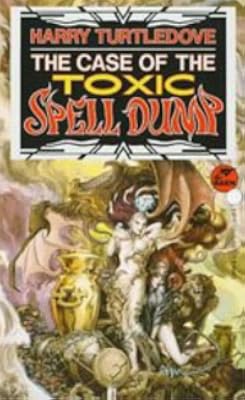
The Case of the Toxic Spell Dump
by Harry Turtledove
On This Page
Description
In an alternate America that runs on magic, a potential environmental disaster plunges an overworked bureaucrat into a deadly conspiracy of evil gods and darkest sorceryDavid Fisher pushes paper for the EPA in a world that's a lot like ours . . . only different. In this California—and throughout the alternate United States—all gods are real, science doesn't exist, and magic rules everything, running imp-driven computers and creating anxiety-inducing bumper-to-bumper flying-carpet rush show more hours. Unfortunately, unchecked magic use can leave dangerous residues, creating hours of mind-numbing deskwork for David and his fellow bureaucrats at the Environmental Perfection Agency. Now a leakage at a toxic spell dump in Angels City is about to complicate David's life in ways he never imagined, unleashing vampires, werewolves, and soulless babies. Even the actual spooks at the CIA concerned. But looking too closely into what might be more than just an accident could have David stepping on the toes of some very nasty deities indeed, imperiling his future on the Other Side . . . and on this one, as well.
When it comes to creating alternate histories—and worlds—no one does it better than the great Harry Turtledove. The multiple-award-winning master of the fantastic carries readers on a droll thrill ride through a richly detailed, ingeniously imagined fantasy reality where the impossible is mundane—and absolutely anything can happen.
. show less
Tags
Recommendations









Member Recommendations

infiniteletters Specifically Magic, Inc. Waldo is rather good, but it doesn't match.
Member Reviews
Nobody would ever accuse Harry Turtledove of originality. For a man who specializes in alternate history, his stories usually take a pretty blunt point of departure: time travelling South Africans give the Confederacy AK-47s, aliens with Gulf War military tech attack in the middle of WW2, thing like that.
The Case of the Toxic Spell Dump is set in a world where all religions are true, where magic works, and where magic is used to duplicate technology in the early 90s-mostly through endless puns of varying quality. That said, the book itself is an enjoyable noir/technothriller hybrid about strange doings in Angel City, and for all the bad jokes feels appropriately gritty and multicultural, with a lot of freeways and bad hamburgers. As show more somebody who grew up in a very mundane LA, it's feels just like home. show less
The Case of the Toxic Spell Dump is set in a world where all religions are true, where magic works, and where magic is used to duplicate technology in the early 90s-mostly through endless puns of varying quality. That said, the book itself is an enjoyable noir/technothriller hybrid about strange doings in Angel City, and for all the bad jokes feels appropriately gritty and multicultural, with a lot of freeways and bad hamburgers. As show more somebody who grew up in a very mundane LA, it's feels just like home. show less
A semi-serious adventure up and down the LA basin and SF valley from Long Beach to Chatsworth in an alternate 1990s where magic is used instead of most technology and carpets on flyways are the means of transportation. Heavy, very heavy on the puns which along with the sly renaming of local features is the basis of the humor, as the actual story is a possible end of the world as they know it as seen from the point of view of the EPA (Environmental Perfection Agency) agent. The gods are real and you'd better hope yours can protect you.
My reaction to reading this novel in 1994. Spoilers follow.
A fun fantasy that gives rein to not only Turtledove’s cleverness but tendency for puns as well. The puns here are complex. My favorite ones are Angeles City for Los Angeles, the SWAT or Special Wizards and Thaumaturges Team, and virtuous reality for virtuous reality. They fit a fantasy world much like our own world but where everything is done by magic rather than technology. Hence there are flying carpets rather than cars; microimps rather than microcomputers; spellcheckers have a new, more magical function; and the magical world is partially protected by the efforts of narrator-protagonist David Fisher of the EPA (Environmental Perfection Agency).
I liked Turtledove’s show more sympathetic of a bureaucrat. Fisher is conscientious, smart, underpaid and generally tries to do some good while putting up with writing endless reports, weekly and pointless meetings, and he admits the EPA is sometimes paperbound.
The charm of the novel is seeing Turtledove recreate Southern California with a magical cultural base rather than technology. It’s still a polyglot of various religions and languages, but it still has aerospace companies (though here it’s Loki’s Cobold Works designing a magic “Garada Bird” for spaceflight), crime, foreign restaurants, and traffic jams. One company pays the expense of maintaining a cult to worship Hermes – god of thieves – as protection The plot involves Fisher, whose regular job is to draw up environmental impact statements on such things as the effects of importing leprechauns from Ireland into the “thecosystem” or whether the original California Indians Chumash pantheon should be saved from extinction by subsidizing a cult, investigating leaks from the toxic spell dump and uncovering a supernatural plot to bring about the Third Sorcerous War. (The Second Sorcerous War was fought by an apsych-soulless-Aleman.) Some bloody Aztec gods are trying to make a comeback with the help of the fading Chumash deities (I lked Turtledove using a seldom-mentioned, native Californian magic system). It’s a story of intrigue and kidnapping, arson, and murder with the inevitable big melee between magic wielders at the end. The plot’s not the attraction – though competently done. It exists to string Turtledove’s central conceit and complex, long puns along. (I also liked the spook – literally -- Henry Legion of the Central Intelligence.)
Turtledove also takes a shot – in the context of his magical milieu – at those who bash Western rational, scientific culture and suggests that Amerindian culture was static and inferior because it could not support as many people as modern culture can given the same resources. show less
A fun fantasy that gives rein to not only Turtledove’s cleverness but tendency for puns as well. The puns here are complex. My favorite ones are Angeles City for Los Angeles, the SWAT or Special Wizards and Thaumaturges Team, and virtuous reality for virtuous reality. They fit a fantasy world much like our own world but where everything is done by magic rather than technology. Hence there are flying carpets rather than cars; microimps rather than microcomputers; spellcheckers have a new, more magical function; and the magical world is partially protected by the efforts of narrator-protagonist David Fisher of the EPA (Environmental Perfection Agency).
I liked Turtledove’s show more sympathetic of a bureaucrat. Fisher is conscientious, smart, underpaid and generally tries to do some good while putting up with writing endless reports, weekly and pointless meetings, and he admits the EPA is sometimes paperbound.
The charm of the novel is seeing Turtledove recreate Southern California with a magical cultural base rather than technology. It’s still a polyglot of various religions and languages, but it still has aerospace companies (though here it’s Loki’s Cobold Works designing a magic “Garada Bird” for spaceflight), crime, foreign restaurants, and traffic jams. One company pays the expense of maintaining a cult to worship Hermes – god of thieves – as protection The plot involves Fisher, whose regular job is to draw up environmental impact statements on such things as the effects of importing leprechauns from Ireland into the “thecosystem” or whether the original California Indians Chumash pantheon should be saved from extinction by subsidizing a cult, investigating leaks from the toxic spell dump and uncovering a supernatural plot to bring about the Third Sorcerous War. (The Second Sorcerous War was fought by an apsych-soulless-Aleman.) Some bloody Aztec gods are trying to make a comeback with the help of the fading Chumash deities (I lked Turtledove using a seldom-mentioned, native Californian magic system). It’s a story of intrigue and kidnapping, arson, and murder with the inevitable big melee between magic wielders at the end. The plot’s not the attraction – though competently done. It exists to string Turtledove’s central conceit and complex, long puns along. (I also liked the spook – literally -- Henry Legion of the Central Intelligence.)
Turtledove also takes a shot – in the context of his magical milieu – at those who bash Western rational, scientific culture and suggests that Amerindian culture was static and inferior because it could not support as many people as modern culture can given the same resources. show less
I've always thought of much of the urban fantasy field as taking off with Ann Rice and Laurel Hamilton books, so when I saw this book was published in 1993, I had to give it a shot. It is of the alternate history kind of urban fantasy, with magic as the basis for technological development. David Fisher works for the Environmental Perfection Agency as an inspector. His manager in the District of St. Columbia wants him to unofficially follow up on a tip that a waste dump north of Angels City might be experiencing problems. As David investigates, he discovers that three area children have been born soulless, and there's more than the usual numbers of elf-shot, werewolves and vampires in the area. The dump manager seems like an honest sort, show more but it'll take a warrant and legal challenges to get more information. When a monastery is burned down, it becomes clear that David is onto a deadly conspiracy.
Apparently arising out of a discussion at a convention, Turtledove created a world-view that mostly works by Principle of Substitution. Instead of 'Los Angeles and the San Fernando Valley,' we have 'Angels City and St. Ferdinand's Valley.' Telephones use imps to pass information, and alarm clocks are powered by small spirits. People use flying carpets instead of cars, and doesn't that just create a new level of merging challenge! Parchment is used instead of paper, but David will still need to convince a judge to issue a warrant to further investigate the dump. Elevators are powered by spell-inscribed parchments and an air spirit. It's an interesting technique; while it allows one to jump right into a story without extensive world-building, I did get the pun-ish vibe of Piers Anthony's Xanth series.
The concepts I found the most intriguing was the general idea of separate-but-equal religions that seems to underlie the worldview. However, I'm not sure it entirely worked, particularly with how the story developed. And no, I don't remember what they said about atheism, except that everyone agreed that the three children born without souls was a profound tragedy. I'm not sure that was ever explained, as it didn't sound like it would impact their earthly experience. There's also some aspects of the story that deal with immigration, an ongoing discussion in the L.A. Basin. I appreciated it was integrated and acknowledged in the story, as so many 'urban' fantasies seem to ignore the nature of the urban setting. However, as the story progressed, I'm not entirely sure that it worked out in a non-judgmental kind of way.
Characters were well developed. Unfortunately, David's a mid-level bureaucrat, and much of his routine is rather mundane. His inner narrative gives insight to the world he lives in, but even discussion of imps and telephones couldn't keep me interested in his phone calls. I particularly liked his relationship with Judith, an editor and proofreader at a grimoire publishing firm. David uses her as a sounding board, and she contributes valuable ideas when they brainstorm. But what I liked even more is that their relationship seemed mature and balanced, without the interpersonal drama (usually due to misunderstandings) that so characterizes the genre.
Plotting was acceptable, although it dragged a bit in the beginning. I almost felt as if Turtledove really had followed a mid-level bureaucrat through a week of his life and then magicalized it. And, as you might imagine, most people's professional details are not interesting enough that detailing them gives any benefit to the sense of routine. I won't spoil it, but as the investigation of the dump starts to escalate, the plotting picks up and becomes more complicated, almost to the point where it seems like another story.
While I was glad to have finally read Turtledove, a classic fantasy author, the story didn't deeply engage me. I read it with intellectual interest as to the world-building, but that isn't always sustainable for a story. Aspects also reminded me of Terry Pratchett, although I'd be hard pressed to say why. Perhaps the tongue-in-cheek tone that simultaneously wants the reader to care about character predicaments while jokes are being made. I'd recommend it for people that are interested in a wide variety of urban fantasy, those who want perspective on the genre, and fans of the time period.
Thank you to NetGalley and to Open Road Media for providing a review's copy of this book show less
Apparently arising out of a discussion at a convention, Turtledove created a world-view that mostly works by Principle of Substitution. Instead of 'Los Angeles and the San Fernando Valley,' we have 'Angels City and St. Ferdinand's Valley.' Telephones use imps to pass information, and alarm clocks are powered by small spirits. People use flying carpets instead of cars, and doesn't that just create a new level of merging challenge! Parchment is used instead of paper, but David will still need to convince a judge to issue a warrant to further investigate the dump. Elevators are powered by spell-inscribed parchments and an air spirit. It's an interesting technique; while it allows one to jump right into a story without extensive world-building, I did get the pun-ish vibe of Piers Anthony's Xanth series.
The concepts I found the most intriguing was the general idea of separate-but-equal religions that seems to underlie the worldview. However, I'm not sure it entirely worked, particularly with how the story developed. And no, I don't remember what they said about atheism, except that everyone agreed that the three children born without souls was a profound tragedy. I'm not sure that was ever explained, as it didn't sound like it would impact their earthly experience. There's also some aspects of the story that deal with immigration, an ongoing discussion in the L.A. Basin. I appreciated it was integrated and acknowledged in the story, as so many 'urban' fantasies seem to ignore the nature of the urban setting. However, as the story progressed, I'm not entirely sure that it worked out in a non-judgmental kind of way.
Characters were well developed. Unfortunately, David's a mid-level bureaucrat, and much of his routine is rather mundane. His inner narrative gives insight to the world he lives in, but even discussion of imps and telephones couldn't keep me interested in his phone calls. I particularly liked his relationship with Judith, an editor and proofreader at a grimoire publishing firm. David uses her as a sounding board, and she contributes valuable ideas when they brainstorm. But what I liked even more is that their relationship seemed mature and balanced, without the interpersonal drama (usually due to misunderstandings) that so characterizes the genre.
Plotting was acceptable, although it dragged a bit in the beginning. I almost felt as if Turtledove really had followed a mid-level bureaucrat through a week of his life and then magicalized it. And, as you might imagine, most people's professional details are not interesting enough that detailing them gives any benefit to the sense of routine. I won't spoil it, but as the investigation of the dump starts to escalate, the plotting picks up and becomes more complicated, almost to the point where it seems like another story.
While I was glad to have finally read Turtledove, a classic fantasy author, the story didn't deeply engage me. I read it with intellectual interest as to the world-building, but that isn't always sustainable for a story. Aspects also reminded me of Terry Pratchett, although I'd be hard pressed to say why. Perhaps the tongue-in-cheek tone that simultaneously wants the reader to care about character predicaments while jokes are being made. I'd recommend it for people that are interested in a wide variety of urban fantasy, those who want perspective on the genre, and fans of the time period.
Thank you to NetGalley and to Open Road Media for providing a review's copy of this book show less
This was my first Harry Turtledove, and I've been wanting to read his works for a while, but mostly for the alternate histories. I eventually read this one, which wasn't one of those, because I got it from Netgalley as a reprint from the original title that came out in 1993.
It's an early Urban Fantasy. I loved the concept behind this world, where all religions are not only valid, but they have a certifiable presence and weight. Our main character is Jewish, and while I started getting excited at first that he might whip out some mystical Kabbalah to handle the problems of his ho-hum government job of investigating environmental spell abuse and leakages, he never did. Alas. Instead, we were at least treated to a Pratchett-esque humorous show more naming system that turned a spellchecker into just that: a spellchecker, identifying and reporting on spells in use in the environment. Okay.
Others were groanworthy, like ethernet, the network that runs on the ether, or virtuous reality, that lets people walk around on the Other Side behind a helmet with wires. They were cute, and there were a lot more, besides.
The feel of the story was like an average mystery, even though our hero works for the magical equivalent of the EPA. His love interest is right out of the 1950's sensibilities, strong but slightly looked down upon. Even the ideas surrounding native americans being not quite worthy to develop their own land was almost too distasteful to continue reading, but I chalked it up to the kind of feel that Turtledove was trying to evoke. So many of his novels were set in alternate WWII settings, after all, and nothing I read was out of place for that time period. I try to let it slide, but it did make me halt a few times.
The religions and monster mashups were pretty damn fun, all said. I was constantly reminding myself that American Gods hadn't been written yet, but I kept feeling the shadow of it on my reading.
Then again, I was also reminding myself that this novel came at the early days of Urban Fantasy before it got its own shelves and before it spread its wings. I was kind of left dragging along with the mystery, but at least the final action sequence was pretty fun.
The only other complaint I might have about the novel was the number of off-page action sequences that would have given the tale more depth and roundness. They even seemed a bit more interesting, after the fact, than most of the actual novel. I wanted to slap someone.
And speaking of slapping someone, I wanted to slap the main character for how he proposed to Judy. Or perhaps Judy should have done it for me. Seriously.
It wasn't a bad novel by any stretch. I have my issues with it, but it held together nicely. It can't hold a candle to many of the later Urban Fantasies I've had the pleasure of reading in the years since this was first published, but that's neither here nor there. In it's proper time and place it might have made a big impact on the scene. I don't really know.
As for me, the outdated worldview and the somewhat clunky treatment of the possibilities brought my scoring down. show less
It's an early Urban Fantasy. I loved the concept behind this world, where all religions are not only valid, but they have a certifiable presence and weight. Our main character is Jewish, and while I started getting excited at first that he might whip out some mystical Kabbalah to handle the problems of his ho-hum government job of investigating environmental spell abuse and leakages, he never did. Alas. Instead, we were at least treated to a Pratchett-esque humorous show more naming system that turned a spellchecker into just that: a spellchecker, identifying and reporting on spells in use in the environment. Okay.
Others were groanworthy, like ethernet, the network that runs on the ether, or virtuous reality, that lets people walk around on the Other Side behind a helmet with wires. They were cute, and there were a lot more, besides.
The feel of the story was like an average mystery, even though our hero works for the magical equivalent of the EPA. His love interest is right out of the 1950's sensibilities, strong but slightly looked down upon. Even the ideas surrounding native americans being not quite worthy to develop their own land was almost too distasteful to continue reading, but I chalked it up to the kind of feel that Turtledove was trying to evoke. So many of his novels were set in alternate WWII settings, after all, and nothing I read was out of place for that time period. I try to let it slide, but it did make me halt a few times.
The religions and monster mashups were pretty damn fun, all said. I was constantly reminding myself that American Gods hadn't been written yet, but I kept feeling the shadow of it on my reading.
Then again, I was also reminding myself that this novel came at the early days of Urban Fantasy before it got its own shelves and before it spread its wings. I was kind of left dragging along with the mystery, but at least the final action sequence was pretty fun.
The only other complaint I might have about the novel was the number of off-page action sequences that would have given the tale more depth and roundness. They even seemed a bit more interesting, after the fact, than most of the actual novel. I wanted to slap someone.
And speaking of slapping someone, I wanted to slap the main character for how he proposed to Judy. Or perhaps Judy should have done it for me. Seriously.
It wasn't a bad novel by any stretch. I have my issues with it, but it held together nicely. It can't hold a candle to many of the later Urban Fantasies I've had the pleasure of reading in the years since this was first published, but that's neither here nor there. In it's proper time and place it might have made a big impact on the scene. I don't really know.
As for me, the outdated worldview and the somewhat clunky treatment of the possibilities brought my scoring down. show less
Hmmm. I've read this several times before, in the original edition; I just reread it, in an ebook version from Netgalley (in return for a review). I know I've enjoyed it before, and it isn't a bad story - but the puns and wordplay got a little annoying this time. And it's very odd that his alternate world, where faith plays a much larger part in people's lives than here, many more names were Anglicized in the Los Angeles (or his City of Angels) area. The city itself, the "St. Ann wind", the "St. Monica Freeway"...and many more. Didn't keep the full names, either (no Ciudad de La Reina de Los Angeles). The concept is neat - in a civilization based on magic, there are at least as many pollutants as there are in our mechanical/electronic show more society, and some of them are much (much much) nastier. On the other hand, there are some extra means of dealing with them... Turtledove spent a lot of time coming up with magical equivalents of our everyday gadgets - telephones run by cloned imps, horological demons to wake you up in the morning (but sometimes they get misadjusted, and laugh at you while you're staggering around trying to wake up), commuting on flying carpets (that, in the numbers used in the City of Angels, fill the air with lint and threads so that sometimes it's hard to breathe...). Our hero is a bureaucrat, an employee of the Environmental Perfection Agency who's dealing with a surge in birth defects (vampirism, lycanthropy, and, most terrible, apsychia (children born without a soul)) around a particular toxic spell dump. And then things start to get interesting... Overall cute concept, mildly interesting setting, OK characters, OK plot - nothing wrong with the book as a whole (if you have a high tolerance for puns - not Xanth level, but not far off), but not a favorite. However, I've remembered it (not in detail) and reread it several times over the years, so it's got something going for it. show less
This is best described as an alternate earth book, not really fantasy or science fiction. In the 'Angels City' (LA) of this alternate USA, (set in what felt like the 1970's) magic works, but the leftovers of magic must be stored in waste dumps. This is a sometimes humorous mystery/action novel exploring this alternate earth. There's no doubt it was written to give the author a chance to pull out some really awful puns and other word plays, but it still made for a decent story.
Members
- Recently Added By
Published Reviews
ThingScore 100
Turtledove strikes a tricky balance between making the novel a tough-minded mystery yarn, a carefully imagined science-fictional treatment of a magical world, and a cheerfully amusing comic fantasy.
added by Nevov
Lists

Best Fantasy Novels
821 works; 361 members

Civil Service Spec Fic
36 works; 4 members
Author Information

279+ Works 43,221 Members
Harry Turtledove was born in Los Angeles, California on June 14, 1949. He received a Ph.D. in Byzantine history from UCLA in 1977. From the late 1970's to the early 1980's, he worked as a technical writer for the Los Angeles County Office of Education. He left in 1991 to become full-time writer. His first two novels, Wereblood and Werenight, were show more published in 1979 under the pseudonym Eric G. Iverson because his editor did not think people would believe that Turtledove was his real name. He used this name until 1985 when he published Herbig-Haro and And So to Bed under his real name. He has received numerous awards including the Homer Award for Short Story for Designated Hitter in 1990, the John Esthen Cook Award for Southern Fiction for Guns of the Southand in 1993, and the Hugo Award for Novella for Down in the Bottomlands in 1994. (Bowker Author Biography) show less
Common Knowledge
- Original publication date
- 1993
Classifications
Statistics
- Members
- 513
- Popularity
- 58,749
- Reviews
- 15
- Rating
- (3.82)
- Languages
- English
- Media
- Paper, Audiobook, Ebook
- ISBNs
- 6
- ASINs
- 2