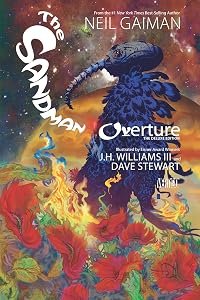
The Sandman: Overture
by Neil Gaiman, J. H. Williams III (Illustrator)
Sandman: Prelúdio (1-3), The Sandman: Overture (Collections and Selections — 1-6), The Sandman (Additional — Overture 1-6)
On This Page
Description
Twenty-five years since THE SANDMAN first changed the landscape of modern comics, Neil Gaiman's legendary series is back in a deluxe edition! THE SANDMAN: OVERTURE heralds NEW YORK TIMES best-selling writer Neil Gaiman's return to the art form that made him famous, ably abetted by artistic luminary JH Williams III (BATWOMAN, PROMETHEA), whose lush, widescreen images provide an epic scope to The Sandman's origin story. From the birth of a galaxy to the moment that Morpheus is captured, THE show more SANDMAN: OVERTURE will feature cameo appearances by fan-favorite characters such as The Corinthian, Merv Pumpkinhead and, of course, the Dream King's siblings: Death, Desire, Despair, Delirium, Destruction and Destiny. show lessTags
Recommendations

Member Reviews
It was with a certain dull dour melancholy that I anticipated reading this. I'm not sure if I was thinking that this would be the sad end of my Sandman reread or that this would be a dull echo of Sandman at its height, a sincere but pale, as it were, imitation. Holy guacamole. That didn't even last a single page.
To be clear, Gaiman does not let the reader down. This isn't a retread of Sandman at all, this is a whole different type and style of Sandman story. Morpheus is proactive, for a start, in a way he generally isn't in the long run of the series, and we get some sense of why that is. This is an epic, action-packed space opera, a huge conflict that Dream must fight with Dream's own weapons and tactics, and he does and it's a giddy show more delight. It's a prelude, but it draws back in a score of threads laid out in the main series and refines them into a fast-paced eye-popping wide-screen thrill ride.
Not just that, but the mythical world of the Endless is deepened and expanded - we meet Mum and Dad! We meet versions of Dream from all over the universe! We hear the story of Aliana (but weren't there three gods? Oh Gaiman, you minx!) There's a giant talking Dream cat! A western! A city of stars!
But galloping gondolas it's JH Williams who takes all the prizes, who elevates the whole thing to a level that surpasses almost everything that went before, except that's not fair because it's like none of the other stories that went before. The art flows and pops and bends time and space on the page. It stretches and bends and still manages to tell a completely coherent story. Literally the only problem with the storytelling using this amazingly complex and vivid art is that once or twice the glossy paper stuck and I skipped two pages by accident.
No dour melancholy or doubt can survive contact with these pages, from the giddy delight of long-laid plot seeds effortlessly flowering and clicking into place like some sort of clockwork mechanical growing flower things to the sweeping action and the mind-bending profusion of ideas and the brilliant colours and the teeming inventions of landscape and alien lives and impossible incomprehensible realms and Destiny saying 'what?'
This is an exciting, exhilarating, comic, an utterly new execution of utterly familiar characters and ideas that enriches what has gone before by prefiguring what is to come. Gaiman and Williams have completely outdone themselves, as have the colourists and the letterer and presumably the vast processing intelligences that fill solar systems with their whirring, god-like, editing brains. It's a fantastic high note to end the reread and I'm already anticipating a future return to the story with the Overture at the start to see how it reshapes and alters the story. show less
To be clear, Gaiman does not let the reader down. This isn't a retread of Sandman at all, this is a whole different type and style of Sandman story. Morpheus is proactive, for a start, in a way he generally isn't in the long run of the series, and we get some sense of why that is. This is an epic, action-packed space opera, a huge conflict that Dream must fight with Dream's own weapons and tactics, and he does and it's a giddy show more delight. It's a prelude, but it draws back in a score of threads laid out in the main series and refines them into a fast-paced eye-popping wide-screen thrill ride.
Not just that, but the mythical world of the Endless is deepened and expanded - we meet Mum and Dad! We meet versions of Dream from all over the universe! We hear the story of Aliana (but weren't there three gods? Oh Gaiman, you minx!) There's a giant talking Dream cat! A western! A city of stars!
But galloping gondolas it's JH Williams who takes all the prizes, who elevates the whole thing to a level that surpasses almost everything that went before, except that's not fair because it's like none of the other stories that went before. The art flows and pops and bends time and space on the page. It stretches and bends and still manages to tell a completely coherent story. Literally the only problem with the storytelling using this amazingly complex and vivid art is that once or twice the glossy paper stuck and I skipped two pages by accident.
No dour melancholy or doubt can survive contact with these pages, from the giddy delight of long-laid plot seeds effortlessly flowering and clicking into place like some sort of clockwork mechanical growing flower things to the sweeping action and the mind-bending profusion of ideas and the brilliant colours and the teeming inventions of landscape and alien lives and impossible incomprehensible realms and Destiny saying 'what?'
This is an exciting, exhilarating, comic, an utterly new execution of utterly familiar characters and ideas that enriches what has gone before by prefiguring what is to come. Gaiman and Williams have completely outdone themselves, as have the colourists and the letterer and presumably the vast processing intelligences that fill solar systems with their whirring, god-like, editing brains. It's a fantastic high note to end the reread and I'm already anticipating a future return to the story with the Overture at the start to see how it reshapes and alters the story. show less
Dream's family is so messed up. I really wish I could just leave that as my review, but dang. We get to see Dream's Father and Mother in this one. We also get to see Dream's messed up siblings, Desire, Destiny, Delirium, Despair, Destruction, and Death as well. And we get to see some new characters such as Hope I was fascinated by.
"The Sandman: Overture" is book #0 in the series. When I bought the first 5 books eons ago, I never got this one because it looks like it came out after I got these. This volume stars with something wrong on a planet and a plant seemingly about to burst into flames. Dream, consults with the oldest Aspect of himself and someone known as "Glory of the First Circle" where he learns that the cause of what he show more feels is wrong is that a star has gone insane and it is going to spread and destroy the entire universe. Glory also tells Dream it's all his fault. We get to read along about how things were born/created, how Dream keeps getting captured, and how things unfold because of something Dream failed to do.
I do love Dream. He keeps insisting that he is not lonely, that he does not feel guilt, that he is in many ways not human, but he is. The things he goes through in this one in order to undo the end of the known world was great. I loved his conversations with his parents, a cat (no spoilers) and Hope. Dream trying to undo and put things back no matter what it meant for him shows why you can't help rooting for him.
Dream's parents are a mess. Time and Night were interesting and I wonder if they pop up again.
The writing is so good and I love Gaiman's take on how the universe came to be and how one day all things must end.
The illustrations are so beautiful. And this graphic novel is more interactive than the other ones. Some panels open up and you have to carefully unfold them. Sometimes you are forced to turn the novel upside down to read what a character is saying. It draws you in so nicely.
The ending of course leaves us with Morpheus/Dream right before volume 1. show less
"The Sandman: Overture" is book #0 in the series. When I bought the first 5 books eons ago, I never got this one because it looks like it came out after I got these. This volume stars with something wrong on a planet and a plant seemingly about to burst into flames. Dream, consults with the oldest Aspect of himself and someone known as "Glory of the First Circle" where he learns that the cause of what he show more feels is wrong is that a star has gone insane and it is going to spread and destroy the entire universe. Glory also tells Dream it's all his fault. We get to read along about how things were born/created, how Dream keeps getting captured, and how things unfold because of something Dream failed to do.
I do love Dream. He keeps insisting that he is not lonely, that he does not feel guilt, that he is in many ways not human, but he is. The things he goes through in this one in order to undo the end of the known world was great. I loved his conversations with his parents, a cat (no spoilers) and Hope. Dream trying to undo and put things back no matter what it meant for him shows why you can't help rooting for him.
Dream's parents are a mess. Time and Night were interesting and I wonder if they pop up again.
The writing is so good and I love Gaiman's take on how the universe came to be and how one day all things must end.
The illustrations are so beautiful. And this graphic novel is more interactive than the other ones. Some panels open up and you have to carefully unfold them. Sometimes you are forced to turn the novel upside down to read what a character is saying. It draws you in so nicely.
The ending of course leaves us with Morpheus/Dream right before volume 1. show less
The Sandman, as written by Neil Gaiman and penciled and inked by a phenomonal cast (Sam Keith, Mike Dringenberg, and so many more) has a justified place in the list of all-time greatest works in comic book history. We can and should revise our assessment of art when the artist has failed us, but the experience of Sandman is a work of many hearts, all of them carrying their own secret pain, and one of them is me.
I was expelled from the universe, by stars caught up with rhetoric and infection. I'm currently inside a Black Hole. - Dream
It's very rare to come across perfection. I believe it even more rare when it's a graphic novel with multiple creators. I'd say I've seen it only a couple of times. Claremont, Byrne, Austin, and Orzechowski on Star-Lord's second appearance. The same team on their brilliant X-Men run...and that's possibly it.
Until now. Neil Gaiman (words), J.H. Williams (images), Dave Stewart (colours), and Todd Klein (letters) have created the most gorgeous looking book I think I may have ever had the pleasure to read. And I make a point of noting the colourist and letterer, because they are often forgotten, but in this case, this show more book would not have been as good as it is without their input. And Gaiman's story? Brilliant.
As other will likely indicate, this is actually best considered "Sandman 0" as it is the lead in to issue #1.
I'm not going to get into it. I'll just say read it. Read it slowly and revel in the magic of the words and sights. Fall in love with this as much as I did. It's beautiful.
It's perfection. show less
It's very rare to come across perfection. I believe it even more rare when it's a graphic novel with multiple creators. I'd say I've seen it only a couple of times. Claremont, Byrne, Austin, and Orzechowski on Star-Lord's second appearance. The same team on their brilliant X-Men run...and that's possibly it.
Until now. Neil Gaiman (words), J.H. Williams (images), Dave Stewart (colours), and Todd Klein (letters) have created the most gorgeous looking book I think I may have ever had the pleasure to read. And I make a point of noting the colourist and letterer, because they are often forgotten, but in this case, this show more book would not have been as good as it is without their input. And Gaiman's story? Brilliant.
As other will likely indicate, this is actually best considered "Sandman 0" as it is the lead in to issue #1.
I'm not going to get into it. I'll just say read it. Read it slowly and revel in the magic of the words and sights. Fall in love with this as much as I did. It's beautiful.
It's perfection. show less
The Sandman: Overture by Neil Gaiman
Neil Gaiman made his mark writing The Sandman. Gaiman took an old DC Comics character from the 70s and used the character to create an astonishingly complex mythology. Sandman grew to become one of the most critically acclaimed comics of all time and launched Gaiman on to his hugely successful books and other endeavors. Sandman: Overture is Gaiman returning to the world and the characters he last left in the mid-90s. Styled as a prequel, Sandman: Overture tells the story of how Dream a/k/a Morpheus has become trapped in Preludes and Nocturnes (the first of the collected Sandman books).
The Sandman: Overture is flat out gorgeous. Knowing they have a hit on their hand, Vertigo (the publisher) gave the show more deluxe edition the time, money and attention to detail that a writer of Gaiman's stature can command. It is interesting to contrast it with the early comics contained in Preludes and Nocturnes to see just how much additional work went into this deluxe edition. From a purely stylistic point of view, The Sandman: Overture is a visual treat.
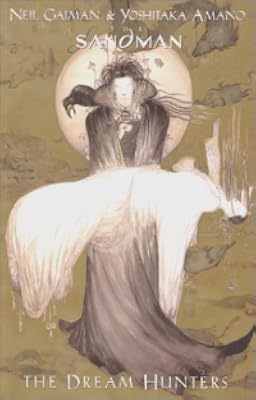
As to the story, this is a prequel in name only. As a dedicated fan of Gaiman who has read all of the Sandman series and almost all of the spin-offs, the story was a fantastic, nostalgic trip through Gaiman's elaborate multiverse. However, this is not the place to introduce a new reader to the Sandman universe. The Sandman: Overture is simply too complex a story with too many careful references to its own mythology to be fully appreciated by a new Sandman reader. Sandman: Overture was everything I hoped it would be - a gorgeous return of fantastic and well loved characters back for a curtain call. It just wasn't an introduction. When my children are old enough to read the Sandman series I will start with Prelude and Nocturnes or perhaps one of the approachable one-offs like Dream Hunters. Sandman: Overture will remain as a fitting capstone that reminds the readers that one of Gaiman's principal themes in the Sandman was the tension between eternity and change. show less
Neil Gaiman made his mark writing The Sandman. Gaiman took an old DC Comics character from the 70s and used the character to create an astonishingly complex mythology. Sandman grew to become one of the most critically acclaimed comics of all time and launched Gaiman on to his hugely successful books and other endeavors. Sandman: Overture is Gaiman returning to the world and the characters he last left in the mid-90s. Styled as a prequel, Sandman: Overture tells the story of how Dream a/k/a Morpheus has become trapped in Preludes and Nocturnes (the first of the collected Sandman books).
The Sandman: Overture is flat out gorgeous. Knowing they have a hit on their hand, Vertigo (the publisher) gave the show more deluxe edition the time, money and attention to detail that a writer of Gaiman's stature can command. It is interesting to contrast it with the early comics contained in Preludes and Nocturnes to see just how much additional work went into this deluxe edition. From a purely stylistic point of view, The Sandman: Overture is a visual treat.
As to the story, this is a prequel in name only. As a dedicated fan of Gaiman who has read all of the Sandman series and almost all of the spin-offs, the story was a fantastic, nostalgic trip through Gaiman's elaborate multiverse. However, this is not the place to introduce a new reader to the Sandman universe. The Sandman: Overture is simply too complex a story with too many careful references to its own mythology to be fully appreciated by a new Sandman reader. Sandman: Overture was everything I hoped it would be - a gorgeous return of fantastic and well loved characters back for a curtain call. It just wasn't an introduction. When my children are old enough to read the Sandman series I will start with Prelude and Nocturnes or perhaps one of the approachable one-offs like Dream Hunters. Sandman: Overture will remain as a fitting capstone that reminds the readers that one of Gaiman's principal themes in the Sandman was the tension between eternity and change. show less
It took nearly 20 years for Morpheus to return with a proper follow-up to his final farewell. Overture's is a six-issue tale bridging the gap between issue one's ambitious, faulty start and the present-day doings of Daniel. Just as well, Overture thematically follows in familiar footsteps to long-time readers, delivering a strong sense of closure for the mythos while answering many lingering questions (like, why exactly does Morpheus don that dorky helmet as battle-gear?).
[N.B. This review includes images, and was formatted for my site, dendrobibliography -- located here.]
The Dream Hunters (1999) provided a stunningly-beautiful fairy tale that just happened to feature Morpheus, and Endless Nights (2003) gave us a collection of show more mostly-cute short stories complementing the Endless' original run rather than building upon it. Overture is more successful in connecting the loose threads that have hung over the series ever since we first spent those 72 years locked in an occultist's basement. It's both fitting as a conclusion, and a posthumous introduction for Morpheus' maxiseries.
Overture's is a story that, more than ever before, binds the Sandman to the greater DC mythology. In many respects, this is a sequel to the parliament of a young universe seen in Endless Nights' 'the Heart of the Star,' with returning figures, themes and stories. The background is peopled with scores of unique mythopoeic monsters (wonderfully realized by J.H. Williams III) styled after the otherworldly creatures of comics past.
Like in Dream's 2003 story, a parliament is held over the whole of the universe: It's a meeting of Dream's own shadows, of his own fragments from every corner of existence, all aspects of a single idea--or not. It's difficult to say; and they argue this way and that while agreeing on everything and nothing with Dream's trademark attitude. It's a surprising exercise in verbosity for Dream, but he only has his own ego to conflate by doing so.
Early in the series, this multitude of Morpheuses struck me as discomforting. It seems to contradict the series' mythology, or at least the feeling it evokes. The idea of Dream's siblings also being fragmented into an infinite number of aspects doesn't hold right. The final issue offers some recompense for these frustrations; although, as always of the Dreaming, it's delivered nebulously and we're left wondering the possibilities. We see multiple Deaths here, and we have before: Are they one and the same, simply seen under different skies? How does this translate to the two Despairs, Daniel, Fox-Dream of Dream Hunters, or Delight's transformation? I don't know. It may just be that the Sandman mythology is too heavy for its own good at this point, especially when we start thinking about worthwhile spin-offs like Lucifer.
## "Because it is the nature of Dreams, and ONLY of Dreams, to define Reality. Destiny is bound to existence. Death is limited by what she will or will not accept."
Dream's oldest aspect acts as his own mentor here, pushing Morpheus towards the path he must take: He exists as the original romantic vision of the earliest gods, formless things that writhed over a black nothing since time's first breath--beings (I like to think) we saw the restless stirrings of in Mike Carey's Lucifer: The Morningstar Option. His direction effects the reconvening of Dream into the mostly-singular entity of Morpheus, the mostly-singular entity of our cats' Dream, and the quick adoption of some blue-skinned humanity to act as a side-kicks and reinforce the hero's goals.
Along the way, stories occur. Destiny finally flirts with a plot, if only for a couple pages (before going back to whatever it is he does in his boring garden); insight into Delight's mysterious transformation is teased for the briefest of moments; Desire plots his/her mischief seen in the maxiseries; and we meet Dream's parents.
Destiny's story is more of a joke, interrupting the every-time and the all-time of the 'Endless Nights' prose-poem. The familiar reading of Destiny's occupation is interrupted by the intrusion of a boat--intrusion because it doesn't exist within his book. Destiny actually expresses an emotion.
Delight's appearance is merely a reference. She's distraught and 'transforming' within a story within the story. Nothing's explained, though I suspect the parents may be involved.
Endless Nights' explanation for Desire and Dream's petty rivalry was unsatisfying: Far too mundane and small a moment to account for billions of years of character development. Their distaste for one another is handled incredibly-well in this series. Rather than a reaction to a cruel joke, their hatred was inevitable: Written by destiny because Desire and Dream are two pieces of a singular function. One's maybe a bit more or less romantic than the other, but they're both too arrogant, self-interested and creative to get along when the concepts themselves are so similar.
Introducing the Endless' parents--(suggested as) Time and Night--was a really creative, if daunting, way to expand the scope of the mythology and its power. Time, the father, feels safe within the confines of the DC multiverse tropes and characters (e.g., mostly envisioned as an old, depressed, arrogant Alan Moore-like occultist). Mother Night is fascinating in her sinister, if comforting, allure, and appears to us as the body of the galaxies themselves, and the dark space between them. They remain as daunting, however, because their power diminishes that of the Endless--is Death no longer the final period on the universe?--and the mythology established by Lucifer.
The main quest echoes much from the maxiseries: Dream's past mistakes have created a vortex tearing apart the fabric of space, and it falls to him to correct the failures of his station. His parents refuse to feed into the storybook deus ex machina reunion he so desires for himself. (I rather suspect their reunion would simply end the universe rather than heal it...?) He's also alone among his siblings--only Desire wishes to help, and we know how likely that could ever happen. It's Destruction's power that's needed, and he's not even available to ask. Dream must exert the creative abilities of his brother at great personal cost, destroying history and creating it anew. This exertion ultimately pushes him into his earliest predicament, bridging the lore of the past 27 years.
The destructive vortex and Morpheus' mistakes make for a cute prelude to the Sandman series. The characterization of our sister-brother, Desire, whose complexity has only grown alongside her/his original author, is especially benefited by this story.
A relaxed release schedule (6 issues / 2 years) evidently worked to the advantage of artist J.H. Williams III--though that would have driven me nuts as a reader--and gave us perhaps the finest art this series has ever seen. It's a style akin to Will Eisner or Craig Thompson, ditching traditional panel layouts in favor of using every inch and corner of the page to share something worthwhile with the reader.
Despite serving as both a prequel and a sequel to the main series, Overture doesn't function well as an introduction. Even its preludes are often written with the knowing reader in mind; every page is drenched in references and nods to the greater lore. More than anything, Overture fits as an extension of the maxiseries' final issues, and the best continuation fans could ask for. Like 'the Wake' chapter, it's an exercise in mourning, for its players and the author, but it also shares a much bigger sense of energy and excitement for a 75-issue story to come, a type of energy we've rarely gotten out of Sandman.
Here's to hoping Overture isn't the period at the end of this world. There are as many stories to tell as there are grains of sand, I imagine. In the mean-time, read Overture; re-read the maxiseries; read or re-read Lucifer; read the Unwritten, if you haven't: Just give time to good stories. show less
[N.B. This review includes images, and was formatted for my site, dendrobibliography -- located here.]
The Dream Hunters (1999) provided a stunningly-beautiful fairy tale that just happened to feature Morpheus, and Endless Nights (2003) gave us a collection of show more mostly-cute short stories complementing the Endless' original run rather than building upon it. Overture is more successful in connecting the loose threads that have hung over the series ever since we first spent those 72 years locked in an occultist's basement. It's both fitting as a conclusion, and a posthumous introduction for Morpheus' maxiseries.
Overture's is a story that, more than ever before, binds the Sandman to the greater DC mythology. In many respects, this is a sequel to the parliament of a young universe seen in Endless Nights' 'the Heart of the Star,' with returning figures, themes and stories. The background is peopled with scores of unique mythopoeic monsters (wonderfully realized by J.H. Williams III) styled after the otherworldly creatures of comics past.
Like in Dream's 2003 story, a parliament is held over the whole of the universe: It's a meeting of Dream's own shadows, of his own fragments from every corner of existence, all aspects of a single idea--or not. It's difficult to say; and they argue this way and that while agreeing on everything and nothing with Dream's trademark attitude. It's a surprising exercise in verbosity for Dream, but he only has his own ego to conflate by doing so.
Early in the series, this multitude of Morpheuses struck me as discomforting. It seems to contradict the series' mythology, or at least the feeling it evokes. The idea of Dream's siblings also being fragmented into an infinite number of aspects doesn't hold right. The final issue offers some recompense for these frustrations; although, as always of the Dreaming, it's delivered nebulously and we're left wondering the possibilities. We see multiple Deaths here, and we have before: Are they one and the same, simply seen under different skies? How does this translate to the two Despairs, Daniel, Fox-Dream of Dream Hunters, or Delight's transformation? I don't know. It may just be that the Sandman mythology is too heavy for its own good at this point, especially when we start thinking about worthwhile spin-offs like Lucifer.
## "Because it is the nature of Dreams, and ONLY of Dreams, to define Reality. Destiny is bound to existence. Death is limited by what she will or will not accept."
Dream's oldest aspect acts as his own mentor here, pushing Morpheus towards the path he must take: He exists as the original romantic vision of the earliest gods, formless things that writhed over a black nothing since time's first breath--beings (I like to think) we saw the restless stirrings of in Mike Carey's Lucifer: The Morningstar Option. His direction effects the reconvening of Dream into the mostly-singular entity of Morpheus, the mostly-singular entity of our cats' Dream, and the quick adoption of some blue-skinned humanity to act as a side-kicks and reinforce the hero's goals.
Along the way, stories occur. Destiny finally flirts with a plot, if only for a couple pages (before going back to whatever it is he does in his boring garden); insight into Delight's mysterious transformation is teased for the briefest of moments; Desire plots his/her mischief seen in the maxiseries; and we meet Dream's parents.
Destiny's story is more of a joke, interrupting the every-time and the all-time of the 'Endless Nights' prose-poem. The familiar reading of Destiny's occupation is interrupted by the intrusion of a boat--intrusion because it doesn't exist within his book. Destiny actually expresses an emotion.
Delight's appearance is merely a reference. She's distraught and 'transforming' within a story within the story. Nothing's explained, though I suspect the parents may be involved.
Endless Nights' explanation for Desire and Dream's petty rivalry was unsatisfying: Far too mundane and small a moment to account for billions of years of character development. Their distaste for one another is handled incredibly-well in this series. Rather than a reaction to a cruel joke, their hatred was inevitable: Written by destiny because Desire and Dream are two pieces of a singular function. One's maybe a bit more or less romantic than the other, but they're both too arrogant, self-interested and creative to get along when the concepts themselves are so similar.
Introducing the Endless' parents--(suggested as) Time and Night--was a really creative, if daunting, way to expand the scope of the mythology and its power. Time, the father, feels safe within the confines of the DC multiverse tropes and characters (e.g., mostly envisioned as an old, depressed, arrogant Alan Moore-like occultist). Mother Night is fascinating in her sinister, if comforting, allure, and appears to us as the body of the galaxies themselves, and the dark space between them. They remain as daunting, however, because their power diminishes that of the Endless--is Death no longer the final period on the universe?--and the mythology established by Lucifer.
The main quest echoes much from the maxiseries: Dream's past mistakes have created a vortex tearing apart the fabric of space, and it falls to him to correct the failures of his station. His parents refuse to feed into the storybook deus ex machina reunion he so desires for himself. (I rather suspect their reunion would simply end the universe rather than heal it...?) He's also alone among his siblings--only Desire wishes to help, and we know how likely that could ever happen. It's Destruction's power that's needed, and he's not even available to ask. Dream must exert the creative abilities of his brother at great personal cost, destroying history and creating it anew. This exertion ultimately pushes him into his earliest predicament, bridging the lore of the past 27 years.
The destructive vortex and Morpheus' mistakes make for a cute prelude to the Sandman series. The characterization of our sister-brother, Desire, whose complexity has only grown alongside her/his original author, is especially benefited by this story.
A relaxed release schedule (6 issues / 2 years) evidently worked to the advantage of artist J.H. Williams III--though that would have driven me nuts as a reader--and gave us perhaps the finest art this series has ever seen. It's a style akin to Will Eisner or Craig Thompson, ditching traditional panel layouts in favor of using every inch and corner of the page to share something worthwhile with the reader.
Despite serving as both a prequel and a sequel to the main series, Overture doesn't function well as an introduction. Even its preludes are often written with the knowing reader in mind; every page is drenched in references and nods to the greater lore. More than anything, Overture fits as an extension of the maxiseries' final issues, and the best continuation fans could ask for. Like 'the Wake' chapter, it's an exercise in mourning, for its players and the author, but it also shares a much bigger sense of energy and excitement for a 75-issue story to come, a type of energy we've rarely gotten out of Sandman.
Here's to hoping Overture isn't the period at the end of this world. There are as many stories to tell as there are grains of sand, I imagine. In the mean-time, read Overture; re-read the maxiseries; read or re-read Lucifer; read the Unwritten, if you haven't: Just give time to good stories. show less
In which Morpheus, the Dream King, the Sandman, is pulled to a surprising gathering and goes to correct an anomaly he caused, but things go awry and the outcome makes him so exhausted that Burgess is capable of capturing him, bringing on the sleeping sickness that occurs at the beginning of the original Sandman series. I received news of this prequel to an, in my mind, already perfect series with huge excitement, but also some trepidation - 25 years is a long time and I wasn't sure that Gaiman would be in a position to tell a story that didn't clash with the original series in style. It didn't take too long for my fears to dissipate, though (and J.H. Williams III's absolutely astounding art helped a lot), and it was soon clear that show more Gaiman has kept the character safe in his mind all of these years; Dream is back, his own insensitive, self-obsessed, responsible, flawed, wonderful, magical self, the way he was when we first made his acquaintance and it is a delight (no pun intended) to meet him (and his family, including his mother and father!) again and to finally find out what made Dream so weak that someone like Roderick Burgess could capture him and keep him imprisoned for seventy-two years - it's a whopper of a tale, if you were wondering, and one that should not be missed. show less
Members
- Recently Added By
Lists

2016 reads
46 works; 1 member

Books Read in 2015
3,299 works; 126 members

Recommend the 20 best books you've read in the last five years
2,168 works; 607 members

Books Read in 2020
4,379 works; 124 members
Author Information

847+ Works 450,536 Members
Neil Gaiman was born in Portchester, England on November 10, 1960. He worked as a journalist and freelance writer for a time, before deciding to try his hand at comic books. Some of his work has appeared in publications such as Time Out, The Sunday Times, Punch, and The Observer. His first comic endeavor was the graphic novel series The Sandman. show more The series has won every major industry award including nine Will Eisner Comic Industry Awards, three Harvey Awards, and the 1991 World Fantasy Award for best short story, making it the first comic ever to win a literary award. He writes both children and adult books. His adult books include The Ocean at the End of the Lane, which won a British National Book Awards, and the Locus Award for Best Fantasy Novel for 2014; Stardust, which won the Mythopoeic Award as best novel for adults in 1999; American Gods, which won the Hugo, Nebula, Bram Stoker, SFX, and Locus awards; Anansi Boys; Trigger Warning: Short Fictions and Disturbances; and The View from the Cheap Seats: Selected Nonfiction, which is a New York Times Bestseller. His children's books include The Day I Swapped My Dad for Two Goldfish; Coraline, which won the Elizabeth Burr/Worzalla, the BSFA, the Hugo, the Nebula, and the Bram Stoker awards; The Wolves in the Walls; Odd and the Frost Giants; The Graveyard Book, which won the Newbery Award in 2009 and The Sandman: Overture which won the 2016 Hugo Awards Best Graphic Story. (Bowker Author Biography) show less
All Editions
Awards and Honors
Awards
Notable Lists
Series

Sandman: Prelúdio
1 works (1-3)

The Sandman: Overture
6 works (Collections and Selections — 1-6)

The Sandman
11 works (Additional — Overture 1-6)
Belongs to Publisher Series
Work Relationships
Is contained in
Contains
Common Knowledge
- Canonical title
- The Sandman: Overture
- Original title
- Sandman: Prelúdio 1
- Original publication date
- 2015-11-04 (collection) (collection); 2013-10-30 – 2015-09-30 (issues) (issues)
- People/Characters
- Dream; Death of the Endless; Destiny of the Endless; Time; Night; Hope Beautiful Lost Nebula (show all 8); The Corinthian; Despair of the Endless
- Important places
- The City of Stars
- Dedication
- For Karen Berger. You made it happen.
And for the SANDMAN periodical editorial team, who scribbled down my corrections and caught up with me in strange places between 1988 and 2015: Art Young, Tom Peyer, Alisa Kwitney, Lis... (show all)a Aufenanger, Shelly Bond, Jenny Lee, and Shelly Bond again.
You were the dream team, and you did your work in the shadows. I'm grateful. - Neil
I dedicate the work in this book to my ever-enchanting wife, Wendy Williams. Many have little understanding that such a thing as SANDMAN: OVERTURE could not possibly exist as you see it here without her.
She is the stuff of dreams. - J.H. - First words
- It was a small planet.
- Last words
- (Click to show. Warning: May contain spoilers.)It can't have been important.
- Original language
- English
Classifications
- Genres
- Graphic Novels & Comics, Fiction and Literature, Horror
- DDC/MDS
- 741.5 — Arts & recreation Drawing & decorative arts Drawing Comic books, graphic novels, fotonovelas, cartoons, caricatures, comic strips
- LCC
- PN6728 .S26 .G4 — Language and Literature Literature (General) Literature (General) Collections of general literature Comic books, strips, etc.
- BISAC
Statistics
- Members
- 1,824
- Popularity
- 11,969
- Reviews
- 66
- Rating
- (4.26)
- Languages
- 8 — English, French, German, Italian, Polish, Spanish, Turkish, Portuguese (Portugal)
- Media
- Paper, Ebook
- ISBNs
- 19
- ASINs
- 3
