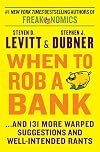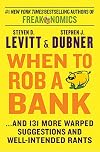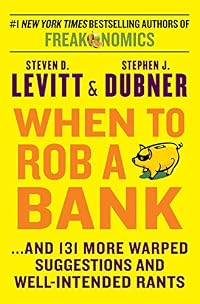
When to Rob a Bank and 131 More Warped Suggestions and Well-Intended Rants
by Steven D. Levitt, Stephen J. Dubner
Freakonomics (4)
On This Page
Description
In celebration of the 10th anniversary of the landmark book Freakonomics comes this curated collection from the most readable economics blog in the universe. It's the perfect solution for the millions of readers who love all things Freakonomics. Surprising and erudite, eloquent and witty, When to Rob a Bank demonstrates the brilliance that has made the Freakonomics guys an international sensation, with more than 7 million books sold in 40 languages, and 150 million downloads of their show more Freakonomics Radio podcast.When Freakonomics was first published, the authors started a blog—and they've kept it up. The writing is more casual, more personal, even more outlandish than in their books. In When to Rob a Bank, they ask a host of typically off-center questions: Why don't flight attendants get tipped? If you were a terrorist, how would you attack? And why does KFC always run out of fried chicken?
Over the past decade, Steven D. Levitt and Stephen J. Dubner have published more than 8,000 blog posts on the Freakonomics website. Many of them, they freely admit, were rubbish. But now they've gone through and picked the best of the best. You'll discover what people lie about, and why; the best way to cut gun deaths; why it might be time for a sex tax; and, yes, when to rob a bank. (Short answer: never; the ROI is terrible.) You'll also learn a great deal about Levitt and Dubner's own quirks and passions, from gambling and golf to backgammon and the abolition of the penny.
. show less
Tags
Recommendations





Member Reviews
Great fun - a fairly random compilation of their blog posts. Reads a bit like a Swiftian satire or a fantasy world along the lines of : "What If...people really behaved in line with economic theory ?" Best joke is the idea of paying Saddam Hussein $100 billion to retire, i.e. a bit less than the cost of the war to unseat him. But they do dig deep into things like sex workers and drug gangs, actually talking directly to people engaged in these shady areas, revealing something of their motives and incentives. Eminent economists are mentioned here and there, usually with tongue-in-cheek respect, and the authors' own dreams, desires and speculations are treated with wry humour.
A neat point is the winner of their new motto for the U.S.: "Our show more harshest critics choose to stay". Not likely to catch on as a slogan, but it does encapsulate the paradox of America's open society.
Spoiler alert: The answer to the challenge in the title is - Don't! show less
A neat point is the winner of their new motto for the U.S.: "Our show more harshest critics choose to stay". Not likely to catch on as a slogan, but it does encapsulate the paradox of America's open society.
Spoiler alert: The answer to the challenge in the title is - Don't! show less
There are books that entertain, books that enlighten, books that teach and books that make you see the view you would never have thus forcing you to think about things you would never have.
Levitt and Dubner's books generally fall in all four categories. This book isn't any different. Continuing to paint the economy color on almost everything that you and I experience in every day life, Levitt and Dubner talk about various questions and experiences in an economic tone.
Another reason why L & D's books are so good is because unlike most economists who cannot help talk in economic terms and jargons, boring the crap out of non-economists, L & D haven't, throughout the book, used any economic term that a person wouldn't hear about in a show more magazine or newspaper.
Interesting, entertaining and thought-provoking, except the part that spoke about American sports that most of the rest of the world might not understand or relate to. show less
Levitt and Dubner's books generally fall in all four categories. This book isn't any different. Continuing to paint the economy color on almost everything that you and I experience in every day life, Levitt and Dubner talk about various questions and experiences in an economic tone.
Another reason why L & D's books are so good is because unlike most economists who cannot help talk in economic terms and jargons, boring the crap out of non-economists, L & D haven't, throughout the book, used any economic term that a person wouldn't hear about in a show more magazine or newspaper.
Interesting, entertaining and thought-provoking, except the part that spoke about American sports that most of the rest of the world might not understand or relate to. show less
I should probably credit the Freakonomics team with partially leading me to studying economics. Of course, I could also blame them for the opportunity cost of having less money (paying for university fees) and less leisure time (because I was studying). But weirdly enough, I did gain utility throughout it all, including reading this collection of their blog posts. If you’ve read these online, you could be familiar with a few but I’m really bad at catching up with blog posts so the time and money investment was worth it.
The main difference with When to Rob a Bank (spoiler: it’s not when you would think) is that the topics and posts are shorter. This can be great if you’ve got five minutes to read, but occasionally disappointing show more if you want to know lots more. Fortunately, there is a collection of references at the back to look into your favourite topics. The shorter posts are also useful if you just want to know the simple answer (like why kiwifruit are really cheap in the US). The book is organised into chapters with a loose link between them all, but I thought the best chapter was the collection of posts that didn’t fit under any other titles. I read this midweek and I found the format worked in well with ad breaks, reading during boring news segments etc. Also, if you aren’t particularly interested in a subject, you can skip or skim it, without feeling that you’ve missed out. Some of the topics aren’t as well thought out as others, but as they are short, I don’t think they need to be. Sometimes they are more of a story than a lesson in economics and that’s OK too. Maybe one of them will spark off an idea for a great study on that topic.
If you want your Freakonomics to be in-depth, I’d recommend the earlier books. For shorter musings, this is your book. Either way, all are easy to read with interesting observations on the mundane to the odd.
http://samstillreading.wordpress.com show less
The main difference with When to Rob a Bank (spoiler: it’s not when you would think) is that the topics and posts are shorter. This can be great if you’ve got five minutes to read, but occasionally disappointing show more if you want to know lots more. Fortunately, there is a collection of references at the back to look into your favourite topics. The shorter posts are also useful if you just want to know the simple answer (like why kiwifruit are really cheap in the US). The book is organised into chapters with a loose link between them all, but I thought the best chapter was the collection of posts that didn’t fit under any other titles. I read this midweek and I found the format worked in well with ad breaks, reading during boring news segments etc. Also, if you aren’t particularly interested in a subject, you can skip or skim it, without feeling that you’ve missed out. Some of the topics aren’t as well thought out as others, but as they are short, I don’t think they need to be. Sometimes they are more of a story than a lesson in economics and that’s OK too. Maybe one of them will spark off an idea for a great study on that topic.
If you want your Freakonomics to be in-depth, I’d recommend the earlier books. For shorter musings, this is your book. Either way, all are easy to read with interesting observations on the mundane to the odd.
http://samstillreading.wordpress.com show less
The authors of Freakonomics collect favorite posts from their blog.
Each chapter thematically explores a variety of topics from sex to criminal behavior to gambling, and a myriad of other subjects, all the while applying the same economic reasoning they have used in their books, albeit in bite-sized pieces and without the same amount of study in most cases. This was very entertaining, and the short blog-post format made it perfect before-bed listening because I could pretty easily get back to the place where I started dozing off. They often expand on things from their books, however, so I think it would work best for readers familiar with their earlier titles. The authors each read their own blog posts, and two other narrators (one show more male, one female) take on the guest posts. show less
Each chapter thematically explores a variety of topics from sex to criminal behavior to gambling, and a myriad of other subjects, all the while applying the same economic reasoning they have used in their books, albeit in bite-sized pieces and without the same amount of study in most cases. This was very entertaining, and the short blog-post format made it perfect before-bed listening because I could pretty easily get back to the place where I started dozing off. They often expand on things from their books, however, so I think it would work best for readers familiar with their earlier titles. The authors each read their own blog posts, and two other narrators (one show more male, one female) take on the guest posts. show less
This book is a collection of blog posts from the Freakonomics website. The authors are open about this fact, even positing why anyone would want to buy something that is available for free. Though the selections are curated, it does still read like a blog, with some posts that amount to musings or half-thoughts rather than fully researched topics. These are still interesting and amusing though. I enjoyed how some of the posts offered more of a personalized look at the authors' lives and their "off the clock" thought process, galaxy-brained or otherwise. I picked up this book to complete the Freakonomics "series" and while I was not disappointed, I was not necessarily impressed either.
Amusing bits with a few more than random economic takes and a lot of counter-intuitive "conclusions." It's just that the very most interesting bit all seem cut brutally short. Or maybe they remained interesting because they were as it were, seen in passing.
Levitt and Dubner became famous ten years ago when they published Freakonomics, a book with many thought-provoking and counter-intuitive insights on human behavior and society. Most of those insights were stimulated by careful economic analysis. Among their more startling conclusions was that the pronounced drop in crime statistics that occurred in the early 1990’s coincided with the Supreme Court’s decision in Roe v. Wade in 1973, which legalized abortion throughout the country. They reasoned that the decision greatly reduced the incidence of the birth of unwanted children, who are more likely to grow into adults who commit crimes.
The authors followed up with a sequel entitled Think like a Freak, a somewhat less successful effort show more to apply similar analysis to a new range of phenomena. They also began to publish a blog. This book is a compilation of their favorite blog posts. Because each entry is short and not likely to be related to the next one, the book is ideal for reading in spare moments. It can be sampled or read consecutively.
The articles cover such subjects as an argument for the abolition of the penny, and why it would probably do Pepsi little or no economic good to know the formula for Coke. They discuss why so many Americans over-estimate the probability of a terrorist attack, and make several interesting suggestions to reduce gun violence in America (not including making guns illegal — that, after all, seems to be impossible). They explore what might help you win at poker, why there are so many fake memoirs in the world, and if growing your own food is really better for you and/or for the planet. They point out that companies singled out in business literature as exceptional are often not very successful five to ten years later. And yes, the best time to rob a bank is . . .never - the return on investment related to risk is terrible.
Evaluation: This book is full of very short, entertaining essays (some just two pages long) about everyday phenomena that become less mysterious when subjected to simple economic reasoning. At the very least, you will come away from this book with some fascinating conversation starters.
(JAB) show less
The authors followed up with a sequel entitled Think like a Freak, a somewhat less successful effort show more to apply similar analysis to a new range of phenomena. They also began to publish a blog. This book is a compilation of their favorite blog posts. Because each entry is short and not likely to be related to the next one, the book is ideal for reading in spare moments. It can be sampled or read consecutively.
The articles cover such subjects as an argument for the abolition of the penny, and why it would probably do Pepsi little or no economic good to know the formula for Coke. They discuss why so many Americans over-estimate the probability of a terrorist attack, and make several interesting suggestions to reduce gun violence in America (not including making guns illegal — that, after all, seems to be impossible). They explore what might help you win at poker, why there are so many fake memoirs in the world, and if growing your own food is really better for you and/or for the planet. They point out that companies singled out in business literature as exceptional are often not very successful five to ten years later. And yes, the best time to rob a bank is . . .never - the return on investment related to risk is terrible.
Evaluation: This book is full of very short, entertaining essays (some just two pages long) about everyday phenomena that become less mysterious when subjected to simple economic reasoning. At the very least, you will come away from this book with some fascinating conversation starters.
(JAB) show less
Members
- Recently Added By
Author Information

19 Works 35,891 Members
Steven D. Levitt received a B.A. from Harvard University in 1989 and a Ph.D. from M.I.T. in 1994. He is a professor of economics at the University of Chicago where he has been teaching since 1997. He was awarded the 2003 John Bates Clark Medal, an award that recognizes the most outstanding economist in America under the age of 40. He is the show more coauthor, with Stephen J. Dubner, of Freakonomics: A Rogue Economist Explores the Hidden Side of Everything. It won the inaugural Quill Award for best business book and a Visionary Award from the National Council on Economic Education. He also wrote SuperFreakonomics, Think Like a Freak and When to Rob a Bank:...And 131 More Warped Suggestions and Well-Intended Rants with Stephen J. Dubner. (Bowker Author Biography) show less

16+ Works 36,378 Members
While attending Appalachian State University, Stephen J. Dubner started a rock band that was signed to Arista Records. He eventually stopped playing music to earn an M.F.A. in writing at Columbia University, where he also taught in the English Department. He was an editor and writer at New York magazine and The New York Times before leaving to show more focus on writing books. He is the coauthor, with Steven D. Levitt, of Freakonomics: A Rogue Economist Explores the Hidden Side of Everything. It won the inaugural Quill Award for best business book and a Visionary Award from the National Council on Economic Education. He also wrote SuperFreakonomics and Think Like a Freak with Steven D. Levitt. His other works include Turbulent Souls: A Catholic Son's Return to His Jewish Family, Confessions of a Hero-Worshiper, and The Boy with Two Belly Buttons. (Bowker Author Biography) show less
Awards and Honors
Awards
Series

Common Knowledge
- Canonical title
- When to Rob a Bank and 131 More Warped Suggestions and Well-Intended Rants
- Original publication date
- 2015
- Dedication
- We dedicate this book to our readers. We are perpetually wowed by your vigor and grateful for your attention.
- First words
- Some of the best ideas in history - nearly all of them, in fact - sounded crazy at first. -Chapter One, We Were Only Trying to Help
- Original language
- English
- Canonical DDC/MDS
- 330
- Canonical LCC
- HB74.P8
Classifications
Statistics
- Members
- 818
- Popularity
- 33,536
- Reviews
- 29
- Rating
- (3.38)
- Languages
- 7 — English, French, German, Hungarian, Polish, Portuguese (Portugal), Spanish
- Media
- Paper, Audiobook, Ebook
- ISBNs
- 29
- ASINs
- 10