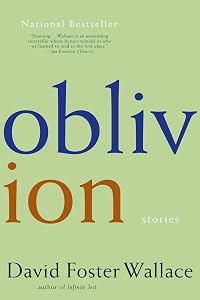
Oblivion: Stories
by David Foster Wallace 
On This Page
Description
In the stories that make up Oblivion, David Foster Wallace joins the rawest, most naked humanity with the infinite involutions of self-consciousness--a combination that is dazzlingly, uniquely his. These are worlds undreamt of by any other mind. Only David Foster Wallace could convey a father's desperate loneliness by way of his son's daydreaming through a teacher's homicidal breakdown ("The Soul Is Not a Smithy"). Or could explore the deepest and most hilarious aspects of creativity by show more delineating the office politics surrounding a magazine profile of an artist who produces miniature sculptures in an anatomically inconceivable way ("The Suffering Channel"). Or capture the ache of love's breakdown in the painfully polite apologies of a man who believes his wife is hallucinating the sound of his snoring ("Oblivion"). Each of these stories is a complete world, as fully imagined as most entire novels, at once preposterously surreal and painfully immediate. show lessTags
Recommendations







Member Reviews
Not only in light of DFW's suicide I don't think, but certainly in light of it, the despair that this collection of stories is shot through with is sobering. There is here a merciless, microlevel, and exacting existential critique both of our outward facing lives in contemporary society, centered in the banalities and inanities of work life, showing through the characters' very commitment to their jobs and roles the utter meaninglessness of them without having to stoop to any even tiny bit of triteness in making the point (instead depending heavily on, ahem, irony), and of our inner lives, or at least of his own inner life, I'm afraid, weighted down heavily with contradictory feelings of grandiosity and insignificance, of feeling like a show more genius and feeling like the worst fraud imaginable.
I don't know how exactly true to life the hilarious and pathetic workplace procedures and terminology and culture and such of the focus group and market testing company as portrayed in the opener, "Mister Squishy", are, as the characters revolve around a new snack cake confection, but the existential horror of finding oneself spending one's life in such an environment is effectively (and comprehensively... some might say too comprehensively!) portrayed.
"The Soul Is Not A Smithy" continues this theme of the horror of modern adult life in a story from the point of view of a grown man looking back to when he was a grade school student involved in an "incident" when he failed to notice his teacher having a mental breakdown at the blackboard, so occupied was he in his own creative imaginations that his soul could be said to be absent from the classroom his body is sat in. The adult narrator at one point remarks,
In "Good Old Neon" the narrator turns from the despair over one's outward-facing life to despair over one's core inner self. Essentially, the feeling that human nature is fundamentally bad, in some sense. He expresses this through a focus on how his connection to other people is inauthentic due to an inability to be honest about himself:
I mean. Ouch.
I can imagine a "love it or hate it" reaction to the prose itself in this collection. I listened to it as an audiobook and thought it worked really well. I'm curious how I would have taken the prose if I was reading it in print instead.
Normally I think I wouldn't be a fan of something that comes off overall so, well, nihilistic. But it's not for effect, not to be transgressive, not fraudulent one might say. The voices here are at root sympathetically all too human, even good, it seems to me. They just can't see their way out into something more of the light. show less
I don't know how exactly true to life the hilarious and pathetic workplace procedures and terminology and culture and such of the focus group and market testing company as portrayed in the opener, "Mister Squishy", are, as the characters revolve around a new snack cake confection, but the existential horror of finding oneself spending one's life in such an environment is effectively (and comprehensively... some might say too comprehensively!) portrayed.
"The Soul Is Not A Smithy" continues this theme of the horror of modern adult life in a story from the point of view of a grown man looking back to when he was a grade school student involved in an "incident" when he failed to notice his teacher having a mental breakdown at the blackboard, so occupied was he in his own creative imaginations that his soul could be said to be absent from the classroom his body is sat in. The adult narrator at one point remarks,
For my own part, I had begun having nightmares about the reality of adult life as early as perhaps age seven. I knew, even then, that the dreams involved my father’s life and job and the way he seemed when he returned home from work at the end of the day.
In "Good Old Neon" the narrator turns from the despair over one's outward-facing life to despair over one's core inner self. Essentially, the feeling that human nature is fundamentally bad, in some sense. He expresses this through a focus on how his connection to other people is inauthentic due to an inability to be honest about himself:
There was a basic logical paradox that I called the 'fraudulence paradox' that I had discovered more or less on my own while taking a mathematical logic course in school...The fraudulence paradox was that the more time and effort you put into trying to appear impressive or attractive to other people, the less impressive or attractive you felt inside - you were a fraud. And the more of a fraud you felt like, the harder you tried to convey an impressive or likable image of yourself so that other people wouldn't find out what a hollow, fraudulent person you really were.
I mean. Ouch.
I can imagine a "love it or hate it" reaction to the prose itself in this collection. I listened to it as an audiobook and thought it worked really well. I'm curious how I would have taken the prose if I was reading it in print instead.
Normally I think I wouldn't be a fan of something that comes off overall so, well, nihilistic. But it's not for effect, not to be transgressive, not fraudulent one might say. The voices here are at root sympathetically all too human, even good, it seems to me. They just can't see their way out into something more of the light. show less
Oblivion reads like a catalog of horrors. Exquisitely wrought horrors. I loved it. The craft in these stories is astonishing, the way they work technically.
Three stories stood out for me: Good Old Neon, Oblivion, and The Suffering Channel. The Suffering Channel is more of a novella, and it's incredibly powerful. On the surface, it's about a 'People'-like magazine doing a story on an 'artist' who poops fully formed sculptures; but that's just on the surface. The story is also Wallace's reaction to September 11th (I know that seems like a big leap, but he pulls it off brilliantly). It functions as a sort of wakeup call to our culture, but not in an obnoxious, manifesto-like way.
In a culture full of beautiful shit, Wallace's writing was a show more cool clear clean reservoir of potable water. God damn it why did he have to kill himself. show less
Three stories stood out for me: Good Old Neon, Oblivion, and The Suffering Channel. The Suffering Channel is more of a novella, and it's incredibly powerful. On the surface, it's about a 'People'-like magazine doing a story on an 'artist' who poops fully formed sculptures; but that's just on the surface. The story is also Wallace's reaction to September 11th (I know that seems like a big leap, but he pulls it off brilliantly). It functions as a sort of wakeup call to our culture, but not in an obnoxious, manifesto-like way.
In a culture full of beautiful shit, Wallace's writing was a show more cool clear clean reservoir of potable water. God damn it why did he have to kill himself. show less
To say that Wallace is an enigma and a genius is not going too far. As I read these stories, I had the oddest sensation that most if not all of them were about aspects of his own experience: of being a boy genius, of being barely in control of himself, of harboring poisonous thoughts that could kill someone (read, black widow spiders) in his head (house), of creating shit (art) that is somehow great art, and yet, still nothing but shit, when you get right down to it. The gift for detail is clearly the result of eidetic memory and obsessive tendencies. As each story is about people who are (in some cases literally) falling apart, the title suggests a deeper theme of desire for surcease from the intense suffering which is common to all show more the characters in all the stories. One, a story about a suicide, comes as close to showing, step-by-step what is going through the mind of a person desperate enough to kill himself. However, what distinguishes Wallace most from post-modern writers (I'm thinking, say, the likes of Witold Gombrowitz or Peter Handke and other obsessively detailed types) is the compassion, the empathy, the - dare I say it - love and affection and pity Wallace pours into each character -- and often quite minor characters have a 'roundness' that is astonishing -- even while ruthlessly ripping them to shreds.
I put ****1/2 stars perversely and pointlessly just to leave room (sort of like those annoying ice-skating judges?) to go higher. It's meaningless, really, Wallace feels like post 2001 (as in Arthur C. Clarke) being different, evolved. As a writer, I feel humbled by him.
Not for the squeamish, not for readers who don't like being inundated with details and lingo, not for readers who like stories to proceed in an orderly manner (Wallace sometimes, in the middle of a long disquisition about one thing, will insert one sentence about something else entirely before sweeping onward), not for readers who don't like either long sentences or long paragraphs...... show less
I put ****1/2 stars perversely and pointlessly just to leave room (sort of like those annoying ice-skating judges?) to go higher. It's meaningless, really, Wallace feels like post 2001 (as in Arthur C. Clarke) being different, evolved. As a writer, I feel humbled by him.
Not for the squeamish, not for readers who don't like being inundated with details and lingo, not for readers who like stories to proceed in an orderly manner (Wallace sometimes, in the middle of a long disquisition about one thing, will insert one sentence about something else entirely before sweeping onward), not for readers who don't like either long sentences or long paragraphs...... show less
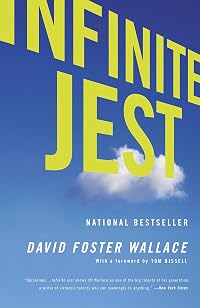
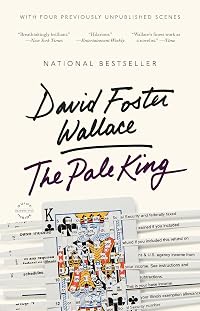
If you are considering reading the ultimate post-modernist work, Wallace's Infinite Jest, but you just can't commit to reading a 1,000-page novel, get a taste of it with these stories. In them, DFW experiments with facets of the techniques that make his writing unique: the narcissistic neurotic who overanalyzes himself; the boring job reported in detail; the absurdities of American corporations; the speech tics that make his characters painfully real; suicide; childhood trauma; unusual physical deformities and abilities. All these themes appear here in exquisitely crafted stories that echo Infinite Jest and prefigure The Pale King.
Zo. Dit was alvast het meest uitdagende boek van David Foster Wallace dat ik las, misschien wel het meest uitdagende boek dat ik ooit las tout court.
Nu was het een doel van Foster Wallace om zijn lezers uit te dagen en hen "net als in het echte leven" te leren genieten van dingen waarvoor ze moesten werken, omdat hij dat als een meerwaarde beschouwde tegenover de eenvoudige, hapklare populaire tv-cultuur. Die missie is alvast geslaagd, me dunkt.
Vier sterren gaf ik toch met overtuiging (een halve ster ongetwijfeld voor mezelf, omdat ik de uitdaging ben aangegaan en niet opgaf toen ze te zwaar leek te worden) 3,5 voor het boek omdat het een verhalenbundel is, en je niet alle verhalen over dezelfde kam kan scheren.
Van de acht verhalen show more zijn er enkele waarover ik niets te vertellen heb maar met plezier las (3 sterren) en andere die me nog lang zullen bijblijven (4 sterren).
Sommige verhalen bloeiden open naarmate ik aandachtiger werd of verder vorderde, andere leken hermetisch gesloten te blijven maar boeiden me toch.
Wie Wallace leest omwille van zijn stijl zal nooit ontgoocheld worden en telkens opnieuw geprikkeld worden. Wie Wallace leest omwille van zijn sociaal empatisch vermogen zal ook niet ontgoocheld worden, al is het soms graven door de verschillende stijl-lagen heen om die te vinden.
Maar laat dat nu net zijn kracht zijn: de verhalen die me lagen en waarin ik mijn weg vond, fileerden relevante kanten van ons bestaan op manieren die ik voorheen niet zag. Ik geloof dat Wallace daarin net een meester was: de weg zo plaveien, soms vol obstakels en doornen, dat als de boodschap bereikt wordt, ze glashelder is. En dan ben je als lezer niet alleen verheugd dat je de uitdaging bent aangegaan, maar evenzeer verblind, geraakt of verbluft door de dingen die Wallace voor je klaar heeft gelegd. Straf. show less
Nu was het een doel van Foster Wallace om zijn lezers uit te dagen en hen "net als in het echte leven" te leren genieten van dingen waarvoor ze moesten werken, omdat hij dat als een meerwaarde beschouwde tegenover de eenvoudige, hapklare populaire tv-cultuur. Die missie is alvast geslaagd, me dunkt.
Vier sterren gaf ik toch met overtuiging (een halve ster ongetwijfeld voor mezelf, omdat ik de uitdaging ben aangegaan en niet opgaf toen ze te zwaar leek te worden) 3,5 voor het boek omdat het een verhalenbundel is, en je niet alle verhalen over dezelfde kam kan scheren.
Van de acht verhalen show more zijn er enkele waarover ik niets te vertellen heb maar met plezier las (3 sterren) en andere die me nog lang zullen bijblijven (4 sterren).
Sommige verhalen bloeiden open naarmate ik aandachtiger werd of verder vorderde, andere leken hermetisch gesloten te blijven maar boeiden me toch.
Wie Wallace leest omwille van zijn stijl zal nooit ontgoocheld worden en telkens opnieuw geprikkeld worden. Wie Wallace leest omwille van zijn sociaal empatisch vermogen zal ook niet ontgoocheld worden, al is het soms graven door de verschillende stijl-lagen heen om die te vinden.
Maar laat dat nu net zijn kracht zijn: de verhalen die me lagen en waarin ik mijn weg vond, fileerden relevante kanten van ons bestaan op manieren die ik voorheen niet zag. Ik geloof dat Wallace daarin net een meester was: de weg zo plaveien, soms vol obstakels en doornen, dat als de boodschap bereikt wordt, ze glashelder is. En dan ben je als lezer niet alleen verheugd dat je de uitdaging bent aangegaan, maar evenzeer verblind, geraakt of verbluft door de dingen die Wallace voor je klaar heeft gelegd. Straf. show less
David Foster Wallace is divisive, and with good reason. I'll try my best not to dive too deep into my opinion of the author; it's more or less irrelevant. But I do think his flaws as a man shine through into his literature. Sometimes it feels like DFW has his head too far up his own ass. A modest man simply doesn't write the 1000 page Infinite Jest, and frankly he shouldn't have. That is, he shouldn't have dedicated his career to torturous and inaccessible writings. Wallace was a wizard, one of the greatest prose writers of the last 50 years. Possibly the most recent entry into the grand American literary canon. But it seemed as though he demanded everything he write be hard to read, and he succeeded, much to the chagrin of everyone show more that isn't willing to pretend they've read a book to seem super smart.
I'm not super smart. But I don't really mind that much, so I freely admit that a Wallace book is like a brick wall to get through. However, underneath it all is the classic story of the tortured genius, the artist in pain. Oblivion is some of his better work: an ultimately uneven and disjointed collection of essays, it feels tossed together but still quietly significant. Wallace is also performing some of his most pessimistic work in this book, with some of the stories being incredibly bleak with no sign of light at the end of the tunnel. What changed, since Jest, when he proposed that language and communication holds the key to breaking from our media-induced hypnoses? Maybe as he got older he got more disenchanted with the world (which is not even a theory, really). Maybe he intended Pale King to follow this book up to provide the blueprint out of the weeds. Or maybe he just wanted to wanted to write about bleakness, darkness, oblivion.
There's 3 grounds to evaluate a book on. Well, there's a lot more than 3, but I use 3 big ones. Intention, Affect, and Merit. The problem with Wallace is that I value his writing so much on literary merit, but question what he's always trying to accomplish and don't always love the result personally. This book is generally no exception, although it's more complicated than that. There's really two Wallaces that emerge from this book, depending on the story and how each one lands for you. Either you see his excessive description as sophomoric and weak, an attempt at using random details to sound smart and immersive, when all it really does is bog down the more interesting themes in a bunch of bullshit that scares away casual readers. Or, you can see his description as a brilliant way to establish humanity- our selves are so intimately tied to random pieces of information and identity, soaking a story in minutia is the only real way to make it seem like something that would happen in modern America. There's nothing more American than random bullshit. What I like about these stories, as opposed to his brick novels, is that the description doesn't generally feel like the means to an end, it's not building to anything. Building to something makes description a tool for some higher purpose, which wouldn't explain why it's so painful to read. The better use for it, and the one more commonly employed here, is that the the description is not a means to an end but an end in of itself.
No matter what, this is all a pretty nuanced line to walk. I have a lot of conflicting thoughts about DFW that extend beyond this book. I'd re-review Infinite Jest every 6 months if I could, but that would probably require reading it again and I refuse to do so. Wallace's stories and essays are a more digestible form of his writing, where one can properly appreciate his talents without having to resort to cult worship just to find the motivation to get through all the footnotes. Oblivion isn't great, but it's good! Several of the essays even get up to fantastic territory, but you have to do some digging to get there.
Which makes this book an incredible starting point for DFW. If that's what you're looking for, find it here. But go in with an open mind, really read each page, and don't tie this book (or any other) to your identity or sense of intellect. No book is worth that. But this book is great for literary nerds and could lead you down a path of writing that is ripe for the chewing and analyzing.
Wallace believed that there were 3 parts of life: shit, art, death. No part was more or less beautiful than the others, all equally important. This book basks in all 3, but doesn't quite find the coherence or optimism to distinguish them. Otherwise, it's typical DFW work, and that should define your opinion of the book. show less
I'm not super smart. But I don't really mind that much, so I freely admit that a Wallace book is like a brick wall to get through. However, underneath it all is the classic story of the tortured genius, the artist in pain. Oblivion is some of his better work: an ultimately uneven and disjointed collection of essays, it feels tossed together but still quietly significant. Wallace is also performing some of his most pessimistic work in this book, with some of the stories being incredibly bleak with no sign of light at the end of the tunnel. What changed, since Jest, when he proposed that language and communication holds the key to breaking from our media-induced hypnoses? Maybe as he got older he got more disenchanted with the world (which is not even a theory, really). Maybe he intended Pale King to follow this book up to provide the blueprint out of the weeds. Or maybe he just wanted to wanted to write about bleakness, darkness, oblivion.
There's 3 grounds to evaluate a book on. Well, there's a lot more than 3, but I use 3 big ones. Intention, Affect, and Merit. The problem with Wallace is that I value his writing so much on literary merit, but question what he's always trying to accomplish and don't always love the result personally. This book is generally no exception, although it's more complicated than that. There's really two Wallaces that emerge from this book, depending on the story and how each one lands for you. Either you see his excessive description as sophomoric and weak, an attempt at using random details to sound smart and immersive, when all it really does is bog down the more interesting themes in a bunch of bullshit that scares away casual readers. Or, you can see his description as a brilliant way to establish humanity- our selves are so intimately tied to random pieces of information and identity, soaking a story in minutia is the only real way to make it seem like something that would happen in modern America. There's nothing more American than random bullshit. What I like about these stories, as opposed to his brick novels, is that the description doesn't generally feel like the means to an end, it's not building to anything. Building to something makes description a tool for some higher purpose, which wouldn't explain why it's so painful to read. The better use for it, and the one more commonly employed here, is that the the description is not a means to an end but an end in of itself.
No matter what, this is all a pretty nuanced line to walk. I have a lot of conflicting thoughts about DFW that extend beyond this book. I'd re-review Infinite Jest every 6 months if I could, but that would probably require reading it again and I refuse to do so. Wallace's stories and essays are a more digestible form of his writing, where one can properly appreciate his talents without having to resort to cult worship just to find the motivation to get through all the footnotes. Oblivion isn't great, but it's good! Several of the essays even get up to fantastic territory, but you have to do some digging to get there.
Which makes this book an incredible starting point for DFW. If that's what you're looking for, find it here. But go in with an open mind, really read each page, and don't tie this book (or any other) to your identity or sense of intellect. No book is worth that. But this book is great for literary nerds and could lead you down a path of writing that is ripe for the chewing and analyzing.
Wallace believed that there were 3 parts of life: shit, art, death. No part was more or less beautiful than the others, all equally important. This book basks in all 3, but doesn't quite find the coherence or optimism to distinguish them. Otherwise, it's typical DFW work, and that should define your opinion of the book. show less
So dense, it feels like an evolution in the history of the short story form, with converging plot-lines that resolve just out of reach of the readers' immediate consciousness.
Oblivion is my favorite book, by the author I most admire in the world.
But that density is its own cost, and so beware, please, the amount of attention required to get everything available out of it.
Still, to reference an ancient SNL sketch: "I laughed. I cried. It was better than Cats. I'm going to [read] it again and again."
Oblivion is my favorite book, by the author I most admire in the world.
But that density is its own cost, and so beware, please, the amount of attention required to get everything available out of it.
Still, to reference an ancient SNL sketch: "I laughed. I cried. It was better than Cats. I'm going to [read] it again and again."
Members
- Recently Added By
Lists

Top Five Books of 2014
1,064 works; 398 members

Vulture's 100 Best Books of the 21st Century (So Far)
98 works; 9 members

Read in 2021
25 works; 1 member
Author Information

89+ Works 47,636 Members
Writer David Foster Wallace was born in Ithaca, New York on February 21, 1962. He received a B.A. from Amherst College in Massachusetts. He was working on his master's degree in creative writing at the University of Arizona when he published his debut novel The Broom of the System (1987). Wallace published his second novel Infinite Jest (1996) show more which introduced a cast of characters that included recovering alcoholics, foreign statesmen, residents of a halfway house, and high-school tennis stars. He spent four years researching and writing this novel. His first collection of short stories was Girl with Curious Hair (1989). He also published a nonfiction work titled Signifying Rappers: Rap and Race in the Urban Present. He committed suicide on September 12, 2008 at the age of 46 after suffering with bouts of depression for 20 years. (Bowker Author Biography) show less
David Foster Wallace has a Legacy Library. Legacy libraries are the personal libraries of famous readers, entered by LibraryThing members from the Legacy Libraries group.
Awards and Honors
Work Relationships
Contains
Common Knowledge
- Canonical title
- Oblivion: Stories
- Original title
- Oblivion
- Original publication date
- 2004
- Publisher's editor
- Pietsch, Michael
Classifications
Statistics
- Members
- 2,761
- Popularity
- 6,628
- Reviews
- 39
- Rating
- (3.93)
- Languages
- 9 — Czech, English, French, German, Greek, Italian, Norwegian (Bokmål), Polish, Spanish
- Media
- Paper, Audiobook, Ebook
- ISBNs
- 34
- ASINs
- 11