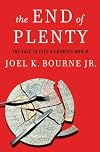
The End of Plenty: The Race to Feed a Crowded World
by Joel K. Bourne Jr
On This Page
Description
When the demographer Robert Malthus (1766-1834) outlined the brutal relationship between food and population, he never imagined the success of modern scientific agriculture. In the mid-twentieth century, an unprecedented agricultural advancement known as the Green Revolution brought hybrid seeds, chemical fertilizers, and improved irrigation that drove the greatest population boom in history but left ecological devastation in its wake. In The End of Plenty, environmental journalist Joel K. show more Bourne Jr. puts our race to feed the world in dramatic perspective. With a skyrocketing world population and tightening global grain supplies spurring riots and revolutions, humanity must produce as much food in the next four decades as it has since the beginning of civilization to avoid a Malthusian catastrophe. Yet climate change could render half our farmland useless by century's end. Bourne takes readers from his family farm to international agricultural hotspots to introduce the new generation of farmers and scientists engaged in the greatest challenge humanity has ever faced. He discovers young, corporate cowboys trying to revive Ukraine as Europe's breadbasket, a Canadian aquaculturist channeling ancient Chinese traditions, the visionary behind the world's largest organic sugar-cane plantation, and many other extraordinary individuals struggling to increase food supplies -- quickly and sustainably -- as droughts, floods, and heat waves hammer crops around the globe. show lessTags
Recommendations



















Member Reviews
This reads exactly like your standard National Geographic magazine story. It isn't terrible, and does have a good high-level overview of food security and the Green Revolution, fairly standard stuff. But there's also lots of gee-whiz reporting, uncritical reporting based on single sources, and some questionable choices of topics. That's why I mostly look at the pictures!
> "To sequence the Arabidopsis genome—the fruit fly of plant breeders—took $70 million and seven years," says Pam Ronald, a rice geneticist at UC Davis. "The same process is now done in a week for $99. …"
> The food riots in Haiti in 2008 revealed the pitfalls of relying on free trade to provide a poor nation with its staple grain. Haiti had been self-sufficient in show more rice as late as the mid-1980s. But in 1994, when President Bill Clinton restored ousted President Jean Bertrand Aristide to power, he requested that Aristide drop Haiti's protective tariffs on imported rice. The country was soon flooded with cheap "Miami rice" from the United States, a crop that is heavily subsidized and grown in just a few states, including Clinton's home state of Arkansas. The imports destroyed local rice production—Haiti's small farmers simply couldn't compete—and left the poorest nation in the Western Hemisphere at the mercy of the international grain market. show less
> "To sequence the Arabidopsis genome—the fruit fly of plant breeders—took $70 million and seven years," says Pam Ronald, a rice geneticist at UC Davis. "The same process is now done in a week for $99. …"
> The food riots in Haiti in 2008 revealed the pitfalls of relying on free trade to provide a poor nation with its staple grain. Haiti had been self-sufficient in show more rice as late as the mid-1980s. But in 1994, when President Bill Clinton restored ousted President Jean Bertrand Aristide to power, he requested that Aristide drop Haiti's protective tariffs on imported rice. The country was soon flooded with cheap "Miami rice" from the United States, a crop that is heavily subsidized and grown in just a few states, including Clinton's home state of Arkansas. The imports destroyed local rice production—Haiti's small farmers simply couldn't compete—and left the poorest nation in the Western Hemisphere at the mercy of the international grain market. show less
Serious study of food. Covers the world and history. From farming practices, GMO, sex (population booms), wars, weather, and all of the other related details - this is a serious call to attention of where we will feed the world.
Referenced on NPR program, June 8, 2015.
Ratings
Members
- Recently Added By
Lists

2016 Notable Books for Adults
26 works; 7 members
Author Information
3+ Works 79 Members
Awards and Honors
Common Knowledge
- Original publication date
- 2015
Classifications
- Genres
- Nonfiction, Economics, Science & Nature, General Nonfiction, Food & Cooking, Business
- DDC/MDS
- 363.8 — Society, Government, and Culture Social problems and social services Other social problems and services Food supply
- LCC
- HD9000.5 .B58 — Social sciences Industries. Land use. Labor Industries. Land use. Labor Special industries and trades Agricultural industries
- BISAC
Statistics
- Members
- 72
- Popularity
- 418,860
- Reviews
- 3
- Rating
- (3.56)
- Languages
- English
- Media
- Paper, Ebook
- ISBNs
- 6
- ASINs
- 1