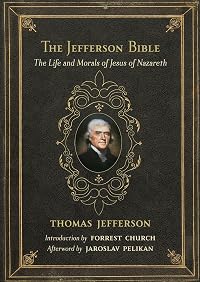
The Jefferson Bible: The Life and Morals of Jesus of Nazareth
by Thomas Jefferson 
On This Page
Description
In 1804 Thomas Jefferson decided to study the gospels to see if he could distill the essence of Jesus' teachings into a concise book that could be quickly read and easily understood. This volume is the result, offering valuable insights into the teachings of Jesus Christ and into the mind and beliefs of Thomas Jefferson. This edition is lavishly illustrated with twelve illustrations by Robert Scott Crandall that are designed to enhance your reading experience.Tags
Recommendations















Member Recommendations
Member Reviews
Finally, I have finished The Jefferson Bible, only took me two years to read a 169 page book. It's not for the lack on content or boring subject, I just kept losing my place over and over and over again... It's hard to find any organization that the original text had since Jefferson literally did a cut and paste job to produce this book, so I kept getting lost trying to follow the chapter verse layout.
Thomas Jefferson worked for a couple restless nights in Washington carefully extracting bible passages from the gospels to revile the true essence of religion; collecting them into a single common sense gospel narrative. A brilliant and enlightening take on the essential heart of the teachings of Jesus of absolute love and service to show more others. Mr. Jefferson eliminated the virgin birth, the miraculous healings, and the resurrection, leaving only the essential teachings and a very human biography of Jesus.
I found it fascinating to see which passages Jefferson felt were the correct telling of Jesus's life and what could be discarded. Then to try to piece those passages into a coherent biography. I think Jefferson did an admirable job, but parts still don't seem to fit quite right, often redundant information is conveyed in several places. I think that has far more to do with the structure of the gospels themselves then with Jefferson's edits. Overall, I feel this is one of the best ways to understand and grasp the true teachings of Jesus of Nazareth. show less
Thomas Jefferson worked for a couple restless nights in Washington carefully extracting bible passages from the gospels to revile the true essence of religion; collecting them into a single common sense gospel narrative. A brilliant and enlightening take on the essential heart of the teachings of Jesus of absolute love and service to show more others. Mr. Jefferson eliminated the virgin birth, the miraculous healings, and the resurrection, leaving only the essential teachings and a very human biography of Jesus.
I found it fascinating to see which passages Jefferson felt were the correct telling of Jesus's life and what could be discarded. Then to try to piece those passages into a coherent biography. I think Jefferson did an admirable job, but parts still don't seem to fit quite right, often redundant information is conveyed in several places. I think that has far more to do with the structure of the gospels themselves then with Jefferson's edits. Overall, I feel this is one of the best ways to understand and grasp the true teachings of Jesus of Nazareth. show less
Only mildly interesting and less "enlightened" than moralistic. Jefferson's selections of "truth" are alternately redundant or contradictory, and his English translation of some words ill-chosen (e.g., "straight" when the context calls for "narrow"). The God of his Deism and his definition of morality are straight from the patriarchal Old Testament of the Jewish faith, despite his concentration on only the gospels, which is consistent with the fact that Jesus was a Jew but not necessarily with his message.
Raised by agnostics, I never had much of a religious education. This book, which was written to focus on the actions and words of Jesus which did not appear to be miraculous, seemed to be a good way to learn about the doctrine of someone who is arguably the most influential people in history. Stripping away the divine acts, the reader is left with a narrative about a man seeking to reform the morality of his time.
Some elements of his philosophy resonate more than others. I wasn't particularly moved by Jesus' proclamations on divorce and adultery. As one who has never has been compelled to change my behavior in the Sabbath, his early counsels not to refrain from doing good works on Sunday seem as a matter of course. Other ideas I show more appreciated more, such as his precepts to love - to love one's neighbor, to love one's enemy. If the world were occupied by more people who sought the betterment of the conditions of others, we would be doing better, I think. To the extent that he talks about money (and I was surprised to discover how much money was discussed), Jesus seemed to favor the rich over the poor, and believe in lifting up those who had the least. In this sense, I think I would have agreed with the person whose creed has become such a world-shaping force.
Ultimately, I was surprised at how brief the read was. Sans miracles, divinity, and awe, the Gospels are a remarkably brief text on a someone who appears to have been an influential, respected man of his time. I'm glad to have read the book, but I have to admit I wasn't much moved by it. show less
Some elements of his philosophy resonate more than others. I wasn't particularly moved by Jesus' proclamations on divorce and adultery. As one who has never has been compelled to change my behavior in the Sabbath, his early counsels not to refrain from doing good works on Sunday seem as a matter of course. Other ideas I show more appreciated more, such as his precepts to love - to love one's neighbor, to love one's enemy. If the world were occupied by more people who sought the betterment of the conditions of others, we would be doing better, I think. To the extent that he talks about money (and I was surprised to discover how much money was discussed), Jesus seemed to favor the rich over the poor, and believe in lifting up those who had the least. In this sense, I think I would have agreed with the person whose creed has become such a world-shaping force.
Ultimately, I was surprised at how brief the read was. Sans miracles, divinity, and awe, the Gospels are a remarkably brief text on a someone who appears to have been an influential, respected man of his time. I'm glad to have read the book, but I have to admit I wasn't much moved by it. show less
In his forward, Brent D. Glass writes, “By removing all references to superstition and the supernatural, Jefferson made clear his admiration of Jesus as a great teacher and moral philosopher while, at the same time, reaffirming his belief in and commitment to the power of reason as the basis for understanding life and the natural world” (pg. 7). Since all interpretations of the Bible are now biased by what the reader wants to find within its pages, it’s refreshing to see such an honest edit to a book that has undergone innumerable edits, translations, and other changes. According to Harry R. Rubenstein and Barbara Clark Smith, “Left behind in the source material were those elements that [Jefferson] could not support through show more reason, that he believed were later embellishments, or that seemed superfluous or repetitious across the Four Evangelists’ accounts. Absent are the annunciation, the resurrection, the water being turned to wine, and the multitudes fed on five loaves of bread and two fishes. It essentially offers what the title indicates: a distillation of the teachings of Jesus the moral reformer, combined with what Jefferson accepted as the historical facts pertaining to Jesus the man” (pg. 30). The main text of this facsimile reprint shows Jefferson’s cut-and-paste technique of removing supernatural elements, cleaning up the text to prevent multiple prepositions on the same sentence, and even allowing Jefferson to compare the original Greek text of the four Gospels, alongside their Latin, French, and English translations (pg. 38-39). For the philologist or those looking to see how meaning changed via translation, the work allows them to follow Jefferson’s scholarship. Further, the work represents an early step in scholarship on the historicity of Jesus, making it a must-read for all religious scholars. Finally, the Jefferson Bible offers the unique opportunity to gain insight into the private thoughts of one of the Founding Fathers of the nation who was among the first to articulate freedom of religion. show less
I picked this up because it was recommended to me as "Jesus without the magic," which it turns out is not quite what it is (nor quite what I was interested in). But like any "best of" list, the most entertaining part of this is arguing with the selections -- "divorce is adultery" is in (twice!) but not the loaves and the fishes? I get wanting to take out the miracles, but in the process Jefferson's managed to remove everything that made it sound like the guy had a sense of humor. I was prepared to be annoyed by duplication, but it turns out that putting in the same story told in different gospels gives a remarkable effect of veracity.
It's an interesting idea. Take the four gospels of the new testament. Put all the accounts into one linear volume and cut out the miracles. What you have is the account of a philosopher/story-teller with a very unhappy ending.
I liked it. It only takes a couple of hours to read, I got to refamiliarise myself with all the parables and imagine a more relatable Jesus figure.
Other only real problem is it gets a bit repetitive. The same lessons get taught at different times over the four gospels so now all the stories are compiled into one Jesus repeats himself a lot.
Not quite sure what the point was. As an atheist, I appreciate a more reality-based telling and can get behind a "be excellent to each other" type message but it's still very show more heavy on "the coming of the kingdom of Christ." Not sure the purpose of taking out miracle healing and virgin births but keeping references to angels, heaven, hell, and all that stuff. It kind of leaves the book in an odd place, it's enough to upset the people that like full-blown magical Jesus but not enough to win over people that want to follow the golden rule without needing heavenly rewards pushed on them. I guess the Jefferson bible is headed to book limbo. show less
I liked it. It only takes a couple of hours to read, I got to refamiliarise myself with all the parables and imagine a more relatable Jesus figure.
Other only real problem is it gets a bit repetitive. The same lessons get taught at different times over the four gospels so now all the stories are compiled into one Jesus repeats himself a lot.
Not quite sure what the point was. As an atheist, I appreciate a more reality-based telling and can get behind a "be excellent to each other" type message but it's still very show more heavy on "the coming of the kingdom of Christ." Not sure the purpose of taking out miracle healing and virgin births but keeping references to angels, heaven, hell, and all that stuff. It kind of leaves the book in an odd place, it's enough to upset the people that like full-blown magical Jesus but not enough to win over people that want to follow the golden rule without needing heavenly rewards pushed on them. I guess the Jefferson bible is headed to book limbo. show less
Although modern listings all refer to this book as “The Jefferson Bible” the proper title, the one that the editor, Thomas Jefferson, gave it is “The Life and Morals of Jesus of Nazareth” I call Jefferson the editor, not the author, for the very good reason that he did not write the book he assembled it. He literally cut and pasted it together from six of his own Bibles, two in English, two in French, and two with both Latin and Greek text printed in parallel. One of the library subject listings for the book explains Jefferson’s intention very succinctly, “Jesus Christ › Biography › Sources, Biblical” Each of the four Gospels tells the same story, the biography of Jesus. Jefferson extracted the biographical information show more from each and assembled them to tell the story of Jesus’ life in a single unit.
I have had the book on my shelves for several years and was motivated to read it after seeing the very Bibles that Jefferson worked with on display at the Smithsonian Museum of American History. I was also interested in learning, after listening to current politicians, what blasphemy Jefferson had committed. All i found is that In one spot he missed clipping all the words in a phrase and in another he lightly wrote in the margin his understanding of the Roman law the priests charged Jesus with breaking. Jefferson seemed to agree with Pilate on Jesus’ innocence. I found no blasphemy. Except for the notes in the margins every word also found in every modern Bible and I expect that many people write notes in the margins of their Bibles, hoping to clarify their thoughts on passages, without committing blasphemy. The missing words, they are at least a harmless mistake made by a 77 year old man tired after a days work and at worst a venial sin of omission.
My edition of Jefferson’s work has a preface by Forrest Church and a short article by Jaroslav Pelkan, both of which help illuminate Jefferson’s motivation for this project and explain the idea of exploring Jesus as a moral teacher, a project undertaken by several of Jefferson’s contemporaries in several forms as the article explains.
It is the morals of Jesus that most stand out after Jefferson finished with his razor and gluepot. “The Life and Morals of Jesus of Nazareth” show that Jesus spoke more of virtue than sin, unlike modern Christians. The road to damnation is not traveled by sinners, they can be forgiven. Damnation, according to the words of Jesus, comes from a lack of virtue. (Matthew 25:37-46)
Much of Jefferson’s earlier writings appears to be inspired by the words of Jesus. “We hold these truths to be self-evident, that all men are created equal, that they are endowed by their Creator with certain unalienable Rights, that among these are Life, Liberty and the pursuit of Happiness.” is, in meaning, no different from the text in Matthew cited above. And what is (Matthew 22:20-22) but Jesus saying that God, the Church, is separate from the state, Caesar.?
Jefferson was concerned that the authors of the Gospels wrote many years after the events they told of and that they were carpenters and fishermen, not men of letters. He also worried that translators over the centuries may have introduced errors, either accidentally or otherwise. Jefferson was very aware of the compromises that need to be made when writing as a group, even in a group of well meaning men. He felt that focusing on the words and acts of Jesus would permit him to see the essence of Christ's teaching. If he was successful it appears to me that modern “Christians” have drifted far from what Jesus taught and have become simply Old Testament Gentiles. show less
I have had the book on my shelves for several years and was motivated to read it after seeing the very Bibles that Jefferson worked with on display at the Smithsonian Museum of American History. I was also interested in learning, after listening to current politicians, what blasphemy Jefferson had committed. All i found is that In one spot he missed clipping all the words in a phrase and in another he lightly wrote in the margin his understanding of the Roman law the priests charged Jesus with breaking. Jefferson seemed to agree with Pilate on Jesus’ innocence. I found no blasphemy. Except for the notes in the margins every word also found in every modern Bible and I expect that many people write notes in the margins of their Bibles, hoping to clarify their thoughts on passages, without committing blasphemy. The missing words, they are at least a harmless mistake made by a 77 year old man tired after a days work and at worst a venial sin of omission.
My edition of Jefferson’s work has a preface by Forrest Church and a short article by Jaroslav Pelkan, both of which help illuminate Jefferson’s motivation for this project and explain the idea of exploring Jesus as a moral teacher, a project undertaken by several of Jefferson’s contemporaries in several forms as the article explains.
It is the morals of Jesus that most stand out after Jefferson finished with his razor and gluepot. “The Life and Morals of Jesus of Nazareth” show that Jesus spoke more of virtue than sin, unlike modern Christians. The road to damnation is not traveled by sinners, they can be forgiven. Damnation, according to the words of Jesus, comes from a lack of virtue. (Matthew 25:37-46)
Much of Jefferson’s earlier writings appears to be inspired by the words of Jesus. “We hold these truths to be self-evident, that all men are created equal, that they are endowed by their Creator with certain unalienable Rights, that among these are Life, Liberty and the pursuit of Happiness.” is, in meaning, no different from the text in Matthew cited above. And what is (Matthew 22:20-22) but Jesus saying that God, the Church, is separate from the state, Caesar.?
Jefferson was concerned that the authors of the Gospels wrote many years after the events they told of and that they were carpenters and fishermen, not men of letters. He also worried that translators over the centuries may have introduced errors, either accidentally or otherwise. Jefferson was very aware of the compromises that need to be made when writing as a group, even in a group of well meaning men. He felt that focusing on the words and acts of Jesus would permit him to see the essence of Christ's teaching. If he was successful it appears to me that modern “Christians” have drifted far from what Jesus taught and have become simply Old Testament Gentiles. show less
Members
- Recently Added By
Published Reviews
ThingScore 75
A lovely addition to thoroughgoing Americana collections.
added by Christa_Josh
Lists

Shaykh Hamza's Book Recommendations
439 works; 3 members
Author Information

421+ Works 12,775 Members
Politician, philosopher, farmer, architect, and author, Jefferson was born to Peter and Jane Randolph Jefferson on April 13, 1743, in Tuckahoe, Virginia. As Jefferson observed in his autobiography, his parents could "trace their pedigree far back in England and Scotland." At the age of 16, Thomas Jefferson entered William and Mary College; at age show more 24, Jefferson was admitted to the bar; at 25, he was elected to the Virginia Assembly. Renowned for his political contributions to the American colonies, and later, to the embryonic Republic, Jefferson published in 1774 A Summary View of the Rights of British America, celebrating the inalienable natural rights claimed by the colonialists. In 1775 Jefferson was elected to the Continental Congress; in 1776 he joined the five-person committee responsible for drafting the Declaration of Independence---a document that is widely regarded as being largely Jefferson's own work. In 1779 Jefferson was elected governor of the state of Virginia, and in subsequent years he distinguished himself both as a cosmopolitan international politician and as a man committed to the future of Virginia. In 1789 he was appointed U.S. secretary of state, in 1797 he served as vice president under President John Adams, and in 1801 he was elected third president of the United States. Jefferson's literary career was no less stellar than his political accomplishments. He authored tracts and books on such diverse subjects as gardening, the life of Jesus, the history of Virginia, and the practices of farming. The precise descriptions of nature that inform his Notes on the State of Virginia (1787) are frequently credited with foreshadowing the Hudson River school of aesthetics. Thomas Jefferson died on the fourth of July. His grave marker, engraved with words of his own choosing, states, "Here lies Thomas Jefferson, Author of the Declaration of American Independence, of the Statute of Virginia for Religious Freedom and Father of the University of Virginia." (Bowker Author Biography) show less
Thomas Jefferson has a Legacy Library. Legacy libraries are the personal libraries of famous readers, entered by LibraryThing members from the Legacy Libraries group.
Some Editions
Series
Belongs to Publisher Series
Work Relationships
Is contained in
Common Knowledge
- Canonical title
- The Jefferson Bible: The Life and Morals of Jesus of Nazareth
Classifications
Statistics
- Members
- 2,008
- Popularity
- 10,495
- Reviews
- 35
- Rating
- (3.75)
- Languages
- English, Greek (Ancient), Korean, Multiple languages
- Media
- Paper, Audiobook, Ebook
- ISBNs
- 74
- UPCs
- 4
- ASINs
- 50