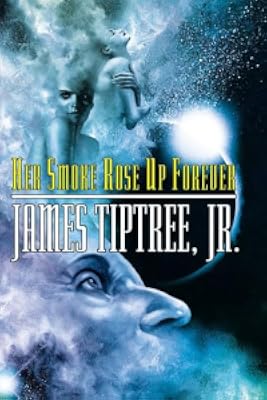
Her Smoke Rose Up Forever
by James Jr. Tiptree
On This Page
Description
There is just one great collection of Tiptree's fiction in print . . .Her Smoke Rose Up Forever from Tachyon Publications. It contains all of her major short stories.'" --New York Times Book Review Her Smoke Rose Up Forever collects eighteen brilliant short stories from a luminary of the science-fiction genre, James Tiptree, Jr. This updated edition is the quintessential Tiptree collection and contains revisions from the author's original notes. Tiptree's fiction reflects the darkly complex show more world its author inhabited: exploring the alien among us; the unreliability of perception; love, sex, and death; and humanity's place in a vast, cold universe. show lessTags
Recommendations













Member Recommendations
Member Reviews
First, a word about James Tiptree if you're not familiar. In the late 1960s, this author appeared on the science fiction scene, was prolific in his output of dark and compelling stories, received nominations for Nebula and Hugo Awards and won some of them—yet no one knew who this reclusive author who refused all interviews really was. About the only thing that was certain was that he wrote well and had a knack for female characters, although in-the-know figures in the SF world such as Silverberg and Ellison declared that they knew he was a "he". Yes, well…Alice Sheldon might be excused had she stolen from Twain to say, "Reports of my masculinity are greatly exaggerated."
Her Smoke Rose Up Forever is a collection of her better-known show more stories compiled after her death into a single volume. It includes the story that first brought her to everyone's attention, "The Last Flight of Doctor Ain"; her Hugo-winning "The Girl Who Was Plugged In"; her Nebula-winning "Love Is the Plan the Plan is Death"; her Hugo/Nebula/Jupiter-winning "Houston, Houston, Do You Read?" It also includes what I consider her best story, "The Screwfly Solution" (which won the Nebula and should have won the Hugo, in my opinion), as well as thirteen other tales.
While I don't think the stories in this collection are of equal caliber—some are quite good and some I'd term acceptable—Sheldon can really write. Her science is occasionally suspect but her words really make you feel what she is trying to convey. On that note, tackle this book when you're in a good mood because what Sheldon is trying to convey is not happiness and sunshine. Her universe is a dark and pessimistic place where Man's baser instincts hold sway and Fate is not waiting with a cookie. Some are cautionary tales; some are not simply because caution would be irrelevant in the face of "you are wired for your own destruction."
Sheldon's mark on the science fiction that came after is hard to ignore. "The Girl Who Was Plugged In" presages the coming cyberpunk movement. "The Last Flight of Doctor Ain" seems somewhat familiar simply because its central plot device has become the theme of many other books and movies. But, don't read her because of whom she influenced; read her because she was good, herself. In the short time span allotted by a demanding literary format, she reaches out and drags you willy-nilly into her own, particular view of what might be coming. Cherry-pick this if you must, but I recommend you give Sheldon a try. show less
Her Smoke Rose Up Forever is a collection of her better-known show more stories compiled after her death into a single volume. It includes the story that first brought her to everyone's attention, "The Last Flight of Doctor Ain"; her Hugo-winning "The Girl Who Was Plugged In"; her Nebula-winning "Love Is the Plan the Plan is Death"; her Hugo/Nebula/Jupiter-winning "Houston, Houston, Do You Read?" It also includes what I consider her best story, "The Screwfly Solution" (which won the Nebula and should have won the Hugo, in my opinion), as well as thirteen other tales.
While I don't think the stories in this collection are of equal caliber—some are quite good and some I'd term acceptable—Sheldon can really write. Her science is occasionally suspect but her words really make you feel what she is trying to convey. On that note, tackle this book when you're in a good mood because what Sheldon is trying to convey is not happiness and sunshine. Her universe is a dark and pessimistic place where Man's baser instincts hold sway and Fate is not waiting with a cookie. Some are cautionary tales; some are not simply because caution would be irrelevant in the face of "you are wired for your own destruction."
Sheldon's mark on the science fiction that came after is hard to ignore. "The Girl Who Was Plugged In" presages the coming cyberpunk movement. "The Last Flight of Doctor Ain" seems somewhat familiar simply because its central plot device has become the theme of many other books and movies. But, don't read her because of whom she influenced; read her because she was good, herself. In the short time span allotted by a demanding literary format, she reaches out and drags you willy-nilly into her own, particular view of what might be coming. Cherry-pick this if you must, but I recommend you give Sheldon a try. show less
I refuse to call her "James Tiptree, Jr.," a name that tolls off the tongue like mud. Her name was Alice Sheldon. Alice Bradley Sheldon. She's no longer hiding in a genre ruled by masculinity, so we could and should forego the dated sexism, and celebrate her work and her ideas and her mind as they were.
I rarely fall for short stories, so I approached this collection with trepidation, digging through lists of classic sci-fi authors associated with the cyberpunk movement. Her Smoke Rose Up Forever wasn't just a pleasant surprise, but a constant state of shock and awe. With a fraction of the word count, Sheldon consistently put her peers to shame, creating believable characters of every gender and background, characters that oozed show more complexities, insecurities, prejudices, and all the signs of wonderful fiction.
Her Smoke Rose Up Forever, a posthumous (1990) anthology collecting the "best" of Sheldon's work from 1968 to her suicide in 1987, is the only collection of Sheldon's short stories still in print. While I can believe this represents many of her best stories, her later work, no less lauded, is conspicuously absent...:
The unusual mixture of delight and depression this collection instilled in me only makes me hunger for all the stories not represented here. Every single story collected in this best-of is worth remembering on their own merits.
"The Last Flight of Dr. Ain" (1969), originally collected in Warm Worlds and Otherwise (1975). ★★★★½
----------
A knock-outof an introduction to Sheldon's style, "the Last Flight of Dr. Ain" was also her first major success as a writer, being nominated for the 1969 Nebula Award. It's told, somewhat loosely, from the perspective of investigators of the titular professor, with points in time and space shifting as more information comes to light.
Dr. Ain is a biological, a cynical academic frustrated by the narrow, selfish goals of not just his fellow academics, but all of humanity. Foreseeing humans as the cause of a worldwide ecological collapse (e.g., the sixth extinction we're currently instigating), Dr. Ain manufactures a virus easily transmittable between any warm-blooded mammal, but a virus that only effectively kills human hosts. His virus affects nothing else, only the humanity he sees as the enemy of nature.
Dr. Ain's last flight is told in fragments, coldly observed from the data put together by those doomed investigators. As they uncover Dr. Ain's methods and movements to transmit the disease, so does the reader, in a style that has to be read to be believed.
"The Screwfly Solution" (1977), originally collected in Out of the Everywhere and Other Extraordinary Visions (1981). ★★★★★
----------
Among the most enthralling, uncomfortable yet beautiful stories I've ever read, "the Screwfly Solution" is an epistolary tale of a pandemic sweeping the world, causing men (and only men) to become emotionally unstable and violent. We learn through letters and articles how the virus is causing uncontrollable violence of men almost exclusively against women. The world is in an uproar trying to understand this uncontrollable behavior, and much of the story is dedicated to faux-journal articles that capture the style of science writing perfectly, never misusing jargon or overdoing it.
The virus, it seems, doesn't just make men blindly violent and murderous to women -- they don't turn into shambling zombies spuming at the mouth to kill -- but causes them to rationalize their violence, taking the act of victim-blaming to its ultimate conclusion. "She was asking for it," the men unanimously decry, slitting the throats of their loved ones for no reason whatsoever.
It's a brilliant take-down of free will and human instinct that holds up surprisingly well to our current neuroscience. The unfolding of the means of transport for the virus, and what causes the murderous inclinations is worth discovering. This was also one of two stories in the collection originally published under the name "Racoona Sheldon" rather than Tiptree.
A cute side note, I also love this story for featuring an accurate depiction of entomological fieldwork. The references to budworm research at the time (1977) accurately reflect the real scientific discussions in budworm science in the mid-to-late '70s -- discussions I used for my own graduate school research.
"And I Awoke and Found Me Here on the Cold Hill's Side" (1972), originally collected in Ten Thousand Light-Years from Home (1973). ★★★★
----------
First contact has come and gone, and humans are joining alien civilizations among the stars. The relationship between aliens and humanity is, however, unexpected -- they aren't saviors, they aren't villains: they just don't care. They've been through the motions before, and humanity is just another species to them.
We, on the other hand, are *obsessed* with alien life. Beyond celebrity worship, we're eager to join in any way we can, offering our services, doing jobs no one else will do. Alien species, for their part, don't care. They don't warn us we're on an unhealthy path. They don't even really take advantage of our eagerness to please them and fit in. Rather, they just. Don't. Care.
"And I Awoke and Found Me Here on the Cold Hill's Side" is the story of a journalist, eager to get their first glimpse of aliens. Instead, what they get is a depressed man who wasted his life away following the aliens, sexually obsessed with the aliens, who spent years watching others do the same and has come to a cynical revelation that these people aren't friends -- that it's the more powerful civilization raping and destroying us, rather t han vice versa.
An addictive, sad story that reigns in a few ideas and nails them, "And I Awoke..." is also notable for being the earliest story Tiptree wrote in the Rift universe, where she set many of her later '80s stories.
"The Girl Who Was Plugged In" (1973), originally collected in Warm Worlds and Otherwise (1975). ★★★★½
----------
One of the earliest cyberpunk stories published in 1973, and the reason I ever looked into James Tiptree, Jr., "the Girl Who Was Plugged In" is a brilliant look at consumerism-gone-wrong; of the need to worship not gods, but celebrities, taken to its most extreme conclusion.
Advertising is illegal in this future, and celebrities are manufactured to buck this law, inspiring worship to sell the products they're paid to use. Their celebrity status scripted with 24/7 reality TV shows. Many of the celebrities, including our plugged-in girl, are so deeply manufactured that their physical bodies are store-bought, controlled from across the world by a volunteer. The cost for these celebrities is loss of sensory input, and giving complete control of their bodies to the company: They plug into these cybernetic bodies, leaving their real bodies to turn to jelly under corporate's uncaring supervision.
One such celebrity, her real life a history of drugs, physical disabilities and suicide attempts, falls in love on-air, and attempts to escape her shell of an existence using that love.
It's remarkably fitting with the cyberpunk genre, along with other early tales like the Stars My Destination, Do Androids Dream of Electric Sheep?, and Dr. Adder. It also deserves a far wider readership than it has.
"The Man Who Walked Home" (1972), originally collected in Ten Thousand Light-Years fro Home (1973) and Byte Beautiful (1985). ★★★★½
----------
A catastrophe has wiped out our civilization, but over centuries humanity slowly bounces back and even thrives. "The Man Who Walked Home" is a puzzle of a time travel story, made up of fragments of history all centered around the location of the unknown catastrophe. While time marches forward, legends, religions and cities all grow around these brief moments in which a man, barely visible, appears from nothing, falling in the air for mere seconds before vanishing again.
The man is a time traveler, and his brief appearances are his travels back to his time -- to the moment of the catastrophe. It's a bombshell of creativity that was more recently used by Dr. Who (although not quite as well!). Interestingly, the earliest and fuzziest appearances of the man -- the appearances closest to the time of the catastrophe -- paint him as more of a monster, a dragon, rather than a man. It's unclear if there is some physical distortion of the traveler as the catastrophe slowly initiates, piece by piece, or if it's simply the imaginations of tale-tellers.
"And I Have Come Upon This Place by Lost Ways" (1972), originally collected in Warm Worlds and Otherwise (1975). ★★★½
----------
An early-career scientist struggles to make his mark among an intimidating group of peers, all of whom look down on him for his interest in anthropological fieldwork and fairy tales. On an alien world, over a primitive alien civilization, he and his peers quietly collect remotely-sensed data, observing the village and the surrounding mountains. Legend tells of a hidden, technologically-advanced culture somewhere on the highest peak above the nearby village, and it's this that interests only our budding scientist hero.
Effectively throwing his career away to pursue that unscientific belief, he casts off his technological heritage and attempts to climb the mountain on his own, with each step forward being driven by an empty feeling of abandoning his heritage and years of study.
His journey is a sad one -- of course, this is Tiptree. His people abandon him, the village below attempts to kill him, and the only thing guiding him is his desperate need to climb the mountain and validate his beliefs.
While I enjoyed this story as much as any other in the collection, I would say it just isn't particularly memorable, especially compared to those stories sharing themes.
"The Women Men Don't See" (1973), originally collected in Warm Worlds and Otherwise (1975). ★★★★
----------
A brutal takedown of sexism, "the Women Men Don't See" is one of many stories that made it clear James Tiptree, Jr. was either a woman or a feminist too far ahead of his time. (The 'masculinity' writers like Harlan Ellison saw and celebrated in Sheldon's work is bafffling to me.) It's also a far cry from Sheldon's typical sci-fi, with the genre only bleeding in over the last pages.
The story is narrated by a man on holiday, hoping to idle his time away catching fish and being, generally, quite manly in the Yucatan Peninsula. He, along with his bush pilot and two American women, crashland along an obscure sandbar. Stranded for days, the narrator comes to quickly distrust the two women, coming up with increasingly wild hypotheses and conspiracies about who they are, what they do, why they are the way they are (i.e., not feminine).
This is a story of men misunderstanding women, but using a place of power write the histories of women. That these Parsons women aren't driven into hysteria by their plight, but actually seem quite capable of taking care of themselves *and* the males of the story, drives the American man into his own fits of hysteria, desperately clinging to the idea that he's objectively analyzing suspcious, untrustworthy women.
I loved this story, though the twist into science fiction seems to come out of nowhere in the last few pages, and it never quite sat well with me.
"Your Faces, O My Sisters! Your Faces Filled of Light! (1976), originally collected in Out of the Everywhere and Other Extraordinary Visions (1981) and Byte Beautiful (1985). ★★★½
---------
Difficult to read both for its style and messages, "Your Faces, O My Sisters! Your Faces Filled of Light" is another feminist tragedy published not under the Tiptree name, but Raccoona Sheldon. Alternating viewpoints and occasionally dipping into stream-of-consciousness, this is the story of a courier walking along the roads of a post-apocalyptic future. This courier is also just a woman with mental instabilities who's escaped from the hospital where she was being treated. Or abused, depending on your view of her therapies or how her doctors viewed her.
In her mind, she's traveling a world of women, where all she meets are her family There are no men in the world, no concept of harm, even -- only the love between Sisters of like mind, of other Travelers. The narrative repeatedly shifts between her point of view as she travels on the road and encounters more friendly Sisters, and the increasingly-ominous view of those looking for her. The reality of her Sisters is startling in contrast to how she has been seeing the world: Her sisters are men and women, always miserable, untrustworthy. To them, this courier and her journey are just some crazy drug addict's trip -- just a foolish path taken by a foolish girl deserving of whatever harm she draws to herself by being so trusting.
How do you think it ends? With her Sisters caring for a fellow courier? Yeah, right.
"Houston, Houston, Do You Read?" (1976), originally collected in Star Songs of an Old Primate (1978). ★★★★★
----------
"Houston, Houston, Do You Read?" won both the Nebula and Hugo Awads in '76 and '77. Deservedly-so: This is possibly Sheldon's most brilliant take on the future of humanity, and on the ills of masculinity in particular. My favorite from the collection -- indeed, one of the most clever (and transgressive) short stories I've ever read -- this is a dark look at masculinity and leadership.
Three astronauts are rounding the sun on a circumsolar mission, and halfway through it they inexplicably find themselves cut off from communications with Houston. Instead, they're finding a ship just around the corner from them populated by what sounds like nothing but Australian women. The American astronauts know of no international or Australian missions, much less any that would be led exclusively by women, so the sudden change to their realities is nearly impossible to grasp.
This story is worth discovering on your own, so the next two paragraphs deserve a spoiler warning.
The teams eventually agree to meet, to come aboard the mystery ship, where we learn our three astronauts have somehow appeared 300 years into the future. In those 300 years, a virus has devastated all of Earth, wiping out men through sterility. Only a small colony of cloned women keep humanity going, although without much visible progress since the astronaut's time.
These three highly-trained, highly-educated men -- these three objective scientists -- break down at these prospects. They can''t comprehend, and even refuse to acknowledge, that a women-only world could mean anything. Humanity is progress: Competition: Social order dictated by men and innovation. That humanity is currently living in a utopia means nothing when there aren't men -- or God, or Jesus -- to educate and research and compete and fight.
"Houston, Houston, Do You Read?" was devastating, brutal, and utterly brilliant. One of the finest works of short fiction in the 20th century. Read it.
"With Delicate Mad Hands" (1981), originally collected in Out of the Everywhere and Other Extraordinary Visions (1981) and Byte Beautiful (1985). ★★★★
----------
Cold Pig and her story are unforgettable. I can't say "With Delicate Mad Hands" was a favorite of mine, but it's nearly impossible to get it out of my head. What a vicious story.
CP was born with nearly impossible dreams: Orphaned -- her mom died in childbirth and her dad, a politician, wanted nothing to do with it -- and with a physical disability that earned her the nickname "Cold Pig," CP's goal is to travel the stars on long-term flights. She lives a quiet, depressing life, defined primarily by abuse and loneliness, with only the voice of her dreams to keep her company.
Dedicating her life to traveling among the stars, she finally earns a career in long-term space travel chiefly because of her appearance -- her superiors think her pig-like nose will mean she'll be subservient to her male peers, and won't incite fights between men vying for her attention. Instead, she'll simply serve as a sexual and physical slave to the crews she works with.
The voice in her head that pushed her towards this dream never leaves her, however, and eventually she works for a captain that pushes her too far: He rapes, beats, and otherwise abuses her in every imaginable way until she snaps, killing the crew and setting off on a suicide mission into the unknown, with only the voice to keep her company and guide her path.
Somewhat miraculously, there is more to the voice than meets the eye, and Cold Pig's story winds down with a lot of tragedy and love.
It's as wonderful as any other Sheldon masterpiece on the surface, but I personally had issues with the pacing. "With Delicate Mad Hands" is too long, with scenes and ideas repeating themselves far too often before any gears can shift.
"A Momentary Taste of Being" (1975), originally collected in Star Songs of an Old Primate (1978). ★★★★½
----------
Like many of Sheldon's stories, 'a Momentary Taste of Being' is about the downfall of humanity. Also like much of her work, it comes with an uncomfortable twist.
Among the longest stories Sheldon wrote, this is a 90-page space odyssey among the last surviving remnants of humanity as they drift through space. Their decades-long mission is to find a suitable replacement for Earth, which lies decaying far behind them, with colony ships awaiting the hopeful discovery of a new home.
In this story, we've found a suitable planet at last -- the final option for a crew anxious to settle down and stop searching, to call their families to join them in a new, wondrous paradise -- but questions arise of safety, and of the other species that inhabit the planet already. Only one member of the surface crew returned, the others, she claims, opting to stay and start their lives on this perfect new world. To the rest of the crew, their reactions are an uncomfortable mixture of skepticism and desperation to believe: She -- Lory -- has no reason to lie to them, and her enthusiasm is genuine, but the idea that the rest of the crew remained behind without supplies just defeats all logic, particularly when Lory appears to have edited their footage from the surface.
It doesn't help that Lory's brought back some native plantlife for no reason at all, and seems anxious for the rest of the explorers to study it, or at least get a momentary glimpse of it.
"A Momentary Taste of Being" is such a fascinating, brilliant and original story. Every page oozes with the desperation of the crew, of the crumbling logic and objectivity that the survival of their crew -- and the entire human race -- rely on.
"We Who Stole the Dream" (1978), originally collected in Out of the Everywhere and Other Extraordinary Visions (1981). ★★★½
----------
Another early Rift story, "We Who Stole the Dream" is another fantastical sci-fi adventure, of humans and aliens at war. The "We" of the title refers to the Joliani, a humanoid alien species enslaved by mankind as physical and sexual servants. The species collectively dream of escaping under the thumb of humanity's (i.e., masculinity's) gross self-obsession and need to fuck everything in sight -- you know, for progress.
The Joliani, weak and abused (with some parallels to Native American subjugation), plot to fight back against their rapists, stealing a ship called the Dream. Using the coordinates for their homeworld -- now entering into mythology due to its distance and time away -- they travel back over generations to find the original Joliani are not old strong-willed, powerful, and brilliant, but just as blood-thirsty and hungry to fuck as humanity is and was.
"...Dream" is touching, enthralling -- depressing as ever -- but it does remind me that I prefer Sheldon's harder sci-fi.
"Her Smoke Rose Up Forever" (1974), originally collected in Star Songs of an Old Primate (1978). ★★★
----------
A record of insecurities Sheldon had about her own accomplishments against her heritage. Also a time travel story, where physical, sexual abuse is the cause of the time travel abilities. This was a challenging, stream-of-consciousness story, not one I took much from, and a difficult one to gauge without Michael Swanwick's 2004 introduction and access to the Internet explaining what I just read. I'm conflicted; this is one to revisit.
"Love is the Plan the Plan is Death" (1973), originally collected in Warm Worlds and Otherwise (1975) and Byte Beautiful (1985). ★★★½
----------
Fate and free will are again Sheldon's toys in "Love is the Plan the Plan is Death." An unusual story of the fantastic (and a difficult one to describe), "Love..." deviates from Sheldon's typical style by focusing on alien species and alien perspectives as they just start to evolve self-awareness and language. There's no humanity in this tale, not even on the edges.
"The Plan" of the title is the mating rituals of the alien species, with Love being the goal of free will, and Death the ultimatum handed by fate. The species in this tale are social critters, who want to meet and love others, to grow families, but their reactions to seeing their own species are themselves uncontrollable, based on the maturity of the individual. As the aliens age, their fur changes from color, with red or black fur initiating uncontrollable feelings of love or a need to devour. The narrating alien of this story is conscious of these urges, and attempts to desperately overcome her own vile, nonsensical instincts as she raises a child.
Considering this story is in this collect by this particular author, you probably know it can't end well.
"On the Last Afternoon" (1972), originally collected in Warm Worlds and Otherwise (1975). ★★★½
----------
Thirty years after crashlanding on an alien shore, human survivors have built a successful -- barely -- colony along the shore. Their farms and homes are rooted in an unusual area, an area that had been cleared before, around the time of their crashlanding. The reason for this clearing, for this area being so suitable for humans, is largely unknown, although the colony's leader has his ideas which prove true.
This is an unusual story of miscommunication between people. The leader refers to the noion, a creature or artifact found buried underground that telepathically speaks to him and only him. It's likely he's only speaking to himself, but, given a certain degree of willpower and prayer, the noion does seem to respond and occasionally help their colony survive harsh conditions.
A monstrous, lobsterlike species uses the colony's homelands for a mating ground roughly every 30 years -- hence the clearing earlier. This story is about their return, about the colonists struggles to accept it and each other, about the leader's communication with the noion to try to save both the monsters and the colonists.
This is a Tiptree tale. Nothing quite works out well for anyone.
Interesting, but not a favorite. The lobstrosities' mating habits are described in detail, and are utterly disturbing given their bulk. Like praying mantises wearing fat suits, both sexes suicidal and bloodthirsty.
"She Waits for All Men Born" (1976), originally collected in Star Songs of an Old Primate (1978). ★★★½
----------
Post-apocalyptic villages, radiation has led to deformities among people desperately trying to control their genes and survive. The ensure survival, settlements typically kill any babies born with physiological deformities due to the extra resources required to take care of them. One blind girl lives, however, and with her blindness comes other unseen mutations. She ages slowly, holding powers beyond her peers that don't manifest themselves until her late puberty: Powers of life and death over all living beings. Simply a look from her dead eyes can kill entire armies or cities.
She also has an insatiable desire for companionship with people who distrust her every move, simply because she's different.
"She Waits for All Men Born" lacks the nuance of Sheldon's most memorable stories, but it's still a great read, and a worthwhile addition to the collection.
"Slow Music" (1980), originally collected in Out of the Everywhere and Other Extraordinary Visions (1981). ★★★★
----------
A long and complicated story, but also one emanating a sad sort of peace, "Slow Music" was the last story Tiptree worked on before the unveiling of Alice B. Sheldon. We see only fragments of a post-apocalyptic world, where sex and reproduction are uncommon, chiefly arranged. The last remaining people tend to rely on pills to initiate sexual attraction, and companions form their relationships more or less without that interplay of domination.
At least, I think so. "Slow Music" really is a story of fragments, with little explained. The world of the River, of conniving, talking animals, of Jakko and Peachthief organizing a future family life and traveling towards or along the River -- a world where the dead can be communed with at certain points of the River -- is often an abstruse world.
A young man, Jakko, is on a spiritual journey to commune with his father's spirit. He meets a young woman, Peachthief, who has tossed aside a communal life to live isolated with her animal friends. Their relationship blossoms over an unusual twisting of sexual norms: The man is hardly masculine, only feeling our typical ideas of masculinity when on the pills or coming close to death -- another twisted aphrodisiac typical of Sheldon's writing. Peachthief, as well, is oddly detached from her sexuality and the expectations society places on her, wanting to live alone with her animals, and, if possible, raise a child on her own in a world without children.
A calm story worthy of meditation and re-reading, I had a hard time keeping up with "Slow Music," but its elements show the best of Sheldon.
"And So On, and So On" (1971), originally collected in Star Songs of an Old Primate (1978). ★★★
----------
A pretty standard sci-fi short story, which is all the more surprising for Sheldon. "And So On, and So On" is a brief four pages, mostly comprised of dialogue between passengers traveling through a wormhole. Older travelers mourn the younger generations, who are seemingly never good enough. The younger travelers are fascinated by the world outside, forever looping, forever repeating, forever being spoken down to by the same older generation. It's a clever idea that doesn't quite come out in its brief length.
----------
Her stories are worth reading not just as classic genre fiction, but as classic literature. It's important that we don't forget the name Tiptree, but we should always remember exactly what that name means for sci-fi, for LGBTQ, for feminism and equal rights, and for the world of literature as its own beast. Read this collection, then hunt obsessively for her many out-of-print collections, read James Tiptree, Jr. and Raccoona Sheldon and all the work of Alice B. Sheldon. She was a rare beacon of brilliance and compassion, an odd mixture of transgressive frustrations and scientific objectivity: Her observations on humanity, though cynical, have proved all too true.
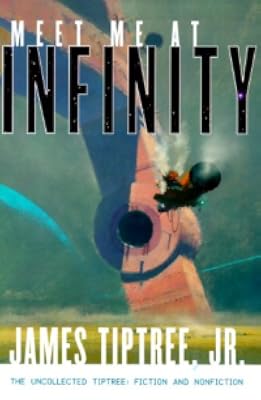
* Also missing is the single original story from Byte Beautiful (1985), otherwise collecting previously-published tales, and any of the 'uncollected' stories found in Meet Me at Infinity (2000), a posthumous collection of her most obscure work and non-fiction. show less
I rarely fall for short stories, so I approached this collection with trepidation, digging through lists of classic sci-fi authors associated with the cyberpunk movement. Her Smoke Rose Up Forever wasn't just a pleasant surprise, but a constant state of shock and awe. With a fraction of the word count, Sheldon consistently put her peers to shame, creating believable characters of every gender and background, characters that oozed show more complexities, insecurities, prejudices, and all the signs of wonderful fiction.
Her Smoke Rose Up Forever, a posthumous (1990) anthology collecting the "best" of Sheldon's work from 1968 to her suicide in 1987, is the only collection of Sheldon's short stories still in print. While I can believe this represents many of her best stories, her later work, no less lauded, is conspicuously absent...:
- Ten Thousand Light-Years from Home (1973): 2 of 15 stories included...
- Warm Worlds and Otherwise (1975): 6 of 12 stories...
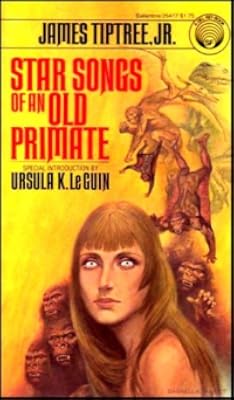
- Star Songs of an Old Primate (1978): 5 of 7 stories...
- Out of the Everywhere and Other Extraordinary Visions (1981): 5 of 10 stories...
- Byte Beautiful (1985): 0 of 1 stories...*
- Tales of the Quintana Roo (1986): 0 of 3 stories...
- The Starry Rift (1986): 0 of 5 stories...
- Crown of Stars (1988): 0 of 10 stories...
- Meet Me at Infinity (2000): 0 of 8 stories...*
The unusual mixture of delight and depression this collection instilled in me only makes me hunger for all the stories not represented here. Every single story collected in this best-of is worth remembering on their own merits.
"The Last Flight of Dr. Ain" (1969), originally collected in Warm Worlds and Otherwise (1975). ★★★★½
----------
A knock-outof an introduction to Sheldon's style, "the Last Flight of Dr. Ain" was also her first major success as a writer, being nominated for the 1969 Nebula Award. It's told, somewhat loosely, from the perspective of investigators of the titular professor, with points in time and space shifting as more information comes to light.
Dr. Ain is a biological, a cynical academic frustrated by the narrow, selfish goals of not just his fellow academics, but all of humanity. Foreseeing humans as the cause of a worldwide ecological collapse (e.g., the sixth extinction we're currently instigating), Dr. Ain manufactures a virus easily transmittable between any warm-blooded mammal, but a virus that only effectively kills human hosts. His virus affects nothing else, only the humanity he sees as the enemy of nature.
Dr. Ain's last flight is told in fragments, coldly observed from the data put together by those doomed investigators. As they uncover Dr. Ain's methods and movements to transmit the disease, so does the reader, in a style that has to be read to be believed.
"The Screwfly Solution" (1977), originally collected in Out of the Everywhere and Other Extraordinary Visions (1981). ★★★★★
----------
Among the most enthralling, uncomfortable yet beautiful stories I've ever read, "the Screwfly Solution" is an epistolary tale of a pandemic sweeping the world, causing men (and only men) to become emotionally unstable and violent. We learn through letters and articles how the virus is causing uncontrollable violence of men almost exclusively against women. The world is in an uproar trying to understand this uncontrollable behavior, and much of the story is dedicated to faux-journal articles that capture the style of science writing perfectly, never misusing jargon or overdoing it.
The virus, it seems, doesn't just make men blindly violent and murderous to women -- they don't turn into shambling zombies spuming at the mouth to kill -- but causes them to rationalize their violence, taking the act of victim-blaming to its ultimate conclusion. "She was asking for it," the men unanimously decry, slitting the throats of their loved ones for no reason whatsoever.
It's a brilliant take-down of free will and human instinct that holds up surprisingly well to our current neuroscience. The unfolding of the means of transport for the virus, and what causes the murderous inclinations is worth discovering. This was also one of two stories in the collection originally published under the name "Racoona Sheldon" rather than Tiptree.
A cute side note, I also love this story for featuring an accurate depiction of entomological fieldwork. The references to budworm research at the time (1977) accurately reflect the real scientific discussions in budworm science in the mid-to-late '70s -- discussions I used for my own graduate school research.
"And I Awoke and Found Me Here on the Cold Hill's Side" (1972), originally collected in Ten Thousand Light-Years from Home (1973). ★★★★
----------
First contact has come and gone, and humans are joining alien civilizations among the stars. The relationship between aliens and humanity is, however, unexpected -- they aren't saviors, they aren't villains: they just don't care. They've been through the motions before, and humanity is just another species to them.
We, on the other hand, are *obsessed* with alien life. Beyond celebrity worship, we're eager to join in any way we can, offering our services, doing jobs no one else will do. Alien species, for their part, don't care. They don't warn us we're on an unhealthy path. They don't even really take advantage of our eagerness to please them and fit in. Rather, they just. Don't. Care.
"And I Awoke and Found Me Here on the Cold Hill's Side" is the story of a journalist, eager to get their first glimpse of aliens. Instead, what they get is a depressed man who wasted his life away following the aliens, sexually obsessed with the aliens, who spent years watching others do the same and has come to a cynical revelation that these people aren't friends -- that it's the more powerful civilization raping and destroying us, rather t han vice versa.
An addictive, sad story that reigns in a few ideas and nails them, "And I Awoke..." is also notable for being the earliest story Tiptree wrote in the Rift universe, where she set many of her later '80s stories.
"The Girl Who Was Plugged In" (1973), originally collected in Warm Worlds and Otherwise (1975). ★★★★½
----------
One of the earliest cyberpunk stories published in 1973, and the reason I ever looked into James Tiptree, Jr., "the Girl Who Was Plugged In" is a brilliant look at consumerism-gone-wrong; of the need to worship not gods, but celebrities, taken to its most extreme conclusion.
Advertising is illegal in this future, and celebrities are manufactured to buck this law, inspiring worship to sell the products they're paid to use. Their celebrity status scripted with 24/7 reality TV shows. Many of the celebrities, including our plugged-in girl, are so deeply manufactured that their physical bodies are store-bought, controlled from across the world by a volunteer. The cost for these celebrities is loss of sensory input, and giving complete control of their bodies to the company: They plug into these cybernetic bodies, leaving their real bodies to turn to jelly under corporate's uncaring supervision.
One such celebrity, her real life a history of drugs, physical disabilities and suicide attempts, falls in love on-air, and attempts to escape her shell of an existence using that love.
It's remarkably fitting with the cyberpunk genre, along with other early tales like the Stars My Destination, Do Androids Dream of Electric Sheep?, and Dr. Adder. It also deserves a far wider readership than it has.
"The Man Who Walked Home" (1972), originally collected in Ten Thousand Light-Years fro Home (1973) and Byte Beautiful (1985). ★★★★½
----------
A catastrophe has wiped out our civilization, but over centuries humanity slowly bounces back and even thrives. "The Man Who Walked Home" is a puzzle of a time travel story, made up of fragments of history all centered around the location of the unknown catastrophe. While time marches forward, legends, religions and cities all grow around these brief moments in which a man, barely visible, appears from nothing, falling in the air for mere seconds before vanishing again.
The man is a time traveler, and his brief appearances are his travels back to his time -- to the moment of the catastrophe. It's a bombshell of creativity that was more recently used by Dr. Who (although not quite as well!). Interestingly, the earliest and fuzziest appearances of the man -- the appearances closest to the time of the catastrophe -- paint him as more of a monster, a dragon, rather than a man. It's unclear if there is some physical distortion of the traveler as the catastrophe slowly initiates, piece by piece, or if it's simply the imaginations of tale-tellers.
"And I Have Come Upon This Place by Lost Ways" (1972), originally collected in Warm Worlds and Otherwise (1975). ★★★½
----------
An early-career scientist struggles to make his mark among an intimidating group of peers, all of whom look down on him for his interest in anthropological fieldwork and fairy tales. On an alien world, over a primitive alien civilization, he and his peers quietly collect remotely-sensed data, observing the village and the surrounding mountains. Legend tells of a hidden, technologically-advanced culture somewhere on the highest peak above the nearby village, and it's this that interests only our budding scientist hero.
Effectively throwing his career away to pursue that unscientific belief, he casts off his technological heritage and attempts to climb the mountain on his own, with each step forward being driven by an empty feeling of abandoning his heritage and years of study.
His journey is a sad one -- of course, this is Tiptree. His people abandon him, the village below attempts to kill him, and the only thing guiding him is his desperate need to climb the mountain and validate his beliefs.
While I enjoyed this story as much as any other in the collection, I would say it just isn't particularly memorable, especially compared to those stories sharing themes.
"The Women Men Don't See" (1973), originally collected in Warm Worlds and Otherwise (1975). ★★★★
----------
A brutal takedown of sexism, "the Women Men Don't See" is one of many stories that made it clear James Tiptree, Jr. was either a woman or a feminist too far ahead of his time. (The 'masculinity' writers like Harlan Ellison saw and celebrated in Sheldon's work is bafffling to me.) It's also a far cry from Sheldon's typical sci-fi, with the genre only bleeding in over the last pages.
The story is narrated by a man on holiday, hoping to idle his time away catching fish and being, generally, quite manly in the Yucatan Peninsula. He, along with his bush pilot and two American women, crashland along an obscure sandbar. Stranded for days, the narrator comes to quickly distrust the two women, coming up with increasingly wild hypotheses and conspiracies about who they are, what they do, why they are the way they are (i.e., not feminine).
This is a story of men misunderstanding women, but using a place of power write the histories of women. That these Parsons women aren't driven into hysteria by their plight, but actually seem quite capable of taking care of themselves *and* the males of the story, drives the American man into his own fits of hysteria, desperately clinging to the idea that he's objectively analyzing suspcious, untrustworthy women.
I loved this story, though the twist into science fiction seems to come out of nowhere in the last few pages, and it never quite sat well with me.
"Your Faces, O My Sisters! Your Faces Filled of Light! (1976), originally collected in Out of the Everywhere and Other Extraordinary Visions (1981) and Byte Beautiful (1985). ★★★½
---------
Difficult to read both for its style and messages, "Your Faces, O My Sisters! Your Faces Filled of Light" is another feminist tragedy published not under the Tiptree name, but Raccoona Sheldon. Alternating viewpoints and occasionally dipping into stream-of-consciousness, this is the story of a courier walking along the roads of a post-apocalyptic future. This courier is also just a woman with mental instabilities who's escaped from the hospital where she was being treated. Or abused, depending on your view of her therapies or how her doctors viewed her.
In her mind, she's traveling a world of women, where all she meets are her family There are no men in the world, no concept of harm, even -- only the love between Sisters of like mind, of other Travelers. The narrative repeatedly shifts between her point of view as she travels on the road and encounters more friendly Sisters, and the increasingly-ominous view of those looking for her. The reality of her Sisters is startling in contrast to how she has been seeing the world: Her sisters are men and women, always miserable, untrustworthy. To them, this courier and her journey are just some crazy drug addict's trip -- just a foolish path taken by a foolish girl deserving of whatever harm she draws to herself by being so trusting.
How do you think it ends? With her Sisters caring for a fellow courier? Yeah, right.
"Houston, Houston, Do You Read?" (1976), originally collected in Star Songs of an Old Primate (1978). ★★★★★
----------
"Houston, Houston, Do You Read?" won both the Nebula and Hugo Awads in '76 and '77. Deservedly-so: This is possibly Sheldon's most brilliant take on the future of humanity, and on the ills of masculinity in particular. My favorite from the collection -- indeed, one of the most clever (and transgressive) short stories I've ever read -- this is a dark look at masculinity and leadership.
Three astronauts are rounding the sun on a circumsolar mission, and halfway through it they inexplicably find themselves cut off from communications with Houston. Instead, they're finding a ship just around the corner from them populated by what sounds like nothing but Australian women. The American astronauts know of no international or Australian missions, much less any that would be led exclusively by women, so the sudden change to their realities is nearly impossible to grasp.
This story is worth discovering on your own, so the next two paragraphs deserve a spoiler warning.
The teams eventually agree to meet, to come aboard the mystery ship, where we learn our three astronauts have somehow appeared 300 years into the future. In those 300 years, a virus has devastated all of Earth, wiping out men through sterility. Only a small colony of cloned women keep humanity going, although without much visible progress since the astronaut's time.
These three highly-trained, highly-educated men -- these three objective scientists -- break down at these prospects. They can''t comprehend, and even refuse to acknowledge, that a women-only world could mean anything. Humanity is progress: Competition: Social order dictated by men and innovation. That humanity is currently living in a utopia means nothing when there aren't men -- or God, or Jesus -- to educate and research and compete and fight.
"Houston, Houston, Do You Read?" was devastating, brutal, and utterly brilliant. One of the finest works of short fiction in the 20th century. Read it.
"With Delicate Mad Hands" (1981), originally collected in Out of the Everywhere and Other Extraordinary Visions (1981) and Byte Beautiful (1985). ★★★★
----------
Cold Pig and her story are unforgettable. I can't say "With Delicate Mad Hands" was a favorite of mine, but it's nearly impossible to get it out of my head. What a vicious story.
CP was born with nearly impossible dreams: Orphaned -- her mom died in childbirth and her dad, a politician, wanted nothing to do with it -- and with a physical disability that earned her the nickname "Cold Pig," CP's goal is to travel the stars on long-term flights. She lives a quiet, depressing life, defined primarily by abuse and loneliness, with only the voice of her dreams to keep her company.
Dedicating her life to traveling among the stars, she finally earns a career in long-term space travel chiefly because of her appearance -- her superiors think her pig-like nose will mean she'll be subservient to her male peers, and won't incite fights between men vying for her attention. Instead, she'll simply serve as a sexual and physical slave to the crews she works with.
The voice in her head that pushed her towards this dream never leaves her, however, and eventually she works for a captain that pushes her too far: He rapes, beats, and otherwise abuses her in every imaginable way until she snaps, killing the crew and setting off on a suicide mission into the unknown, with only the voice to keep her company and guide her path.
Somewhat miraculously, there is more to the voice than meets the eye, and Cold Pig's story winds down with a lot of tragedy and love.
It's as wonderful as any other Sheldon masterpiece on the surface, but I personally had issues with the pacing. "With Delicate Mad Hands" is too long, with scenes and ideas repeating themselves far too often before any gears can shift.
"A Momentary Taste of Being" (1975), originally collected in Star Songs of an Old Primate (1978). ★★★★½
----------
Like many of Sheldon's stories, 'a Momentary Taste of Being' is about the downfall of humanity. Also like much of her work, it comes with an uncomfortable twist.
Among the longest stories Sheldon wrote, this is a 90-page space odyssey among the last surviving remnants of humanity as they drift through space. Their decades-long mission is to find a suitable replacement for Earth, which lies decaying far behind them, with colony ships awaiting the hopeful discovery of a new home.
In this story, we've found a suitable planet at last -- the final option for a crew anxious to settle down and stop searching, to call their families to join them in a new, wondrous paradise -- but questions arise of safety, and of the other species that inhabit the planet already. Only one member of the surface crew returned, the others, she claims, opting to stay and start their lives on this perfect new world. To the rest of the crew, their reactions are an uncomfortable mixture of skepticism and desperation to believe: She -- Lory -- has no reason to lie to them, and her enthusiasm is genuine, but the idea that the rest of the crew remained behind without supplies just defeats all logic, particularly when Lory appears to have edited their footage from the surface.
It doesn't help that Lory's brought back some native plantlife for no reason at all, and seems anxious for the rest of the explorers to study it, or at least get a momentary glimpse of it.
"A Momentary Taste of Being" is such a fascinating, brilliant and original story. Every page oozes with the desperation of the crew, of the crumbling logic and objectivity that the survival of their crew -- and the entire human race -- rely on.
"We Who Stole the Dream" (1978), originally collected in Out of the Everywhere and Other Extraordinary Visions (1981). ★★★½
----------
Another early Rift story, "We Who Stole the Dream" is another fantastical sci-fi adventure, of humans and aliens at war. The "We" of the title refers to the Joliani, a humanoid alien species enslaved by mankind as physical and sexual servants. The species collectively dream of escaping under the thumb of humanity's (i.e., masculinity's) gross self-obsession and need to fuck everything in sight -- you know, for progress.
The Joliani, weak and abused (with some parallels to Native American subjugation), plot to fight back against their rapists, stealing a ship called the Dream. Using the coordinates for their homeworld -- now entering into mythology due to its distance and time away -- they travel back over generations to find the original Joliani are not old strong-willed, powerful, and brilliant, but just as blood-thirsty and hungry to fuck as humanity is and was.
"...Dream" is touching, enthralling -- depressing as ever -- but it does remind me that I prefer Sheldon's harder sci-fi.
"Her Smoke Rose Up Forever" (1974), originally collected in Star Songs of an Old Primate (1978). ★★★
----------
A record of insecurities Sheldon had about her own accomplishments against her heritage. Also a time travel story, where physical, sexual abuse is the cause of the time travel abilities. This was a challenging, stream-of-consciousness story, not one I took much from, and a difficult one to gauge without Michael Swanwick's 2004 introduction and access to the Internet explaining what I just read. I'm conflicted; this is one to revisit.
"Love is the Plan the Plan is Death" (1973), originally collected in Warm Worlds and Otherwise (1975) and Byte Beautiful (1985). ★★★½
----------
Fate and free will are again Sheldon's toys in "Love is the Plan the Plan is Death." An unusual story of the fantastic (and a difficult one to describe), "Love..." deviates from Sheldon's typical style by focusing on alien species and alien perspectives as they just start to evolve self-awareness and language. There's no humanity in this tale, not even on the edges.
"The Plan" of the title is the mating rituals of the alien species, with Love being the goal of free will, and Death the ultimatum handed by fate. The species in this tale are social critters, who want to meet and love others, to grow families, but their reactions to seeing their own species are themselves uncontrollable, based on the maturity of the individual. As the aliens age, their fur changes from color, with red or black fur initiating uncontrollable feelings of love or a need to devour. The narrating alien of this story is conscious of these urges, and attempts to desperately overcome her own vile, nonsensical instincts as she raises a child.
Considering this story is in this collect by this particular author, you probably know it can't end well.
"On the Last Afternoon" (1972), originally collected in Warm Worlds and Otherwise (1975). ★★★½
----------
Thirty years after crashlanding on an alien shore, human survivors have built a successful -- barely -- colony along the shore. Their farms and homes are rooted in an unusual area, an area that had been cleared before, around the time of their crashlanding. The reason for this clearing, for this area being so suitable for humans, is largely unknown, although the colony's leader has his ideas which prove true.
This is an unusual story of miscommunication between people. The leader refers to the noion, a creature or artifact found buried underground that telepathically speaks to him and only him. It's likely he's only speaking to himself, but, given a certain degree of willpower and prayer, the noion does seem to respond and occasionally help their colony survive harsh conditions.
A monstrous, lobsterlike species uses the colony's homelands for a mating ground roughly every 30 years -- hence the clearing earlier. This story is about their return, about the colonists struggles to accept it and each other, about the leader's communication with the noion to try to save both the monsters and the colonists.
This is a Tiptree tale. Nothing quite works out well for anyone.
Interesting, but not a favorite. The lobstrosities' mating habits are described in detail, and are utterly disturbing given their bulk. Like praying mantises wearing fat suits, both sexes suicidal and bloodthirsty.
"She Waits for All Men Born" (1976), originally collected in Star Songs of an Old Primate (1978). ★★★½
----------
Post-apocalyptic villages, radiation has led to deformities among people desperately trying to control their genes and survive. The ensure survival, settlements typically kill any babies born with physiological deformities due to the extra resources required to take care of them. One blind girl lives, however, and with her blindness comes other unseen mutations. She ages slowly, holding powers beyond her peers that don't manifest themselves until her late puberty: Powers of life and death over all living beings. Simply a look from her dead eyes can kill entire armies or cities.
She also has an insatiable desire for companionship with people who distrust her every move, simply because she's different.
"She Waits for All Men Born" lacks the nuance of Sheldon's most memorable stories, but it's still a great read, and a worthwhile addition to the collection.
"Slow Music" (1980), originally collected in Out of the Everywhere and Other Extraordinary Visions (1981). ★★★★
----------
A long and complicated story, but also one emanating a sad sort of peace, "Slow Music" was the last story Tiptree worked on before the unveiling of Alice B. Sheldon. We see only fragments of a post-apocalyptic world, where sex and reproduction are uncommon, chiefly arranged. The last remaining people tend to rely on pills to initiate sexual attraction, and companions form their relationships more or less without that interplay of domination.
At least, I think so. "Slow Music" really is a story of fragments, with little explained. The world of the River, of conniving, talking animals, of Jakko and Peachthief organizing a future family life and traveling towards or along the River -- a world where the dead can be communed with at certain points of the River -- is often an abstruse world.
A young man, Jakko, is on a spiritual journey to commune with his father's spirit. He meets a young woman, Peachthief, who has tossed aside a communal life to live isolated with her animal friends. Their relationship blossoms over an unusual twisting of sexual norms: The man is hardly masculine, only feeling our typical ideas of masculinity when on the pills or coming close to death -- another twisted aphrodisiac typical of Sheldon's writing. Peachthief, as well, is oddly detached from her sexuality and the expectations society places on her, wanting to live alone with her animals, and, if possible, raise a child on her own in a world without children.
A calm story worthy of meditation and re-reading, I had a hard time keeping up with "Slow Music," but its elements show the best of Sheldon.
"And So On, and So On" (1971), originally collected in Star Songs of an Old Primate (1978). ★★★
----------
A pretty standard sci-fi short story, which is all the more surprising for Sheldon. "And So On, and So On" is a brief four pages, mostly comprised of dialogue between passengers traveling through a wormhole. Older travelers mourn the younger generations, who are seemingly never good enough. The younger travelers are fascinated by the world outside, forever looping, forever repeating, forever being spoken down to by the same older generation. It's a clever idea that doesn't quite come out in its brief length.
----------
Her stories are worth reading not just as classic genre fiction, but as classic literature. It's important that we don't forget the name Tiptree, but we should always remember exactly what that name means for sci-fi, for LGBTQ, for feminism and equal rights, and for the world of literature as its own beast. Read this collection, then hunt obsessively for her many out-of-print collections, read James Tiptree, Jr. and Raccoona Sheldon and all the work of Alice B. Sheldon. She was a rare beacon of brilliance and compassion, an odd mixture of transgressive frustrations and scientific objectivity: Her observations on humanity, though cynical, have proved all too true.
* Also missing is the single original story from Byte Beautiful (1985), otherwise collecting previously-published tales, and any of the 'uncollected' stories found in Meet Me at Infinity (2000), a posthumous collection of her most obscure work and non-fiction. show less
James Tiptree Jr was the pseudonym of Alice Sheldon, a fascinating woman in her own right (I have her biography next up, but I thought I'd read the fiction first). In a thirty year career, she dazzled the field with short stories, including two Hugos and two Nebulas, and kept up a steady correspondence that hid her real identity.
Sheldon has her themes, and she hits theme again and again. Those themes are best summed up in the titles of two of the stories, "The Women Men Don't See" and "Love is the Plan the Plan is Death." Her stories are full of ignored and abused women achieving a kind of tenuous victory in the face of the patriarchy, and immense urges to breed and die that overwhelm futuristic astronauts in orgies of race suicide and show more nuclear apocalypse. The scope is Ballardian, but where Ballard dreams submerged psychological behemoths rising through the consumer detritus of the Space Age, Sheldon sees the Space Age as a futile masculine gesture against death.
The short fiction is incredible. Sheldon can write 10 pages of high-concept weirdness that'll knock your socks off. Unfortunately, that energy is dissipated rather than amplified over longer stories, which play around with drugged or mentally damaged unreliable narrators and non-linear temporality.
But holy shit, "The Screwfly Solution". If she's written just than, it'd be a career! show less
Sheldon has her themes, and she hits theme again and again. Those themes are best summed up in the titles of two of the stories, "The Women Men Don't See" and "Love is the Plan the Plan is Death." Her stories are full of ignored and abused women achieving a kind of tenuous victory in the face of the patriarchy, and immense urges to breed and die that overwhelm futuristic astronauts in orgies of race suicide and show more nuclear apocalypse. The scope is Ballardian, but where Ballard dreams submerged psychological behemoths rising through the consumer detritus of the Space Age, Sheldon sees the Space Age as a futile masculine gesture against death.
The short fiction is incredible. Sheldon can write 10 pages of high-concept weirdness that'll knock your socks off. Unfortunately, that energy is dissipated rather than amplified over longer stories, which play around with drugged or mentally damaged unreliable narrators and non-linear temporality.
But holy shit, "The Screwfly Solution". If she's written just than, it'd be a career! show less
Death was the engine of their lives, death fueled their sexuality. Death drove them at each other's throats and into each other's arms. Dying, they triumphed. . . .That was human life.
There is a lot of death and killing in these stories, of individual men, women and aliens and of the whole human race. I wonder if the author's age had anything to do with it - maybe someone who starts writing in their 50s is already facing up to the fact that Death 'waits for all men born', unlike the young who think that they will live forever.
And there is so much anger about the bad things happen to women (and aliens) in these stories at the hands of men, both human and alien, that I am not surprised that James Tiptree Jr. was suspected of being a woman show more well before her true identity was discovered.
Long hesitation. When she speaks again her voice is different. "Women have no rights, Don, except what men allow us. Men are more aggressive and powerful, and they run the world. When the next real crisis upsets them, our so-called rights will vanish like—like that smoke. We'll be back where we always were: property. And whatever has gone wrong will be blamed on our freedom, like the fall of Rome was. You'll see." show less
There is a lot of death and killing in these stories, of individual men, women and aliens and of the whole human race. I wonder if the author's age had anything to do with it - maybe someone who starts writing in their 50s is already facing up to the fact that Death 'waits for all men born', unlike the young who think that they will live forever.
And there is so much anger about the bad things happen to women (and aliens) in these stories at the hands of men, both human and alien, that I am not surprised that James Tiptree Jr. was suspected of being a woman show more well before her true identity was discovered.
Long hesitation. When she speaks again her voice is different. "Women have no rights, Don, except what men allow us. Men are more aggressive and powerful, and they run the world. When the next real crisis upsets them, our so-called rights will vanish like—like that smoke. We'll be back where we always were: property. And whatever has gone wrong will be blamed on our freedom, like the fall of Rome was. You'll see." show less
A classic collection of stories by James Tiptree, Jr. (real name: Alice Sheldon), one of the more enigmatic and interesting figures in the history of science fiction. These stories feature such recurring themes as sex and gender, power and violence, and the poignant inevitability of death, and range from the vaguely unsettling to the deeply disturbing. Not all of them are created equal; one or two are a bit overlong for what they're trying to do, and the shock value of the first and oldest piece is significantly diminished by the fact that the ideas at the heart of it have become a little too familiar since it was written. But even the weakest of them are well-written, intelligent, and provocative, while the best are powerful enough to show more make the hair on the back of your neck stand up.
I'm giving this one five out of five stars, not something I do very often. Even if not everything in here is entirely perfect, cumulatively... Wow. This is writing that does strange, memorable things to your brain, and it represents some of the best of what the SF genre has to offer. show less
I'm giving this one five out of five stars, not something I do very often. Even if not everything in here is entirely perfect, cumulatively... Wow. This is writing that does strange, memorable things to your brain, and it represents some of the best of what the SF genre has to offer. show less
James Tiptree Jr's writing was unique. Her stories are otherworldly, creative, deep, and sometimes almost incomprehensible but achingly emotional. So much that's written is worth one quick read and done. Hers rewards you with more each time. I can be infuriated by my lack of understanding but also greatly rewarded. Not for everyone.
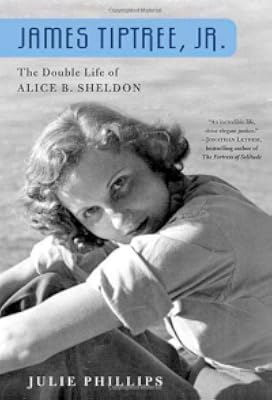
I read most of these stories when I was very young, and they probably shaped my taste in science fiction and literature in general. I re-read this collection right after reading Julie Phillips’ biography of Tiptree, and beyond the gender dynamics, which I remember well, I’m struck by how huge a theme death is in her writing.
As always with a collection, some stories are stronger than others, but even a mediocre Tiptree outshines most science fiction, and these stories for the most part are still relevant and contemporary.
As always with a collection, some stories are stronger than others, but even a mediocre Tiptree outshines most science fiction, and these stories for the most part are still relevant and contemporary.
Members
- Recently Added By
Lists

Best Science Fiction Novels
816 works; 426 members

Favorite Science Fiction by Women Authors
737 works; 202 members

Best Feminist Science Fiction
188 works; 34 members

S.F. Masterworks (Complete)
229 works; 15 members

Favorite Short Fiction
228 works; 99 members

Best Feminist Literature
188 works; 26 members

Bookriot's 100 Must-Read Sci-Fi Fantasy Novels By Female Authors
100 works; 9 members

SF Masterworks
193 works; 8 members

David Brin: Dire Warnings And Self-Preventing Prophecies
17 works; 3 members

What Makes This Book So Great
102 works; 16 members
Recommended Speculative Fiction by Women and People of Color
298 works; 45 members

Short Story Collections and Anthologies
261 works; 42 members

Science Fiction by female authors
43 works; 4 members

Unbound Worlds 100 Best SF Books
100 works; 8 members

Books Read in 2019
4,052 works; 108 members

Otherland Book Club
36 works; 2 members

Books With Complete Sentence Titles
374 works; 15 members

Books Read in 2021
5,361 works; 114 members

Read These Too
458 works; 9 members

Mustich's 1000 Books to Read Before You Die: A Life Changing List
1,001 works; 19 members
Books With the Most Memorable Titles
478 works; 158 members
Favorite Science Fiction
456 works; 218 members
Author Information

122+ Works 6,915 Members
James Tiptree, Jr., was the pseudonym that Alice Bradley Sheldon began to use for her writing in 1967. Born in Chicago, she grew up in Africa and India, worked for the CIA, and earned a Ph.D. in psychology. In 1987, when Tiptree and her husband became gravely ill, she killed him and herself
Some Editions
Awards and Honors
Awards
Notable Lists
Series
Belongs to Publisher Series
SF Masterworks (New design)
Work Relationships
Contains
Common Knowledge
- Original publication date
- 1990
- Epigraph
- If I could describe a "human being" I would be more than I am - and probably living in the future, because I think of human beings as something to be realized ahead.... But clearly "human beings" have sometimes to do with the... (show all) luminous image you see in a bright child's eyes - the exploring, wondering, eagerly grasping, undestructive quest for life. I see that undescribed spirit as central to us all. -Tiptree/Sheldon
- First words
- It may not be the truth about American writers, but it is the story. So we print the story. American writers, we say, are like meteors. Flashes in the pan. Mayfly angels. Out of nowhere, into the here they come, hurtling braz... (show all)enly through their short days to give us joy, strewing largesse and seed about as though there were no tomorrow, which indeed there isn't - because the air on the planet soon gets them, seizes shut the wings of song, burns them out. Afterwards stuck together with mucilage and pulp, they may linger for a few years in the atriums of America, for hire; but it is not a warm world for sharecroppers, and after the mating flight American writers are terribly fragile, like beehives in a frost. They rust. The crumble at the touch. This is the story we are told, the legend we print, half-right but vicious. -Introduction, John Clute
Dr. Ain was recognized on the Omaha-Chicago flight. A biologist colleague from Pasadena came out of the toilet and saw Ain in an aisle seat. Five years before, this man had been jealous of Ain's huge grants. Now he nodded col... (show all)dly and was surprised at the intensity of Ain's response. He almost turned back to speak, but he felt too tired; like nearly everyone, he was fighting the flu. -The Last Flight of Dr. Ain - Last words
- (Click to show. Warning: May contain spoilers.)Still the essence of his earthly self moved slowly after hers into the closing mists of infinity, carrying upon the River a configuration that had been a man striving forever after a loved dark girl, who followed a ghostly white milch deer. -Slow Music
(Click to show. Warning: May contain spoilers.)The child Rovy was creeping stealthily toward the screen that looked on no-space, his eyes intend and bright. -Epilogue, And Man Abides... - Canonical DDC/MDS
- 813.54
- Canonical LCC
- PS3570.I66 A6
Classifications
Statistics
- Members
- 1,377
- Popularity
- 17,236
- Reviews
- 46
- Rating
- (4.25)
- Languages
- English
- Media
- Paper, Audiobook, Ebook
- ISBNs
- 6
- ASINs
- 9