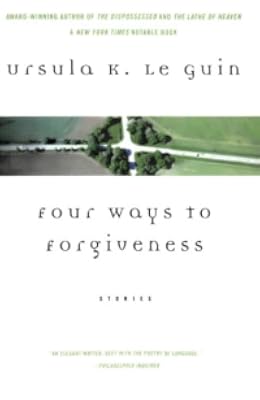
Four Ways to Forgiveness
by Ursula K. Le Guin
Yeowe and Werel (1-4), Hainish Cycle, Chronological (7), Hainish Cycle (7)
On This Page
Description
At the far end of our universe, on the twin planets of Werel and Yeowe, all humankind is divided into "assets" and "owners," tradition and liberation are at war, and freedom takes many forms. Here is a society as complex and troubled as any on our world, peopled with unforgettable characters struggling to become fully human. For the disgraced revolutionary Abberkam, the callow "space brat" Solly, the haughty soldier Teyeo, and the Ekumen historian and Hainish exile Havzhiva, freedom and duty show more both begin in the heart, and success as well as failure has its costs. In this stunning collection of four intimately interconnected novellas, Ursula K. Le Guin returns to the great themes that have made her one of America's most honored and respected authors. show lessTags
Recommendations















Member Reviews
Ursula Le Guin's writing is something to savour, always. I love her ability to so subtly create entire worlds and people that are so true, so flawed, so beautiful. There was a need to pause, to meditate after each novella, I was both impatient and hesitant to begin the next one.
These are stories of freedom and liberation, of slavery of body and mind.
Why wasn't this one of my five stars' books? Writing about atrocities and cruelty is extremely difficult, and there is fine balance to maintain - how much do you tell, how much do you imply, how do you get your message across... I felt the balance wasn't always perfect, in this case.
These are stories of freedom and liberation, of slavery of body and mind.
Why wasn't this one of my five stars' books? Writing about atrocities and cruelty is extremely difficult, and there is fine balance to maintain - how much do you tell, how much do you imply, how do you get your message across... I felt the balance wasn't always perfect, in this case.
I cannot say that this is Le Guin's best book--that honor still goes to [The Left Hand of Darkness], I think--but this is quite possibly her most beautifully written and most emotionally affecting book. That I can say.
Set on neighboring planets, Werel and Yeowe, this collection of four novellas is a study of relationships: between a man and a woman, between men and women, between enslavers and enslaved, between natives and foreigners. As we read these stories--which, at their cores, are all love stories--we learn the history of a civilization that mirrors our own in uncomfortable ways. Le Guin has structured this book perfectly, beginning with a slow and subtle introduction to this society and gradually building to an emotional show more crescendo.
The first two novellas could be paired with each other, as could the last two. In each of the first two stories, an unlikely relationship forms between a man and a woman. Thrown together by circumstance, they move past their initial assumptions and prejudices, and first see, then come to love, the other. The first story, Betrayals, is quiet, reminiscent, and almost elegiac in its tone, told from the point of view of an older woman in self-exile who believes that her life is essentially over when she rediscovers love. Only a bit of Yeowe's turbulent history is revealed; once a planet of slaves, there was a long and violent revolutionary war, and the planet's inhabitants dispelled their enslavers back to Werel and won their independence. In the second story, Forgiveness Day, more is revealed about these two planets' societies, particularly the strict separation of men and women and general oppression of women on Werel. An envoy from the federation of planets called the Ekumen, a young woman, arrives on Werel and shocks her bodyguard, a former soldier, with her behavior. But when they are kidnapped together, they come to know each other as people and, eventually, to accept each other on equal terms.
The second two novellas are also a pair, more closely related. A Man of the People tells the story of another Ekumen envoy, providing a rare glimpse of life on Hain, where he is from, and how historians are trained. Once he arrives on Yeowe, he becomes aware of the societal oppression of women and is drawn into the women's liberation movement, which he subtly affects as he can from his position as an influential outsider. The final story, "A Woman's Liberation," is the most powerful and emotionally wrenching of the four. Le Guin reveals without flinching the brutal history of these two planets, as experienced by one woman, who is first a slave, then liberated, then enslaved again as a "use woman," a sexual slave, then escapes to Yeowe, where she thinks she will be free. There she finds a still total oppression of women, and she eventually joins the underground liberation movement, where she meets the Hainish envoy. As their love grows, she is able to let go of her past, to forgive herself and her people for their history. She is able to fully become who she is meant to be, to help bring about true liberation and document the history so the past won't be repeated. And she is able to love, as an equal. This was such a powerful, moving piece of writing that I can't do it justice in describing it.
For those longtime fans of Le Guin's science fiction, this collection has an added bonus: a supplemental brief history of Hain, a tantalizing society that we have before only glimpsed in her work, and the history of the Ekumen. This is a book I am sure I will return to again and again, the product of a great (and underappreciated) writer at the height of her abilities. show less
Set on neighboring planets, Werel and Yeowe, this collection of four novellas is a study of relationships: between a man and a woman, between men and women, between enslavers and enslaved, between natives and foreigners. As we read these stories--which, at their cores, are all love stories--we learn the history of a civilization that mirrors our own in uncomfortable ways. Le Guin has structured this book perfectly, beginning with a slow and subtle introduction to this society and gradually building to an emotional show more crescendo.
The first two novellas could be paired with each other, as could the last two. In each of the first two stories, an unlikely relationship forms between a man and a woman. Thrown together by circumstance, they move past their initial assumptions and prejudices, and first see, then come to love, the other. The first story, Betrayals, is quiet, reminiscent, and almost elegiac in its tone, told from the point of view of an older woman in self-exile who believes that her life is essentially over when she rediscovers love. Only a bit of Yeowe's turbulent history is revealed; once a planet of slaves, there was a long and violent revolutionary war, and the planet's inhabitants dispelled their enslavers back to Werel and won their independence. In the second story, Forgiveness Day, more is revealed about these two planets' societies, particularly the strict separation of men and women and general oppression of women on Werel. An envoy from the federation of planets called the Ekumen, a young woman, arrives on Werel and shocks her bodyguard, a former soldier, with her behavior. But when they are kidnapped together, they come to know each other as people and, eventually, to accept each other on equal terms.
The second two novellas are also a pair, more closely related. A Man of the People tells the story of another Ekumen envoy, providing a rare glimpse of life on Hain, where he is from, and how historians are trained. Once he arrives on Yeowe, he becomes aware of the societal oppression of women and is drawn into the women's liberation movement, which he subtly affects as he can from his position as an influential outsider. The final story, "A Woman's Liberation," is the most powerful and emotionally wrenching of the four. Le Guin reveals without flinching the brutal history of these two planets, as experienced by one woman, who is first a slave, then liberated, then enslaved again as a "use woman," a sexual slave, then escapes to Yeowe, where she thinks she will be free. There she finds a still total oppression of women, and she eventually joins the underground liberation movement, where she meets the Hainish envoy. As their love grows, she is able to let go of her past, to forgive herself and her people for their history. She is able to fully become who she is meant to be, to help bring about true liberation and document the history so the past won't be repeated. And she is able to love, as an equal. This was such a powerful, moving piece of writing that I can't do it justice in describing it.
For those longtime fans of Le Guin's science fiction, this collection has an added bonus: a supplemental brief history of Hain, a tantalizing society that we have before only glimpsed in her work, and the history of the Ekumen. This is a book I am sure I will return to again and again, the product of a great (and underappreciated) writer at the height of her abilities. show less
UK LeGuin is just a wonderful writer. This collection of four linked novellas about a society in which slavery is just coming to an end demonstrates why she is so highly respected. Lean, supple prose, complex societies revealed through realistic characters making hard choices. One of the things I respect enormously about her work is that she is often able to create fictions that work as fictions - that have the elements of story - and still somehow convey some of the complexity of lived experience, which is generally too messy and open ended to fit in story.
Four Ways to Forgiveness contains four novella set on the planet Werel and its colony planet, Yoewe. Werel has a violent and oppressive history and although having become technologically quite advance, the practice of slavery is still the basis of their society.
The first story is set on Yeowe following their War of Liberation and features an old woman and her relationship with a former Chief of the revolution. This story seems mostly to serve as exposition and a commentary on how elders are treated in the burgeoning free era.
Next, we follow an Ekumenical sub-envoy and her struggles with the extremely misogynistic practices in place on Werel. She is trying to bring enlightenment and is treated alternately like a man and a precocious show more child, but just wants to be seen as an independent woman. This is difficult for the Werelians to deal with.
The third story begins on Hain, which is nice because of all the talk so far in this series of the Hainish and the Ekumen having originated there, none of the action has ever been set there. It is interesting to note that there are still some “backwards” and “rural” areas of Hain. It is not the enlightened utopia I had come to think of judging by its description and the characters in other books who are from there. The narrator of this tale begins life in a rural area and grows to be an Envoy to Werel. His early life and training period are quite interesting and his adventures on Werel serve to tie some threads together from the first two stories.
This Envoy will also appear in our fourth story, which is presented as a memoir of a woman who is born in slavery on Werel, but because of some very fortunate events is able to participate in a Werelian slave-revolt, learn to read, write and teach, and finally end up on Yeowe helping to continue the revolution and enlightenment there.
The themes throughout are, of course, forgiveness, as well as how two people from different walks of life can find love together. Each of these stories features a set of very unlikely lovers, often of different planets of origin, who find common ground. This could be applied as a metaphor for mixed-race relations here in America (or even on Planet Earth). The other main theme is feminism. The revolution on Yeowe originated in the women’s camp, but after liberation, women are still treated as property, often with less power than they had as slaves. The message seems to be that many men need to have someone to oppress in order to feel powerful, even if they have been oppressed themselves and know how that feels. Of course, as the society grows and becomes more “civilized” the genders need to be treated more equally. This is also a comment on Earthly societal norms.
LeGuin has long been a pioneer of feminist science fiction. She is adept at spinning an engaging tale that stands alone on its own merit, as well as presenting an underlying message that is almost sneaky in the way it inhabits the readers mind and (hopefully!) transforms the reader’s attitudes on the subject. show less
The first story is set on Yeowe following their War of Liberation and features an old woman and her relationship with a former Chief of the revolution. This story seems mostly to serve as exposition and a commentary on how elders are treated in the burgeoning free era.
Next, we follow an Ekumenical sub-envoy and her struggles with the extremely misogynistic practices in place on Werel. She is trying to bring enlightenment and is treated alternately like a man and a precocious show more child, but just wants to be seen as an independent woman. This is difficult for the Werelians to deal with.
The third story begins on Hain, which is nice because of all the talk so far in this series of the Hainish and the Ekumen having originated there, none of the action has ever been set there. It is interesting to note that there are still some “backwards” and “rural” areas of Hain. It is not the enlightened utopia I had come to think of judging by its description and the characters in other books who are from there. The narrator of this tale begins life in a rural area and grows to be an Envoy to Werel. His early life and training period are quite interesting and his adventures on Werel serve to tie some threads together from the first two stories.
This Envoy will also appear in our fourth story, which is presented as a memoir of a woman who is born in slavery on Werel, but because of some very fortunate events is able to participate in a Werelian slave-revolt, learn to read, write and teach, and finally end up on Yeowe helping to continue the revolution and enlightenment there.
The themes throughout are, of course, forgiveness, as well as how two people from different walks of life can find love together. Each of these stories features a set of very unlikely lovers, often of different planets of origin, who find common ground. This could be applied as a metaphor for mixed-race relations here in America (or even on Planet Earth). The other main theme is feminism. The revolution on Yeowe originated in the women’s camp, but after liberation, women are still treated as property, often with less power than they had as slaves. The message seems to be that many men need to have someone to oppress in order to feel powerful, even if they have been oppressed themselves and know how that feels. Of course, as the society grows and becomes more “civilized” the genders need to be treated more equally. This is also a comment on Earthly societal norms.
LeGuin has long been a pioneer of feminist science fiction. She is adept at spinning an engaging tale that stands alone on its own merit, as well as presenting an underlying message that is almost sneaky in the way it inhabits the readers mind and (hopefully!) transforms the reader’s attitudes on the subject. show less
Four nice short(er) stories connect via the worldbuilding, and what a worldbuilding it is. Slavery, feminism and so on. The book is filled with amazing moments, speeches, and thoughts. I think Le Guin is probably the best at this kind of writing, the characters are a bit blank, but that's good, because then they can reflect the worlds (and yes it's important that it's plural) around them, which are essentially experiments in antropology and culture.
**Four Ways to Forgiveness** is part of *Ursula K. Le Guin*'s Hainish Cycle, and gives us a bit of a backstory on the Hainish themselves, how the Ekumen was founded, and how worlds may come to join the Ekumen. The story is told in four parts, a character apiece. The characters do interact, but they form their own narratives. From the perspective of a slave, a military slave owner, an envoy, and a historian, we gain a perspective on the world of Werel, and the rebellion of the slaves against their owners. I was very impressed with the discussion of slavery, dependence, culture, misogyny, and revolution from the different perspectives. It's not easy reading though – Le Guin doesn't shy away from depicting all the horrible parts of show more oppression and slavery. Despite that, the stories were touching and hopeful and noticeably written to work well together. show less
I have to admit, I was a little hesitant about this book, which consists of four novellas. I wanted to explore science fiction and this title sounded interesting, but knowing that Ursula Le Guin is such a big name in science fiction, I was a little concerned I was going to be getting into a book that was going to be just a little too weird for me quite frankly. However, I soon forgot I was reading science fiction and really enjoyed this title. Le Guin's focus is much more on her characters and their lives, outer and inner, which made this book particularly interesting to me. I just found out that this book is one of a series, so that could explain why I was a little confused here and there about the two new worlds she created, although show more I found that figuring out exactly what these worlds were all about added to my pleasure of reading this book. Le Guin is masterful with her writing, and the final novella, written in the first person, is particularly gripping. It was particularly fascinating how the four novellas, while each could be read as a stand alone, were intimately connected and added to each other. If I had more time, I would love to go back and re-read the entire book after gaining knowledge about the two new worlds from all four novellas. show less
Members
- Recently Added By
Lists

Best Science Fiction Novels
816 works; 430 members

Favorite Science Fiction by Women Authors
741 works; 203 members

Best Feminist Science Fiction
188 works; 34 members
Best Contemporary Literary Fiction (Around the Last 30 Years)
400 works; 124 members

20th Century Literature
1,161 works; 55 members

Best Feminist Literature
188 works; 26 members

Stories About Other Worlds
145 works; 13 members

Short Story Collections and Anthologies
261 works; 42 members
Recommended Speculative Fiction by Women and People of Color
298 works; 45 members

Nineties
43 works; 10 members

Shannon's Read-Alikes List
71 works; 8 members

Speculative Fiction to Read
706 works; 32 members

SFFKit 2016
13 works; 1 member

Top Five Books of 2016
795 works; 229 members

Books With Numbers in the Title
308 works; 13 members

Character-driven SF
59 works; 1 member
Science Fiction and Fantasy
63 works; 4 members

Female Protagonist
1,056 works; 57 members

Books Read in 2008
336 works; 8 members

Books Read in 2016
4,666 works; 199 members
Books Set on Extraterrestrial Planets
27 works; 5 members
Literature About Women and Girls
426 works; 40 members

1990s
309 works; 17 members
Favourite Books
1,820 works; 316 members

Read in 2008
32 works; 1 member
Survey of Classic Science Fiction
171 works; 48 members
Author Information

502+ Works 167,699 Members
Ursula K. Le Guin was born Ursula Kroeber in Berkeley, California on October 21, 1929. She received a bachelor's degree from Radcliffe College in 1951 and a master's degree in romance literature of the Middle Ages and Renaissance from Columbia University in 1952. She won a Fulbright fellowship in 1953 to study in Paris, where she met and married show more Charles Le Guin. Her first science-fiction novel, Rocannon's World, was published in 1966. Her other books included the Earthsea series, The Left Hand of Darkness, The Dispossessed: An Ambiguous Utopia, The Lathe of Heaven, Four Ways to Forgiveness, and The Telling. A Wizard of Earthsea received an American Library Association Notable Book citation, a Horn Book Honor List citation, and the Lewis Carroll Shelf Award in 1979. She received the Medal for Distinguished Contribution to American Letters in 2014. She also received the Nebula Award and the Hugo Award. She also wrote books of poetry, short stories collections, collections of essays, children's books, a guide for writers, and volumes of translation including the Tao Te Ching of Lao Tzu and selected poems by Gabriela Mistral. She died on January 22, 2018 at the age of 88. (Bowker Author Biography) show less
Awards and Honors
Awards
Series


Belongs to Publisher Series
Work Relationships
Common Knowledge
- Canonical title*
- Neljä anteeksiantoa
- Original title
- Four Ways to Forgiveness
- Original publication date
- 1994
- People/Characters
- Yoss; Abberkam; Solly; Teyeo; Havzhiva; Rakam
- Important places
- Werel (planet); Yeowe (planet)
- First words
- "On the planet O there has not been a war for five thousand years," she read, "and on Gethen there has never been a war."
- Quotations
- It is in our bodies that we lose or begin our freedom, in our bodies that we accept or end our slavery.
- Last words
- (Click to show. Warning: May contain spoilers.)So I wrote this book for my friend, with whom I have lived and will die free.
- Blurbers
- Griffith, Nicola; Paley, Grace; Freeman, Judith; Lethem, Jonathan; Gloss, Molly; Russell, Mary Doria (show all 7); Kitzer, Carolyn
- Original language
- English
*Some information comes from Common Knowledge in other languages. Click "Edit" for more information.
Classifications
Statistics
- Members
- 1,356
- Popularity
- 17,698
- Reviews
- 27
- Rating
- (3.90)
- Languages
- 10 — Danish, English, Finnish, French, Greek, Polish, Portuguese, Russian, Spanish, Turkish
- Media
- Paper, Ebook
- ISBNs
- 20
- ASINs
- 7