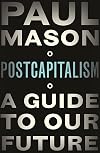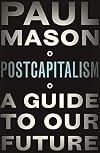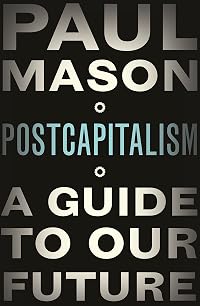
Postcapitalism: a guide to our future
by Paul Mason
On This Page
Description
"Over the past two centuries or so, capitalism has undergone profound changes--economic cycles that veer from boom to bust--from which it has always emerged transformed and strengthened. Surveying this turbulent history, Paul Mason's Postcapitalism argues that we are on the brink of a change so big and so profound that this time capitalism itself, the immensely complex system within which entire societies function, will mutate into something wholly new. At the heart of this change is show more information technology, a revolution that is driven by capitalism but, with its tendency to push the value of much of what we make toward zero, has the potential to destroy an economy based on markets, wages, and private ownership. Almost unnoticed, in the niches and hollows of the market system, swaths of economic life are beginning to move to a different rhythm. Vast numbers of people are changing how they behave and live, in ways contrary to the current system of state-backed corporate capitalism. And as the terrain changes, new paths open. In this bold and prophetic book, Mason shows how, from the ashes of the crisis, we have the chance to create a more socially just and sustainable economy. Although the dangers ahead are profound, he argues that there is cause for hope. This is the first time in human history in which, equipped with an understanding of what is happening around us, we can predict and shape the future"-- "In the tradition of No Logo and Empire, Postcapitalism is a sharply polemical but deeply analytical and historically informed account of the transition from capitalism to a new economic order"-- show lessTags
Recommendations

Member Recommendations
Member Reviews
I deliberately read ‘Postcapitalism’ quite slowly, as it deserves considerable thought. I find it striking that such a book was written by a journalist, in an engagingly journalistic style, rather than an academic or that ambiguous figure in between, a public intellectual. Although perhaps Paul Mason falls into the latter category? I’m not sure. Anyway, he isn’t an economist, and I think this book demonstrates quite clearly why that enables him to think beyond neoliberalism. As an aside, a few days ago I was asked about my disciplinary background in a job interview. I answered that I’d studied economics and had a grounding in micro and macro, but hastened to add that I was not an economist. As Mason points out, to be an show more economist, or even a student of economics, today is to be an evangelist of neoliberal ideology.
Rather to my amusement, I found that Mason’s approach to explaining his notion of postcapitalism reminded me a little of Slavoj Žižek, except with a diametrically opposite prose style. Like Žižek, Mason has picked through various theorists and writers of the last 200 years, extracted what he found most convincing, and stitched it together loosely. He takes the reader through Kondratieff cycles (which I vaguely remember from my undergraduate days), elements of Marx’s [b:Grundrisse: Foundations of the Critique of Political Economy|409558|Grundrisse Foundations of the Critique of Political Economy|Karl Marx|https://images.gr-assets.com/books/1387703356s/409558.jpg|1194861] (which I found fascinating), and a Soviet economist called Bogdanov (whose novel, [b:Red Star|400399|Red Star|Alexander Bogdanov|https://images.gr-assets.com/books/1391055952s/400399.jpg|389821], I’ve been meaning to read for years). From these building blocks, he constructs a loose theory of capitalism’s collapse in the face of the information economy, recounting the history of industrialisation in the process.
Probably the most critical observation to this theory is that information now forms a huge and growing proportion of the goods and services that make up GDP. Yet it is cannot be priced using standard economic theory, which states that a market is in equilibrium when marginal cost equals marginal benefit. Information has zero marginal cost, as it can be copied infinitely, the only cost involved being the electricity this requires. Moreover, the category of information keeps expanding, to include music, books, films, TV shows, patterns and designs to make or do just about any other thing. Whilst there is obviously a cost to producing this information, that is generally also falling. Only legal structures prevent everyone with an internet connection being able to listen to practically every song, watch practically every film, and read practically every book ever created. Realistically, everyone willing to pirate already does. Business models based on defending copyright are fighting a losing battle, as internet connections get faster, storage cheaper, and files quality better. I have long blamed my comfort with media piracy on A-level economics, which helpfully taught me that a good with zero marginal cost should also be priced at zero. Mason notes that the so-called ‘Internet of Things’ (a concept I am admittedly somewhat dubious of) will expand both the volume and proportion of information in our goods and services. At the moment, the information that we passively create by browsing the web (which certainly feels like a passive activity much of the time) is controlled by state and private monopolies; google and the NSA, broadly. The argument here is all such information should be made more public, in order that it can be used to drive innovation.
I think there is a lot more to be written just on that one point, never mind the many others this book makes, however Mason makes a strong start. The question he is really posing, it seems to me, is whether technology breaking neoliberalism will result in technology breaking capitalism entirely. Postcapitalism strikes me as somewhat like postmodernism - highly contingent, depending on the commentator and discipline under discussion. By this I mean that Mason is advocating a sort of mixed economy, in which information is set free to encourage innovation and the productivity gains of automation are used to provide a basic income for all, yet markets and governments still fit together somewhere. In some ways such proposals aren’t novel, as many have advocated similar things before. Yet this is the first book that I’ve read to propose that a new, albeit vague, kind of capitalism is not only possible but inevitable, as neoliberalism’s contradictions are consuming it. Moreover, it deploys Marx effectively to support the central thesis.
In a 400 page book one cannot expect to find the answer to every question, however there was one relative omission that really struck me: democracy. This makes ‘Postcapitalism’ a striking mirror to [b:The End of History and the Last Man|57981|The End of History and the Last Man|Francis Fukuyama|https://images.gr-assets.com/books/1391572633s/57981.jpg|56476], which it is essentially refuting. Fukuyama spends most of his book on arguments for democracy’s lasting survival, apparently thinking that free market capitalism more or less justifies its own immortality. Mason, meanwhile, spends considerable time on the structural weaknesses of free market capitalism, only occasionally touching on the role of the state and governance. Indeed, towards the end of the book the ‘withering away’ of the state, after Marx, is envisaged. I think there is a lot more to be said here, although it’s fair enough that there wasn’t space in the book. Most notably, I wonder about the ways in which an information-based economy facilitates and obscures democratic decision-making. At present, the 24-hour news cycle and culture of social media outrage creates an instantaneity that is also intensely volatile. How can a democratic process adequately respond to a constant stream of conflicting, changing information? At present a great deal of this responsiveness is entrusted to markets and citizens are told that their power lies in consumption choices. Postcapitalism envisages a much smaller role for markets and a greater role for collaboration. Whilst evidently this would redistribute power very significantly, the role of the state would become much more important, at least initially. Mason strongly argues that natural monopolies such as utilities should be nationalised, although presumably the rise of information could also improve their productivity.
I am meandering here, as this book is extremely thought-provoking. The question I’m trying to articulate is something like: is access to information sufficient for transparency and accountability? Can it create parallel means of governance (as Mason seems to envisage) that reduces the need for a centralised state as currently exists? Personally I rather doubt it, as information is no more neutral as a means of production than labour or capital. Whilst access to it is a form of power, wider access doesn't remove the power of those who process the information and write the algorithms that determine what action is taken in response to it. Moreover, it is incredibly difficult to say these days what is personal data and what isn’t. ‘Big data’ is surely just millions of pieces of personal information aggregated together. Thus, freeing some forms of information intended to be public (music, films, books) is a very different matter to freeing information that those creating it are barely aware of (medical data, shopping habits, how an office printer is used). There is the obvious response of anonymising the data, then the equally obvious rejoinder of whether that is ever truly possible when every detail of life is recorded in some device. The thought experiment of what if all information really was freely available, somehow, really makes you aware of how many monopolies defend it at present (amazon, google, facebook, et al). Quite apart from the resistance such companies would put up to transparency, the implications are dizzying. Increasing technological innovation is the very least of them. Do you want to know the number of times you have bought the same sandwich from Tesco? How would you feel about the knowledge of how much Tesco profited over years from just those sandwich purchases? If you could know the exact supply chain that produced your sandwich, indeed all your purchases, could you cope with all that information? Or is it easier to proceed on the basis of habit, given the exhaustion of information overload? If you could find information on everything, how would you prioritise? How would you find the energy to care about anything if you knew everything? Yet I agree with Mason that the current monopolistic situation is fragile and unsustainable.
I should try and get to the point here. I don’t agree with the subtitle of this book, ‘A guide to our future’. Rather, it is an original analysis of our present and its instabilities. Mason is trying to provide a positive, albeit vague, vision for the future (although I note he uses the term ‘utopian’ in an inconsistent and ambivalent fashion), to inspire something beyond the fatalism of There Is No Alternative. In my view, though, the value of the book is its original critique of neoliberal economic theory and attempt to posit new theories. Moreover, it spends quite a lot of time on history. As such, it reads well with [b:The Shock Doctrine: The Rise of Disaster Capitalism|1237300|The Shock Doctrine The Rise of Disaster Capitalism|Naomi Klein|https://images.gr-assets.com/books/1442590618s/1237300.jpg|2826418], which critiques neoliberalism on a very practical, international basis.
I hope that ‘Postcapitalism’ is widely read, as it raises vitally important issues (international debt, demographic timebombs, and climate change, amongst others). Also, I want to discuss it with people. I agree with Mason’s economic arguments as to why neoliberal capitalism is doomed, however a lot more thought is required to come up with a replacement for it. Mason doesn’t claim to have the answers, but he is definitely asking the right questions. show less
Rather to my amusement, I found that Mason’s approach to explaining his notion of postcapitalism reminded me a little of Slavoj Žižek, except with a diametrically opposite prose style. Like Žižek, Mason has picked through various theorists and writers of the last 200 years, extracted what he found most convincing, and stitched it together loosely. He takes the reader through Kondratieff cycles (which I vaguely remember from my undergraduate days), elements of Marx’s [b:Grundrisse: Foundations of the Critique of Political Economy|409558|Grundrisse Foundations of the Critique of Political Economy|Karl Marx|https://images.gr-assets.com/books/1387703356s/409558.jpg|1194861] (which I found fascinating), and a Soviet economist called Bogdanov (whose novel, [b:Red Star|400399|Red Star|Alexander Bogdanov|https://images.gr-assets.com/books/1391055952s/400399.jpg|389821], I’ve been meaning to read for years). From these building blocks, he constructs a loose theory of capitalism’s collapse in the face of the information economy, recounting the history of industrialisation in the process.
Probably the most critical observation to this theory is that information now forms a huge and growing proportion of the goods and services that make up GDP. Yet it is cannot be priced using standard economic theory, which states that a market is in equilibrium when marginal cost equals marginal benefit. Information has zero marginal cost, as it can be copied infinitely, the only cost involved being the electricity this requires. Moreover, the category of information keeps expanding, to include music, books, films, TV shows, patterns and designs to make or do just about any other thing. Whilst there is obviously a cost to producing this information, that is generally also falling. Only legal structures prevent everyone with an internet connection being able to listen to practically every song, watch practically every film, and read practically every book ever created. Realistically, everyone willing to pirate already does. Business models based on defending copyright are fighting a losing battle, as internet connections get faster, storage cheaper, and files quality better. I have long blamed my comfort with media piracy on A-level economics, which helpfully taught me that a good with zero marginal cost should also be priced at zero. Mason notes that the so-called ‘Internet of Things’ (a concept I am admittedly somewhat dubious of) will expand both the volume and proportion of information in our goods and services. At the moment, the information that we passively create by browsing the web (which certainly feels like a passive activity much of the time) is controlled by state and private monopolies; google and the NSA, broadly. The argument here is all such information should be made more public, in order that it can be used to drive innovation.
I think there is a lot more to be written just on that one point, never mind the many others this book makes, however Mason makes a strong start. The question he is really posing, it seems to me, is whether technology breaking neoliberalism will result in technology breaking capitalism entirely. Postcapitalism strikes me as somewhat like postmodernism - highly contingent, depending on the commentator and discipline under discussion. By this I mean that Mason is advocating a sort of mixed economy, in which information is set free to encourage innovation and the productivity gains of automation are used to provide a basic income for all, yet markets and governments still fit together somewhere. In some ways such proposals aren’t novel, as many have advocated similar things before. Yet this is the first book that I’ve read to propose that a new, albeit vague, kind of capitalism is not only possible but inevitable, as neoliberalism’s contradictions are consuming it. Moreover, it deploys Marx effectively to support the central thesis.
In a 400 page book one cannot expect to find the answer to every question, however there was one relative omission that really struck me: democracy. This makes ‘Postcapitalism’ a striking mirror to [b:The End of History and the Last Man|57981|The End of History and the Last Man|Francis Fukuyama|https://images.gr-assets.com/books/1391572633s/57981.jpg|56476], which it is essentially refuting. Fukuyama spends most of his book on arguments for democracy’s lasting survival, apparently thinking that free market capitalism more or less justifies its own immortality. Mason, meanwhile, spends considerable time on the structural weaknesses of free market capitalism, only occasionally touching on the role of the state and governance. Indeed, towards the end of the book the ‘withering away’ of the state, after Marx, is envisaged. I think there is a lot more to be said here, although it’s fair enough that there wasn’t space in the book. Most notably, I wonder about the ways in which an information-based economy facilitates and obscures democratic decision-making. At present, the 24-hour news cycle and culture of social media outrage creates an instantaneity that is also intensely volatile. How can a democratic process adequately respond to a constant stream of conflicting, changing information? At present a great deal of this responsiveness is entrusted to markets and citizens are told that their power lies in consumption choices. Postcapitalism envisages a much smaller role for markets and a greater role for collaboration. Whilst evidently this would redistribute power very significantly, the role of the state would become much more important, at least initially. Mason strongly argues that natural monopolies such as utilities should be nationalised, although presumably the rise of information could also improve their productivity.
I am meandering here, as this book is extremely thought-provoking. The question I’m trying to articulate is something like: is access to information sufficient for transparency and accountability? Can it create parallel means of governance (as Mason seems to envisage) that reduces the need for a centralised state as currently exists? Personally I rather doubt it, as information is no more neutral as a means of production than labour or capital. Whilst access to it is a form of power, wider access doesn't remove the power of those who process the information and write the algorithms that determine what action is taken in response to it. Moreover, it is incredibly difficult to say these days what is personal data and what isn’t. ‘Big data’ is surely just millions of pieces of personal information aggregated together. Thus, freeing some forms of information intended to be public (music, films, books) is a very different matter to freeing information that those creating it are barely aware of (medical data, shopping habits, how an office printer is used). There is the obvious response of anonymising the data, then the equally obvious rejoinder of whether that is ever truly possible when every detail of life is recorded in some device. The thought experiment of what if all information really was freely available, somehow, really makes you aware of how many monopolies defend it at present (amazon, google, facebook, et al). Quite apart from the resistance such companies would put up to transparency, the implications are dizzying. Increasing technological innovation is the very least of them. Do you want to know the number of times you have bought the same sandwich from Tesco? How would you feel about the knowledge of how much Tesco profited over years from just those sandwich purchases? If you could know the exact supply chain that produced your sandwich, indeed all your purchases, could you cope with all that information? Or is it easier to proceed on the basis of habit, given the exhaustion of information overload? If you could find information on everything, how would you prioritise? How would you find the energy to care about anything if you knew everything? Yet I agree with Mason that the current monopolistic situation is fragile and unsustainable.
I should try and get to the point here. I don’t agree with the subtitle of this book, ‘A guide to our future’. Rather, it is an original analysis of our present and its instabilities. Mason is trying to provide a positive, albeit vague, vision for the future (although I note he uses the term ‘utopian’ in an inconsistent and ambivalent fashion), to inspire something beyond the fatalism of There Is No Alternative. In my view, though, the value of the book is its original critique of neoliberal economic theory and attempt to posit new theories. Moreover, it spends quite a lot of time on history. As such, it reads well with [b:The Shock Doctrine: The Rise of Disaster Capitalism|1237300|The Shock Doctrine The Rise of Disaster Capitalism|Naomi Klein|https://images.gr-assets.com/books/1442590618s/1237300.jpg|2826418], which critiques neoliberalism on a very practical, international basis.
I hope that ‘Postcapitalism’ is widely read, as it raises vitally important issues (international debt, demographic timebombs, and climate change, amongst others). Also, I want to discuss it with people. I agree with Mason’s economic arguments as to why neoliberal capitalism is doomed, however a lot more thought is required to come up with a replacement for it. Mason doesn’t claim to have the answers, but he is definitely asking the right questions. show less
This is the thing that keeps me up at night. All these topics interest me greatly. I happen to violently disagree with the author about the solution or even interpretation of some of the facts but it's still a stimulating read and I always enjoy books by positive people. That's a bit of characteristic of hardcore communists (I mean he does work at the BBC) - they're all convinced of the inevitability of their victory.
Also for fuck's sake, stop repeating this bullshit: you can earn money selling GPLed software, there is nothing in the license about not charging money. So many non-technical authors repeat this lie, Stallman is pre-emptively spinning before being buried. Open source is not communism (despite what Ballmer says)! Get your show more own social movement.
I absolve you of this sin because you made me laugh with cyber-stalinism. show less
Also for fuck's sake, stop repeating this bullshit: you can earn money selling GPLed software, there is nothing in the license about not charging money. So many non-technical authors repeat this lie, Stallman is pre-emptively spinning before being buried. Open source is not communism (despite what Ballmer says)! Get your show more own social movement.
I absolve you of this sin because you made me laugh with cyber-stalinism. show less
I was genuinely surprised by this book, which is the highest praise I have. I think the blurb by Gillian Tett is on the money (!?) when she recommends it to those who are both in favour of and who oppose capitalism as it currently exists.
There is an entire genre of books about the evils of neoliberalism (or whatever you're having yourself). Many are exhaustive - and exhausting - exercises in misery train-spotting. The next, superior group diagnose the causes of said macroeconomic and social misery. The very smallest group, and the best kind of books in this genre, are a response to the criticisms which can be levelled at the preceding groups, namely "so what" and "so, what next".
Mason diagnoses how we got to where we are, and because show more he has a plausible theory of where we were and where we might be now, he has some workable (if, admittedly utopian) or at least interesting proposals for where we might go next. I don't agree with everything he says, but he has made a significant effort to avoid the usual clichés, and even if you have read and know it all, he consistently leavens it with frequent nuggets of insight.
There is plenty I disagree with, and the material on Marx and the labour theory of value could conceivably have been either shortened somewhat, or made a bit more compelling. If this had been the case, though, there might have been a sense that this book lacked depth, but this is not the case. Recommended. show less
There is an entire genre of books about the evils of neoliberalism (or whatever you're having yourself). Many are exhaustive - and exhausting - exercises in misery train-spotting. The next, superior group diagnose the causes of said macroeconomic and social misery. The very smallest group, and the best kind of books in this genre, are a response to the criticisms which can be levelled at the preceding groups, namely "so what" and "so, what next".
Mason diagnoses how we got to where we are, and because show more he has a plausible theory of where we were and where we might be now, he has some workable (if, admittedly utopian) or at least interesting proposals for where we might go next. I don't agree with everything he says, but he has made a significant effort to avoid the usual clichés, and even if you have read and know it all, he consistently leavens it with frequent nuggets of insight.
There is plenty I disagree with, and the material on Marx and the labour theory of value could conceivably have been either shortened somewhat, or made a bit more compelling. If this had been the case, though, there might have been a sense that this book lacked depth, but this is not the case. Recommended. show less
Highly engaging and entertaining. A curious read for anyone that will be around in some form, frozen or not, past 2050. In the first part of the book Mason provides an entertaining, if not deeply labor biased, summary of economic thought from Adam Smith and Karl Marx to Kondratieff. Here Mason sets up his basic argument that Neoliberal Capitalism is a gamed system whose primary tools: fiat money and financialization will become less effective as we move toward an information based system of Capitalism where increasingly the goods that we buy and sell are not influenced by the traditional rules of scarcity that drive supply and demand and 'rational' markets. In short with IT, Robotics, AGI, Nanotech, 3D printing, Holograms, Crypto show more Currencies and VR much of what our economy will produce in the near future we will be able to create, copy and distribute for free and Mason appears optimistic that there is nothing that governments or corporations can do to prevent it. And since InfoTech will automate most of our work our rapidly expanding population of workers will not have sufficient means to acquire capital. In this scenario zero cost production and distribution seems almost required.
The scope of this book is large and I plan to reread it in a few months once some more substantive critiques come out. In the interim I'll just highlight some other points I found interesting:
1. Mason compares the upcoming shift that Capitalism will undergo as similar to what occurred from Feudalism to Merchant Capitalism. He uses the plays of Shakespeare to make visible some of the social changes that occurred during the playwrights' life. In an interview on the Guardian Mason suggested that people watch Wolf Hall (I've only read it) to get an understanding of what this transition will be like. I'll just remind you that even the crafty Cromwell could not navigate those times with his head still on.
2. Environmental and population demographic pressures are covered but too briefly. He describes regional haves and have nots where migration into all richer countries will have to be quelled. These sections are, in my view mostly incontrovertible at this point, but it's hard to deny that by 2050, ceteris paribus, most schemes to keep the current world economies financially healthy seem far too short sighted. One of the simpler examples, if I recall correctly, is that according to Mason upwards of 60% of the actual value of most of the world’s energy companies are currently locked in reserves of carbon which if actually utilized could effectively destroy the planet. However, if these energy reserves are not pursued or are otherwise obstructed the value of these companies is basically hollowed out along with many of the world’s economies that are tied to this speculative wealth in some manner.
3. Marx's 'Fragment on Machines', not translated into English until 1973, is covered more extensively than in other recent books that concern themselves with automation and labor: 'Rise of the Robots', 'Machines of Loving Grace' etc. In this fragment Marx anticipated something like the Info Capitalism that Mason suggests, where abstract knowledge will become the primary force of production. There is a lot more to mine here.
4. Mason's solution, Project Zero, which includes a closed zero-carbon-energy system where the production of machines, products and services whose marginal costs trend toward zero and which drive labor time to zero will all be managed by extremely sophisticated computer networks and models. Of course this will happen in degrees. I am not in the current camp that worries about malevolent AI as much as I worry about all of our critical infrastructure relying on models that can evolve beyond our cognitive comprehension and control. It will be hard to secure such systems from each other-those wily, poor 'have nots' above for example. Mason anticipates this by saying that any changes to the economy will be simulated millions of times before they are actually implemented in situ, and pervasively deployed software agents will monitor the entire network in real time at all times. For people not born into this world it will probably be alien and terrifying or worse stultifying beyond belief.
5. Property is not sufficiently covered but as Mason argues that the 1% will basically be eliminated, for their own benefit-they are miserable anyway, I suspect that all of their holdings will be communized in some manner. A UBI is proposed, at least initially. Again the primary argument here is that the marginal costs of products and services will naturally trend toward zero and so the UBI could as well. show less
The scope of this book is large and I plan to reread it in a few months once some more substantive critiques come out. In the interim I'll just highlight some other points I found interesting:
1. Mason compares the upcoming shift that Capitalism will undergo as similar to what occurred from Feudalism to Merchant Capitalism. He uses the plays of Shakespeare to make visible some of the social changes that occurred during the playwrights' life. In an interview on the Guardian Mason suggested that people watch Wolf Hall (I've only read it) to get an understanding of what this transition will be like. I'll just remind you that even the crafty Cromwell could not navigate those times with his head still on.
2. Environmental and population demographic pressures are covered but too briefly. He describes regional haves and have nots where migration into all richer countries will have to be quelled. These sections are, in my view mostly incontrovertible at this point, but it's hard to deny that by 2050, ceteris paribus, most schemes to keep the current world economies financially healthy seem far too short sighted. One of the simpler examples, if I recall correctly, is that according to Mason upwards of 60% of the actual value of most of the world’s energy companies are currently locked in reserves of carbon which if actually utilized could effectively destroy the planet. However, if these energy reserves are not pursued or are otherwise obstructed the value of these companies is basically hollowed out along with many of the world’s economies that are tied to this speculative wealth in some manner.
3. Marx's 'Fragment on Machines', not translated into English until 1973, is covered more extensively than in other recent books that concern themselves with automation and labor: 'Rise of the Robots', 'Machines of Loving Grace' etc. In this fragment Marx anticipated something like the Info Capitalism that Mason suggests, where abstract knowledge will become the primary force of production. There is a lot more to mine here.
4. Mason's solution, Project Zero, which includes a closed zero-carbon-energy system where the production of machines, products and services whose marginal costs trend toward zero and which drive labor time to zero will all be managed by extremely sophisticated computer networks and models. Of course this will happen in degrees. I am not in the current camp that worries about malevolent AI as much as I worry about all of our critical infrastructure relying on models that can evolve beyond our cognitive comprehension and control. It will be hard to secure such systems from each other-those wily, poor 'have nots' above for example. Mason anticipates this by saying that any changes to the economy will be simulated millions of times before they are actually implemented in situ, and pervasively deployed software agents will monitor the entire network in real time at all times. For people not born into this world it will probably be alien and terrifying or worse stultifying beyond belief.
5. Property is not sufficiently covered but as Mason argues that the 1% will basically be eliminated, for their own benefit-they are miserable anyway, I suspect that all of their holdings will be communized in some manner. A UBI is proposed, at least initially. Again the primary argument here is that the marginal costs of products and services will naturally trend toward zero and so the UBI could as well. show less
OK, cards on the table: economics is not my thing. I struggle to give it the credence that our current system insists is its due. Perhaps, because of this, I give up too easily when reading about the subject: perhaps I am simply an economic thicko. I don't know. What I do know, is that this book lost me within its first one hundred pages. The book is written in English, but I found that I read and re-read a page taking in precisely nothing.
I have given the book a middling three star review because I genuinely cannot decide as to where the fault lies; in the subject matter, the author or the reader...
I have given the book a middling three star review because I genuinely cannot decide as to where the fault lies; in the subject matter, the author or the reader...
A deep, difficult to read book by an author who values an executed Russian economists long cycle theory about the life cycle of capitalism. It makes for interesting reading at points but the jumps between certain parameters are hard to fathom and also don’t seem to be realistic. I think that this is postmodern idealism and a lot of what he says although it sounds great is practically too much of a stone to roll up the hill. I’d avoid this in the future.
(Rating: 2.5 / 5.0, rounded up)
Members
- Recently Added By
Lists

Books Read in 2016
4,666 works; 197 members

Economics
16 works; 1 member
Author Information

7+ Works 1,085 Members
Paul Mason is a former award-winning economics editor of Britain's Channel 4 News. His books include Meltdown: The End of the Age of Greed and Why It's Still Kicking Off Everywhere: The New Global Revolutions. He writes for The Guardian and the New Statesman, among other publications.
Awards and Honors
Distinctions
The Guardian Book of the Day (2015-08-18)
The Guardian Book of the Day (2015-08-03)
Common Knowledge
- Canonical title
- Postcapitalism: a guide to our future
- Original title
- Postcapitalism
- Original publication date
- 2015
- Dedication
- For Calum, Anya, Robbie and James
Classifications
- Genres
- Economics, Nonfiction, General Nonfiction, Politics and Government, Business, History
- DDC/MDS
- 303.4 — Society, government, & culture Social sciences, sociology & anthropology Social processes Social change
- LCC
- HB3730 .M37 — Social sciences Economic theory. Demography Economic theory. Demography Business cycles. Economic fluctuations
- BISAC
Statistics
- Members
- 601
- Popularity
- 48,523
- Reviews
- 8
- Rating
- (3.82)
- Languages
- 10 — Danish, Dutch, English, German, Greek, Italian, Portuguese, Spanish, Swedish, Turkish
- Media
- Paper, Audiobook, Ebook
- ISBNs
- 31
- ASINs
- 9