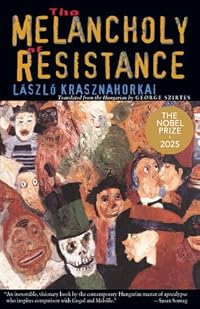
The Melancholy of Resistance
by Laszlo Krasznahorkai
On This Page
Description
WINNER OF THE 2025 NOBEL PRIZEThe Hungarian master's first work to appear in English, and still one of the best
A powerful, surreal novel, in the tradition of Gogol, about the chaotic events surrounding the arrival of a circus in a small Hungarian town. The Melancholy of Resistance, László Krasznahorkai's magisterial, surreal novel, depicts a chain of mysterious events in a small Hungarian town. A circus, promising to display the stuffed body of the largest whale in the world, arrives in show more the dead of winter, prompting bizarre rumors. Word spreads that the circus folk have a sinister purpose in mind, and the frightened citizens cling to any manifestation of order they can find music, cosmology, fascism. The novel's characters are unforgettable: the evil Mrs. Eszter, plotting her takeover of the town; her weakling husband; and Valuska, our hapless hero with his head in the clouds, who is the tender center of the book, the only pure and noble soul to be found. Compact, powerful and intense, The Melancholy of Resistance, as its enormously gifted translator George Szirtes puts it, "is a slow lava flow of narrative, a vast black river of type." And yet, miraculously, the novel, in the words of The Guardian, "lifts the reader along in lunar leaps and bounds.". show less
Tags
Recommendations



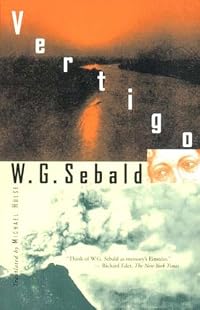
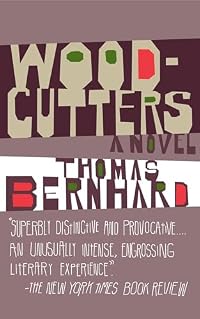
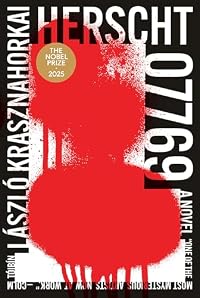
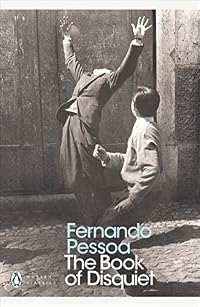





Member Recommendations
Member Reviews
A read that requires focus - with all sentences running half a page and paragraphs that run for a long chapter, keeping place is some work and not something to turn to late at night. The massive sentences are packed with content and amazing style- fascinating, brilliant, tender, horrible. Each chapter covers events in an individual’s life during tumultuous events representing revolution, alternating randomly between characters. As a political allegory it is a bit hard to know which of the two opposing groups represents which side of the political divide, though it is meant to be clear. I guess the obese circus director represents capitalism. The devious villain who simply uses both sides to achieve their own ends is one of the lives show more that gets chapters, as are two likeable but easily controlled characters that seem to represent the intelligentsia and the gullible public. Though likeable and by far the most sympathetic characters/stories they don’t have much of a chance against the cynicism and ruthlessness of power hungry schemers or the ignorant conservatives that support them.
The prose is exceptional, and the translation stunning. The story is in many ways timeless, perhaps reflecting the feel of an old Hungarian city. It seems almost like Crime and Punishment at times, but then a telephone, or television, or car makes a cameo and the illusion is shattered.
A literal way to look at it would be as the story of a set of related characters, parent and child, and a separated husband and wife during turmoil and violence triggered by a visiting circus and a band of its followers. Oh, and a dead whale.
The ending is very unusual - it will not round things off for you. As a biochemist I enjoyed it, but expect others may just find it weird.
In a excerpt on the back cover from a review by W.G. Sebald states that it rivals Gogol’s Dead Souls, and I see the connection. show less
The prose is exceptional, and the translation stunning. The story is in many ways timeless, perhaps reflecting the feel of an old Hungarian city. It seems almost like Crime and Punishment at times, but then a telephone, or television, or car makes a cameo and the illusion is shattered.
A literal way to look at it would be as the story of a set of related characters, parent and child, and a separated husband and wife during turmoil and violence triggered by a visiting circus and a band of its followers. Oh, and a dead whale.
The ending is very unusual - it will not round things off for you. As a biochemist I enjoyed it, but expect others may just find it weird.
In a excerpt on the back cover from a review by W.G. Sebald states that it rivals Gogol’s Dead Souls, and I see the connection. show less
As always, Krasznahorkai's writing is baroque and bulimic, full of seemingly insignificant details, minor characters without whom the protagonists would go round in circles, and unexplained and inexplicable things.
The novel has a beginning, but seems to have no end, only a conclusion that leaves more questions open than it answers, but that's okay, because this story, which apparently recounts the chaotic events surrounding the arrival of an extravagant circus in a small Hungarian town and the night of madness that follows, is an imaginative metaphor for the small and large power struggles we face every day.
The novel has a beginning, but seems to have no end, only a conclusion that leaves more questions open than it answers, but that's okay, because this story, which apparently recounts the chaotic events surrounding the arrival of an extravagant circus in a small Hungarian town and the night of madness that follows, is an imaginative metaphor for the small and large power struggles we face every day.
I'm starting to think that when people say a book is 'in the tradition of Gogol,' they really mean 'it's set somewhere East of Paris but West of Tokyo.' I guess this is in the tradition of Gogol, inasmuch as it's satirical, and not from Western Europe. But the point of Krasznahorkai's novel is not slight mockery-of-the-rurals. It is the sentences, the paragraphs rather, which pile up and leave you nowhere to go--and thank all that is holy for George Szirtes, who has made this masterpiece accessible to the linguistically impoverished! A distant second to the squat blocks of language that are thrust at us is the presence of the demonic and humankind's attempts, often enough successful, to outdo Satan's cruelty to ourselves. Otherwise, show more this is the kind of book you really want to give people like me, who grow ever more tired of and bored with twentieth century 'realism.' There's nothing particularly novel here in terms of structure, or point of view, or meta-literariness. There's just that language piling up and the depth of insights into human life. When Eszter finally broke and decides to "abjure thought," I nearly fainted with joy at Krasznahorkai's skill, while also fainting in fear of what that skill might have revealed.
Easily the best book I've read in the last six months. show less
Easily the best book I've read in the last six months. show less
It was said that modern Mayans rolled their eyes at the suggestion of Armageddon on 12/21/12. But in László Krasznahorkai's novel, nobody is rolling his eyes as something wicked comes the way of a Hungarian village. The seriousness of the situation is evident from the ambiance of fear and foreboding as Mrs. Plauf travels by train to her home. She can't shake off the feeling that an infinitesimal change in the landscape brought something amiss to the relative peace of the village. That constricting feeling of impending apocalypse suffuses the novel's introductory chapter, titled "An Emergency".
After so much gossip, so much terrifying rumour-mongering, she could now see for herself that 'it was all going down the drain', for she show more understood that while her own particular immediate danger was over, in 'a world where such things happen' the collapse into anarchy would inevitably follow.
The anarchy comes later in the book, but it happens after much paranoid and apocalyptic proselytizing by its characters. Like the Argentinian novelist César Aira, Krasznahorkai is a proponent of spontaneous realism, where the narratives unfold in real time and almost any scene can be considered in medias res. The characters ride a literal "train of thought", not so much in streaming consciousness, but a branching out of consciousness. They think aloud and they follow no discernible script except what insights their "walking minds" alight on.
Quotations of stock phrases (as in the above passage: 'it was all going down the drain'; 'a world where such things happen') make this narrative of constant "scenario-building" somehow realistic, somehow not hackneyed. They anchor the narrative to certain familiar tropes and avoid being too precious despite the seriousness of "the threat of end of times". At times, they provoke a certain "war on idioms and clichés" in a world where every usable concept may already have been labeled and delimited as to be "set off" and "qualified". Yet again, the quotes can be literally literal, as for example, Mrs. Eszter in front of her ex-husband's dirty laundry ("... if Valuska was willing to keep it a secret, she would like to wash her husband's dirty laundry with 'her own two hands', explaining how, through all the preceding years, she had regarded the husband who had so coldly rejected her with such unconditional fidelity and respect that it saturated her entire being.") or "cherry picking" later in the novel with real cherries in front of her.
After Mrs. Plauf, the paranoid narration is passed on to another character in a manner of a relay race. But this is a relay where, due to the almost standstill pace of real time narration, the baton is almost grudgingly passed on. The snail-paced race is continued by Mrs. Eszter, the ambitious lady who plans on leading the town as a decorated political leader; by Valuska, the half-wit and son of Mrs. Plauf, whose naivety is a contrast to the other characters' worldly cares; by Mr. Eszter, the estranged husband of Mrs. Eszter, who seems to have renounced the world and retreats into his house a physically broken man; and in between by characters who launch into monologues. These major characters perform the race according to their own slow motion and spontaneous meandering. Murphy's law is at work but there is at least one certain thing in the story: apocalypse lies at the finish line of the track and field
There is barely a plot in the story. A traveling circus is in town to showcase a very large whale and other circus oddities. It, along with some strange local occurrences, seems to have elicited the general fear of the town's "backward" populace. There's an undeniable apocalyptic flavor to the goings on behind the circus tent.
Krasznahorkai's whale seems to be a projection of all the uncertainties, pent-up anxieties, and random menace the world (or modern life or existence) is capable of inflicting on the human race. The ominous whale of monstrous proportions offends the sensibility of the provincial villagers. At the same time, the "fifty-metre truck-load" seems to have generated a cult following from the other villages it visited. These doomy attitudes ("an infection of the imagination") of the people ("spellbound mob") are bound to manifest a doomsday of their own. That doomsday is anything but joyful, except that the existential funk and angst of the characters are all too darkly and comically explored within a stylish, dense prose. Kilometric sentences within blocks of text not set off by paragraphs, a profusion of commas and dependent clauses: the tics of a handful of excellent European writers.
He recalled various stages in his frantic efforts and the fact that even then, in what was imposing itself as a general frame of mind, he had suspected that any eventual resolution would not be due entirely to taking rational thought in the matter, a suspicion that had in the meantime become a certainty, for in divorcing the heavy artillery of his intellect (so typical of him) as he was, metaphorically, edging forward, or, in his own words, divorcing the 'ostensible fire-power of a determined general' from 'the chain of practical action and reaction', he had achieved mastery not through the application of a logical experimental process but through constant, wholly involuntary adaptations to the moment-by-moment nature of necessity; a process that no doubt reflected his intellectual bent but took no cognition of it. To judge by appearances, he summarized, the clear lesson was that the serious issue underlying this apparently insignificant task had been resolved by a persistent assault embodying a flexible attitude to permutations, the passage from 'missing the point' to 'hitting the nail on the head' so to speak, owing nothing, absolutely nothing, to concentrated logic and everything to improvisation, to an ever new set of exploratory motions, or so he had thought as he set out on his tour of inspection of the house to check whether any loose boards needed more secure fixing; there was nothing to indicate that the body's command mechanism, that well-oiled part of the human organism focused on the reality principle (he entered the kitchen) had imposed itself between the legislating mind and the executive hand and remained so well hidden that it could only be discovered, as he put it, 'between, if such a thing were possible, the dazzling object of illusion and the eye that perceives that object, a position that entailed conscious recognition of the illusory nature of the object'. It seemed it was the very freedom of choice between the range of competing ideas that actually decided the angle, the height, and experimental path between the top of the arc and the point of the nail.
The character, Mr. Eszter, is here speaking literally of hammer and nails, as he learns again "to master the art of banging in nails". In the course of this intellectualizing of carpentry, he also shares some of the qualities of the narrative's spontaneous realism. This seamlessly bridging of "the legislating mind and the executive hand" is an appeal to the authenticity of fresh ideas being transcribed as they occur.
The effect seems to be an illusion that nothing is predetermined, that there is a higher intelligence at work governing the fate of plot and story. In the hands of a prose stylist, the extraordinary turns of phrase (and plot) can be pedantically funny and refreshing. It can lend playfulness to the anticipation and perception of events and a spontaneous beauty to seemingly random details "freely" selected from a "range of competing ideas".
The Melancholy of Resistance may be a philosophical novel outlining its own state of nature ("the present state of the area") but not offering a social contract.
He had been wrong, he decided a few steps from his house, wrong in assuming that steady decay was the essence of the situation, for that was in effect to say that some element of good persisted in it while there was no evidence of that whatsoever, and this walk had convinced him that there never could have been, not because it had been lost but because 'the present state of the area' never had the slightest shred of meaning in the first place. It was not meant to have a point; if it was meant for anything at all it was expressely (sic) for the purpose of having no point.
The speaker's stance is pessimistic and nihilistic and any resistance to this state of nature is predicted to fail. The failure is here dramatized as a thought experiment, with the novel's apocalyptic scenes leading to self-realization and epiphany of the characters yet nonetheless consuming them. The whale has been likened to Hobbes's Leviathan but Kafka's looming Castle may also be an appropriate template. It is more a symptom of one's inability to comprehend things at a glance. When the idiot Valuska sees the whale, he is at least aware that his perception of it will be hopelessly incomplete.
Seeing the whale did not mean he could grasp the full meaning of the sight, since to comprehend the enormous tail fin, the dried, cracked, steel-grey carapace and, halfway down the strangely bloated hulk, the top fin, which alone measured several metres, appeared a singularly hopeless task. It was just too big and too long, Valuska simply couldn't see it all at once, and failed even to get a proper look at its dead eyes.... (I)t was simply impossible to see the enormous head as an integral whole.
Perhaps there is something there about the danger of populist/mass thinking, its innate lack of foresight, and its consequent savagery arising from the inability to see the forest for the trees, the whole for the parts. Our yearning for the end of the world is but our failure to exact meaning from existence: our own enactment of intellectual mass suicide.
It's not surprising that W. G. Sebald contributes a blurb to the book which states that the novel's universal vision "rivals that of Gogol's Dead Souls and far surpasses all the lesser concerns of contemporary writing". He and Krasznahorkai are priests of a sort of European "literature of doom". Thomas Bernhard also belongs to that company. The Hungarian novelist seems to share in the Austrian's laments: "the whole of human history is no more ... than the histrionics of a stupid, bloody, miserable outcast in an obscure corner of a vast stage, a kind of tortured confession of error, a slow acknowledgement of the painful fact that this creation was not necessarily a brilliant success".
That is a quite depressing worldview, but there may be comedy in the delivery. Plus, we can take comfort from the fact that the end is nigh. show less
After so much gossip, so much terrifying rumour-mongering, she could now see for herself that 'it was all going down the drain', for she show more understood that while her own particular immediate danger was over, in 'a world where such things happen' the collapse into anarchy would inevitably follow.
The anarchy comes later in the book, but it happens after much paranoid and apocalyptic proselytizing by its characters. Like the Argentinian novelist César Aira, Krasznahorkai is a proponent of spontaneous realism, where the narratives unfold in real time and almost any scene can be considered in medias res. The characters ride a literal "train of thought", not so much in streaming consciousness, but a branching out of consciousness. They think aloud and they follow no discernible script except what insights their "walking minds" alight on.
Quotations of stock phrases (as in the above passage: 'it was all going down the drain'; 'a world where such things happen') make this narrative of constant "scenario-building" somehow realistic, somehow not hackneyed. They anchor the narrative to certain familiar tropes and avoid being too precious despite the seriousness of "the threat of end of times". At times, they provoke a certain "war on idioms and clichés" in a world where every usable concept may already have been labeled and delimited as to be "set off" and "qualified". Yet again, the quotes can be literally literal, as for example, Mrs. Eszter in front of her ex-husband's dirty laundry ("... if Valuska was willing to keep it a secret, she would like to wash her husband's dirty laundry with 'her own two hands', explaining how, through all the preceding years, she had regarded the husband who had so coldly rejected her with such unconditional fidelity and respect that it saturated her entire being.") or "cherry picking" later in the novel with real cherries in front of her.
After Mrs. Plauf, the paranoid narration is passed on to another character in a manner of a relay race. But this is a relay where, due to the almost standstill pace of real time narration, the baton is almost grudgingly passed on. The snail-paced race is continued by Mrs. Eszter, the ambitious lady who plans on leading the town as a decorated political leader; by Valuska, the half-wit and son of Mrs. Plauf, whose naivety is a contrast to the other characters' worldly cares; by Mr. Eszter, the estranged husband of Mrs. Eszter, who seems to have renounced the world and retreats into his house a physically broken man; and in between by characters who launch into monologues. These major characters perform the race according to their own slow motion and spontaneous meandering. Murphy's law is at work but there is at least one certain thing in the story: apocalypse lies at the finish line of the track and field
There is barely a plot in the story. A traveling circus is in town to showcase a very large whale and other circus oddities. It, along with some strange local occurrences, seems to have elicited the general fear of the town's "backward" populace. There's an undeniable apocalyptic flavor to the goings on behind the circus tent.
Krasznahorkai's whale seems to be a projection of all the uncertainties, pent-up anxieties, and random menace the world (or modern life or existence) is capable of inflicting on the human race. The ominous whale of monstrous proportions offends the sensibility of the provincial villagers. At the same time, the "fifty-metre truck-load" seems to have generated a cult following from the other villages it visited. These doomy attitudes ("an infection of the imagination") of the people ("spellbound mob") are bound to manifest a doomsday of their own. That doomsday is anything but joyful, except that the existential funk and angst of the characters are all too darkly and comically explored within a stylish, dense prose. Kilometric sentences within blocks of text not set off by paragraphs, a profusion of commas and dependent clauses: the tics of a handful of excellent European writers.
He recalled various stages in his frantic efforts and the fact that even then, in what was imposing itself as a general frame of mind, he had suspected that any eventual resolution would not be due entirely to taking rational thought in the matter, a suspicion that had in the meantime become a certainty, for in divorcing the heavy artillery of his intellect (so typical of him) as he was, metaphorically, edging forward, or, in his own words, divorcing the 'ostensible fire-power of a determined general' from 'the chain of practical action and reaction', he had achieved mastery not through the application of a logical experimental process but through constant, wholly involuntary adaptations to the moment-by-moment nature of necessity; a process that no doubt reflected his intellectual bent but took no cognition of it. To judge by appearances, he summarized, the clear lesson was that the serious issue underlying this apparently insignificant task had been resolved by a persistent assault embodying a flexible attitude to permutations, the passage from 'missing the point' to 'hitting the nail on the head' so to speak, owing nothing, absolutely nothing, to concentrated logic and everything to improvisation, to an ever new set of exploratory motions, or so he had thought as he set out on his tour of inspection of the house to check whether any loose boards needed more secure fixing; there was nothing to indicate that the body's command mechanism, that well-oiled part of the human organism focused on the reality principle (he entered the kitchen) had imposed itself between the legislating mind and the executive hand and remained so well hidden that it could only be discovered, as he put it, 'between, if such a thing were possible, the dazzling object of illusion and the eye that perceives that object, a position that entailed conscious recognition of the illusory nature of the object'. It seemed it was the very freedom of choice between the range of competing ideas that actually decided the angle, the height, and experimental path between the top of the arc and the point of the nail.
The character, Mr. Eszter, is here speaking literally of hammer and nails, as he learns again "to master the art of banging in nails". In the course of this intellectualizing of carpentry, he also shares some of the qualities of the narrative's spontaneous realism. This seamlessly bridging of "the legislating mind and the executive hand" is an appeal to the authenticity of fresh ideas being transcribed as they occur.
The effect seems to be an illusion that nothing is predetermined, that there is a higher intelligence at work governing the fate of plot and story. In the hands of a prose stylist, the extraordinary turns of phrase (and plot) can be pedantically funny and refreshing. It can lend playfulness to the anticipation and perception of events and a spontaneous beauty to seemingly random details "freely" selected from a "range of competing ideas".
The Melancholy of Resistance may be a philosophical novel outlining its own state of nature ("the present state of the area") but not offering a social contract.
He had been wrong, he decided a few steps from his house, wrong in assuming that steady decay was the essence of the situation, for that was in effect to say that some element of good persisted in it while there was no evidence of that whatsoever, and this walk had convinced him that there never could have been, not because it had been lost but because 'the present state of the area' never had the slightest shred of meaning in the first place. It was not meant to have a point; if it was meant for anything at all it was expressely (sic) for the purpose of having no point.
The speaker's stance is pessimistic and nihilistic and any resistance to this state of nature is predicted to fail. The failure is here dramatized as a thought experiment, with the novel's apocalyptic scenes leading to self-realization and epiphany of the characters yet nonetheless consuming them. The whale has been likened to Hobbes's Leviathan but Kafka's looming Castle may also be an appropriate template. It is more a symptom of one's inability to comprehend things at a glance. When the idiot Valuska sees the whale, he is at least aware that his perception of it will be hopelessly incomplete.
Seeing the whale did not mean he could grasp the full meaning of the sight, since to comprehend the enormous tail fin, the dried, cracked, steel-grey carapace and, halfway down the strangely bloated hulk, the top fin, which alone measured several metres, appeared a singularly hopeless task. It was just too big and too long, Valuska simply couldn't see it all at once, and failed even to get a proper look at its dead eyes.... (I)t was simply impossible to see the enormous head as an integral whole.
Perhaps there is something there about the danger of populist/mass thinking, its innate lack of foresight, and its consequent savagery arising from the inability to see the forest for the trees, the whole for the parts. Our yearning for the end of the world is but our failure to exact meaning from existence: our own enactment of intellectual mass suicide.
It's not surprising that W. G. Sebald contributes a blurb to the book which states that the novel's universal vision "rivals that of Gogol's Dead Souls and far surpasses all the lesser concerns of contemporary writing". He and Krasznahorkai are priests of a sort of European "literature of doom". Thomas Bernhard also belongs to that company. The Hungarian novelist seems to share in the Austrian's laments: "the whole of human history is no more ... than the histrionics of a stupid, bloody, miserable outcast in an obscure corner of a vast stage, a kind of tortured confession of error, a slow acknowledgement of the painful fact that this creation was not necessarily a brilliant success".
That is a quite depressing worldview, but there may be comedy in the delivery. Plus, we can take comfort from the fact that the end is nigh. show less
Susan Sontag compared this mystifying, inspiring, tiring, hilarious, disturbing book as worthy of comparisons to Gogol and Melville. Can't quibble with that. I thought more of the lines of the mutant offspring of Faulkner and Bulgakov. The book in its filibuster, paragraph-less seems like a modernist masterwork, put then Krasznahorkai, as if to spit on his own genius, takes a jarring post-modern turn with the final few pages in which he kills the reader. This is a book that will never let you cling to any emotion or thought. Moments after a guffaw someone will get raped and murdered. The story is not told in live actions but rather like a play (Eugene O'Neill meets Moliere) things happen offstage and the characters try to make sense of show more them in flawed retellings to other characters. This is a book of a half dozen semi-reliable narrations. It is a rare book that produces in the reader a state akin to that of the characters: disquiet, confusion, loss of faith, loss of balance, and, then, in the last few pages, loss of life. show less
On the heels of László Krasznahorkai's victory this year for winning the Best Translated Book Award (BTBA) two years in a row, ever astute critic Scott Esposito has assembled a crash course in all things Krasznahorkai. The gist is that one can begin with Krasznahorkai anywhere, and, while I do agree with this, I also believe that my own journey through the work of the great "Hungarian master of apocalypse"—to use Susan Sontag's remarks on his work, and The Melancholy of Resistance in particular—has proven a wise move. Consider this, then, less a review proper then an account of a personal reading journey through the bleak and labyrinthine prose of one of the greatest writers in world literature today.
When Satantango was finally show more published in 2012 by New Directions, in a brilliant translation by poet George Szirtes, Anglophone readers finally held in their hands the very first novel by the mysterious Krasznahorkai. While The Melancholy of Resistance was the first of his novels to be translated into English, it is in fact Krasznahorkai's second novel with which Anglophone readers commended their journey through his oeuvre. Indeed, beginning with Melancholy might not be a bad move: the opening section dealing with one Mrs. Plauf's public—and increasingly private—struggles while on board a delayed train as she believes she is being watched, stalked, and finally harassed contains one of the most succinct introductions to the macabre mix of humor, pathos, and terror that readers find on every page of Krasznahorkai's fiction. Read by itself, Melancholy's introduction would, in my view, best serve as a summation of Krasznahorkai's major themes, and allow reader to get a sense of his prose style: how it saturates; how it alienates; how it buries one within it (a veritable "lava flow of narrative," as Szirtes has commented).
However, when I reviewed Satantango for the Los Angeles Review of Books (on Goodreads here), it was all I had read of Krasznahorkai—and I'm glad of this now. I stand by my review even if I refuse to re-read it now, fearful of resorting to the same adjectives to describe both the technical aspect and the experience of reading Krasznahorkai's prose (e.g., "labyrinthine," "ornate," "claustrophobic," and so on). Structurally, Satantango is extremely well-conceived—and I would invite you to read my review of the novel where I consider the Möbius
strip narrative in some depth—and this carries over into his subsequent work. It often seems that when one encounters a review or a piece on Krasznahorkai, one is faced with an exploration of his almost obsessive themes, these recursive dynamics to which he returns again and again; however, I think this does a gross injustice to Krasznahorkai's more technical side as it obscures it from most discussions of his work and his work's resonance. Melancholy's structure is not as complex as Satantango, but it shows Krasznahorkai moving forward: as such, it would do him a disfavor to read Melancholy (again, his second novel) before Satantango which, as a first novel, shows an erudite skill in uniting both schematic and thematic approaches to a small village on the brink of change.
And these schematics (structural and otherwise) as well as the much-discussed thematics span the breadth of Krasznahorkai's work. While I had read Animalinside, his collaboration with artist Max Neumann (and which I reviewed here), after Satantango I had not opened another novel of Krasznahorkai's—without really being able to answer why. Perhaps I recalled the harsh extremes in his first novel, the long sentences that leave no room to breathe, the unrelenting dissection of individual and collective psychological states—and boy, does Krasznahorkai know and channel his Freud—that leave little room outside the narrative space. Perhaps I wasn't ready to immerse myself in a textual zone from which I would have no easy way to escape.
But that is also the wonder of Krasznahorkai: that he is able to create these textual spaces so charged with violence and intimacy, with pessimism and yet an underlying humanity, with an eye keen on critiquing avarice in all its forms just as much as it is extremely interested in those who are marginal to mass culture: the outsiders, the downtrodden, those who are all too often used as scapegoats by those in positions of power. Satantango thematizes this throughout, so it was no wonder, as I began to read The Melancholy of Resistance in earnest that I felt like I was returning to a familiar space, a canny and known zone. It was only after settling back into Krasznahorkai's rhythmic prose that I realized I had been keeping him at bay for all the wrong reasons.
The Melancholy of Resistance deals, like Satantango does, with life in a small, unnamed Hungarian town; in both novels, the locals are waiting for the appearance of visitors. In Melancholy, the circus troupe that enters the town, offering the greatest spectacle on earth (the Leviathan figure of an embalmed whale) for the poor, cold, hungry, and bitter denizens to escape the shackles and desolate deprivations of everyday existence. But there is an interesting dualism at work here: that which offers escape is also a venture rooted in consumerism; it is, in effect, profiting from the immense unease and unrest of the public, all in the name of spectacle, art, and performance.
Likewise, the townspeople cling to all measures of "order" when faced with a world thrown into utter chaos. Mrs. Plauf orders her flat, meticulously, priding herself on her flowers; Eszter, the local intellect and music scholar, immerses himself in the harmonies of Andreas Werckmeister, trying to find the perfect tuning of piano keys that would best echo the music of the heavenly spheres; Valuska, our hapless hero of sorts, clings to cosmology even if his speeches about orbits and plants result in a tavern full of drunks labeling him "the village idiot," for they come to rely upon these enactments of planetary movements as much as he does himself; and, finally, Mrs. Eszter, the composer's estranged wife, who clings to institutionalized forms of power with claws sharpened so that she can take anyone down who will stand in her way.
Krasznahorkai pits these individuals against one another and the result, as one can imagine, is sinister, bloody, and downright impossible to read at times, so enveloped in the prose (this never-ending "lava flow" of black text) that any exit is entirely blocked from view. And in doing so, our position as readers mirrors those of the main characters who are similarly trapped, not only geographically, but in their attempts to apply order to a world that resists these attempts. If chaos reigns—to use a phrase plucked from Lars von Trier's film Antichrist—then the sole purpose of fashioning order from the planets, the musical scales, law and carceral codes is, in effect, pointless despite how our lives are so governed by these very attempts to fashion sense by creating cleanly demarcated lines of order.
When order collapses, Krasznahorkai is the master at providing readers with the effects at the individual and social levels. And because Melancholy opens up a bit wider in terms of its structure than the earlier novel Satantango, one can see Krasznahorkai's evolution as an artist more clearly when they are read in order of composition, not of translation. Personally, the imprisoning and shattered world of Satantango helped me to see more clearly what Krasznahorkai was doing in both his collaborative text Animalinside as well as here in Melancholy. It is my understanding, too, that the world of War & War opens up schematically and structurally a notch more as well, and so, for me, it makes sense to follow the progression of Krasznahorkai's work at it was written.
To see alone how he has woven in more philosophical strands of thoughts, more fleshed out characters, and mastered—even more so, for he was master to begin with—the mood and tone just from Satantango to Melancholy was a rewarding experience, one I would have never had had I read them back to front. It is my hope that, when I turn to Krasznahorkai again, War & War will continue this progression, this evolution, this me-learning-from-Krasznahorkai as a sort of pupil to a questionably dark shaman who is as acquainted with and schooled in the brief amount of light as he is with the immense amount of dark. Further into the darkness, then, so that we may emerge: enlightened maybe; still surrounded by pitch black, perhaps; but selves later and selves beyond the first journey—that, at least, is a certainty. show less
When Satantango was finally show more published in 2012 by New Directions, in a brilliant translation by poet George Szirtes, Anglophone readers finally held in their hands the very first novel by the mysterious Krasznahorkai. While The Melancholy of Resistance was the first of his novels to be translated into English, it is in fact Krasznahorkai's second novel with which Anglophone readers commended their journey through his oeuvre. Indeed, beginning with Melancholy might not be a bad move: the opening section dealing with one Mrs. Plauf's public—and increasingly private—struggles while on board a delayed train as she believes she is being watched, stalked, and finally harassed contains one of the most succinct introductions to the macabre mix of humor, pathos, and terror that readers find on every page of Krasznahorkai's fiction. Read by itself, Melancholy's introduction would, in my view, best serve as a summation of Krasznahorkai's major themes, and allow reader to get a sense of his prose style: how it saturates; how it alienates; how it buries one within it (a veritable "lava flow of narrative," as Szirtes has commented).
However, when I reviewed Satantango for the Los Angeles Review of Books (on Goodreads here), it was all I had read of Krasznahorkai—and I'm glad of this now. I stand by my review even if I refuse to re-read it now, fearful of resorting to the same adjectives to describe both the technical aspect and the experience of reading Krasznahorkai's prose (e.g., "labyrinthine," "ornate," "claustrophobic," and so on). Structurally, Satantango is extremely well-conceived—and I would invite you to read my review of the novel where I consider the Möbius
strip narrative in some depth—and this carries over into his subsequent work. It often seems that when one encounters a review or a piece on Krasznahorkai, one is faced with an exploration of his almost obsessive themes, these recursive dynamics to which he returns again and again; however, I think this does a gross injustice to Krasznahorkai's more technical side as it obscures it from most discussions of his work and his work's resonance. Melancholy's structure is not as complex as Satantango, but it shows Krasznahorkai moving forward: as such, it would do him a disfavor to read Melancholy (again, his second novel) before Satantango which, as a first novel, shows an erudite skill in uniting both schematic and thematic approaches to a small village on the brink of change.
And these schematics (structural and otherwise) as well as the much-discussed thematics span the breadth of Krasznahorkai's work. While I had read Animalinside, his collaboration with artist Max Neumann (and which I reviewed here), after Satantango I had not opened another novel of Krasznahorkai's—without really being able to answer why. Perhaps I recalled the harsh extremes in his first novel, the long sentences that leave no room to breathe, the unrelenting dissection of individual and collective psychological states—and boy, does Krasznahorkai know and channel his Freud—that leave little room outside the narrative space. Perhaps I wasn't ready to immerse myself in a textual zone from which I would have no easy way to escape.
But that is also the wonder of Krasznahorkai: that he is able to create these textual spaces so charged with violence and intimacy, with pessimism and yet an underlying humanity, with an eye keen on critiquing avarice in all its forms just as much as it is extremely interested in those who are marginal to mass culture: the outsiders, the downtrodden, those who are all too often used as scapegoats by those in positions of power. Satantango thematizes this throughout, so it was no wonder, as I began to read The Melancholy of Resistance in earnest that I felt like I was returning to a familiar space, a canny and known zone. It was only after settling back into Krasznahorkai's rhythmic prose that I realized I had been keeping him at bay for all the wrong reasons.
The Melancholy of Resistance deals, like Satantango does, with life in a small, unnamed Hungarian town; in both novels, the locals are waiting for the appearance of visitors. In Melancholy, the circus troupe that enters the town, offering the greatest spectacle on earth (the Leviathan figure of an embalmed whale) for the poor, cold, hungry, and bitter denizens to escape the shackles and desolate deprivations of everyday existence. But there is an interesting dualism at work here: that which offers escape is also a venture rooted in consumerism; it is, in effect, profiting from the immense unease and unrest of the public, all in the name of spectacle, art, and performance.
Likewise, the townspeople cling to all measures of "order" when faced with a world thrown into utter chaos. Mrs. Plauf orders her flat, meticulously, priding herself on her flowers; Eszter, the local intellect and music scholar, immerses himself in the harmonies of Andreas Werckmeister, trying to find the perfect tuning of piano keys that would best echo the music of the heavenly spheres; Valuska, our hapless hero of sorts, clings to cosmology even if his speeches about orbits and plants result in a tavern full of drunks labeling him "the village idiot," for they come to rely upon these enactments of planetary movements as much as he does himself; and, finally, Mrs. Eszter, the composer's estranged wife, who clings to institutionalized forms of power with claws sharpened so that she can take anyone down who will stand in her way.
Krasznahorkai pits these individuals against one another and the result, as one can imagine, is sinister, bloody, and downright impossible to read at times, so enveloped in the prose (this never-ending "lava flow" of black text) that any exit is entirely blocked from view. And in doing so, our position as readers mirrors those of the main characters who are similarly trapped, not only geographically, but in their attempts to apply order to a world that resists these attempts. If chaos reigns—to use a phrase plucked from Lars von Trier's film Antichrist—then the sole purpose of fashioning order from the planets, the musical scales, law and carceral codes is, in effect, pointless despite how our lives are so governed by these very attempts to fashion sense by creating cleanly demarcated lines of order.
When order collapses, Krasznahorkai is the master at providing readers with the effects at the individual and social levels. And because Melancholy opens up a bit wider in terms of its structure than the earlier novel Satantango, one can see Krasznahorkai's evolution as an artist more clearly when they are read in order of composition, not of translation. Personally, the imprisoning and shattered world of Satantango helped me to see more clearly what Krasznahorkai was doing in both his collaborative text Animalinside as well as here in Melancholy. It is my understanding, too, that the world of War & War opens up schematically and structurally a notch more as well, and so, for me, it makes sense to follow the progression of Krasznahorkai's work at it was written.
To see alone how he has woven in more philosophical strands of thoughts, more fleshed out characters, and mastered—even more so, for he was master to begin with—the mood and tone just from Satantango to Melancholy was a rewarding experience, one I would have never had had I read them back to front. It is my hope that, when I turn to Krasznahorkai again, War & War will continue this progression, this evolution, this me-learning-from-Krasznahorkai as a sort of pupil to a questionably dark shaman who is as acquainted with and schooled in the brief amount of light as he is with the immense amount of dark. Further into the darkness, then, so that we may emerge: enlightened maybe; still surrounded by pitch black, perhaps; but selves later and selves beyond the first journey—that, at least, is a certainty. show less
Μετα το συγκλονιστικο Πολεμος και πολεμος οι προσδοκιες ηταν πολυ μεγαλες οι οποιες ομως επαληθευτηκαν στο επακρο. Αλλο ενα μεγιστο επιτευγμα απο τον Ουγγρο συγγραφεα η γραφη του οποιου σε σφυροκοπαει με ανελεητο τροπο προκαλωντας σφιξιμο στο στομαχι, τεντωμα των νευρων και υπερδιεγερση του εγκεφαλου. Νοητικοι λαβυρινθοι και παραληρηματικοι συλλογισμοι διατρεχουν ολο το κειμενο μεσα σε ενα σκοτεινο, show more μιζερο και ζοφερο περιβαλλον γεματο απο γκροτεσκες ανθρωπινες φιγουρες που παλευουν αναμεσα στην επιβολη και στην αντισταση, στην παραιτηση και στην διατηρηση. Βαθυτατα πολιτικο, φιλοσοφικο και υπαρξιακο εργο, με μεγαλες δοσεις κοινωνικης σατιρας. Ο εγκλωβισμος στη σφαιρα του παραλογου, της παρανοιας, του φοβου και της υποταγης, δεν ειναι τιποτα περισσοτερο απο το αποτελεσμα του συνολικου αθροισματος ολων των μικροσυμφεροντων τα οποια κινουν αυτο που ονομαζεται "ζωη", αγνοωντας ομως αυτο που τελικα κυριαρχει και καταβροχθιζει τα παντα. show less
Members
- Recently Added By
Lists

1001 Books You Must Read Before You Die
1,448 works; 1,131 members

Top Five Books of 2013
1,562 works; 721 members

1980s
356 works; 23 members

1,001 BYMRBYD Concensus
723 works; 27 members

Cooper
79 works; 1 member

Books Read in 2016
4,666 works; 197 members

Books Read in 2019
4,052 works; 108 members

Weird but doesn't mean it's bad
5 works; 1 member

contemporary literary fiction list to check out
47 works; 1 member

The LonesomeReader Book Club
36 works; 1 member

To read
39 works; 1 member
Author Information

37+ Works 6,576 Members
László Krasznahorkai is an Hungarian Author who has won the 2015 Man Booker International Prize. The $117,600 biennial prize is awarded to a living author, whose body of work is available in English or English translation, in recognition of his or her contribution to fiction 'on the world stage'. (Bowker Author Biography)
Some Editions
Awards and Honors
Series
Belongs to Publisher Series
Gallimard, Folio (6152)
Work Relationships
Has the adaptation
Common Knowledge
- Canonical title
- The Melancholy of Resistance
- Original title
- Az ellenállás melankóliája
- Original publication date
- 1989
- Related movies
- Werckmeister harmóniák (2000 , tt0249241)
- Epigraph
- It passes, but it does not pass away.
- Blurbers
- Sontag, Susan
- Original language
- Hungarian
Classifications
- Genres
- Fiction and Literature, General Fiction
- DDC/MDS
- 894.51134 — Literature & rhetoric Asian Literature Literatures of Altaic, Uralic, Hyperborean, Dravidian languages; literatures of miscellaneous languages of south Asia Finno-Ugric languages Ugric languages Hungarian Hungarian fiction 2000–
- LCC
- PH3281 .K8866 .E3413 — Language and Literature Uralic languages. Basque language Uralic. Basque Hungarian
- BISAC
Statistics
- Members
- 1,384
- Popularity
- 17,048
- Reviews
- 31
- Rating
- (3.97)
- Languages
- 16 — Arabic, Danish, Dutch, English, Finnish, French, German, Greek, Hebrew, Hungarian, Italian, Polish, Serbian, Spanish, Swedish, Turkish
- Media
- Paper, Ebook
- ISBNs
- 33
- ASINs
- 12