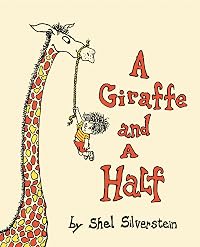
A Giraffe and a Half
by Shel Silverstein (Illustrator)
On This Page
Description
Cumulative rhymed text explains what might happen if you had a giraffe that stretched another half, put on a hat in which lived a rat that looked cute in a suit, and so on.Tags
Recommendations

Member Reviews
This book of poetry was a great read. I appreciated the flow of the words and as well as the humor. I also really liked how the rhymes slowly escalated, adding a new rhyme to the current paragraph, until the plot reverses and returns back to a single giraffe. The book starts out with a giraffe who continually has things added to him. In the middle of the story, where the plot reverses, it says, “But…if you brought him a pole to climb out of the hole and the whale left his tail and went off for the mail…” It finally ends with “You would have a giraffe.” The full circle keeps the children focused and engaged.
Silverstein uses silly language to help developing students get a grasp on rhyming. He uses everyday words that you show more wouldn’t imagine being connected. For example, he says, “If you glued a rose to the tip of his nose…you would have a giraffe and a half with a rat in his hat looking cute in a suit with a rose on his nose.” The humor incorporated throughout the book keeps children entertained and wanting to read more.
The main idea of this piece of writing is to develop students’ phonological awareness. Rhyming allows students to hear and manipulate words in order to understand sounds. Silverstein is able to accomplish this by making his rhymes fun and engaging. show less
Silverstein uses silly language to help developing students get a grasp on rhyming. He uses everyday words that you show more wouldn’t imagine being connected. For example, he says, “If you glued a rose to the tip of his nose…you would have a giraffe and a half with a rat in his hat looking cute in a suit with a rose on his nose.” The humor incorporated throughout the book keeps children entertained and wanting to read more.
The main idea of this piece of writing is to develop students’ phonological awareness. Rhyming allows students to hear and manipulate words in order to understand sounds. Silverstein is able to accomplish this by making his rhymes fun and engaging. show less
A book that children will love to read and adults will love to read aloud to them (or just for them too!). It is funny and delightful. A must have if you are teaching about rhyming, poetry or repetition!
I loved Shek Silverstein as a kid. I bought two recently and my son had a blasted reading this book about a giraffe collecting various things and then getting back to a giraffe. Great book!
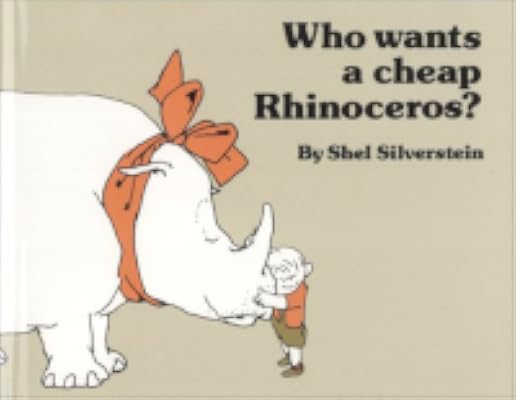
I just recently read Who Wants a Cheap Rhinoceros? So I thought that A Giraffe and a Half might be structured in a similar way, but my hypothesis was wrong. I really enjoyed this book, but the whole time I was reading I thought I was reading some alternate version of Green Eggs and Ham by Dr.Seuss. Now I even went to look up the publication dates on both books just to see which one came out first and Green Eggs and Ham was published August 12,1960. A Giraffe and a Half was published about four years later on January 1,1964. The way that A Giraffe and a Half is structured the same way Green Eggs and Ham is. We start Silverstein's book with a Giraffe and each page something else happens and the previous things that happened to him are show more repeated. Then, when you think nothing else can happen to this giraffe it goes backwards and the poems become shorter. I don't know if Silverstein was inspired by Seuss or if it was just a coincidence. show less
This is a favorite in our family! Written in an almost musical cadence, this book is so fun to read! My children absolutely adore it!
Summary:
A little boy with a very wild imagination. About what if. What if, you had a giraffe and crazy things happen to him.
Personal Reaction:
This is a very silly book. Not really much point or moral to it at all. Just for fun and laughter. Sometimes I think it is good to read a book for no other reason, but its funny and you need to laugh.
Classroom Extension:
I can see that children would really love this book.
1. To practice Rhyming words. Play a memory matching game, suit/cute, snake/cake, bee/knee, etc.
2. Create your own additional rhymes to add to the book.
A little boy with a very wild imagination. About what if. What if, you had a giraffe and crazy things happen to him.
Personal Reaction:
This is a very silly book. Not really much point or moral to it at all. Just for fun and laughter. Sometimes I think it is good to read a book for no other reason, but its funny and you need to laugh.
Classroom Extension:
I can see that children would really love this book.
1. To practice Rhyming words. Play a memory matching game, suit/cute, snake/cake, bee/knee, etc.
2. Create your own additional rhymes to add to the book.
A Giraffe and a Half is book written using rhyme and repetition to tell the account of what one would do if they “had a giraffe and he stretched another half.” The comedic poem uses alliteration and imagery to engage readers both, young and old. However, I found that even more exciting were Silverstein’s illustrations accompanying the poem. Although they are black and white, the illustrations are intricate and imaginative.
Members
- Recently Added By
Lists

Remarkable Collection Of Children's Poetry
19 works; 1 member
Author Information

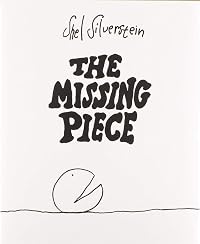
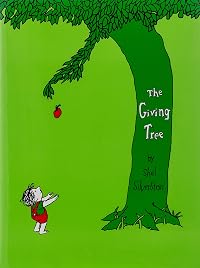
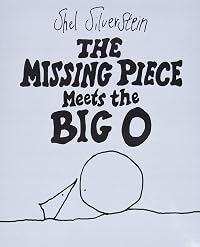
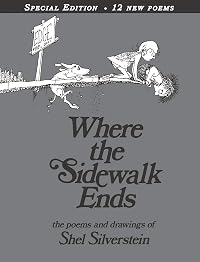
The most popular current writer of humorous verse for children, Shel Silverstein was born in Chicago, Illinois, has been married and divorced, has one daughter, and currently lives in Brooklyn, New York. His career includes composing popular songs, drawing cartoons, writing many adult articles (several for Playboy), and acting. However, he is best show more known for his self-illustrated children's poetry. His first such book was Uncle Shelby's Story of Lafcadio, the Lion Who Shot Back (1963), the humorous tale of a lion who turns the tables on hunters. It was followed by The Giving Tree (1964), a story of a parentlike tree that gives endlessly and is endlessly used by its son. Several other such picture books followed, including The Missing Piece (1976), about a circle that goes in search of a missing piece, and its sequel, The Missing Piece Meets the Big O (1981). However, two collections of poetry are probably his best-loved work: Where the Sidewalk Ends: The Poems and Drawings of Shel Silverstein (1974), and A Light in the Attic (1981). All of Silverstein's poetry for children employs the language play common to Lewis Carroll and Edward Lear. Silverstein is probably the best of the contemporary nonsense poets for children. (Bowker Author Biography) show less
Some Editions
Work Relationships
Classifications
Statistics
- Members
- 2,124
- Popularity
- 9,713
- Reviews
- 58
- Rating
- (4.14)
- Languages
- 6 — Chinese, English, French, Hungarian, Spanish, Portuguese (Portugal)
- Media
- Paper, Ebook
- ISBNs
- 19
- UPCs
- 1
- ASINs
- 16