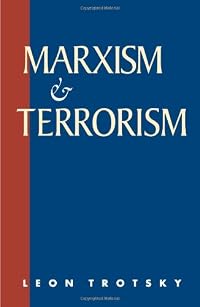
Marxism and Terrorism
by Leon Trotsky
On This Page
Description
The propertied classes have always laid the charge of "terrorism" on those leading the struggle against exploitation and oppression. But it has been the terror of the capitalist rulers against which an outraged majority eventually rises. Trotsky explains why the working class is the only social force capable of leading the toiling majority in overthrowing the capitalist exploiters and beginning the construction of a new society and why individual terrorism--whatever its intention--relegates show more the workers to the role of spectators and opens the workers movement to provocation and victimization. show lessTags
Recommendations








Member Reviews
Trotsky was a prolific writer, as were most leading socialists at the time. But none matched Trotsky's knack for reasoning and lucid thinking. This is a collection of four polemics against terrorism and individuals acting on behalf of the working class. He draws his conclusions from the Marxist theory of working class emancipation, as well as the conditions that had formed Russian intelligentsia's class consciousness.
Ratings
Members
- Recently Added By
Author Information

782+ Works 7,707 Members
Leon Trotsky was born Lev Davidovich Bronshteyn on November 7, 1879 in Yanovka, Ukraine. As a teenager, he became involved in underground activities and was soon arrested, jailed and exiled to Siberia where he joined the Social Democratic Party. He escaped from exile in Siberia by using the name of a jailer called Trotsky on a false passport. show more During World War I, he lived in Switzerland, France, England, and New York City, where he edited the newspaper Novy Mir (New World). In 1917, after the overthrow of Tsar Nicholas II, he went back to Russia and joined Vladimir Lenin in the first, abortive, July Revolution of the Bolsheviks. A key organizer of the successful October Revolution, he was People's Commissar for Foreign Affairs in the Lenin regime. He was then made war commissar and in this capacity, built up the Red Army which prevailed against the White Russian forces in the civil war. Antagonism developed between him and Joseph Stalin during the Civil War of 1918-1920. When Lenin fell ill and died, Stalin became the new leader and Trotsky was thrown out of the party in 1927. Trotsky fled across Siberia to Norway, France, and finally settled in Mexico in 1936. He began working on the biography of Stalin. He was able to complete 7 of the 12 chapters before an assassin, acting on Stalin's orders, stabbed Trotsky with an ice pick. He died on August 21, 1940. The construction of the remaining five chapters was accomplished by the translator Charles Malamuth, from notes, worksheets, and fragments. (Bowker Author Biography) show less
Classifications
- Genres
- Nonfiction, Economics, General Nonfiction, Politics and Government, History, Philosophy
- DDC/MDS
- 335 — Social sciences Economics Socialism and related systems
- LCC
- HX550 .R48 .T76 — Social sciences Socialism. Communism. Anarchism Socialism. Communism. Anarchism Communism/socialism in relation to special
Statistics
- Members
- 41
- Popularity
- 712,050
- Reviews
- 2
- Rating
- (4.18)
- Languages
- English
- Media
- Paper
- ISBNs
- 1