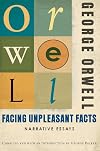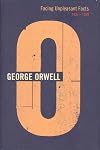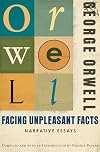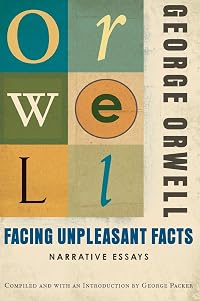
Facing Unpleasant Facts
by George Orwell 
On This Page
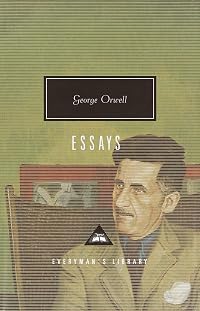
Description
Honoring the author's mastery of the essay form, brings together such classic works as "Shooting an Elephant" with passages from his wartime diary and lesser-known journalistic pieces that weave together the personal and political in studies of his boyhood in an English boarding school and his experiences during the Spanish Civil War.Tags
Recommendations
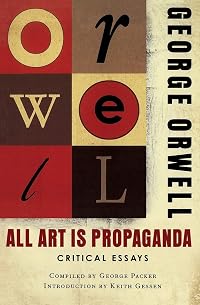
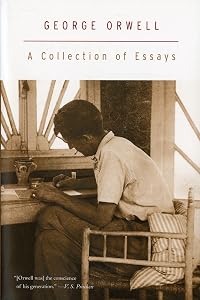













Member Recommendations


Member Reviews
About his tramping days, George Orwell tells us in the opening essay of Facing Unpleasant Facts, “Already, at eight o’clock in the morning, we were bored…There was nothing to talk about except the petty gossip of the road…Tramps hardly ever get away from these subjects; they talk, as it were, nothing but shop.”
The day before reading that passage, I’d listened to two homeless-looking men talk enthusiastically about reincarnation. More than shop talk for them, I thought, after starting the book. Later it occurred to me their situation statistically placed them nearer the other side than most and reincarnation might well qualify as talking shop. But at first Orwell’s observation seemed a collision with experience and not a show more good beginning. On reading further, especially after such fine pieces as his “Wartime Diary” and “Looking Back on the Spanish War,” my opinion improved considerably.
Celebrated by American conservatives for his portrait of the jarring losses to liberty and selfhood created by the “leftist” totalitarianism in his novel 1984, Orwell here will disappoint these people with his conviction, expressed in one of the pieces titled “As I Please,” that what we call “political correctness” should be observed when speaking of people who are not white:
“One can at least remember that the colour problem exists. And there is one small precaution…which can perhaps do a little to mitigate the horrors of colour war. That is to avoid using insulting nicknames…I have just been carefully going through proofs of a reprinted book of mine, cutting out the word ‘Chinaman’ wherever it occurred and substituting ‘Chinese.’”
That remark is characteristic of the man. He was on no one’s program but his own.
The essays in this collection offer contrasts. Mr. Orwell is frank in his disdain for the leftist intelligentsia with its Stalinist sympathies while also insistently disdaining the oligarchy of money and privilege and the ones he calls “dividend-drawers all over the world” who create “the shackles of the capitalist system.” Those of us who are his targets may outnumber those who are not. We need such writers speaking loudly. show less
The day before reading that passage, I’d listened to two homeless-looking men talk enthusiastically about reincarnation. More than shop talk for them, I thought, after starting the book. Later it occurred to me their situation statistically placed them nearer the other side than most and reincarnation might well qualify as talking shop. But at first Orwell’s observation seemed a collision with experience and not a show more good beginning. On reading further, especially after such fine pieces as his “Wartime Diary” and “Looking Back on the Spanish War,” my opinion improved considerably.
Celebrated by American conservatives for his portrait of the jarring losses to liberty and selfhood created by the “leftist” totalitarianism in his novel 1984, Orwell here will disappoint these people with his conviction, expressed in one of the pieces titled “As I Please,” that what we call “political correctness” should be observed when speaking of people who are not white:
“One can at least remember that the colour problem exists. And there is one small precaution…which can perhaps do a little to mitigate the horrors of colour war. That is to avoid using insulting nicknames…I have just been carefully going through proofs of a reprinted book of mine, cutting out the word ‘Chinaman’ wherever it occurred and substituting ‘Chinese.’”
That remark is characteristic of the man. He was on no one’s program but his own.
The essays in this collection offer contrasts. Mr. Orwell is frank in his disdain for the leftist intelligentsia with its Stalinist sympathies while also insistently disdaining the oligarchy of money and privilege and the ones he calls “dividend-drawers all over the world” who create “the shackles of the capitalist system.” Those of us who are his targets may outnumber those who are not. We need such writers speaking loudly. show less
On Imperialism and War
This is the second in the series of re-publishing of George Orwell essays edited by George Packer. The focus of this collection is to highlight Orwell's more journalistic side. The essays in this collection are less persuasive and much more narrative and impressionist.
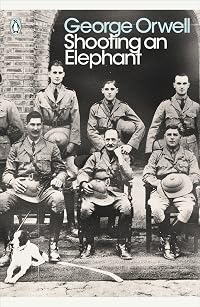
Orwell's famous "Shooting an Elephant" essay on British imperialism in Burma is included here. It is no wonder the essay has become a standard in most undergraduate courses on British empire, Orwell exposes the contradictions of empire, that "when the white man turns tyrant it is his own freedom he destroys."
Probably the most interesting essays are the diary entries by Orwell during and after the Battle of Britain which are written with unflinching show more lucidity. We've all read about Dunkirk, Coventry, etc... but its always fascinating to read what real people felt at the time, to read about their reactions in the moment, rather than historical texts or even old newspapers. In between descriptions, Orwell even enlightens us with the odd insight such as his observation that "War is simply a reversal of civilised life."
A few of the essays at the end of the book, post-WWII are interesting such as his essay on racial prejudice titled "As I Please." But the final series of essays "Such, Such were the Joys" are no more than ramblings about the banalities of private school, specifically St. Cyprians where Orwell went to school.
Overall, I would recommend this book if just for the 100 or so pages from Orwell's diary during the war. The rest is average by Orwell's standards, which is certainly better than most. show less
This is the second in the series of re-publishing of George Orwell essays edited by George Packer. The focus of this collection is to highlight Orwell's more journalistic side. The essays in this collection are less persuasive and much more narrative and impressionist.
Orwell's famous "Shooting an Elephant" essay on British imperialism in Burma is included here. It is no wonder the essay has become a standard in most undergraduate courses on British empire, Orwell exposes the contradictions of empire, that "when the white man turns tyrant it is his own freedom he destroys."
Probably the most interesting essays are the diary entries by Orwell during and after the Battle of Britain which are written with unflinching show more lucidity. We've all read about Dunkirk, Coventry, etc... but its always fascinating to read what real people felt at the time, to read about their reactions in the moment, rather than historical texts or even old newspapers. In between descriptions, Orwell even enlightens us with the odd insight such as his observation that "War is simply a reversal of civilised life."
A few of the essays at the end of the book, post-WWII are interesting such as his essay on racial prejudice titled "As I Please." But the final series of essays "Such, Such were the Joys" are no more than ramblings about the banalities of private school, specifically St. Cyprians where Orwell went to school.
Overall, I would recommend this book if just for the 100 or so pages from Orwell's diary during the war. The rest is average by Orwell's standards, which is certainly better than most. show less
I think Orwell was a great man as well as a great writer. And if you haven't read "Shooting an Elephant" recently (I assume you probably read it in school at some point), brace yourself before reading it again -- it's actually very disturbing throughout, but especially at the end.
includes "Shooting an Elephant" and lesser known essays, including memories of horrible prep school
So insightful and perceptive!
Ratings
Members
- Recently Added By
Published Reviews
Even more, it oversimplifies Orwell to boil down his sensibilities to sound bites, to the allegorical starkness of "Animal Farm" or "1984." Nearly 59 years after his death of tuberculosis at age 46, Orwell's legacy now seems shackled by those novels, his restless intellect reduced to slogans: "War is Peace; Freedom is Slavery; Ignorance is Strength," "Big Brother is watching you."
For Orwell, show more "Animal Farm" and "1984" were distillations; written late in his career, they represent a summing up. Far more fundamental is how he came to their perspective, how the worldview they portray arose. Like many of his books, they have roots in the pieces he contributed, beginning in the early 1930s, to newspapers, anthologies and journals -- essays, columns, criticism, observations, the efforts of a working writer, which, more than anything, is what he was. show less
For Orwell, show more "Animal Farm" and "1984" were distillations; written late in his career, they represent a summing up. Far more fundamental is how he came to their perspective, how the worldview they portray arose. Like many of his books, they have roots in the pieces he contributed, beginning in the early 1930s, to newspapers, anthologies and journals -- essays, columns, criticism, observations, the efforts of a working writer, which, more than anything, is what he was. show less
added by John_Vaughan
Author Information

393+ Works 221,501 Members
George Orwell was born Eric Arthur Blair on June 25, 1903 in Motihari in Bengal, India and later studied at Eton College for four years. He was an assistant superintendent with the Indian Imperial Police in Burma. He left that position after five years and moved to Paris, where he wrote his first two books: Burmese Days and Down and Out in Paris show more and London. He then moved to Spain to write but decided to join the United Workers Marxist Party Militia. After being decidedly opposed to communism, he served in the British Home Guard and with the Indian Service of the BBC during World War II. After the war, he wrote for the Observer and was literary editor for the Tribune. His best known works are Animal Farm and 1984. His other works include A Clergyman's Daughter, Keep the Aspidistra Flying, The Road to Wigan Pier, Homage to Catalonia, and Coming Up for Air. He died on January 21, 1950 at the age of 46. (Bowker Author Biography) show less
George Orwell has a Legacy Library. Legacy libraries are the personal libraries of famous readers, entered by LibraryThing members from the Legacy Libraries group.
All Editions
Series
Belongs to Publisher Series
Common Knowledge
- Original publication date
- 2009
Classifications
Statistics
- Members
- 363
- Popularity
- 86,710
- Reviews
- 5
- Rating
- (4.32)
- Languages
- English
- Media
- Paper, Ebook
- ISBNs
- 6
- ASINs
- 4