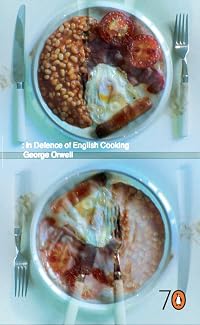
In Defence of English Cooking
by George Orwell 
On This Page
Description
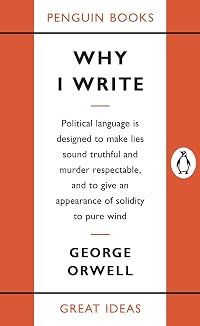
In May 2005 Penguin will publish 70 unique titles to celebrate the company's 70th birthday. The titles in the Pocket Penguins series are emblematic of the renowned breadth of quality of the Penguin list and will hark back to Penguin founder Allen Lane's vision of good books for all'. political thinkers of the twentieth century, he is also the author of the bestselling Penguin title of all time: Animal Farm first published in Penguin in 1951. These heartfelt essays demonstrate Orwell's show more wide-ranging appeal, and range from political manifesto to affectionate consideration of what being English truly means. show lessTags
Recommendations






























Member Recommendations


Member Reviews
This George Orwell collection of essays and articles was published by Penguin books, as were some of his major works. As a celebration of Penguins achievements in creating literature that could be afforded by all, and to commemorate the special 70’s Editions this book was reissued.
In opening his work Orwell states; “It is commonly said, even by the English themselves, that English cooking is the worst in the world. It is supposed to be not merely incompetent, but also imitative, and I even read quite recently, in a book by a French writer, the remark: ‘The best English cooking is, of course, simply French cooking.’ Now that is simply not true, as anyone who has lived long abroad will know, there is a whole host of delicacies show more which it is quite impossible to obtain outside the English-speaking countries.”
Orwell went on – in his brave but surely futile attempt to defend the “English Cuisine” of the 1940’s and 1950 years – to list such stalwarts of the British diet as kippers, haggis, suet puddings, marrow jam and, he bewailed that abroad ”one can not find sausages of quite the same kind as ours”. After breathing a collective sigh of relief of no longer having to ‘enjoy’ Orwell’s list, many of us survivors of those years and the boiled cabbages will read on in delight at his spirited articles in this charming collection of nostalgia.
Long live the suet pud called “Spotted Dick”! show less
In opening his work Orwell states; “It is commonly said, even by the English themselves, that English cooking is the worst in the world. It is supposed to be not merely incompetent, but also imitative, and I even read quite recently, in a book by a French writer, the remark: ‘The best English cooking is, of course, simply French cooking.’ Now that is simply not true, as anyone who has lived long abroad will know, there is a whole host of delicacies show more which it is quite impossible to obtain outside the English-speaking countries.”
Orwell went on – in his brave but surely futile attempt to defend the “English Cuisine” of the 1940’s and 1950 years – to list such stalwarts of the British diet as kippers, haggis, suet puddings, marrow jam and, he bewailed that abroad ”one can not find sausages of quite the same kind as ours”. After breathing a collective sigh of relief of no longer having to ‘enjoy’ Orwell’s list, many of us survivors of those years and the boiled cabbages will read on in delight at his spirited articles in this charming collection of nostalgia.
Long live the suet pud called “Spotted Dick”! show less
Pocket Penguin 23 George Orwell In Defence of English Cooking...celebrating 70 years of Penguin books, 70 titles. c1984
Ratings
Members
- Recently Added By
Published Reviews
Probably the first thing that comes to mind when one thinks of Orwell's descriptions of food is his unparalleled ability to capture the disgusting: Mr Brooker's black thumbprint on the bread-and-butter in the squalid tripe shop above which Orwell lodges in The Road to Wigan Pier; the fish-filled frankfurter in Coming up for Air; the cooks and waiters fingering the steak in Down and Out in show more Paris and London. His attitude to eating was often grimly pragmatic – what is a human being after all, he wrote in The Road to Wigan Pier, but "primarily a bag for putting food into". In In Defence of English Cooking, however, he writes passionately about good food. show less
added by John_Vaughan
Author Information

389+ Works 221,200 Members
George Orwell was born Eric Arthur Blair on June 25, 1903 in Motihari in Bengal, India and later studied at Eton College for four years. He was an assistant superintendent with the Indian Imperial Police in Burma. He left that position after five years and moved to Paris, where he wrote his first two books: Burmese Days and Down and Out in Paris show more and London. He then moved to Spain to write but decided to join the United Workers Marxist Party Militia. After being decidedly opposed to communism, he served in the British Home Guard and with the Indian Service of the BBC during World War II. After the war, he wrote for the Observer and was literary editor for the Tribune. His best known works are Animal Farm and 1984. His other works include A Clergyman's Daughter, Keep the Aspidistra Flying, The Road to Wigan Pier, Homage to Catalonia, and Coming Up for Air. He died on January 21, 1950 at the age of 46. (Bowker Author Biography) show less
George Orwell has a Legacy Library. Legacy libraries are the personal libraries of famous readers, entered by LibraryThing members from the Legacy Libraries group.
Series
Belongs to Publisher Series
Work Relationships
Is contained in
Common Knowledge
- Canonical title
- In Defence of English Cooking
Classifications
Statistics
- Members
- 164
- Popularity
- 199,591
- Reviews
- 2
- Rating
- (3.73)
- Languages
- English
- Media
- Paper
- ISBNs
- 1