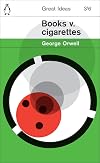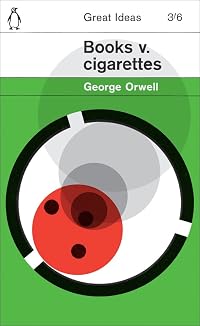
Books v. Cigarettes
by George Orwell 
On This Page
Description
Beginning with a dilemma about whether he spends more money on reading or smoking, George Orwell's entertaining and uncompromising essays go on to explore everything from the perils of second-hand bookshops to the dubious profession of being a critic, from freedom of the press to what patriotism really means.Throughout history, some books have changed the world. They have transformed the way we see ourselves - and each other. They have inspired debate, dissent, war and revolution. They have show more enlightened, outraged, provoked and comforted. They have enriched lives - and destroyed them. Now Penguin brings you the works of the great thinkers, pioneers, radicals and visionaries whose ideas shook civilization and helped make us who we are. show lessTags
Recommendations





Member Recommendations
Member Reviews
When I was younger I read 1984 and Animal Farm, and I fell in love with George Orwell. A few years after that, at a very different stage in my life, I read Down and Out, and fell out of love with George Orwell. A couple weeks ago, when I saw Books v. Cigarettes at a little bookstore on Vancouver Island, I didn't know what to do. The back of the book piqued my interest, but memories of his autobiography made me hesitant. Then a very attractive employee at said bookstore talked about the book in an excitable way and I was sold.
In the titular essay, Orwell tries to figure out if he's spent more money on books or cigarettes in his life. I don't think he actually figures it out, but his journey is very fun, and he makes a good point. I show more don't think he really cares which one he's spent more money on; it's more a response to people not reading and using affordability as an excuse. The only part that made me sad was, “The combines can never squeeze the small, independent bookseller out of existence as they have squeezed the grocer and the milkman.” We all know how wrong he was. Most of the rest of the essays in this tiny book were just as, or more, interesting.
“The Prevention of Literature” is a fascinating essay about journalist and literature being under attack. It feels like, almost eighty years later, this is still true; though I wonder how far we've come. It feels like we're less censored now, but that could just be because there are significantly less intellectuals than there were in Mr. Orwell's day. When he goes on to talk about totalitarianism and how it demands history be rewritten and a “disbelief in the very existence of objective truth,” it feels like it could have been written last week. I don't know if that's a good thing or not.
Some of the essays made me remember some of the things I don't like about him. He talks about how the war made him patriotic. He says he could never do anything to fight the other side and even wants to fight for his country in said war. Kinda gross. He says it feels like sacrilege to not stand during God Bless the King.” Barf.
He talks about class and how much worse poor people get treat in every aspect of life. Then in the next essay he comes out in favor of abusing children to make them preform better in school. He was obviously a complicated man, and that's ok. My feelings towards him are complicated too, but this book helped me understand him better than I had. Better than his autobiography as a matter of fact. It's cheap and it's tiny, so I would definitely recommend picking it up if you get the chance. show less
In the titular essay, Orwell tries to figure out if he's spent more money on books or cigarettes in his life. I don't think he actually figures it out, but his journey is very fun, and he makes a good point. I show more don't think he really cares which one he's spent more money on; it's more a response to people not reading and using affordability as an excuse. The only part that made me sad was, “The combines can never squeeze the small, independent bookseller out of existence as they have squeezed the grocer and the milkman.” We all know how wrong he was. Most of the rest of the essays in this tiny book were just as, or more, interesting.
“The Prevention of Literature” is a fascinating essay about journalist and literature being under attack. It feels like, almost eighty years later, this is still true; though I wonder how far we've come. It feels like we're less censored now, but that could just be because there are significantly less intellectuals than there were in Mr. Orwell's day. When he goes on to talk about totalitarianism and how it demands history be rewritten and a “disbelief in the very existence of objective truth,” it feels like it could have been written last week. I don't know if that's a good thing or not.
Some of the essays made me remember some of the things I don't like about him. He talks about how the war made him patriotic. He says he could never do anything to fight the other side and even wants to fight for his country in said war. Kinda gross. He says it feels like sacrilege to not stand during God Bless the King.” Barf.
He talks about class and how much worse poor people get treat in every aspect of life. Then in the next essay he comes out in favor of abusing children to make them preform better in school. He was obviously a complicated man, and that's ok. My feelings towards him are complicated too, but this book helped me understand him better than I had. Better than his autobiography as a matter of fact. It's cheap and it's tiny, so I would definitely recommend picking it up if you get the chance. show less
This is very much a book of two halves. The first consists of short pieces of five to ten pages on the subjects of literature, politics, and health. The latter half is a single extended account of Orwell's years at a boarding school called St Cyprian's. The tone of each half is rather different, but they still work well together as an anthology. The writing throughout is fluent, humane, dry, and beautifully expressed. The first few pieces made me laugh with their wittily expressed grumpiness, especially ‘Confessions of a Book Reviewer’.
The most interesting, though, was ‘The Prevention of Literature’ which discusses the incompatibility between totalitarian regimes and the production of good literature. Orwell’s thesis is that show more poetry, art, architecture, and music can all be twisted to propaganda purposes and used to glorify a regime. Moreover, they can be undertaken collectively, such that no single author is identifiable. Literature, by contrast, requires freedom of thought and individuality. It is a conceptually appealing argument and reminds me of the magnificence of the Russian novel ‘Life and Fate’ by Vasily Grossman, suppressed in the USSR for decades. Orwell comments, ‘The fact is that certain themes cannot be celebrated in words, and tyranny is one of them. No-one ever wrote a good book in praise of the Inquisition.’ This made me wonder whether his thesis could be applied to North Korea, which has managed to keep up a totalitarian state for several generations. What sort of literature is written there? Does anyone outside North Korea know about it?
The extended piece about Orwell’s childhood is very personal and I found it moving. He writes quite dispassionately about an experience that was relatively common at the time; the sheer misery of boarding school. Beatings, hunger, cold, humiliation, and ‘general squalor’ abound. At the time he was writing, Orwell comments that schools have improved markedly, as the philosophy of education has changed so. From a twenty-first century perspective, the cruelty and violence seem even more distant and horrifying, although they took a long time to die out. He relates his experience to pre-WWI social mores, which I found striking. He saw the first decade of the twentieth century as a time when money was venerated, especially when inherited, and the rich treated as morally superior. That sounds too much like the first decade of the twenty-first century for comfort. show less
The most interesting, though, was ‘The Prevention of Literature’ which discusses the incompatibility between totalitarian regimes and the production of good literature. Orwell’s thesis is that show more poetry, art, architecture, and music can all be twisted to propaganda purposes and used to glorify a regime. Moreover, they can be undertaken collectively, such that no single author is identifiable. Literature, by contrast, requires freedom of thought and individuality. It is a conceptually appealing argument and reminds me of the magnificence of the Russian novel ‘Life and Fate’ by Vasily Grossman, suppressed in the USSR for decades. Orwell comments, ‘The fact is that certain themes cannot be celebrated in words, and tyranny is one of them. No-one ever wrote a good book in praise of the Inquisition.’ This made me wonder whether his thesis could be applied to North Korea, which has managed to keep up a totalitarian state for several generations. What sort of literature is written there? Does anyone outside North Korea know about it?
The extended piece about Orwell’s childhood is very personal and I found it moving. He writes quite dispassionately about an experience that was relatively common at the time; the sheer misery of boarding school. Beatings, hunger, cold, humiliation, and ‘general squalor’ abound. At the time he was writing, Orwell comments that schools have improved markedly, as the philosophy of education has changed so. From a twenty-first century perspective, the cruelty and violence seem even more distant and horrifying, although they took a long time to die out. He relates his experience to pre-WWI social mores, which I found striking. He saw the first decade of the twentieth century as a time when money was venerated, especially when inherited, and the rich treated as morally superior. That sounds too much like the first decade of the twenty-first century for comfort. show less
Orwell is best known for two of his novels, but his nonfiction is definitely not to be missed. This short collection of essays compares the relative costs of books and cigarettes, making the case for the printed form as a worthwhile investment that is nonetheless cheaper than many might think; his analysis of the idea of censorship in literature is something that chimes with Koba the Dread by Martin Amis, also about the Communists and far left - and you really appreciate how insightful Orwell was, writing so many decades before Amis; and the second half of the book is given over to a detailed and often chilling account of Orwell's time at boarding school. A slim volume, but a memorable collection - Great Ideas indeed.
What a wonderful book. Seven essays - all of which are interesting, insightful and readable - and it definitely saves the best until last...
As with so much of his work the final essay, "Such, Such Were The Joys", an account of Orwell's school days, combines the personal with the polemical. One minute we're reading a wince-inducing account of the brutality of St Cyprians (Orwell's prep school) and the next this meanders into social history, philosophy and a deconstruction of the pre-WW1 class system. And all of it written with George Orwell's customary clarity and readability.
All the essays are interesting. In the opener, "Books v. Cigarettes", Orwell argues, in 1946, that books are a relatively cheap form of entertainment despite many show more people's assertions to the contrary. He compares the cost of the books he's bought over the years with the amount he's spent on beer and cigarettes, and finds that even with his relatively high book consumption, books cost less than other vices. The same must surely still apply. When Orwell wrote his essay, he states that there were 15,000 books published annually in the UK. According to Wikipedia, in 2011 there were 149,800 books published in the UK. What does that tell us? Has the market for reading expanded ten fold in the interim?
Who'd be a book reviewer if Orwell's description in "Confessions Of A Book Reviewer" is accurate? What's the value of a professional review? Worthless, according to Orwell. Still a book reviewer is better off than a film reviewer who doesn't get to work at home and sells his honour for a glass of inferior sherry
"The Prevention of Literature" makes a passionate, and when written, a topical, argument describing how totalitarianism, or other all prevailing orthodoxies, crush worthwhile literature, and how the destruction of individual liberty cripples the journalist, the sociological writer, the historian, the novelist, the critic and the poet, in that order. Imagination will not breed in captivity.
Patriotism comes under the Orwell gaze in "My Country Right or Left", and Orwell concludes that no substitute has yet been found for patriotism. He even confesses to a faint feeling of sacrilege when he does not to stand to attention during God Save The King.
The penultimate essay "How the Poor Die" is a real eye opener. I was particularly struck how in the Parisian hospital Orwell describes in 1929, and as a non-paying patient in the uniform nightshirt, the patient is primarily a specimen. The doctors and medical students ignoring the individual and discussing the patient as if he were not there. Orwell states he did not resent this but could never get used to it.
This book is a mere 125 pages and every page contains something interesting and enlightening. Proof that good writing never dates. show less
As with so much of his work the final essay, "Such, Such Were The Joys", an account of Orwell's school days, combines the personal with the polemical. One minute we're reading a wince-inducing account of the brutality of St Cyprians (Orwell's prep school) and the next this meanders into social history, philosophy and a deconstruction of the pre-WW1 class system. And all of it written with George Orwell's customary clarity and readability.
All the essays are interesting. In the opener, "Books v. Cigarettes", Orwell argues, in 1946, that books are a relatively cheap form of entertainment despite many show more people's assertions to the contrary. He compares the cost of the books he's bought over the years with the amount he's spent on beer and cigarettes, and finds that even with his relatively high book consumption, books cost less than other vices. The same must surely still apply. When Orwell wrote his essay, he states that there were 15,000 books published annually in the UK. According to Wikipedia, in 2011 there were 149,800 books published in the UK. What does that tell us? Has the market for reading expanded ten fold in the interim?
Who'd be a book reviewer if Orwell's description in "Confessions Of A Book Reviewer" is accurate? What's the value of a professional review? Worthless, according to Orwell. Still a book reviewer is better off than a film reviewer who doesn't get to work at home and sells his honour for a glass of inferior sherry
"The Prevention of Literature" makes a passionate, and when written, a topical, argument describing how totalitarianism, or other all prevailing orthodoxies, crush worthwhile literature, and how the destruction of individual liberty cripples the journalist, the sociological writer, the historian, the novelist, the critic and the poet, in that order. Imagination will not breed in captivity.
Patriotism comes under the Orwell gaze in "My Country Right or Left", and Orwell concludes that no substitute has yet been found for patriotism. He even confesses to a faint feeling of sacrilege when he does not to stand to attention during God Save The King.
The penultimate essay "How the Poor Die" is a real eye opener. I was particularly struck how in the Parisian hospital Orwell describes in 1929, and as a non-paying patient in the uniform nightshirt, the patient is primarily a specimen. The doctors and medical students ignoring the individual and discussing the patient as if he were not there. Orwell states he did not resent this but could never get used to it.
This book is a mere 125 pages and every page contains something interesting and enlightening. Proof that good writing never dates. show less
Only two of the seven chapters were really about books. The occasional publishing/printing error in the book made it feel as if a machine had mindlessly produced the book, randomly choosing essays from other works, and copying the text without any human editor to check the completed work. That said, Orwell's thoughts, experiences and ideas about the various happenings in his life were interesting and well conveyed. I would have preferred it if this book was a collection of his writings on just the books and bookshop experiences in his life, including some of his fictional bookshops. "...plenty of not quite certifiable lunatics walking the streets, and they tend to gravitate towards bookshops...". I was fascinated by his essay The show more Prevention of Literature: "The mere prevalence of certain ideas can spread like poison...". "..easy for a poet to keep away from dangerous subjects...even when he does utter them, they may escape notice." Orwell's description of primitive people composing verse communally through improvisation, and his ideas of the future: newspapers being superseded by television, novels superseded by film, low-grade fiction produced by machinery, imagination eliminated from the process of writing. All this under a totalitarian state. "Imagination...will not breed in captivity." show less
There is no such thing as genuinely non-political literature, and least of all in an age like our own, when fears, hatreds, and loyalties of a directly political kind are near to the surface of everyone's consciousness.
O the timelessness of Orwell's words!
The first half dealt with Orwell's relationship with books, the written word, and politics, set out in that clear, logical way that any reader of Orwell is now familiar with. The second half was more emotional as it was a series of small portraits of Orwell's experiences at preparatory school. It dealt with the usual terribleness of English boarding schools of that early twentieth century period: the snobbery, the loneliness, the bullying, the corporal punishment, the favouritism of show more the upper class and the constant reminder to the scholarship students of their lower-class worthlessness.
There's nothing new presented here but it's worthwhile just to be swept along by Orwell's immensely readable and companionable prose. Makes me want to pick up the four-volume tome of Orwell's writing I got a while ago. show less
O the timelessness of Orwell's words!
The first half dealt with Orwell's relationship with books, the written word, and politics, set out in that clear, logical way that any reader of Orwell is now familiar with. The second half was more emotional as it was a series of small portraits of Orwell's experiences at preparatory school. It dealt with the usual terribleness of English boarding schools of that early twentieth century period: the snobbery, the loneliness, the bullying, the corporal punishment, the favouritism of show more the upper class and the constant reminder to the scholarship students of their lower-class worthlessness.
There's nothing new presented here but it's worthwhile just to be swept along by Orwell's immensely readable and companionable prose. Makes me want to pick up the four-volume tome of Orwell's writing I got a while ago. show less
I picked up this book at McNally Robinson at the Forks when I was in between appointments and needed something to read. Since then it stayed in my purse and I would read it if I was waiting anywhere. It was really ideal for that. It's one of a number of titles published by Penguin in their Great Ideas series. I found some of the essays a little hard to read, especially the ones about his experiences at boarding school. On the whole, though, I enjoyed getting a glimpse into this author's thoughts ranging from the perils of second-hand bookshops to what patriotism really means.
Members
- Recently Added By
Published Reviews
Apart from provoking outrage and enlightenment, Orwell’s essays confront the dilemma of progress versus eternal issues of war and peace.
They remind us how far we have come when you read How the Poor Die, from 1946, when Orwell, sick as ever with TB, was admitted to Hôpital X in Paris, enduring a compulsory bath first, just as he would in prison or the workhouse.
They remind us how far we have come when you read How the Poor Die, from 1946, when Orwell, sick as ever with TB, was admitted to Hôpital X in Paris, enduring a compulsory bath first, just as he would in prison or the workhouse.
added by John_Vaughan
Lists

The Enlightened Economist
107 works; 1 member
Author Information

372+ Works 222,265 Members
George Orwell was born Eric Arthur Blair on June 25, 1903 in Motihari in Bengal, India and later studied at Eton College for four years. He was an assistant superintendent with the Indian Imperial Police in Burma. He left that position after five years and moved to Paris, where he wrote his first two books: Burmese Days and Down and Out in Paris show more and London. He then moved to Spain to write but decided to join the United Workers Marxist Party Militia. After being decidedly opposed to communism, he served in the British Home Guard and with the Indian Service of the BBC during World War II. After the war, he wrote for the Observer and was literary editor for the Tribune. His best known works are Animal Farm and 1984. His other works include A Clergyman's Daughter, Keep the Aspidistra Flying, The Road to Wigan Pier, Homage to Catalonia, and Coming Up for Air. He died on January 21, 1950 at the age of 46. (Bowker Author Biography) show less
George Orwell has a Legacy Library. Legacy libraries are the personal libraries of famous readers, entered by LibraryThing members from the Legacy Libraries group.
Some Editions
Series
Belongs to Publisher Series
Penguin Great Ideas (57)
Work Relationships
Contains
Common Knowledge
- Canonical title
- Books v. Cigarettes
- Original publication date
- 1936-52
- First words
- A couple of years ago a friend of mine, a newspaper editor, was fire-watching with some factory workers.
Books v. Cigarettes - Last words
- (Click to show. Warning: May contain spoilers.)And if our book consumption remains as low as it has been, at least let us admit that it is because reading is a less exciting pastime than going to the dogs the pictures or the pub, and not because books, whether bought or borrowed, are too expensive.
Books v. Cigarettes
Classifications
Statistics
- Members
- 779
- Popularity
- 36,063
- Reviews
- 20
- Rating
- (3.75)
- Languages
- 6 — Catalan, English, French, Greek, Portuguese, Turkish
- Media
- Paper, Ebook
- ISBNs
- 9
- ASINs
- 6