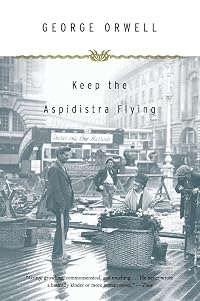
Keep the Aspidistra Flying
by George Orwell 
On This Page
Description
Gordon Comstock is a poor young man who works by day in a grubby London bookstore and spends his evenings shivering in a rented room, trying to write. Gordon has published a slim volume of verse and is determined to keep free of the "money world" of safe, lucrative jobs, marriage, and family responsibilities. This world, to Gordon, spells the end of art and aspidistra, the homely, indestructible house plant that stands in every middle-class British window. Gordon's sweetheart, Rosemary, show more understands him: she is patient with his pride and lack of funds. But then, as it happens with all lovers, events overtake them. Orwell's picture of the "money world," as Gordon sees it, is in his best satirical vein. show lessTags
Recommendations








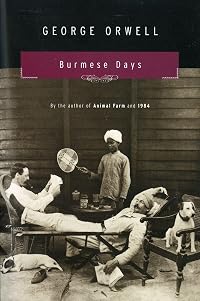














Member Recommendations



Babou_wk La vie quotidienne d'un chômeur des années 30. La volonté de ne pas trouver une bonne place.


Member Reviews
Yeesh. You know when satire is so spot-on that it becomes too uncomfortable to bear? That is what happened here with Gordon Comstock, a pretentious poet who yearns to escape money’s corrupting influence on his artistic aspirations by quitting his job and trying to live a life of “integrity.” Gordon has to learn the hard way what Maugham succinctly states in Of Human Bondage: “Money is like a sixth sense without which you cannot make a complete use of the other five.”
It turns out that poverty ain’t all it’s cracked up to be (it also doesn’t hurt that Gordon has no talent or work-ethic). Gordon is just the worst and reading about his spectacular screw ups made me genuinely uncomfortable. If you too hate money and have a show more strong stomach for unsavory characters, maybe give this one a go if; if not, don’t feel too bad about skipping out on this early Orwell experiment. show less
It turns out that poverty ain’t all it’s cracked up to be (it also doesn’t hurt that Gordon has no talent or work-ethic). Gordon is just the worst and reading about his spectacular screw ups made me genuinely uncomfortable. If you too hate money and have a show more strong stomach for unsavory characters, maybe give this one a go if; if not, don’t feel too bad about skipping out on this early Orwell experiment. show less
I have to admit, the first time I read this book I really disliked it. I kept thinking, "Gah, Gordon, get a real job or at least stop whining about your voluntary poverty!" But somehow, the book grew on me, and I found myself wanting to read it repeatedly. (Even though I still think the aspidistra symbol is overused. That stupid plant is mentioned on just about every other page.)
Best of all, I believe, are the descriptions in the story. Orwell has got a way of making the viewer feel, smell and taste poverty and all the squalor that goes with it.
As an added bonus: find the part where Gordon wakes up in his cell after being arrested. Then open up your copy of 1984 and find the part where Winston is sitting on that bench with all those show more people in the white cell after his arrest. Compare the two passages. show less
Best of all, I believe, are the descriptions in the story. Orwell has got a way of making the viewer feel, smell and taste poverty and all the squalor that goes with it.
As an added bonus: find the part where Gordon wakes up in his cell after being arrested. Then open up your copy of 1984 and find the part where Winston is sitting on that bench with all those show more people in the white cell after his arrest. Compare the two passages. show less
Keep the Aspidistra Flying and Burmese Days are my favourite Orwells so far. Both have flawed protagonists who look at their surroundings and relationships in unorthodox ways. In each, the respective protagonists are pressured to submit to these external influences. There are a few simple formulae which make Orwell's earlier works addictive, of which Keep the Aspidistra Flying is a great example.
First, Orwell focuses on issues familiar to him. The inner thoughts of Gordon Comstock, a young struggling writer who works in a bookshop, are crafted with exceptional realism. It makes me want to read a biography of Orwell to understand the author better: his A Collection of Essays and Down and Out in Paris and London are good starts, but show more somehow I feel there is more behind the words.
Second, the simplicity of Orwell's language makes his writing accessible. This adds poignancy to Gordon's depressing lifestyle: struggling to make ends meet; ignored by acquaintances; ingrained insecurity; loss of all respectability. The battle with the "money-god" is internal as well as external. Hearing a clear voice, whose meaning is sometimes coherent but often confused, helps the reader join a turbulent journey with minimal effort.
Third, the novel deals with the unseen realities of being poor. It's not just about being hungry, cold and dirty. It's about the stigma attached to having no money. How can one accept charity from a friend without damaging their friendship? How can a man maintain a relationship with a woman whom he can't afford to treat? How can you accept the sacrifices your sister has made for you, knowing that they can never be repaid? More than all this, how, when you have nothing in the world, can you believe that all those whom you hold dear don't see you as a failure?
Favourite Quotes
"No rich man ever succeeds in disguising himself as a poor man; for money, like murder, will out."
"Gordon never spent more than an hour or two with Ravelston. One’s contacts with rich people, like one’s visits to high altitudes, must always be brief."
"The money-god is so cunning. If he only baited his traps with yachts and race-horses, tarts and champagne, how easy it would be to dodge him. It is when he gets at you through your sense of decency that he finds you helpless." show less
First, Orwell focuses on issues familiar to him. The inner thoughts of Gordon Comstock, a young struggling writer who works in a bookshop, are crafted with exceptional realism. It makes me want to read a biography of Orwell to understand the author better: his A Collection of Essays and Down and Out in Paris and London are good starts, but show more somehow I feel there is more behind the words.
Second, the simplicity of Orwell's language makes his writing accessible. This adds poignancy to Gordon's depressing lifestyle: struggling to make ends meet; ignored by acquaintances; ingrained insecurity; loss of all respectability. The battle with the "money-god" is internal as well as external. Hearing a clear voice, whose meaning is sometimes coherent but often confused, helps the reader join a turbulent journey with minimal effort.
Third, the novel deals with the unseen realities of being poor. It's not just about being hungry, cold and dirty. It's about the stigma attached to having no money. How can one accept charity from a friend without damaging their friendship? How can a man maintain a relationship with a woman whom he can't afford to treat? How can you accept the sacrifices your sister has made for you, knowing that they can never be repaid? More than all this, how, when you have nothing in the world, can you believe that all those whom you hold dear don't see you as a failure?
Favourite Quotes
"No rich man ever succeeds in disguising himself as a poor man; for money, like murder, will out."
"Gordon never spent more than an hour or two with Ravelston. One’s contacts with rich people, like one’s visits to high altitudes, must always be brief."
"The money-god is so cunning. If he only baited his traps with yachts and race-horses, tarts and champagne, how easy it would be to dodge him. It is when he gets at you through your sense of decency that he finds you helpless." show less
Poor Gordon: he wants to be completely divorced from money, or the desire for making more money. He hates money, he says, and yet he allows the thought of it to rule his life: instead of simply keeping the job that paid okay and might possibly bring in some more cash, he must quit and take a shitty no-pay job that leaves him completely frustrated because he barely has enough money to live. His pride won't allow him to accept money from anyone, even Dutch treat with his sweetheart.
I love Orwell: his writing that is so direct and clear; his sly and self-deprecating sense of humor; his startling kowledge of human weaknesses, and his great compassion for those weaknesses--all these combine to make a moving, funny, and very satisfying show more expreience every time I read his work. One feels that G.O. stares straight at you, unblinking, and just lays his thoughts out for you to examine. show less
I love Orwell: his writing that is so direct and clear; his sly and self-deprecating sense of humor; his startling kowledge of human weaknesses, and his great compassion for those weaknesses--all these combine to make a moving, funny, and very satisfying show more expreience every time I read his work. One feels that G.O. stares straight at you, unblinking, and just lays his thoughts out for you to examine. show less
Orwell’s flawed but nevertheless important novel about a young man’s single-handed struggle against capitalism is an easy and often amusing read.
Gordon Comstock, whose inflexible philosophy drives him further and further into destitution, starts out in a low-paid but reasonable job with a reasonably attractive girlfriend and semi-decent accommodation. But each of these reminds him only of his servitude of a system he loathes. As the novel progresses, he gradually abandons one after the other.
It’s a tragic and lamentable tale, not least because the honest among us all sympathise with the inability to maintain our ideals in a world which falls far short of perfect. As Gordon takes yet another ill-considered course of action of which show more he is the only victim, you can’t help but wince despite understanding his motivation.
It’s only his friends that stand firm while all around him crumbles and this leads to an ending that, for me, seemed more like Orwell compromising his ideals rather than his character.
Again, like Tender is the Night which I’ve just reviewed, my greatest interest in the novel was the discovery that it mirrors so much of the author’s own experience. Knowing that really does add a dimension to reading it that simply wouldn’t be there otherwise.
Orwell can definitely spin a yarn and, for me, this is an important novel because it shows how the art form can be used to communicate an ideal so much more realistically than any treatise can. I’d find it hard to motivate myself to read about alternatives to capitalism in non-fiction form. But give me a novel that explores the subject and I’m fascinated and will emerge far more able to debate its merits. Orwell was very good at that even if his ideals were not, alas, cherished by the world he wrote for. show less
Gordon Comstock, whose inflexible philosophy drives him further and further into destitution, starts out in a low-paid but reasonable job with a reasonably attractive girlfriend and semi-decent accommodation. But each of these reminds him only of his servitude of a system he loathes. As the novel progresses, he gradually abandons one after the other.
It’s a tragic and lamentable tale, not least because the honest among us all sympathise with the inability to maintain our ideals in a world which falls far short of perfect. As Gordon takes yet another ill-considered course of action of which show more he is the only victim, you can’t help but wince despite understanding his motivation.
It’s only his friends that stand firm while all around him crumbles and this leads to an ending that, for me, seemed more like Orwell compromising his ideals rather than his character.
Again, like Tender is the Night which I’ve just reviewed, my greatest interest in the novel was the discovery that it mirrors so much of the author’s own experience. Knowing that really does add a dimension to reading it that simply wouldn’t be there otherwise.
Orwell can definitely spin a yarn and, for me, this is an important novel because it shows how the art form can be used to communicate an ideal so much more realistically than any treatise can. I’d find it hard to motivate myself to read about alternatives to capitalism in non-fiction form. But give me a novel that explores the subject and I’m fascinated and will emerge far more able to debate its merits. Orwell was very good at that even if his ideals were not, alas, cherished by the world he wrote for. show less
Reason read: TBR takedown for June 2025.
This is not my favorite of my Orwell reads but then again, he created a character I absolutely could not stand. Gordon Comstock is a man who quits a good job to protest capitalism and "the love of money". He is a wanna be writer, dabbling at writing poetry. It's all fine and good to have principals but he takes advantages of others who work for their money when he decides to live below what can sustain him. But I disliked him for more than that. He is a man who cannot handle is booze. He is a man who needles his girlfriend into having unprotected sex "if she loves him". Cheats on her with other women. And most of all he cannot even handle money in a respectable manner. The title is the most show more interesting part of this book. An Aspidistra is a plant that can be grown in most conditions even with hardly any light. In fact it doesn't like too much light. Kind of like our Gordon Comstock. The Aspidistra is a symbal of the middle class in Victorian times. The title is supposedly "hooray for the middle class".
The novel explores themes of poverty, materialism, and the search for authenticity in a world dominated by consumerism. I think this was a rather stupid novel all in all. Gordon self imposes poverty. He wants as much as the next guy, makes a show of denying himself but in the end he really isn't denying himself. There is nothing authentic about Gordon until he quits fooling himself. show less
This is not my favorite of my Orwell reads but then again, he created a character I absolutely could not stand. Gordon Comstock is a man who quits a good job to protest capitalism and "the love of money". He is a wanna be writer, dabbling at writing poetry. It's all fine and good to have principals but he takes advantages of others who work for their money when he decides to live below what can sustain him. But I disliked him for more than that. He is a man who cannot handle is booze. He is a man who needles his girlfriend into having unprotected sex "if she loves him". Cheats on her with other women. And most of all he cannot even handle money in a respectable manner. The title is the most show more interesting part of this book. An Aspidistra is a plant that can be grown in most conditions even with hardly any light. In fact it doesn't like too much light. Kind of like our Gordon Comstock. The Aspidistra is a symbal of the middle class in Victorian times. The title is supposedly "hooray for the middle class".
The novel explores themes of poverty, materialism, and the search for authenticity in a world dominated by consumerism. I think this was a rather stupid novel all in all. Gordon self imposes poverty. He wants as much as the next guy, makes a show of denying himself but in the end he really isn't denying himself. There is nothing authentic about Gordon until he quits fooling himself. show less
Warning - if you are one of those people who can't stand novels without "sympathetic" central characters, "Keep the Aspidistra Flying" is not for you.
Gordon Comstock is one of the most pathetic figures in twentieth century novels. He's one of those annoying artistic-type people who inflict unhappiness upon themselves and those around them because they regard themselves as too pure for the corrupt world we all live in. Gordon is self-pitying, he whinges about his life, and he constantly sponges off his friends and family. Orwell generally succeeds in making him interesting, however, and you keep reading in order to see how and where he will receive his comeuppance.
Orwell's descriptions of the seedy side of working class London in the show more 1930s are wonderful. In my mind, Gordon's decadent and degrading night out in Soho is one of the great "drunk" scenes in literature. show less
Gordon Comstock is one of the most pathetic figures in twentieth century novels. He's one of those annoying artistic-type people who inflict unhappiness upon themselves and those around them because they regard themselves as too pure for the corrupt world we all live in. Gordon is self-pitying, he whinges about his life, and he constantly sponges off his friends and family. Orwell generally succeeds in making him interesting, however, and you keep reading in order to see how and where he will receive his comeuppance.
Orwell's descriptions of the seedy side of working class London in the show more 1930s are wonderful. In my mind, Gordon's decadent and degrading night out in Soho is one of the great "drunk" scenes in literature. show less
Members
- Recently Added By
Published Reviews
The book received mixed reviews. Cyril Connolly complained that the book's obsession with money prevented it being considered a work of art. The Daily Mail praised the novel's vigour but was unconvinced by its demolition of middle England: "among the aspidistra, Mr Orwell seems to lose the plot". The misfortunes did not end there. Many of the first print run of 3,000 were lost in a bombing show more raid in the early years of world war two. show less
added by John_Vaughan
Lists

1001 Books You Must Read Before You Die
1,448 works; 1,134 members

20th Century Literature
1,161 works; 55 members

novels in or about bookshops (or libraries)
59 works; 21 members

Top Five Books of 2017
757 works; 231 members

Western World's Greatest Books - Project Gutenberg
295 works; 15 members

Five star books
1,767 works; 110 members

1,001 BYMRBYD Concensus
723 works; 27 members

1930s
262 works; 5 members

A Good Read (Radio 4)
287 works; 1 member

Books Read in 2017
4,249 works; 130 members

Art of Reading
188 works; 5 members

Books Read in 2021
5,361 works; 113 members

Books With the Most Memorable Titles
478 works; 158 members

Read
27 works; 1 member
Reading LIst
648 works; 1 member

Books mentioned in The Diary of a Bookseller
26 works; 1 member

Classics
31 works; 1 member
Author Information

366+ Works 229,196 Members
George Orwell was born Eric Arthur Blair on June 25, 1903 in Motihari in Bengal, India and later studied at Eton College for four years. He was an assistant superintendent with the Indian Imperial Police in Burma. He left that position after five years and moved to Paris, where he wrote his first two books: Burmese Days and Down and Out in Paris show more and London. He then moved to Spain to write but decided to join the United Workers Marxist Party Militia. After being decidedly opposed to communism, he served in the British Home Guard and with the Indian Service of the BBC during World War II. After the war, he wrote for the Observer and was literary editor for the Tribune. His best known works are Animal Farm and 1984. His other works include A Clergyman's Daughter, Keep the Aspidistra Flying, The Road to Wigan Pier, Homage to Catalonia, and Coming Up for Air. He died on January 21, 1950 at the age of 46. (Bowker Author Biography) show less
George Orwell has a Legacy Library. Legacy libraries are the personal libraries of famous readers, entered by LibraryThing members from the Legacy Libraries group.
Some Editions
Awards and Honors
Distinctions
Series
Belongs to Publisher Series
Work Relationships
Is contained in
Has the adaptation
Common Knowledge
- Canonical title*
- Houd de sanseferia hoog
- Original title
- Keep the Aspidistra Flying
- Alternate titles*
- Houd de sanseveria hoog
- Original publication date
- 1936
- People/Characters
- Gordon Comstock; Rosemary Waterlow; Julia Comstock; Philip Ravelston; Mrs. Wisbeach; George Flaxman (show all 23); Mr. McKechnie; Mr. Cheeseman; Aunt Angela; Aunt Charlotte; Barbara; Dora; Gran'pa Comstock; Hermione Slater; Lorenheim; Miss Weeks; Mr. Clew; Mr. Erskine; Mr. Warner; Mrs. Beaver; Mrs. Weaver; Mrs. Penn; Uncle Walter
- Important places
- London, England, UK; Slough, England, UK; Farnham Common, England, UK; Crickham-on-Thames, England, UK; England, UK
- Related movies
- Keep the Aspidistra Flying (1965 | IMDb); Keep the Aspidistra Flying (1997 | IMDb)
- Epigraph
- Though I speak with the tongues of men and of angels, and have not money, I am become as a sounding brass, or a tinkling cymbal. And though I have the gift of prophecy, and understand all mysteries, and all knowledge; a... (show all)nd though I have all faith, so that I could remove mountains, and have not money, I am nothing. And though I bestow all my goods to feed the poor, and though I give my body to be burned, and have not money, it profiteth me nothing. Money suffereth long, and is kind; money envieth not; money vaunteth not
itself, is not puffed up, doth not behave unseemly, seeketh not her own, is not easily provoked, thinketh no evil; rejoiceth not in iniquity, but rejoiceth in the truth; beareth all things, believeth all things, hopeth all things, endureth all things. . . . And now abideth faith, hope, money, these three; but the greatest of these is money.
I Corinthians xiii (adapted) - First words
- The clock struck half past two.
- Quotations
- Rosemary waded through a bed of drifted beech leaves that rustled about her, knee-deep, like a weightless red-gold sea. "Oh, Gordon, these leaves! Look at them with the sun on them! They're like gold. They really are like go... (show all)ld." "Fairy gold. As a matter of fact, if you want an exact simile, they're just the colour of tomata soup." "Don't be a pig, Gordon! Listen how they rustle. `Thick as autumnal leaves that strow the brooks in Vallombrosa'." "Or like one of those breakfast cereals. Tru-weet Breakfast Crisps. `Kiddies clamour for their Breakfast Crisps'." She laughed. They walked on hand in hand, swishing anle-leaves and declaiming: "Thick as the Breakfast Crisps that strow the plates / In Welwyn Garden City!"
The aspidistra became a sort of symbol for Gordon ... It ought to be on our coat of arms instead of the lion and the unicorn.
Publicity - advertising - is the dirtiest ramp that capitalism has yet produced.... The public are swine; advertising is the rattling of a stick inside a swill-bucket.
his miserable book of poems ... "Mice" ... Of the thirteen BFs who had reviewed it ... not one had seen the none too subtle joke of that title.
He never felt any pity for the genuine poor. It is the black-coated poor, the middle-middle class, who need pitying. - Last words
- (Click to show. Warning: May contain spoilers.)Well, once again things were happening in the Comstock family.
- Original language
- English
*Some information comes from Common Knowledge in other languages. Click "Edit" for more information.
Classifications
- Genres
- Fiction and Literature, General Fiction
- DDC/MDS
- 828.91209 — Literature & rhetoric English & Old English literatures English miscellaneous writings English miscellaneous writings 1900- English miscellaneous writings 1900-1999 English miscellaneous writings 1900-1945 Individual authors not limited to or chiefly identified with one specific form.
- LCC
- PR6029 .R8 .K44 — Language and Literature English English Literature 1900-1960
- BISAC
Statistics
- Members
- 3,396
- Popularity
- 4,954
- Reviews
- 57
- Rating
- (3.83)
- Languages
- 19 — Czech, Dutch, English, Estonian, Finnish, French, German, Hungarian, Italian, Japanese, Lithuanian, Norwegian (Bokmål), Polish, Romanian, Russian, Spanish, Swedish, Turkish, Portuguese (Portugal)
- Media
- Paper, Audiobook, Ebook
- ISBNs
- 107
- ASINs
- 53