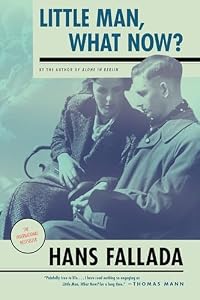
Little Man, What Now?
by Hans Fallada
On This Page
Description
Written just before the Nazis came to power, this darkly enchanting novel tells the story of a young German couple trying to eke out a decent life amidst an economic crisis that is transforming their country into a place of anger and despair. Little Man, What Now? was an international bestseller upon its release, and was made into a Hollywood movie - by Jewish producers, which prompted the rising Nazis to begin paying ominously close attention to Hans Fallada, even as his novels held out show more stirring hope for the human spirit. It is presented here in its first-ever uncut translation, by Susan Bennett, and with an afterword by Philip Brady that details the calamitous background of the novel, its worldwide reception, and how it turned out to be, for the author, a dangerous book. show lessTags
Recommendations




















Member Recommendations
Member Reviews
Fallada’s 1932 bestseller is the story of a young couple struggling with the economic realities of life in Weimar Germany during the Great Depression. We have a pretty good idea of the sort of world the young bookkeeper Pinneberg and his Lämmchen are facing already in the opening chapter, where the lovers visit a gynaecologist and learn the bad news that they have unwittingly condemned themselves to parenthood and marriage.
It’s all very New Objectivity, written in stark, plain language with a focus on the mundane details of income and expenditure that come to dominate the characters’ lives, and on the many small hazards that lie in wait for those with no safety margin. Pinneberg is not a Mr Micawber who can rise above the show more humiliations life throws at him, he is repeatedly knocked down by the sense of worthlessness he gets from being unemployed and forced to depend on the odd jobs his wife is able to pick up here and there. Touching and painful to read, and there’s probably a lot here that would resonate with young people today struggling to earn enough to be able to afford the basics of modern life. show less
It’s all very New Objectivity, written in stark, plain language with a focus on the mundane details of income and expenditure that come to dominate the characters’ lives, and on the many small hazards that lie in wait for those with no safety margin. Pinneberg is not a Mr Micawber who can rise above the show more humiliations life throws at him, he is repeatedly knocked down by the sense of worthlessness he gets from being unemployed and forced to depend on the odd jobs his wife is able to pick up here and there. Touching and painful to read, and there’s probably a lot here that would resonate with young people today struggling to earn enough to be able to afford the basics of modern life. show less
“They were standing right up to the shop window, well-dressed people, respectable people, people who earned money. But reflected in the window was another figure: a pale outline without a collar, in a shabby coat, with trousers besmirched with tar. And suddenly Pinneberg understood everything. Faced with the policeman, these respectable people, this bright shop window, he understood that he was on the outside now, that he didn’t belong any more…”
Unemployment was at 42% in Weimar when Hans Fallada published this tender and often charming novel of Germany between the wars. In a country being devoured by hyperinflation, with more and more people falling into a nameless, faceless nothingness where they no longer mattered to any one, show more the newly installed Chancellor cut unemployment support. Nine days later, Little Man, What Now?, a book written in only sixteen weeks, was published, giving the downtrodden a voice. Fifty German newspapers serialized the book, and it became a worldwide sensation. It also brought Fallada disfavor when it was turned into a wonderful film in America, starring the luminous Margaret Sullavan as Lammchen, and the underrated Douglass Montgomery as Pinneberg. The film, you see, was made by Jews in Hollywood…
Fallada’s focus in the novel is a young German couple with a child on the way. The reader only knows the unborn child by the affectionate term used by Sonny and Lammchen — Shrimp. Through Pinneberg and Lammchen’s struggles, and their slide downward, we see peripherally a people desperate to latch onto either the lofty ideals of Communism, or the promises of jobs proffered by the Nazi Party. In a novel nearly apolitical, because it’s focus is the little guy, we see the conditions that give birth to what happened, and get a glimpse — not from hindsight, because this was published in 1932 — at an ugliness that would only grow more fervent, until it threatened to engulf the world.
There is a soft neorealism to Fallada’s narrative, which is tremendously intimate, and terribly charming. Yet interspersed with this realism is the kind of loveliness such as one might find in one of Remarque’s novels:
“The white curtains moved gently against the windows in the wind. A soft light radiated through the room. An enchantment drew them towards the open window, arm in arm, and they leaned out. The countryside was bathed in moonlight. Far to the right there was a tiny flickering dot of light; the last gas-lamp on Feldstrasse. But before them lay the countryside, beautifully divided up into patches of friendly brightness, and deep soft shade where the trees stood. It was so quiet that even up here they could hear the Strela rippling over the stones. And the night wind blew very gently on their foreheads.”
In essence, the entire novel is made up of realistic vignettes, the love story of a couple who marry upon discovering that Emma (Lammchen) is with child. Johannes Pinneberg (Sonny) very much loves his Lammchen, and has to work in a different town just to survive. Their struggles are not unlike any newly married couple’s problems, but poverty and the growing unrest and desperation in Germany between the wars begins closing in on them, inch by inch. Fallada shows in great detail how such times bring out the best in some people, but the worst in others. He also shows how employers, knowing how valuable having a job was, took advantage. All this is done with great charm, humor, and slice-of-life moments which are universal. Pinneberg must even play up to a girl and keep his marriage to Lammchen secret in order to keep one job. No job is safe, however, and no matter how hard Pinneberg tries, the couple slowly move toward the gutter. Pinngeberg’s pessimism, and his desperation to take care of his Lammchen, is perhaps best represented by this apolitical passage:
“There was a wild, wide, noisy and hostile world out there, which knew nothing of them and cared less.”
In many ways, Lammchen is the stronger of the two, and she knows it. Pinneberg knows that despite his job, they are one step from hopelessness, and joining his comrades. The slide is so gradual, their day-to-day struggle so consuming, it is the reader who sees it best, through Fallada’s remarkably intimate and charming vignettes. Even as they are relegated to a tiny loft above a cinema, and then Lammchen must spend hours darning socks for just a small amount to feed the Shrimp and themselves, because Pinneberg can no longer find work, there is charm, and some hope. But Pinneberg knows that it is only his friend Heilbut’s kindness that is keeping them from the gutter. Lammchen’s Sonny boy, is losing himself, and his dignity.
Lammchen senses this, but knows that one day things will be better, if they can hang on. Her greatest fear is that her Sonny boy will do something before they are back on their feet which will stain him, and haunt him long after the tide has turned. She reveals this to the lovable scoundrel Jachman near the end of the book, while they are waiting for Pinneberg to arrive. But Sonny is very late, and her fear for him is growing. It brings about an open-ended conclusion that is terribly moving. It is also terribly lovely, one of the most beautifully written scenes you’ll ever come across in literature.
Fallada, whose own life was fraught with adversity, both outward and inward, based Emma (Lammchen) on his wife Anna Issel, and it is easy to see that Pinneberg is much like Fallada himself. This novel had tremendous success, easing Fallada’s own financial problems for a time. Though it perhaps takes too long to get to its moving conclusion, few will be sorry they read it. One of the most remarkable things about the book is that it was penned during the events, as these things were happening to Fallada and others. Fallada lived this, and the intimacy of Sonny and Lammchen’s story affords readers a bird’s eye view of what was really happening. In doing so, it gives us a better understanding of history.
For those interested, there is a good article about Fallada here: http://hansfallada.com
Someone was forced to take down the youtube link I had previously posted for the charming Hollywood film (there was one made in Germany also) based on the book. It stars Margaret Sullavan, who is luminous, and Douglass Montgomery, who is equally wonderful. It ends differently from the novel, however. For modern readers, it is a strange circumstance where I would almost recommend viewing the lovely 1934 film first — if possible — because it will help you get into the older style of Fallada’s intimate narrative of Little Man, What Now? show less
Unemployment was at 42% in Weimar when Hans Fallada published this tender and often charming novel of Germany between the wars. In a country being devoured by hyperinflation, with more and more people falling into a nameless, faceless nothingness where they no longer mattered to any one, show more the newly installed Chancellor cut unemployment support. Nine days later, Little Man, What Now?, a book written in only sixteen weeks, was published, giving the downtrodden a voice. Fifty German newspapers serialized the book, and it became a worldwide sensation. It also brought Fallada disfavor when it was turned into a wonderful film in America, starring the luminous Margaret Sullavan as Lammchen, and the underrated Douglass Montgomery as Pinneberg. The film, you see, was made by Jews in Hollywood…
Fallada’s focus in the novel is a young German couple with a child on the way. The reader only knows the unborn child by the affectionate term used by Sonny and Lammchen — Shrimp. Through Pinneberg and Lammchen’s struggles, and their slide downward, we see peripherally a people desperate to latch onto either the lofty ideals of Communism, or the promises of jobs proffered by the Nazi Party. In a novel nearly apolitical, because it’s focus is the little guy, we see the conditions that give birth to what happened, and get a glimpse — not from hindsight, because this was published in 1932 — at an ugliness that would only grow more fervent, until it threatened to engulf the world.
There is a soft neorealism to Fallada’s narrative, which is tremendously intimate, and terribly charming. Yet interspersed with this realism is the kind of loveliness such as one might find in one of Remarque’s novels:
“The white curtains moved gently against the windows in the wind. A soft light radiated through the room. An enchantment drew them towards the open window, arm in arm, and they leaned out. The countryside was bathed in moonlight. Far to the right there was a tiny flickering dot of light; the last gas-lamp on Feldstrasse. But before them lay the countryside, beautifully divided up into patches of friendly brightness, and deep soft shade where the trees stood. It was so quiet that even up here they could hear the Strela rippling over the stones. And the night wind blew very gently on their foreheads.”
In essence, the entire novel is made up of realistic vignettes, the love story of a couple who marry upon discovering that Emma (Lammchen) is with child. Johannes Pinneberg (Sonny) very much loves his Lammchen, and has to work in a different town just to survive. Their struggles are not unlike any newly married couple’s problems, but poverty and the growing unrest and desperation in Germany between the wars begins closing in on them, inch by inch. Fallada shows in great detail how such times bring out the best in some people, but the worst in others. He also shows how employers, knowing how valuable having a job was, took advantage. All this is done with great charm, humor, and slice-of-life moments which are universal. Pinneberg must even play up to a girl and keep his marriage to Lammchen secret in order to keep one job. No job is safe, however, and no matter how hard Pinneberg tries, the couple slowly move toward the gutter. Pinngeberg’s pessimism, and his desperation to take care of his Lammchen, is perhaps best represented by this apolitical passage:
“There was a wild, wide, noisy and hostile world out there, which knew nothing of them and cared less.”
In many ways, Lammchen is the stronger of the two, and she knows it. Pinneberg knows that despite his job, they are one step from hopelessness, and joining his comrades. The slide is so gradual, their day-to-day struggle so consuming, it is the reader who sees it best, through Fallada’s remarkably intimate and charming vignettes. Even as they are relegated to a tiny loft above a cinema, and then Lammchen must spend hours darning socks for just a small amount to feed the Shrimp and themselves, because Pinneberg can no longer find work, there is charm, and some hope. But Pinneberg knows that it is only his friend Heilbut’s kindness that is keeping them from the gutter. Lammchen’s Sonny boy, is losing himself, and his dignity.
Lammchen senses this, but knows that one day things will be better, if they can hang on. Her greatest fear is that her Sonny boy will do something before they are back on their feet which will stain him, and haunt him long after the tide has turned. She reveals this to the lovable scoundrel Jachman near the end of the book, while they are waiting for Pinneberg to arrive. But Sonny is very late, and her fear for him is growing. It brings about an open-ended conclusion that is terribly moving. It is also terribly lovely, one of the most beautifully written scenes you’ll ever come across in literature.
Fallada, whose own life was fraught with adversity, both outward and inward, based Emma (Lammchen) on his wife Anna Issel, and it is easy to see that Pinneberg is much like Fallada himself. This novel had tremendous success, easing Fallada’s own financial problems for a time. Though it perhaps takes too long to get to its moving conclusion, few will be sorry they read it. One of the most remarkable things about the book is that it was penned during the events, as these things were happening to Fallada and others. Fallada lived this, and the intimacy of Sonny and Lammchen’s story affords readers a bird’s eye view of what was really happening. In doing so, it gives us a better understanding of history.
For those interested, there is a good article about Fallada here: http://hansfallada.com
Someone was forced to take down the youtube link I had previously posted for the charming Hollywood film (there was one made in Germany also) based on the book. It stars Margaret Sullavan, who is luminous, and Douglass Montgomery, who is equally wonderful. It ends differently from the novel, however. For modern readers, it is a strange circumstance where I would almost recommend viewing the lovely 1934 film first — if possible — because it will help you get into the older style of Fallada’s intimate narrative of Little Man, What Now? show less
The first thing I learned when I started reading about Hans Fallada was that his surname means “failure” in Spanish. The second thing I learned was that Fallada’s real name was Rudolf Ditzen (he drew his pen name from two tales by the Grimm brothers). The third thing I learned was that at the age of 18, he and a friend entered into a mutual suicide pact. To maintain their families’ reputations, they decided to perform it in the guise of a duel: they would shoot each other. The friend missed. Ditzen didn’t. He immediately took his revolver and shot himself in the chest. He survived, however, to be convicted of murder and sentenced to an insane asylum. The year before the suicide pact, Fallada contracted typhoid. The year before show more that he was run over by a cart, causing lifelong pain. After release from the asylum, he was twice convicted of embezzling from his employers. His younger brother died during WWI. He and his wife lost a baby at birth. Unsurprisingly, Ditzen/Fallada struggled with alcohol and drugs for the rest of his life.
None of that got in the way of his writing and Little Man, What Now made a huge splash. It shot to the top of the best-seller list in Germany in 1932 displacing no less a work than All Quiet on the Western Front. Fallada’s book sold over one million copies and saved his publisher from bankruptcy, was translated into fifteen languages, and reached the pinnacle of 1930s success: it was made into a Hollywood movie. Fallada then published one novel a year for the next nine years. Thomas Mann, Graham Greene, and Hermann Hesse all offered praise. Primo Levi, who had intimate familiarity with Nazi brutality, wrote of another of Fallada’s books, “The greatest book ever written about German resistance to the Nazis.” Richard Simon (a founder of the American publisher Simon & Schuster) called Little Man “perilously close to a masterpiece.” The writing was on the wall in 1930s Germany, easy for thousands, if not millions, of Germans to read. Fallada refused to go and he remained in Germany until his death in 1947 at 54, despite having the Nazi regime label him an “undesirable author” as early as 1935. Fallada wrote his last novel, The Drinker, in an asylum for the criminally insane three years before his death. After its publication (in English) in 1952, Fallada and his work simply disappeared, not to be revived for more than half a century.
Little Man, What Now recounts the decline and fall of an unassuming, decent working-class couple during the first few years of the depression from 1929 to 1931. Johannes and Emma Pinneberg meet, marry, and struggle, mostly in Berlin. The plot—such as it is—is no more (or less) than the struggle to survive from day to day: finding (and keeping) a job, finding housing, finding enough to eat. Every day brings fresh challenges and although not much happens, Fallada’s depiction of day-to-day life is a masterful portrayal of a moment in history. German politics plays little role but the economics of daily existence, the toll of too little money, the insanities of bureaucracies, are constantly in play and work anywhere. An implicit theme running through the book is the additional toll of such a life on self-respect. The book’s enormous popularity was, I think, less a result of Fallada’s occasional economic and political explanations than his portrait of a loving marriage, of a couple’s battles to cope with the bare-knuckles brawl of daily survival. Three-fourths of the way through the book, Johannes and Emma go to the movies and, though Fallada is ostensibly describing the on-screen story, a single sentence summarizes the novel perfectly: “A foolish wife, perhaps, who didn’t know how to manage the money, but she was his small share of happiness, and he didn’t find her foolish.” Even though the description doesn’t fit Lammchen, that phrase, “his small share of happiness,” is what the book is about. Their marriage was a refuge from the world, a constant and a blessing in an increasingly troubled time.
Fallada’s prose is colloquial; it is easy-to-read, unadorned language, reflecting the Pinnebergs themselves. There is humor and pathos but the English translation is peculiar, to say the least. Susan Bennett decided that “it has to be translated in the slang of the 30s.” Although that decision makes sense, she further concluded that because “it is specific to a place,” she would “deploy Cockney (i.e. popular London) equivalents”! The novel takes place in Berlin, she acknowledges it is very place-specific, so she chooses…London? This results in sentences like “Expecting, aren’t yer? Na, if we wanted kids bawling round the ‘ouse, we’d ‘ave our own. Then we could ‘ave a choir of ‘em.” Or, “I can shift the mirror meself, guv”! She compounds this foolishness by using German and English money terms interchangeably. So the reader encounters marks and pfennigs in one line and bob (or shillings) and pence further down the page. Bennett treats the couple’s terms of affection for each other strangely as well. She retains Emma’s German nickname (Lämmchen, or little lamb; she claims in a note preceding the book that she has “anglicized” it because she removed the umlaut) but she inexplicably decides that she has to translate Johannes’s “Junge” into “Sonny.” Bennett can’t decide where she wishes to be. Though her translation reads easily and the tone is (appropriately) light, these infelicities too often make for an odd read. (I have five other novels by Fallada…translated by four different translators.) What a pity.
I found the ending masterfully done; Fallada manages to bring his story to a heart-breaking, if predictable, close. I need, of course, to read more of his work, but based solely on this novel, I find it little short of astounding that his books “disappeared” for as long as they did. Although I wondered for a long time what Mann, Hesse, Levi, and Greene saw in Fallada’s work, I should have had more faith in their judgment. That Fallada’s novels have been rediscovered and published is worth celebrating. show less
None of that got in the way of his writing and Little Man, What Now made a huge splash. It shot to the top of the best-seller list in Germany in 1932 displacing no less a work than All Quiet on the Western Front. Fallada’s book sold over one million copies and saved his publisher from bankruptcy, was translated into fifteen languages, and reached the pinnacle of 1930s success: it was made into a Hollywood movie. Fallada then published one novel a year for the next nine years. Thomas Mann, Graham Greene, and Hermann Hesse all offered praise. Primo Levi, who had intimate familiarity with Nazi brutality, wrote of another of Fallada’s books, “The greatest book ever written about German resistance to the Nazis.” Richard Simon (a founder of the American publisher Simon & Schuster) called Little Man “perilously close to a masterpiece.” The writing was on the wall in 1930s Germany, easy for thousands, if not millions, of Germans to read. Fallada refused to go and he remained in Germany until his death in 1947 at 54, despite having the Nazi regime label him an “undesirable author” as early as 1935. Fallada wrote his last novel, The Drinker, in an asylum for the criminally insane three years before his death. After its publication (in English) in 1952, Fallada and his work simply disappeared, not to be revived for more than half a century.
Little Man, What Now recounts the decline and fall of an unassuming, decent working-class couple during the first few years of the depression from 1929 to 1931. Johannes and Emma Pinneberg meet, marry, and struggle, mostly in Berlin. The plot—such as it is—is no more (or less) than the struggle to survive from day to day: finding (and keeping) a job, finding housing, finding enough to eat. Every day brings fresh challenges and although not much happens, Fallada’s depiction of day-to-day life is a masterful portrayal of a moment in history. German politics plays little role but the economics of daily existence, the toll of too little money, the insanities of bureaucracies, are constantly in play and work anywhere. An implicit theme running through the book is the additional toll of such a life on self-respect. The book’s enormous popularity was, I think, less a result of Fallada’s occasional economic and political explanations than his portrait of a loving marriage, of a couple’s battles to cope with the bare-knuckles brawl of daily survival. Three-fourths of the way through the book, Johannes and Emma go to the movies and, though Fallada is ostensibly describing the on-screen story, a single sentence summarizes the novel perfectly: “A foolish wife, perhaps, who didn’t know how to manage the money, but she was his small share of happiness, and he didn’t find her foolish.” Even though the description doesn’t fit Lammchen, that phrase, “his small share of happiness,” is what the book is about. Their marriage was a refuge from the world, a constant and a blessing in an increasingly troubled time.
Fallada’s prose is colloquial; it is easy-to-read, unadorned language, reflecting the Pinnebergs themselves. There is humor and pathos but the English translation is peculiar, to say the least. Susan Bennett decided that “it has to be translated in the slang of the 30s.” Although that decision makes sense, she further concluded that because “it is specific to a place,” she would “deploy Cockney (i.e. popular London) equivalents”! The novel takes place in Berlin, she acknowledges it is very place-specific, so she chooses…London? This results in sentences like “Expecting, aren’t yer? Na, if we wanted kids bawling round the ‘ouse, we’d ‘ave our own. Then we could ‘ave a choir of ‘em.” Or, “I can shift the mirror meself, guv”! She compounds this foolishness by using German and English money terms interchangeably. So the reader encounters marks and pfennigs in one line and bob (or shillings) and pence further down the page. Bennett treats the couple’s terms of affection for each other strangely as well. She retains Emma’s German nickname (Lämmchen, or little lamb; she claims in a note preceding the book that she has “anglicized” it because she removed the umlaut) but she inexplicably decides that she has to translate Johannes’s “Junge” into “Sonny.” Bennett can’t decide where she wishes to be. Though her translation reads easily and the tone is (appropriately) light, these infelicities too often make for an odd read. (I have five other novels by Fallada…translated by four different translators.) What a pity.
I found the ending masterfully done; Fallada manages to bring his story to a heart-breaking, if predictable, close. I need, of course, to read more of his work, but based solely on this novel, I find it little short of astounding that his books “disappeared” for as long as they did. Although I wondered for a long time what Mann, Hesse, Levi, and Greene saw in Fallada’s work, I should have had more faith in their judgment. That Fallada’s novels have been rediscovered and published is worth celebrating. show less
The book is written in Germany of 1932. One year before Hitler came to power.
I first read this in Swedish a few years ago. The Swedish title, What'll Become Of The Pinnebergs? is a bit cheesy; it sounds a bit like a 30s comedy, which of course it is in a way, but it doesn't seem to have the weight of the original's Little Man, What Now? At the same time I can't help but like the title, as if it's setting us up less to see a warning (which it is) and more to see the people in it, as a (which it also is) nice, low-intensity but increasingly desperate story about a young family just trying to get along.
Start from the beginning: Johannes Pinneberg marries Emma "Lämmchen" ("Little lamb") Mörschel. They hadn't really planned to get there show more this quickly, but they're young, they forget about contraception, and whoops. No big, these are modern times and it's not that much of a moral issue. They're well into their 20s, they already have jobs (though of course she'll have to quit hers), they were going to end up here anyway, now they just have just under 9 months to get their proper adult married lives in order before the little one arrives. They're in love, they're willing to work hard, they don't demand any luxury... What could possibly go wrong?
Well, there's the bit about getting started. If you want to feed three mouths on one salary, you need to save money. To save money, you need to have money. If you can't afford to buy your own place, you need to rent expensive furnished rooms, and they don't want squalling newborns. You need a fixed income, but the economy is hurting and if you don't like the deal, there are thousands of others who want your job, and...
(...and there's political unrest brewing in the background, communists and Nazis fighting in the streets, and say what you want about the Nazis, they may be violent thugs but at least they're OUR violent thugs, good German boys who are bound to grow up if we just show them some respect, and let's be honest, nobody likes the Jews, so we'll see after the election...)
The book is written in Germany of 1932. One year before Hitler came to power.
And Pinneberg works and toils but he can't get ahead, he clings to any job he can get by his fingernails, locked in competition with his co-workers. They're in a recession, and you know the business owners are hurting too, what with the taxes and all, and they'd love to offer better wages but &c. Don't cause any trouble, keep your head down, don't come across as political by demanding more than what we say is your share, you'll get pie in the sky when you die. Emma's class-conscious worker parents sneer at her for "marrying up", Johannes' aging madam of a mother can't understand why they're so hung up on something as hopelessly common as money. All Johannes and Emma ask is to love and earn their keep, but anything they can say or do is turned against them. Pride fucks with ya; nobody likes a beggar, but what to do when you're reduced to asking for mercy? The harder society becomes, the more we hate the weak, the weakness in ourselves.
Down the slippery slope, sunk without trace, utterly destroyed. Order and cleanliness, gone; work, material security, gone; making progress and hope, gone. Poverty is not just misery, poverty is an offence, poverty is a stain, poverty is suspect.
And yet Fallada describes them with such warmth and wide-eyed optimism, as if he can't bear the thought that it's hopeless even as he piles on the misfortune and they increasingly lose their grip on that steep, slippery slope. He describes their lives so simply, so matter-of-factly that he never lets us forget that this is happening NOW - in the 30s, sure, but that wasn't long ago, this isn't some weird mediaeval Dickens world, these are two young people in 20th century Europe. They're in love. They have no money. They're slipping, and they can't hold on. And they're not alone, and fear and paranoia is spreading, and SOMETHING is going to happen to society very soon.
And it breaks my heart, and leaves me fucking furious that I know what'll become of the Pinnebergs. Whatever they ended up doing over the next 15 years, they became part of that thing that we've been so busy arguing that it can never happen again that we completely ignore any hint that it can, as if "Never Again" were some magical formula. Nobody saw it coming that time, so common wisdom states... Except for Fallada and other writers, obviously... So clearly we'll see it coming next time, right? Increasing inequality, rising unemployment, fear, xenophobia, more people running to extremist parties, that's all stuff that just kind of happens in 2014. Germany of 1932 was long ago.
And yet I read this book and I love it, I can almost forget what I know, I can read it and see that question mark at the end of the title. The book is so now, and the Pinnebergs so multi-faceted and so trusting in each other and believing that somehow it has to work out, there's simply no other option, that I want to believe it. Fallada didn't know; he could suspect, but he could hope. He could be as naive as Johannes and Emma are at the start. Because really, what else is there?
The book is written in Germany of 1932. It sold massively, was serialized all over Europe, became the 1930s version of Orange Is The New Black, was discussed everywhere. Then Hitler took over anyway. The pen didn't stand a chance against the sword.
Little man... what now? show less
I first read this in Swedish a few years ago. The Swedish title, What'll Become Of The Pinnebergs? is a bit cheesy; it sounds a bit like a 30s comedy, which of course it is in a way, but it doesn't seem to have the weight of the original's Little Man, What Now? At the same time I can't help but like the title, as if it's setting us up less to see a warning (which it is) and more to see the people in it, as a (which it also is) nice, low-intensity but increasingly desperate story about a young family just trying to get along.
Start from the beginning: Johannes Pinneberg marries Emma "Lämmchen" ("Little lamb") Mörschel. They hadn't really planned to get there show more this quickly, but they're young, they forget about contraception, and whoops. No big, these are modern times and it's not that much of a moral issue. They're well into their 20s, they already have jobs (though of course she'll have to quit hers), they were going to end up here anyway, now they just have just under 9 months to get their proper adult married lives in order before the little one arrives. They're in love, they're willing to work hard, they don't demand any luxury... What could possibly go wrong?
Well, there's the bit about getting started. If you want to feed three mouths on one salary, you need to save money. To save money, you need to have money. If you can't afford to buy your own place, you need to rent expensive furnished rooms, and they don't want squalling newborns. You need a fixed income, but the economy is hurting and if you don't like the deal, there are thousands of others who want your job, and...
(...and there's political unrest brewing in the background, communists and Nazis fighting in the streets, and say what you want about the Nazis, they may be violent thugs but at least they're OUR violent thugs, good German boys who are bound to grow up if we just show them some respect, and let's be honest, nobody likes the Jews, so we'll see after the election...)
The book is written in Germany of 1932. One year before Hitler came to power.
And Pinneberg works and toils but he can't get ahead, he clings to any job he can get by his fingernails, locked in competition with his co-workers. They're in a recession, and you know the business owners are hurting too, what with the taxes and all, and they'd love to offer better wages but &c. Don't cause any trouble, keep your head down, don't come across as political by demanding more than what we say is your share, you'll get pie in the sky when you die. Emma's class-conscious worker parents sneer at her for "marrying up", Johannes' aging madam of a mother can't understand why they're so hung up on something as hopelessly common as money. All Johannes and Emma ask is to love and earn their keep, but anything they can say or do is turned against them. Pride fucks with ya; nobody likes a beggar, but what to do when you're reduced to asking for mercy? The harder society becomes, the more we hate the weak, the weakness in ourselves.
Down the slippery slope, sunk without trace, utterly destroyed. Order and cleanliness, gone; work, material security, gone; making progress and hope, gone. Poverty is not just misery, poverty is an offence, poverty is a stain, poverty is suspect.
And yet Fallada describes them with such warmth and wide-eyed optimism, as if he can't bear the thought that it's hopeless even as he piles on the misfortune and they increasingly lose their grip on that steep, slippery slope. He describes their lives so simply, so matter-of-factly that he never lets us forget that this is happening NOW - in the 30s, sure, but that wasn't long ago, this isn't some weird mediaeval Dickens world, these are two young people in 20th century Europe. They're in love. They have no money. They're slipping, and they can't hold on. And they're not alone, and fear and paranoia is spreading, and SOMETHING is going to happen to society very soon.
And it breaks my heart, and leaves me fucking furious that I know what'll become of the Pinnebergs. Whatever they ended up doing over the next 15 years, they became part of that thing that we've been so busy arguing that it can never happen again that we completely ignore any hint that it can, as if "Never Again" were some magical formula. Nobody saw it coming that time, so common wisdom states... Except for Fallada and other writers, obviously... So clearly we'll see it coming next time, right? Increasing inequality, rising unemployment, fear, xenophobia, more people running to extremist parties, that's all stuff that just kind of happens in 2014. Germany of 1932 was long ago.
And yet I read this book and I love it, I can almost forget what I know, I can read it and see that question mark at the end of the title. The book is so now, and the Pinnebergs so multi-faceted and so trusting in each other and believing that somehow it has to work out, there's simply no other option, that I want to believe it. Fallada didn't know; he could suspect, but he could hope. He could be as naive as Johannes and Emma are at the start. Because really, what else is there?
The book is written in Germany of 1932. It sold massively, was serialized all over Europe, became the 1930s version of Orange Is The New Black, was discussed everywhere. Then Hitler took over anyway. The pen didn't stand a chance against the sword.
Little man... what now? show less
I find myself drawn to Fallada novels, partly because his 1930's/40's Germany seems to be resonating eerily with 21st century America, and partly because there is some kind of purity in his straightforward telling of real people caught in impossible situations. This is my 3rd Fallada (after Every Man Dies Alone and The Drinker...he doesn't leave you guessing on content, does he?). Onward to the massive Wolf Among Wolves for my next Fallada...
Meno angosciante di nessuno muore solo, ma comunque non particolarmente allegro. La scrittura asciutta, scorrevole e la struttura a capitoli di poche pagine, con un titolo accattivante, tiene incollati alle pagine, permeate di pessimismo e da una sensazione di inesorabilità. Comunisti e nazisti sono messi su un piano analogo, Fallada descrive il povero uomo incapace di spiccare e di uscire dalla sua miseria, che non crolla definitivamente solo grazie alla forza della donna che ha accanto.
I personaggi sono tutti ben descritti, con le loro peculiarità, le loro luci e le loro ombre: un perfetto affresco della Germania tra le due guerre, sull’orlo del tracollo. Un gioiellino, ottimo modo di cominciare il mio 2019 libresco.
I personaggi sono tutti ben descritti, con le loro peculiarità, le loro luci e le loro ombre: un perfetto affresco della Germania tra le due guerre, sull’orlo del tracollo. Un gioiellino, ottimo modo di cominciare il mio 2019 libresco.
A gritty young couple, the wife pregnant with a child they call "the Shrimp," must unrelentingly kämpfen to keep food in their stomachs and their noses somehow above the many torrents of threat in 1930's Berlin, where day-to-day survival opportunities are all but nonexistent. The star of the show is their tender but rock-hard fidelity to each other; and the comedy in how they're able to survive, but just barely.
Hans Fallada is a unique writer and stylist, well worth getting to know. I look forward to reading his later book, Every Man Dies Alone, which is supposed to be one of the best accounts ever about Germany during the war, and which also tells the rarely chronicled story of the many Germans who tried to resist Hitler.
Hans Fallada is a unique writer and stylist, well worth getting to know. I look forward to reading his later book, Every Man Dies Alone, which is supposed to be one of the best accounts ever about Germany during the war, and which also tells the rarely chronicled story of the many Germans who tried to resist Hitler.
Members
- Recently Added By
Published Reviews
ThingScore 75
added by nagel175
Lists

German Literature
514 works; 50 members

In or About the 1930s
198 works; 26 members

Top Five Books of 2017
757 works; 231 members

Best books read in 2011
200 works; 50 members

Books set in Berlin
46 works; 4 members

Books Read in 2017
4,249 works; 130 members

Publisher's Weekly Bestsellers Part I - 1895-1939
399 works; 8 members

Canon de la narrativa universal del s. XX (cicutadry)
499 works; 3 members
Author Information

152+ Works 8,185 Members
Hans Fallada is a pseudonym of Rudolf Ditzen, who was born in Greifswald, Germany, in 1893. Many of Fallada's works, including the posthumously published The Drinker, were about his life, which was rife with addictions and instability. Another subject of his works was his homeland Germany. Earlier works, including international bestseller Little show more Man, What Now?, show a Germany that would allow itself to become a Nazi nation under Hitler. Later works deal with the aftermath and guilt of this decision. He died on February 5, 1947, in Berlin. (Bowker Author Biography) show less
All Editions
Some Editions
Awards and Honors
Series
Belongs to Publisher Series
Work Relationships
Is contained in
Has the adaptation
Common Knowledge
- Canonical title*
- Kleiner Mann - was nun?
- Original title
- Kleiner Mann, was nun?
- Original publication date
- 1932
- People/Characters
- Johannes Pinneberg ('Sonny'); Emma Mörschel ('Lammchen'); Marie Pinneberg; Heilbutt; Kleinholz; Jachmann (show all 7); Horst ('the Shrimp')
- Important places
- Platz, Germany; Ducherow, Mecklenburg-Vorpommern, Germany; Berlin, Germany
- Important events*
- Crisisjaren (1929-1930)
- Related movies
- Little Man, What Now? (1934 | IMDb)
- First words
- Five minutes past four.
Es ist fünf Minuten nach vier. - Quotations
- 'He walked slowly on. There were the law-courts and there were the cells. Perhaps there were other tormented souls behind those lightless barred windows. You ought to know about such things; perhaps life would be easier if yo... (show all)u did. But you were so terribly ignorant. You went on your way ,thinking your own thoughts, horribly alone, and on an evening like this you didn't know where to go.
- Last words
- (Click to show. Warning: May contain spoilers.)Then they both went into the hut where the baby lay asleep.
(Click to show. Warning: May contain spoilers.)Und dann gehen sie beide ins Haus, in dem der Murkel schläft. - Original language
- German
*Some information comes from Common Knowledge in other languages. Click "Edit" for more information.
Classifications
- Genres
- General Fiction, Fiction and Literature
- DDC/MDS
- 833.912 — Literature & rhetoric German & related literatures German fiction 1900- 1900-1990 1900-1945
- LCC
- PT2607 .I6 .K613 — Language and Literature German, Dutch and Scandinavian literatures German literature Individual authors or works 1860/70-1960
- BISAC
Statistics
- Members
- 1,134
- Popularity
- 22,105
- Reviews
- 33
- Rating
- (3.96)
- Languages
- 18 — Catalan, Czech, Danish, Dutch, English, Finnish, French, German, Greek, Hebrew, Hungarian, Italian, Norwegian (Bokmål), Norwegian, Romanian, Russian, Spanish, Swedish
- Media
- Paper, Audiobook, Ebook
- ISBNs
- 76
- ASINs
- 33