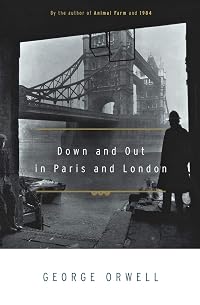
Down and Out in Paris and London
by George Orwell 
On This Page
Description
Orwell's own experiences inspire this semi-autobiographical novel about a man living in Paris in the early 1930s without a penny. The narrator's poverty brings him into contact with strange incidents and characters, which he manages to chronicle with great sensitivity and graphic power. The latter half of the book takes the English narrator to his home city, London, where the world of poverty is different in externals only. A socialist who believed that the lower classes were the wellspring show more of world reform, Orwell actually went to live among them in England and on the continent. His novel draws on his experiences of this world, from the bottom of the echelon in the kitchens of posh French restaurants to the free lodging houses, tramps, and street people of London. In the tales of both cities, we learn some sobering Orwellian truths about poverty and society. show lessTags
Recommendations


























Member Recommendations

WoodsieGirl I'd recommend reading both, just to see how little things change.
80



John_Vaughan On re-reading these two books it is hard to believe that these two works were written almost at the same time and about the same culture. One by Blair deliberatly self-impoverished, one by Morton - by car!

alv Orwell lives together with the lowest of the lowest in the Paris and London of the final 20s.
Walraff impersonates a turkish immigrant to the prosperous Federal Republic of Germany of the mid-80s.




WSB7 Contrasting life of the down and out at the same period of time in New Orleans.
Member Reviews
Orwell delves into the uncomfortable subject of poverty, but there's few you can trust as much as him to make the journey worthwhile. Initially he dodges homelessness but eventually falls prey and descends to the tramp life, the very lowest rung on the social ladder. His life at that point becomes merely existence, consumed by daily strategizing over how to find the next meal, the next bed. More often than not the food will be insufficient, the bed hardly better than sleeping on the ground. Fortunately he has a lifeline, a light at the end of the tunnel, which is more hope than his fellow travelers can rely on.
It's an extremely sympathetic portrayal of his fellows, a creditable job of portraying tramps as weakened by circumstance and show more not weak by nature. The stories he shares of their travails bear parallel echoes of the stories of life at any level - lucky moments, tragic setbacks, funny circumstance. Discomfort and indignities are the paramount differences around which tramp life revolves. There is still nobility, morality and brotherhood. As with every echelon, this one too has its social rules. Orwell learns the hard way what perfect honesty gets him, who he owes it to and who he does not. He also learns the vital importance of who you know, and who you trust.
Society's supports may differ today, but I can imagine the experience of subsistence is largely the same as what's described here from a hundred years ago. Orwell has some suggestions for how more comfort and dignity might be provided and it always begins with acknowledging the homeless as people like anyone else, desirous of living and thinking beyond just the moment. show less
It's an extremely sympathetic portrayal of his fellows, a creditable job of portraying tramps as weakened by circumstance and show more not weak by nature. The stories he shares of their travails bear parallel echoes of the stories of life at any level - lucky moments, tragic setbacks, funny circumstance. Discomfort and indignities are the paramount differences around which tramp life revolves. There is still nobility, morality and brotherhood. As with every echelon, this one too has its social rules. Orwell learns the hard way what perfect honesty gets him, who he owes it to and who he does not. He also learns the vital importance of who you know, and who you trust.
Society's supports may differ today, but I can imagine the experience of subsistence is largely the same as what's described here from a hundred years ago. Orwell has some suggestions for how more comfort and dignity might be provided and it always begins with acknowledging the homeless as people like anyone else, desirous of living and thinking beyond just the moment. show less
George Orwell went to Paris in February 1928. As usual, he travelled with very little money and few belongings. After a fellow lodger stole his money, it was time to find work. Although he had been making a little money as an English tutor, that work disappeared overnight when the student disappeared, leaving Orwell out of fifty francs.
Small articles were pawned, followed by clothing. The level of living accommodation deteriorated almost weekly as he moved from one boarding house to another. Enter Boris. Orwell portrays him as a former Russian cavalry officer, living in self imposed exile in Paris like so many other Russians. Boris persuaded Orwell that a Russian friend would be opening a restaurant soon, a place where they could both show more work as waiters and make a good living. Time passed, and little progress was made on the restaurant. The reader is left wondering whether Boris is yet another con man, or merely an eternal optimist.
In the meantime, Orwell took a job as a plongeur, a dishwasher at a fairly decent hotel catering mostly to well off Americans. What follows is a portrayal of life in such an environment, where the workers are little better than slaves, working seventeen hours a day under miserable conditions for wages so low it would be impossible to ever contemplate having a family, or a place of one’s own.
Eventually the Russian’s establishment opened, and Boris and Orwell started working there. Here it was even worse. Take the first two hours of the day:
Only another fifteen hours or so to go.
Orwell threw in the towel, borrowing money from a friend in England for his return fare and a job. However, once in England, he had to wait several weeks to start, leaving him once again short of money. He starting tramping. Vagrancy laws were such that they almost encouraged the practise. Men could not stay in the same hostel two nights in a row, and were forced to move on out of not only the hostel, but often the city in which it was located.
The conditions in a hostel conditions depended upon which agency was running it. There were certain similarities: a mug of tea and two to four slices of bread with margarine were given out at supper and breakfast at most of them, along with a chit for food along the way, which usually was enough for the same fare, only in a café. Sheets were always filthy, clothing and possessions were taken away for the night, and at some places you might actually be locked in a cell with a stranger in total darkness.
Orwell was sympathetic to the lives of the tramps, calling them useless lives at the mercy of government rules. He suggests perhaps allowing them to stay longer in one place, possibly working for their keep, but given that there were tens of thousands of them in England, arriving at a solution would be daunting indeed.
There is some discussion as to whether or not Orwell actually experienced the events he described. He says he did, but not necessarily in the order given, although the broad outline and dates are correct.
Ostensibly an account of life among the working poor and those living in poverty without work, there were two surprises here. One was that a man with such strong empathy for these groups would hold other, non class based, strong prejudices against various groups on his periphery. The other was the raconteur - like telling of his time in Paris and London. I had expected more outright political opinion, but this works just as well.
Turned down twice for publication before Victor Gollancz, then a new publisher agreed to take him on. Gollancz removed some of the saltier language, leaving dashes instead. The writer, whose real name was Eric Blair, used the name George Orwell for the first time. My Penguin Modern Classics edition from a 1966 reprinting has a note from Gollancz saying:
As for Orwell, his closing remarks were: I shall never again think that all tramps are drunken scoundrels, nor expect a beggar to be grateful when I give him a penny, nor be surprised if men out of work lack energy, nor subscribe to the Salvation Army, nor pawn my clothes, nor refuse a handbill, nor enjoy a meal at a smart restaurant. That is a beginning. show less
Small articles were pawned, followed by clothing. The level of living accommodation deteriorated almost weekly as he moved from one boarding house to another. Enter Boris. Orwell portrays him as a former Russian cavalry officer, living in self imposed exile in Paris like so many other Russians. Boris persuaded Orwell that a Russian friend would be opening a restaurant soon, a place where they could both show more work as waiters and make a good living. Time passed, and little progress was made on the restaurant. The reader is left wondering whether Boris is yet another con man, or merely an eternal optimist.
In the meantime, Orwell took a job as a plongeur, a dishwasher at a fairly decent hotel catering mostly to well off Americans. What follows is a portrayal of life in such an environment, where the workers are little better than slaves, working seventeen hours a day under miserable conditions for wages so low it would be impossible to ever contemplate having a family, or a place of one’s own.
Eventually the Russian’s establishment opened, and Boris and Orwell started working there. Here it was even worse. Take the first two hours of the day:
Every morning at six I drove myself out of bed, did not shave, sometimes washed, hurried up to the Place d’Italie and fought for a place on the Métro. By seven I was in the desolation of the cold, filthy kitchen, with the potato skins and bones and fishtails littered on the floor, and a pile of plates, stuck together in their grease, waiting from overnight. I could not start on the plates yet because the water was cold, and I had to fetch milk and make coffee, for the others arrived at eight and expected to find coffee ready. Also, there were always several copper saucepans to clean. These pans are the bane of a plongeur’s life. They have to be scoured with sand and bunches of chains, ten minutes to each one, and then polished on the outside with Brasso.
Only another fifteen hours or so to go.
Orwell threw in the towel, borrowing money from a friend in England for his return fare and a job. However, once in England, he had to wait several weeks to start, leaving him once again short of money. He starting tramping. Vagrancy laws were such that they almost encouraged the practise. Men could not stay in the same hostel two nights in a row, and were forced to move on out of not only the hostel, but often the city in which it was located.
The conditions in a hostel conditions depended upon which agency was running it. There were certain similarities: a mug of tea and two to four slices of bread with margarine were given out at supper and breakfast at most of them, along with a chit for food along the way, which usually was enough for the same fare, only in a café. Sheets were always filthy, clothing and possessions were taken away for the night, and at some places you might actually be locked in a cell with a stranger in total darkness.
Orwell was sympathetic to the lives of the tramps, calling them useless lives at the mercy of government rules. He suggests perhaps allowing them to stay longer in one place, possibly working for their keep, but given that there were tens of thousands of them in England, arriving at a solution would be daunting indeed.
There is some discussion as to whether or not Orwell actually experienced the events he described. He says he did, but not necessarily in the order given, although the broad outline and dates are correct.
Ostensibly an account of life among the working poor and those living in poverty without work, there were two surprises here. One was that a man with such strong empathy for these groups would hold other, non class based, strong prejudices against various groups on his periphery. The other was the raconteur - like telling of his time in Paris and London. I had expected more outright political opinion, but this works just as well.
Turned down twice for publication before Victor Gollancz, then a new publisher agreed to take him on. Gollancz removed some of the saltier language, leaving dashes instead. The writer, whose real name was Eric Blair, used the name George Orwell for the first time. My Penguin Modern Classics edition from a 1966 reprinting has a note from Gollancz saying:
The blanks in this passage appeared in the original edition, which I had the pleasure of publishing. The text cannot now be debowdlerized, for the manuscript and the original proofs have disappeared. The words written by George Orwell were doubtless of a kind that no publisher could have printed at that time without risking gaol; and even if he had decided to risk it, no printer would have abetted him.
As for Orwell, his closing remarks were: I shall never again think that all tramps are drunken scoundrels, nor expect a beggar to be grateful when I give him a penny, nor be surprised if men out of work lack energy, nor subscribe to the Salvation Army, nor pawn my clothes, nor refuse a handbill, nor enjoy a meal at a smart restaurant. That is a beginning. show less
In one sense an easy read, in that the narrative sweeps the reader along: in another, difficult, because the story, describing conditions of brutal poverty as a 'plongeur' in a Paris hotel kitchen, then as an English tramp in southern England is unappetising in the extreme. The diary-like narrative is interspersed with anecdotes from the lives of other characters, such as his Russian friend Boris, and with more political reflections to make a striking and unforgettable short book. Not to be read before going out to a restaurant for dinner....
Down and Out in Paris and London is not a novel ... it’s a searing autopsy of dignity. Orwell drags you by the throat into the bowels of human existence, where grease coats your lungs, your stomach gnaws itself from hunger, and the stench of unwashed humanity clings like a curse you can’t scrub off.
Forget the polite image of “living rough.” This is the real thing: lice, filth, starvation, humiliation ... the slow rot of a man who’s become invisible. Orwell doesn’t romanticize poverty; he vivisects it. He shows you how despair isn’t loud or tragic ... it’s tedious, monotonous, and smells of cold cabbage water and damp wool.
His time in the Paris kitchens is a nightmare of futility ... endless piles of filthy plates, show more scalding water, and the hiss of oil so thick with grime you feel slimy just reading the words. Then London arrives like a wet slap ... the soup kitchens, the tramps shuffling from workhouse to workhouse, the cold so deep it seeps into your thoughts. It’s not just poverty you feel ... it’s degradation made tangible, a slow suffocation of spirit.
I read this book as a lazy, cocky young man and it scared the hell out of me. It was the slap I needed. I could smell the rot in those pages, taste the bitterness, and I swore I’d never, ever let myself fall into that kind of oblivion. Orwell made the struggle real and made me get off my ass and do something about it.
This isn’t literature to admire. It’s literature to endure. It doesn’t entertain; it haunts. You don’t finish it clean. You finish it grateful. For anyone who's ever thought about living hard just to experience that existence, read this ... and take the better road. show less
Forget the polite image of “living rough.” This is the real thing: lice, filth, starvation, humiliation ... the slow rot of a man who’s become invisible. Orwell doesn’t romanticize poverty; he vivisects it. He shows you how despair isn’t loud or tragic ... it’s tedious, monotonous, and smells of cold cabbage water and damp wool.
His time in the Paris kitchens is a nightmare of futility ... endless piles of filthy plates, show more scalding water, and the hiss of oil so thick with grime you feel slimy just reading the words. Then London arrives like a wet slap ... the soup kitchens, the tramps shuffling from workhouse to workhouse, the cold so deep it seeps into your thoughts. It’s not just poverty you feel ... it’s degradation made tangible, a slow suffocation of spirit.
I read this book as a lazy, cocky young man and it scared the hell out of me. It was the slap I needed. I could smell the rot in those pages, taste the bitterness, and I swore I’d never, ever let myself fall into that kind of oblivion. Orwell made the struggle real and made me get off my ass and do something about it.
This isn’t literature to admire. It’s literature to endure. It doesn’t entertain; it haunts. You don’t finish it clean. You finish it grateful. For anyone who's ever thought about living hard just to experience that existence, read this ... and take the better road. show less
This is Orwell’s famous description of his experiences living hand to mouth for a time as a young man in the late 1920s, providing evocative descriptions of poverty in both cities. This was the first book published under his Orwell pseudonym, in 1930. He was not actually “down and out” as such in Paris, as he lived in rented accommodation while unemployed, then working first in a hotel and then in a newly opened restaurant, as a dishwasher. He describes the punishingly long hours he works at this task (17 and a half hours a day at one point, from 7am to 12.30 am the following day, plus a commute each way to his lodging). But even this is better than the hunger he had experienced beforehand and which he vividly describes that it show more “reduces one to an utterly spineless, brainless condition, more like the after-effects of influenza than anything else. It is as though one had been turned into a jellyfish, or as though all one’s blood had been pumped out and lukewarm water substituted. Complete inertia is my chief memory of hunger; that, and being obliged to spit very frequently, and the spittle being curiously white and flocculent, like cuckoo-spit. I do not know the reason for this but everyone who has gone hungry several days has noticed it.”
Owing to a friend’s generosity in paying his passage back to England, he lands up back in London, but a promised job is delayed and he once again falls on hard times. Here he tramps from “spike” to “spike” (temporary accommodation attached to workhouses), to stay for the permitted one night only in each place, often in the company of an Irish tramp predictably called Paddy. As well as the poverty, the monotony comes across too - the malnutrition caused by the constant diet of just tea, bread and margarine, staying in bleak and often cold and noisy cells or dormitories, with unhealthy, dirty and wretched men (there are very few female tramps). For Orwell, of course, unlike most of the others, this period of time has a finite length and at the end of the book he reflects on the nature, causes of, and prejudices against vagrancy and how they might be addressed. show less
Owing to a friend’s generosity in paying his passage back to England, he lands up back in London, but a promised job is delayed and he once again falls on hard times. Here he tramps from “spike” to “spike” (temporary accommodation attached to workhouses), to stay for the permitted one night only in each place, often in the company of an Irish tramp predictably called Paddy. As well as the poverty, the monotony comes across too - the malnutrition caused by the constant diet of just tea, bread and margarine, staying in bleak and often cold and noisy cells or dormitories, with unhealthy, dirty and wretched men (there are very few female tramps). For Orwell, of course, unlike most of the others, this period of time has a finite length and at the end of the book he reflects on the nature, causes of, and prejudices against vagrancy and how they might be addressed. show less
"There is such a hopelessness about some of the people there – decent, broken-down types who have pawned their collars but are still trying for office jobs." (pg. 157)
A lucid and candid piece of reportage by George Orwell on the homeless, disenfranchised, jobless and unlucky denizens of our whited sepulchre of a society. His journalistic approach is less honed than it would become in his timeless polemic The Road to Wigan Pier, but this is still a remarkable piece, and one that remains, unfortunately, quite contemporary. We might not know what shillings and d are nowadays, but there are plenty who know, coldly, what it means to be absolutely wretched and discarded: to be condemned to a maddening "enforced idleness" (pg. 182) and live show more "no freer than if he were bought and sold. His work is servile and without art; he is paid just enough to keep him alive; his only holiday is the sack. He is cut off from marriage, or, if he marries, his wife must work too. Except by a lucky chance, he has no escape from this life, save into prison. At this moment there are men with university degrees scrubbing dishes in Paris for ten or fifteen hours a day. One cannot say that it is mere idleness on their part… they have simply been trapped by a routine which makes thought impossible." (pg. 117)
Ennui is a difficult thing to write about, because in order to evoke it honestly you need to bore the reader somewhat. Orwell gets a good balance between representing the dreariness and reviving the reader, largely because his prose is stellar. The book could perhaps have been better in providing a narrative, or in bringing out the characters among the down-and-outs (as John Steinbeck was soon to do in his writing; only Bozo in Orwell's book meets this standard). Nevertheless, Orwell is a sympathetic witness to the shameful rut these people endure; this is not poverty porn, and Orwell shows us that they retain their dignity and their humanity. Rather, the flaw of the book is not in any of its content but in its essential futility; it's not that people don't recognise the humanity of the down-and-outs, but that they don't want to. There are among us many dogs who have developed a taste for dog, and many rats who will eat anything, and for all those compassionate people like Orwell, or even those who recognise the validity of the phrase 'there but for the grace of God go I', there are countless multiples of that number who prefer exploitation and cruelty towards those who are struggling, the better to advance themselves, and can perform it without penalty, and often with great reward. The problem is not in the calibre of those who are down and out, but in the calibre of those who are thriving. show less
A lucid and candid piece of reportage by George Orwell on the homeless, disenfranchised, jobless and unlucky denizens of our whited sepulchre of a society. His journalistic approach is less honed than it would become in his timeless polemic The Road to Wigan Pier, but this is still a remarkable piece, and one that remains, unfortunately, quite contemporary. We might not know what shillings and d are nowadays, but there are plenty who know, coldly, what it means to be absolutely wretched and discarded: to be condemned to a maddening "enforced idleness" (pg. 182) and live show more "no freer than if he were bought and sold. His work is servile and without art; he is paid just enough to keep him alive; his only holiday is the sack. He is cut off from marriage, or, if he marries, his wife must work too. Except by a lucky chance, he has no escape from this life, save into prison. At this moment there are men with university degrees scrubbing dishes in Paris for ten or fifteen hours a day. One cannot say that it is mere idleness on their part… they have simply been trapped by a routine which makes thought impossible." (pg. 117)
Ennui is a difficult thing to write about, because in order to evoke it honestly you need to bore the reader somewhat. Orwell gets a good balance between representing the dreariness and reviving the reader, largely because his prose is stellar. The book could perhaps have been better in providing a narrative, or in bringing out the characters among the down-and-outs (as John Steinbeck was soon to do in his writing; only Bozo in Orwell's book meets this standard). Nevertheless, Orwell is a sympathetic witness to the shameful rut these people endure; this is not poverty porn, and Orwell shows us that they retain their dignity and their humanity. Rather, the flaw of the book is not in any of its content but in its essential futility; it's not that people don't recognise the humanity of the down-and-outs, but that they don't want to. There are among us many dogs who have developed a taste for dog, and many rats who will eat anything, and for all those compassionate people like Orwell, or even those who recognise the validity of the phrase 'there but for the grace of God go I', there are countless multiples of that number who prefer exploitation and cruelty towards those who are struggling, the better to advance themselves, and can perform it without penalty, and often with great reward. The problem is not in the calibre of those who are down and out, but in the calibre of those who are thriving. show less
George Orwell writes an autobiographical yet fictionalized account of living in poverty in two great European cities. One gets the sense that Orwell is looking at the situation as an outsider, someone who knows he will not always live in poverty, yet its not false in that he really is living in poverty at the time. Much of the book describes survival techniques trying to scrape together a life on a low rung of Paris’ hotel caste system and later tramping about London’s suburbs to keep a step ahead of the ridiculous vagrancy laws. Through all this his keen mind works making discoveries and proposing solutions to the problems that plague millions throughout their lives.
“It is altogether curious, your first contact with poverty. You show more have thought so much about poverty – it is the thing you feared all your life, the thing you knew would happen sooner or later; and it is all so utterly and prosaically different. You thought it would be quite simple; it is extraordinarily complicated. You thought it would be terrible; it is merely squalid and boring. It is the peculiar lowness of poverty that you discover first; the shifts that it puts you to, the complicated meanness, the crust-wiping.” (p. 17)
“It does not matter whether his work is needed or not, he must work, because work in itself is good – for slaves, at least. This sentiment still survives, and it has piled up mountains of useless drudgery. I believe that the instinct to perpetuate useless work is, at bottom, simply fear of the mob. The mob (the thought runs) are such low animals that they would be dangerous if they had leisure; it is safer to keep them too busy to think.” (p. 119)
“Why are beggars despised? – for they are despised, universally. I believe it is for the simple reason that they fail to earn a decent living. In practice nobody cares whether work is useful or useless, productive or parasitic; the sole thin demanded is that it shall be profitable … Money has become the grand test of virtue. By this test, beggars fail, and for this they are despised … A beggar, looked at realistically, is simply a business man, getting his living, like other business men, in the way that comes to hand. He has not, more than most modern people, sold his honour; he has merely made the mistake of choosing a trade at which it is impossible to grow rich.” (p. 174)
“Of its very nature swearing is irrational as magic – indeed, it is a species of magic. But there is also a paradox about it, namely this: Our intention in swearing is to shock and wound, which we do by mentioning something that should be kept secret … But the strange thing is that when a word is well established as a swear word, it seems to list its original meaning; that is, it loses the thing that made it a swear word. A word becomes an oath because it means a certain thing, and, because it has become an oath, it ceases to mean that thing.” (p. 177)
“It is curious how people take it for granted that they have a right to preach at you and pray over you as soon as your income falls below a certain level.” (p. 181) show less
“It is altogether curious, your first contact with poverty. You show more have thought so much about poverty – it is the thing you feared all your life, the thing you knew would happen sooner or later; and it is all so utterly and prosaically different. You thought it would be quite simple; it is extraordinarily complicated. You thought it would be terrible; it is merely squalid and boring. It is the peculiar lowness of poverty that you discover first; the shifts that it puts you to, the complicated meanness, the crust-wiping.” (p. 17)
“It does not matter whether his work is needed or not, he must work, because work in itself is good – for slaves, at least. This sentiment still survives, and it has piled up mountains of useless drudgery. I believe that the instinct to perpetuate useless work is, at bottom, simply fear of the mob. The mob (the thought runs) are such low animals that they would be dangerous if they had leisure; it is safer to keep them too busy to think.” (p. 119)
“Why are beggars despised? – for they are despised, universally. I believe it is for the simple reason that they fail to earn a decent living. In practice nobody cares whether work is useful or useless, productive or parasitic; the sole thin demanded is that it shall be profitable … Money has become the grand test of virtue. By this test, beggars fail, and for this they are despised … A beggar, looked at realistically, is simply a business man, getting his living, like other business men, in the way that comes to hand. He has not, more than most modern people, sold his honour; he has merely made the mistake of choosing a trade at which it is impossible to grow rich.” (p. 174)
“Of its very nature swearing is irrational as magic – indeed, it is a species of magic. But there is also a paradox about it, namely this: Our intention in swearing is to shock and wound, which we do by mentioning something that should be kept secret … But the strange thing is that when a word is well established as a swear word, it seems to list its original meaning; that is, it loses the thing that made it a swear word. A word becomes an oath because it means a certain thing, and, because it has become an oath, it ceases to mean that thing.” (p. 177)
“It is curious how people take it for granted that they have a right to preach at you and pray over you as soon as your income falls below a certain level.” (p. 181) show less
Members
- Recently Added By
Lists

1001 Books You Must Read Before You Die
1,448 works; 1,137 members

Best Autobiographies and Memoirs
370 works; 67 members

Really Good Narrative Non-Fiction
65 works; 24 members

Best "Foodie" Books
114 works; 40 members
501 Must-Read Books
529 works; 72 members

Memoirs - Mary Karr
14 works; 1 member

20th Century Literature
1,161 works; 55 members

Recommend the 20 best books you've read in the last five years
2,168 works; 603 members

Books Read in 2026
2,133 works; 70 members

Novels with a city or town in the title
61 works; 1 member

Wishlist
4 works; 1 member
Reading LIst
648 works; 1 member

Non-Fiction
68 works; 1 member

Books Read in 2024
4,727 works; 128 members

One Book, Many Authors
441 works; 40 members

Books Read in 2022
5,226 works; 115 members

Fiction about the Working Class
74 works; 10 members

1930s
262 works; 5 members

Books Read in 2019
4,052 works; 110 members

Read This Next
120 works; 3 members

Books
85 works; 1 member

Unread books
1,063 works; 87 members

Best books set in London
26 works; 1 member

Books Read By artturnerjr - 2017
7 works; 1 member

Books Read in 2016
4,666 works; 199 members

stories at work
43 works; 7 members
Books Read in 2015
3,299 works; 129 members

Puffin Books 70th anniversary handbook recommendations
537 works; 10 members

Literary Works Read in College
316 works; 15 members

Paris, City of Lights
103 works; 17 members

Perspectives Book Club Picks
49 works; 3 members

Books With Place Names in the Title
315 works; 12 members

LT picks: Blue Books
197 works; 44 members
Author Information

370+ Works 222,168 Members
George Orwell was born Eric Arthur Blair on June 25, 1903 in Motihari in Bengal, India and later studied at Eton College for four years. He was an assistant superintendent with the Indian Imperial Police in Burma. He left that position after five years and moved to Paris, where he wrote his first two books: Burmese Days and Down and Out in Paris show more and London. He then moved to Spain to write but decided to join the United Workers Marxist Party Militia. After being decidedly opposed to communism, he served in the British Home Guard and with the Indian Service of the BBC during World War II. After the war, he wrote for the Observer and was literary editor for the Tribune. His best known works are Animal Farm and 1984. His other works include A Clergyman's Daughter, Keep the Aspidistra Flying, The Road to Wigan Pier, Homage to Catalonia, and Coming Up for Air. He died on January 21, 1950 at the age of 46. (Bowker Author Biography) show less
George Orwell has a Legacy Library. Legacy libraries are the personal libraries of famous readers, entered by LibraryThing members from the Legacy Libraries group.
Some Editions
Awards and Honors
Notable Lists
Series
Belongs to Publisher Series
Work Relationships
Is contained in
Has as a reference guide/companion
Common Knowledge
- Canonical title*
- Aan de grond in Londen en Parijs
- Original title
- Down and Out in Paris and London
- Original publication date
- 1933
- People/Characters
- George Orwell; Boris; Paddy
- Important places
- London, England, UK; Paris, France
- Epigraph
- O scathful harm, condition of poverte!
—Chaucer - First words
- The Rue du Coq d'Or, Paris, seven in the morning. A succession of furious, choking yells from the street. Madame Monce, who kept the little hotel opposite mine, had come out on to the pavement to address a lodger on the third... (show all) floor.
- Quotations
- [Chapter 30]
The next morning we began looking once more for Paddy's friend, who was called Bozo, and was a screever—that is, a pavement artist. . . . He was an embittered atheist (the sort of atheist who does not so... (show all) much disbelieve in God as personally dislike Him), and took a sort of pleasure in thinking that human affairs would never improve. - Last words
- (Click to show. Warning: May contain spoilers.)I shall never again think that all tramps are drunken scoundrels, nor expect a beggar to be grateful when I give him a penny, nor be surprised if men out of work lack energy, nor subscribe to the Salvation Army, nor pawn my clothes, nor refuse a handbill, nor enjoy a meal at a smart restaurant. This is a beginning.
- Blurbers
- Mortimer, John
- Original language
- English UK
*Some information comes from Common Knowledge in other languages. Click "Edit" for more information.
Classifications
- Genre
- Biography & Memoir
- DDC/MDS
- 914.436 — History & geography Geography & travel Geography of and travel in Europe France and Monaco Grand Est and Ile-de-France Île-de-France; Paris metropolitan area, River Seine
- LCC
- DC715 .O7 — History of Europe, Asia, Africa and Oceania France – Andorra – Monaco History of France Local history and description Paris
- BISAC
Statistics
- Members
- 8,778
- Popularity
- 1,249
- Reviews
- 152
- Rating
- (4.04)
- Languages
- 25 — Basque, Catalan, Chinese, Czech, Danish, Dutch, English, Estonian, Finnish, French, German, Hebrew, Hungarian, Icelandic, Italian, Japanese, Lithuanian, Norwegian (Bokmål), Farsi/Persian, Polish, Romanian, Spanish, Swedish, Turkish, Portuguese (Portugal)
- Media
- Paper, Audiobook, Ebook
- ISBNs
- 162
- ASINs
- 81