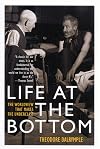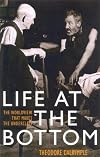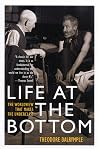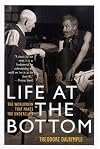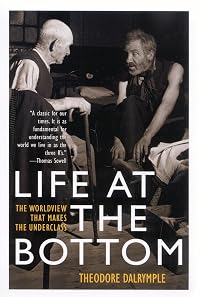
Life at the Bottom : The Worldview that Makes the Underclass
by Theodore Dalrymple
On This Page
Description
Here is a searing account-probably the best yet published-of life in the underclass and why it persists as it does. Theodore Dalrymple, a British psychiatrist who treats the poor in a slum hospital and a prison in England, has seemingly seen it all. Yet in listening to and observing his patients, he is continually astonished by the latest twist of depravity that exceeds even his own considerable experience. Dalrymple's key insight in Life at the Bottom is that long-term poverty is caused not show more by economics but by a dysfunctional set of values, one that is continually reinforced by an elite culture searching for victims. This culture persuades those at the bottom that they have no responsibility for their actions and are not the molders of their own lives. Drawn from the pages of the cutting-edge political and cultural quarterly City Journal, Dalrymple's book draws upon scores of eye-opening, true-life vignettes that are by turns hilariously funny, chillingly horrifying, and all too revealing-sometimes all at once. And Dalrymple writes in prose that transcends journalism and achieves the quality of literature. show lessTags
Recommendations














Member Recommendations


Member Reviews
Hard to say that I /enjoyed/ this. It's really quite sad (and in some cases disturbing - read at your own risk if you're sensitive to suffering and cruelty). That said, it inspired me to continue to do my best to live as a good and decent person and to raise my children the same way. Our world seems to be growing more mad by the day. It's strange to remember that this book was written back in the late 90's and early 2000s!
Overall, I wish the author had given a bit more named credit to the worldview that made Britain (Christianity. It was Christianity) rather than just lamenting that it was lost.
Still, an excellent read.
"The idea that it is possible to base a society on no cultural or philosophical presuppositions at all, or, show more alternatively, that all such presuppositions may be treated equally so that no choice has to be made between them, is absurd." show less
Overall, I wish the author had given a bit more named credit to the worldview that made Britain (Christianity. It was Christianity) rather than just lamenting that it was lost.
Still, an excellent read.
"The idea that it is possible to base a society on no cultural or philosophical presuppositions at all, or, show more alternatively, that all such presuppositions may be treated equally so that no choice has to be made between them, is absurd." show less
Nothing I write here is going to do this book justice. It's one of the best collections of essays I've ever read, and one that I forced myself to read slowly so as not to glut on them. It's also the most depressing book ever written. Its subject: "the baleful influence of bad ideas." One can perform the random page test and find perfect sentences one after the other. Dalrymple also demonstrates, over and over, his genuine compassion for those whom the intelligentsia claim to defend, as well as those whose lives have been ruined by policies and cultural trends. This makes the book sound like a political-science, wonkish collection, but it's not: almost every essay begins with a scene in a hospital or prison from which Dalrymple show more extrapolates an observation about the contemporary scene. Don't even listen to me: it's just great writing, period.
Have I mentioned that this really impressed me? show less
Have I mentioned that this really impressed me? show less
Nothing analy retentive here. Its about 40 years of fashionably open sphincters leaving the Western world covered in mountains of immovable sh..t.
The reader can choose between broken marriages (too restrictive), abandoned children (society's responsibility), violent crime (society's fault), worthless schooling (bricks in the wall), feeble policing (criminals as victims), easy welfare (automatic rights) etc. etc. with Dalrymple using an anecdotal format to illustrate his lifetimes professional experience of the British underclass.
When even the British prime minister and German chancellor admit that multiculturalism has failed, then the edifice of political correctness is showing some cracks but the author doesn't suggest how it can be show more demolished or the way in which personal responsibility can be returned to the millions of people who don't want it and have never experienced it.
The state continues take more taxes and remove more personal responsibility enhancing the parent / child relationship between state and citizen so a clear change of direction in welfare psychology appears to be someway down the road.
I would easily have given the book 5 stars if Dalrymple had provided some kind of map to the reconstruction of Western society, but in its absence I would suppose that the old Hippies will never change and finally be replaced with a new generation/ideas in the same way that the old Stalinists of Russia are fading away.
An unfortunate complication that he doesn't mention is that these clowns have saddled the new generation with mountains of debt allowing them to consume now while their children pay later (if they can - their jobs have been exported to Asia). show less
The reader can choose between broken marriages (too restrictive), abandoned children (society's responsibility), violent crime (society's fault), worthless schooling (bricks in the wall), feeble policing (criminals as victims), easy welfare (automatic rights) etc. etc. with Dalrymple using an anecdotal format to illustrate his lifetimes professional experience of the British underclass.
When even the British prime minister and German chancellor admit that multiculturalism has failed, then the edifice of political correctness is showing some cracks but the author doesn't suggest how it can be show more demolished or the way in which personal responsibility can be returned to the millions of people who don't want it and have never experienced it.
The state continues take more taxes and remove more personal responsibility enhancing the parent / child relationship between state and citizen so a clear change of direction in welfare psychology appears to be someway down the road.
I would easily have given the book 5 stars if Dalrymple had provided some kind of map to the reconstruction of Western society, but in its absence I would suppose that the old Hippies will never change and finally be replaced with a new generation/ideas in the same way that the old Stalinists of Russia are fading away.
An unfortunate complication that he doesn't mention is that these clowns have saddled the new generation with mountains of debt allowing them to consume now while their children pay later (if they can - their jobs have been exported to Asia). show less
Like most of us, the author looks for evidence to back his already-entrenched views. And I don't agree with his already-entrenched views, so I find him fairly objectionable. I'm sure the reverse would apply. But it's an interesting book, and does shine a light on problems we usually ignore, and should not.
This book presents a clear and coherent description of some of the reasons that have led to the extensive and unnecessary social and criminal justice problems that exist in this country. It is indeed withering and relentless in its criticism of UK policy (or failure to implement it) and the prevailing liberalist dogma that is largely responsible for stifling or restricting serious debate in this area.
'Life at the Bottom' is very well written with an abundance of black humour - it is polemical but most of the logic is faultless. Highly recommended.
'Life at the Bottom' is very well written with an abundance of black humour - it is polemical but most of the logic is faultless. Highly recommended.
Lots of food for thought in this series of essays on poverty and the underclass in Britain. His ideas could cover any western country, including Australia. Theodore Dalrymple is a doctor and columnist. He has a weekly column in the London Spectator, in which he specialises in skewering sacred cows, especially those held by the so-called chattering classes. But it's not as if he is talking through his hat - as a doctor he has worked with many underprivileged communities, both in England and Africa.
Авторът е британски лекар психиатър (вече възрастен), който прекарва живота си в работа в болница в едно от лондонските гета и в близкия затвор. В тази книга той описва живота на хората на дъното на обществото и тяхното виждане за света, което ги държи там въпреки всяческите усилия на правителство и организации да им помогнат.
Книгата е хубава, с много примери от практиката на автора и много зрънца мъдрост, show more които ми се ще да закача на стената на Българския хелзинкски комитет (не, че от това ще им дойде акъла на БХК), но поради честото и натрапчиво морализаторстване (сигурно е от възрастта на Далримпъл) в анти-ляв дух, е според мен практически нечитаема за който и да е, освен за тия, които ги знаят вече или поне ги подозират тия работи - т.е. тия които има нужда да ги прочетат и разберат никога няма да го направят и ще я оставят след втората страница, определяйки я за прекалено едностранчива. show less
Книгата е хубава, с много примери от практиката на автора и много зрънца мъдрост, show more които ми се ще да закача на стената на Българския хелзинкски комитет (не, че от това ще им дойде акъла на БХК), но поради честото и натрапчиво морализаторстване (сигурно е от възрастта на Далримпъл) в анти-ляв дух, е според мен практически нечитаема за който и да е, освен за тия, които ги знаят вече или поне ги подозират тия работи - т.е. тия които има нужда да ги прочетат и разберат никога няма да го направят и ще я оставят след втората страница, определяйки я за прекалено едностранчива. show less
Members
- Recently Added By
Lists

Jordan B. Peterson's Recommended Books
104 works; 5 members
Author Information

62+ Works 3,236 Members
Theodore Dalrymple is a physician and psychiatrist who practices in England. He writes a column for the London Spectator, contributes frequently to the Daily Telegraph, and is a contributing editor of the Manhattan's Institute's City Journal
Common Knowledge
- Canonical title
- Life at the Bottom : The Worldview that Makes the Underclass
- Original title
- Life at the Bottom : The Worldview that Makes the Underclass
- Original publication date
- 2001
- First words
- A specter is haunting the Western world: the underclass.
- Last words
- (Click to show. Warning: May contain spoilers.)Nero was a committed firefighter by comparison.
- Blurbers*
- Rutenfrans, Chris
*Some information comes from Common Knowledge in other languages. Click "Edit" for more information.
Classifications
Statistics
- Members
- 843
- Popularity
- 32,658
- Reviews
- 17
- Rating
- (4.02)
- Languages
- Dutch, English, Portuguese, Swedish
- Media
- Paper, Audiobook, Ebook
- ISBNs
- 8
- ASINs
- 6