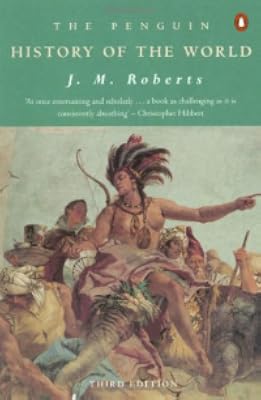
History of the World
by J. M. Roberts
On This Page
Description
In his monumental History of the World, J. M. Roberts delivered a powerful vision of human history as a story of change, a deliberate shaping of experience and environment. This revised and updated edition takes into account the great range of events and discoveries that have altered our views on everything from early civilizations to post-Cold War globalism. Large portions of the text have been rewritten. Roberts' view of history is exceptional in its global and comprehensive nature as it show more shows the development of different civilizations through the ages, from our origins on the African savannah to the modern world in the wake of the 2001 terrorist attacks. Like no other book, this History of the World succeeds in conveying the staggering diversity of the human experience. show lessTags
Recommendations














Member Reviews
How do you cover the history of the world in 1100 pages or so? By being very careful in what you cover of course.
The previous editions of J. M. Roberts's book had been around since 1976 (for the first edition) and had long be considered one of the better one volume histories out there. For the 6th edition Odd Arne Westad rewrites the first and last parts of the book (prehistory had changed a lot in the last decades and adding the collapse of USSR and its aftermath could not have been done earlier) and revised the rest. The result is an uptodate book (or mostly uptodate - things keep changing with new discoveries).
You will not find a list of battles here or a list of all the rulers of a country or an empire. You won't find the list of show more political entries in certain territories listed anywhere. The book starts with an introduction which is important - it tells you how the authors built the book and explain what you are about to read. It is all about influence - an empire existing for 300 years and leaving no traces in the history or culture of the area (or outside of it); a ruler who was there for 10 years and conquered everyone will get more space than that empire.
The book is not a political history or a cultural history; neither it is the history of the English speaking world. If one believes their country to be considered the best in the world, they will get disappointed - while some countries have outsized influence, they are not the only ones covered and they are not just praised (looking at the British) and Americans may be a bit disappointed that until the very last section, USA is pretty much ignored - and even there, it is its foreign influence that matters so it is not that prominent.
It sounds almost disjointed in parts, it feels like it omits too much and covers weird things in detail but it all adds up to a narrative history that works. It has a lot of maps but I wish that there were a lot more (and even an Atlas to accompany it - with maps of the different areas in different times). It also can make you laugh in places - for example when the Portuguese and the Spanish split the known world between each other, the Pope agreed, all was going well and then a Portuguese ship swings too wide on the way back from Asia to work around some winds and hits land - and Brazil's history is changed forever. The way it is written is almost like an old joke - with a pun line and all. The serious and the curious coexist and the analysis added allows for connections to be seen where they are almost hidden.
It is not easy to summarize a history that usually takes 200 pages in a page (or less). Things need to be missed, priorities need to be set. And somehow it works here. It made me read more about a lot of times and places (and people and cultures) but it is a great overview. And thinking on what it covered, all the places and battles and people it actually covered, you wonder how exactly that happened on this number of pages. It is a dense text, it requires attention and the more you know about the history of the places and times you are reading about, the more you will see in these sections. I suspect I will be returning to this book over and over.
It is a narrative history - it flows as one story, parts relies on what you already read about before. While different sections can be read on their own, you will miss a lot if you do not keep what was already said in mind. The important comparisons and connections are spelled out but the details are not.
If you are looking for a one volume history of the world and you can read dense texts, this is a marvelous choice - although it requires a lot of patience and focus. show less
The previous editions of J. M. Roberts's book had been around since 1976 (for the first edition) and had long be considered one of the better one volume histories out there. For the 6th edition Odd Arne Westad rewrites the first and last parts of the book (prehistory had changed a lot in the last decades and adding the collapse of USSR and its aftermath could not have been done earlier) and revised the rest. The result is an uptodate book (or mostly uptodate - things keep changing with new discoveries).
You will not find a list of battles here or a list of all the rulers of a country or an empire. You won't find the list of show more political entries in certain territories listed anywhere. The book starts with an introduction which is important - it tells you how the authors built the book and explain what you are about to read. It is all about influence - an empire existing for 300 years and leaving no traces in the history or culture of the area (or outside of it); a ruler who was there for 10 years and conquered everyone will get more space than that empire.
The book is not a political history or a cultural history; neither it is the history of the English speaking world. If one believes their country to be considered the best in the world, they will get disappointed - while some countries have outsized influence, they are not the only ones covered and they are not just praised (looking at the British) and Americans may be a bit disappointed that until the very last section, USA is pretty much ignored - and even there, it is its foreign influence that matters so it is not that prominent.
It sounds almost disjointed in parts, it feels like it omits too much and covers weird things in detail but it all adds up to a narrative history that works. It has a lot of maps but I wish that there were a lot more (and even an Atlas to accompany it - with maps of the different areas in different times). It also can make you laugh in places - for example when the Portuguese and the Spanish split the known world between each other, the Pope agreed, all was going well and then a Portuguese ship swings too wide on the way back from Asia to work around some winds and hits land - and Brazil's history is changed forever. The way it is written is almost like an old joke - with a pun line and all. The serious and the curious coexist and the analysis added allows for connections to be seen where they are almost hidden.
It is not easy to summarize a history that usually takes 200 pages in a page (or less). Things need to be missed, priorities need to be set. And somehow it works here. It made me read more about a lot of times and places (and people and cultures) but it is a great overview. And thinking on what it covered, all the places and battles and people it actually covered, you wonder how exactly that happened on this number of pages. It is a dense text, it requires attention and the more you know about the history of the places and times you are reading about, the more you will see in these sections. I suspect I will be returning to this book over and over.
It is a narrative history - it flows as one story, parts relies on what you already read about before. While different sections can be read on their own, you will miss a lot if you do not keep what was already said in mind. The important comparisons and connections are spelled out but the details are not.
If you are looking for a one volume history of the world and you can read dense texts, this is a marvelous choice - although it requires a lot of patience and focus. show less
Roberts is a master of the broad brush, managing to make world history a page-turner and 1200 pages seem like 300 (or so). Because the subject’s so large, it always feels like you’re moving at high speed and observing from high above. There’s little room for detail, but that’s the nature of world history. The beauty of it is that Roberts makes connections and observations of patterns, and we’re able to do the same, which wouldn’t be possible in a history of smaller scope with more detail (of course, we need both). One particularly valuable example is the context in which he places the American Revolution and subsequent US expansion. At the time, the revolution was a relatively small matter and Europe was focused on more show more important things. After the war, Britain controlled the seas and also controlled the territory north of the new nation. With a weak power (Spain) controlling much of the areas south and west, and with France checked by Britain in North America, the US was able to expand in an essentially invisible bubble of protection created by Britain. It was in Britain’s interests to let this weak little English-speaking upstart expand rather than allowing another European power to fill the relative void of North America (it doesn’t make it right, but one of the European powers would have done it if the US hadn’t). A little deflating for our national mythology, but isn’t that one of the purposes of history done well? show less
I have a copy of this tome on my shelves and decided a couple weeks ago to reread it. (Mine is the 1993 Oxford University Press Edition.) It's comprehensive, covering human prehistory to the 1990s. In summary, much of human events can be seen as one group of people trying to steal stuff from another group of people, killing a lot of them and exploiting the rest. Then, over time and distance, the pattern repeats with conqueror become conquered and so on. (Yeah, you probably already knew that, but this gives names and dates.)
It's not light reading. Literally. The hardcover edition I have has over 950 pages and the sucker is heavy. Trying to read it in bed can be a challenge. The prose tends to the verbose, and punctuation and word choice show more make it a tougher slog than it needs to be. At times, the narrator almost sounds like Yoda... Obscure, the words at times and commas it has few to clarify meaning that is intended. (That kind of stuff.) And there are a few typos. It could use another round of copy editing.
Still, as a single volume of history, it's a great informative source. It will stay on my shelf and I may reread it again. show less
It's not light reading. Literally. The hardcover edition I have has over 950 pages and the sucker is heavy. Trying to read it in bed can be a challenge. The prose tends to the verbose, and punctuation and word choice show more make it a tougher slog than it needs to be. At times, the narrator almost sounds like Yoda... Obscure, the words at times and commas it has few to clarify meaning that is intended. (That kind of stuff.) And there are a few typos. It could use another round of copy editing.
Still, as a single volume of history, it's a great informative source. It will stay on my shelf and I may reread it again. show less
This book should be consumed by any and everyone interested in history.No wait... by EVERYONE in the Whole Wide World! You need to get it into your system. The knowledge and understand reflected by Mr. Roberts is essential for understanding life on Earth. I'm not kidding. Mr Roberts has been called a "master of the broad brush stroke" and indeed he is! He is a genius at finding the important bits of history and connecting them in a way that is easy to understand without trivializing the realities. He understands history and relates his knowledge to you like some kindly uncle telling you a bedtime story. Hardly a date is mentioned. History is not just a collection of dates to be memorized. You cannot understand history without show more considering the people in it. Mr Roberts frequently shows how people of the past thought about (and dealt with) life, the world and humanity's place in it and how different their way was from what we think and feel now.
I have two editions of this opus. I was NOT impressed by the illustrated edition which I tried to read some years back. The pictures were too distracting. This edition, however, rolls on majestically like a mighty river continuously bringing nuggets of nutrients to fertilize the brain.
I find it to be perfect summer reading, far superior to any of the novels I've come across so far this summer. show less
I have two editions of this opus. I was NOT impressed by the illustrated edition which I tried to read some years back. The pictures were too distracting. This edition, however, rolls on majestically like a mighty river continuously bringing nuggets of nutrients to fertilize the brain.
I find it to be perfect summer reading, far superior to any of the novels I've come across so far this summer. show less
Imagine you're sitting by the fireplace with a stuffy historian, but you think, "Well, he's a scholar in his field, so I'm going to listen. Plus, I have to be here, since my class is forcing me to 'listen' to him."
He starts talking, nay, rambling, jumping from year to year, with run-on sentences, unclear subjects... Your confused look betrays you. He pauses momentarily to look down over his glasses and pipe and says, "I presume you already understand everything there is to know about world history, yes?" and without waiting for your answer, he continues his overview, emphasizing his contempt for Europe and America and for every past historical position ever taken. You discreetly pull out your phone and google everything he's saying, show more just so you can keep up. You feel like this fireplace chat (class) will never end.
That's what this book is like. show less
He starts talking, nay, rambling, jumping from year to year, with run-on sentences, unclear subjects... Your confused look betrays you. He pauses momentarily to look down over his glasses and pipe and says, "I presume you already understand everything there is to know about world history, yes?" and without waiting for your answer, he continues his overview, emphasizing his contempt for Europe and America and for every past historical position ever taken. You discreetly pull out your phone and google everything he's saying, show more just so you can keep up. You feel like this fireplace chat (class) will never end.
That's what this book is like. show less
Impressive Accomplishment, but Fundamentally Flawed: John Roberts' "History of the World" is an impressive tome that undertakes what many thought to be an impossible task: writing a single-volume history of the world from pre-human times until the present day. The result is not a book for those who lack either time or commitment. With 922 history-packed pages, "History of the World" is a book that cannot be read in any short amount of time.
However, I did have a couple of problems with Roberts' work. For one thing, Europe clearly occupies the central role in the narrative. The entire precolonial histories of India and China receive only 15 and 17 pages in this book, respectively. The mere 400 years of Western Europe's "Dark Ages" (AD700 show more - 1100) on the other hand, are discussed over 25 pages. While some amount of Eurocentrism in a historical work can be forgiven due to Europe's global domination in recent centuries, discrepancies such as this one seem excessive, to say the least. Roberts' book at its worst moments seems to be a history of Europe with occasional chapters on the rest of the world tossed in at the appropriate times, as opposed to a balanced history of the world.
I was also mildly irritated by some of the illustrations and maps which appear in the "History of the World." The artwork and photographs were generally related to the text, although they didn't add much to the narrative. Some, however, were completely random. Why would someone include Byzantine art with a discussion of Japan's Meiji Restoration? The maps were usually of decent quality, though many were cramped and hard to read. Some of these also appeared to be included in the book as afterthoughts. I'll supply one example: a map detailing the spread of Muslim rule in India accompanies a discussion of the Indian Mauryan Empire, which rose and fell centuries before the founding of Islam. Some readers may not be bothered by these rather slight annoyances; others may be irritated, as I was.
Ultimately, though, the central dilemma of Roberts' "History of the World" is its very nature. Trying to write a one-volume history of the world seems an act of almost foolhardy ambition. The end result packs in so much history that it is too imposing to be of use as an introductory reading, but at the same time is not able to go 'deep' enough to please history buffs (who will likely know most of what they read). To put it simply, I don't think that super-large one-volume histories are the best way to read (or write) history. Although Roberts' work is certainly impressive, I would recommend that readers seek out more in-depth works on more specific historical topics instead of devoting themselves to this "History of the World." Three stars. show less
However, I did have a couple of problems with Roberts' work. For one thing, Europe clearly occupies the central role in the narrative. The entire precolonial histories of India and China receive only 15 and 17 pages in this book, respectively. The mere 400 years of Western Europe's "Dark Ages" (AD700 show more - 1100) on the other hand, are discussed over 25 pages. While some amount of Eurocentrism in a historical work can be forgiven due to Europe's global domination in recent centuries, discrepancies such as this one seem excessive, to say the least. Roberts' book at its worst moments seems to be a history of Europe with occasional chapters on the rest of the world tossed in at the appropriate times, as opposed to a balanced history of the world.
I was also mildly irritated by some of the illustrations and maps which appear in the "History of the World." The artwork and photographs were generally related to the text, although they didn't add much to the narrative. Some, however, were completely random. Why would someone include Byzantine art with a discussion of Japan's Meiji Restoration? The maps were usually of decent quality, though many were cramped and hard to read. Some of these also appeared to be included in the book as afterthoughts. I'll supply one example: a map detailing the spread of Muslim rule in India accompanies a discussion of the Indian Mauryan Empire, which rose and fell centuries before the founding of Islam. Some readers may not be bothered by these rather slight annoyances; others may be irritated, as I was.
Ultimately, though, the central dilemma of Roberts' "History of the World" is its very nature. Trying to write a one-volume history of the world seems an act of almost foolhardy ambition. The end result packs in so much history that it is too imposing to be of use as an introductory reading, but at the same time is not able to go 'deep' enough to please history buffs (who will likely know most of what they read). To put it simply, I don't think that super-large one-volume histories are the best way to read (or write) history. Although Roberts' work is certainly impressive, I would recommend that readers seek out more in-depth works on more specific historical topics instead of devoting themselves to this "History of the World." Three stars. show less
Anyone fascinated by world history will be delighted with the appearance of a new edition of John Robert's History of the World. His ill health mentioned in the preface made it hard work, and his recent death confirms his prophesy that this will be the final edition of this successful book. Overall Roberts provides a great summation of world history, supplying a sweeping overview with perceptive insights, and avoiding the temptation to become enmeshed in encyclopedic detail. The themes he follows, those of change and continuity, the impetus of history and the relationship between tradition and innovation in human history are well chosen and help to find a context for this daunting subject. Additionally he makes relevant the weight of show more the past to present events (including a very good job of bringing the book right up to date with post-9/11 events). His overall perspective on history has changed surprisingly little over the years, perhaps because one of his basic philosophies is durable; "the two phenomena of inertia and innovation continue to operate in all historical developments ... we shall always find what happens both more, and less, surprising than we expect". Sounds like a bet both ways, however thinking about recent events it is quite plausable.
The book, it is freely acknowledged by Roberts, comes from a white, middle class western perspecive, however every edition finds him attempting to balance his global coverage further, as well as expanding the text to include more on gender issues and the environment. The thinness of material on non-Western cultures, such as Africa and Latin America is more related to knowledge than bias. He certainly has always argued strongly for the "European Age" since the age of exploration and I think he tends to overemphasise its influence on the world's population as a whole (important as it was). A little more material on imperialism from the subjects perspective might have helped, although don't get the impression that the book is a whitewash.
His prose is enjoyable, although his sentance structure could be improved at times, and the book provides a servicable set of maps.
Anyone who reads this book will certainly gain a comprehensive and valuable overview of the forces of the past that manifestly continue to shape the world today, and a fine insight into the way human societies and cultures work. show less
The book, it is freely acknowledged by Roberts, comes from a white, middle class western perspecive, however every edition finds him attempting to balance his global coverage further, as well as expanding the text to include more on gender issues and the environment. The thinness of material on non-Western cultures, such as Africa and Latin America is more related to knowledge than bias. He certainly has always argued strongly for the "European Age" since the age of exploration and I think he tends to overemphasise its influence on the world's population as a whole (important as it was). A little more material on imperialism from the subjects perspective might have helped, although don't get the impression that the book is a whitewash.
His prose is enjoyable, although his sentance structure could be improved at times, and the book provides a servicable set of maps.
Anyone who reads this book will certainly gain a comprehensive and valuable overview of the forces of the past that manifestly continue to shape the world today, and a fine insight into the way human societies and cultures work. show less
Members
- Recently Added By
Lists

r/History Recommended Reading List
603 works; 12 members

Will Durant's 100 Books: An Update
46 works; 4 members

My List
302 works; 1 member
Author Information

84+ Works 6,045 Members
Some Editions
Common Knowledge
- Original publication date
- 1976; 2013 (6th edition) (6th edition)
- First words
- Where does History begin?
- Last words
- (Click to show. Warning: May contain spoilers.)History, we must recognize, still clutters up our present and there is no sign that that will come to an end.
- Blurbers
- Sumption, Jonathan; Hibbert, Christopher; Taylor, A. J. P.; Plumb, J. H.
Classifications
Statistics
- Members
- 2,773
- Popularity
- 6,635
- Reviews
- 19
- Rating
- (3.86)
- Languages
- 8 — Chinese, Danish, Dutch, English, German, Greek, Italian, Spanish
- Media
- Paper, Audiobook, Ebook
- ISBNs
- 38
- UPCs
- 1
- ASINs
- 14