On This Page
Description
Fiction. Mystery. Suspense. Thriller. As any herpetologist will tell you, the fer-de-lance is among the most dreaded snakes known to man. When someone makes a present of one to Nero Wolfe, Archie Goodwin knows he's getting dreadfully close to solving the devilishly clever murders of an immigrant and a college president. As for Wolfe, he's playing snake charmer in a case with more twists than an anaconda—whistling a seductive tune he hopes will catch a killer who's still got poison in his show more heart. show lessTags
Recommendations




































Member Recommendations

LamontCranston Alex Benedict stays at home handling sales and research while Chase Kolpath is the leg (wo)man in the field
Member Reviews
This book is Exhibit A in the argument for not always starting to read a series with the first book. And yes, I usually do start with the first book when I can, and sometimes it's absolutely essential in order to fully appreciate how the characters evolve. But Stout's Nero Wolfe series of mysteries, which were written over a span of time between 1938 and 1975, are most certainly the exception that proves the rule.
That's due in large part to the way Stout structures the books. While the setting of each book reflects the time period in which it was written, the characters themselves — enormously sedentary detecting genius Nero Wolfe; his handsome, wisecracking, athletic assistant Archie Goodwin (swoon); live-in gourmet French chef show more Fritz; police nemeses Inspector Cramer and Sergeant Stebbins; newspaperman Lon Cohen — never change. They remain the same ages and personalities from the first book to the last, with only minor exceptions. Wolfe is forever in his mid 50s, Archie is forever 32-ish, and so on.
It might sound odd to think of characters never aging even as they operate in a New York City and an American culture that changes drastically, but somehow Stout makes it work. And it has the advantage of avoiding the absurdity of Robert B. Parker's detective Spenser, who in the early 1970s is a Korean War vet and ages at a normal pace through the series, yet is still somehow kicking ass and taking names in the 21st century, well past the age he should be worrying bout breaking a hip during one of his inevitable fisticuffs.
While it's true that Stout's characters remain the same age, that's not to say that they sprang fully formed from the beginning, and that brings us around to why you shouldn't start this series with this book, the first. It took maybe 3 or 4 full-length novels before Stout had fully found Archie's and Nero's voices. Having read the later masterpieces like If Death Ever Slept, a discerning reader will find the dialogue a bit stilted in this maiden effort without the characteristic sparkle and sass that would develop in Archie's first-person narration once Stout hit his stride.
The mystery, though, is still first-rate, involving a snake, a golf club, and an airplane — to say more would be to say too much. Just do me and yourself a favor and don't read it until you've already fallen in love with Wolfe's World. Hands off Archie, though; I saw him first. show less
That's due in large part to the way Stout structures the books. While the setting of each book reflects the time period in which it was written, the characters themselves — enormously sedentary detecting genius Nero Wolfe; his handsome, wisecracking, athletic assistant Archie Goodwin (swoon); live-in gourmet French chef show more Fritz; police nemeses Inspector Cramer and Sergeant Stebbins; newspaperman Lon Cohen — never change. They remain the same ages and personalities from the first book to the last, with only minor exceptions. Wolfe is forever in his mid 50s, Archie is forever 32-ish, and so on.
It might sound odd to think of characters never aging even as they operate in a New York City and an American culture that changes drastically, but somehow Stout makes it work. And it has the advantage of avoiding the absurdity of Robert B. Parker's detective Spenser, who in the early 1970s is a Korean War vet and ages at a normal pace through the series, yet is still somehow kicking ass and taking names in the 21st century, well past the age he should be worrying bout breaking a hip during one of his inevitable fisticuffs.
While it's true that Stout's characters remain the same age, that's not to say that they sprang fully formed from the beginning, and that brings us around to why you shouldn't start this series with this book, the first. It took maybe 3 or 4 full-length novels before Stout had fully found Archie's and Nero's voices. Having read the later masterpieces like If Death Ever Slept, a discerning reader will find the dialogue a bit stilted in this maiden effort without the characteristic sparkle and sass that would develop in Archie's first-person narration once Stout hit his stride.
The mystery, though, is still first-rate, involving a snake, a golf club, and an airplane — to say more would be to say too much. Just do me and yourself a favor and don't read it until you've already fallen in love with Wolfe's World. Hands off Archie, though; I saw him first. show less
I can see how over like 35 years this became a class act series. These detective characters are entertaining. But man, in this first one, Archie Goodwin is so notable for both his racism and the sheer improbability of his outlandishly frequent consumption of glasses of milk. Both the racism and all that milk are kind of gross, unpleasant, and unheroic.
Six-word review: Classic mystery still delivers satisfying entertainment.
Extended review:
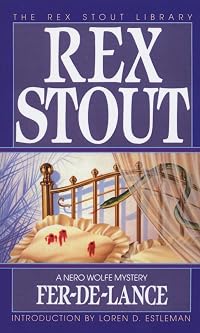
Following an impulse to renew my former familiarity with the Nero Wolfe series after forty-plus years, I began with a used paperback of the first one, Fer-de-Lance, which I purchased online. This happens to be a 1992 reissue from Bantam, and it begins with an introduction by one Loren D. Estleman, whom I don't know. Estleman gives a brief overview of the series and observes that there's no need to worry about reading the books in order because Rex Stout avoided the problem of confusing chronology "by the simple expedient of never changing his characters." How he got them right from the very beginning is a marvel that I had never contemplated show more before.
I approached this reread with very few memories of specific cases and none of the outcomes, meaning that I could read them all as if new. What I remember--no spoiler here--is the framework: the house setup, the daily routine, the relationship between Wolfe and Archie, the final showdown scene, and how the culprit is always outed in the end. I'm delighted to return to that world-righting certainty, especially after a few too many contemporary murder mysteries in which the author decided to treat us to existential angst instead of a satisfying solution.
Estleman concludes the introduction with this paragraph:
This is a world where all things make sense in time, a world better than our own. If you are an old hand making a return swing through its orbit, welcome back; pull up the red leather chair and sit down. If this is your first trip, I envy you the surprises that await you behind that unprepossessing front door.
I can't remember the last time, if ever, I was ushered into a book by an introduction that addresses repeat readers. That alone suggests how well the series holds up.
Not that this 1934 novel fully withstands scrutiny with a 21st-century lens; dated references aside (how many of us remember Decoration Day?), there are clear, inescapable instances of ethnic and gender stereotyping and prejudice that would never get past the guardians of PC today. For example, one character is suspect because he "look(s) like a foreigner"--a defect that narrator Archie expresses using an epithet that I've never heard before, but that plainly isn't very nice; and young female office workers are girls, but when one is replaced by a male of the same age, he's a man.
However, I do believe that we have to allow for attitudes that are products of their place and time, which is not to condone them, but neither is it to condemn them for not being three-quarters of a century ahead of their time. I'm certainly not going to deny myself the pleasure of revisiting the world of Nero Wolfe and Archie Goodwin on that account. Not when I know that I can rely on it, just as Estleman says, to present a place where truth, order, and justice prevail. That's what I want from an old-fashioned murder mystery, that and the illusion that real life could sometimes work that way. Because the world I come from doesn't.
Fer-de-Lance brings us a full-scale exhibition of Nero Wolfe's eccentricity, audacity, and blazing brilliance right from the start: a missing-persons inquiry leads straight to a deduction of murder from a few seemingly unrelated clues. Finding hard evidence to back up what appears to be a bizarre conjecture becomes the task of Wolfe and his associates. Wolfe allows neither convention nor possible legal impediment to stand in the way of his pursuit of the truth.
Although the climactic final confrontation scene that is the hallmark of a Nero Wolfe mystery does not occur in this initial episode, everything necessary is present. The story drew me in, held my attention, fulfilled its promises, and delivered a satisfactory ending. How nice to know there are several dozen more where this came from. show less
Extended review:
Following an impulse to renew my former familiarity with the Nero Wolfe series after forty-plus years, I began with a used paperback of the first one, Fer-de-Lance, which I purchased online. This happens to be a 1992 reissue from Bantam, and it begins with an introduction by one Loren D. Estleman, whom I don't know. Estleman gives a brief overview of the series and observes that there's no need to worry about reading the books in order because Rex Stout avoided the problem of confusing chronology "by the simple expedient of never changing his characters." How he got them right from the very beginning is a marvel that I had never contemplated show more before.
I approached this reread with very few memories of specific cases and none of the outcomes, meaning that I could read them all as if new. What I remember--no spoiler here--is the framework: the house setup, the daily routine, the relationship between Wolfe and Archie, the final showdown scene, and how the culprit is always outed in the end. I'm delighted to return to that world-righting certainty, especially after a few too many contemporary murder mysteries in which the author decided to treat us to existential angst instead of a satisfying solution.
Estleman concludes the introduction with this paragraph:
This is a world where all things make sense in time, a world better than our own. If you are an old hand making a return swing through its orbit, welcome back; pull up the red leather chair and sit down. If this is your first trip, I envy you the surprises that await you behind that unprepossessing front door.
I can't remember the last time, if ever, I was ushered into a book by an introduction that addresses repeat readers. That alone suggests how well the series holds up.
Not that this 1934 novel fully withstands scrutiny with a 21st-century lens; dated references aside (how many of us remember Decoration Day?), there are clear, inescapable instances of ethnic and gender stereotyping and prejudice that would never get past the guardians of PC today. For example, one character is suspect because he "look(s) like a foreigner"--a defect that narrator Archie expresses using an epithet that I've never heard before, but that plainly isn't very nice; and young female office workers are girls, but when one is replaced by a male of the same age, he's a man.
However, I do believe that we have to allow for attitudes that are products of their place and time, which is not to condone them, but neither is it to condemn them for not being three-quarters of a century ahead of their time. I'm certainly not going to deny myself the pleasure of revisiting the world of Nero Wolfe and Archie Goodwin on that account. Not when I know that I can rely on it, just as Estleman says, to present a place where truth, order, and justice prevail. That's what I want from an old-fashioned murder mystery, that and the illusion that real life could sometimes work that way. Because the world I come from doesn't.
Fer-de-Lance brings us a full-scale exhibition of Nero Wolfe's eccentricity, audacity, and blazing brilliance right from the start: a missing-persons inquiry leads straight to a deduction of murder from a few seemingly unrelated clues. Finding hard evidence to back up what appears to be a bizarre conjecture becomes the task of Wolfe and his associates. Wolfe allows neither convention nor possible legal impediment to stand in the way of his pursuit of the truth.
Although the climactic final confrontation scene that is the hallmark of a Nero Wolfe mystery does not occur in this initial episode, everything necessary is present. The story drew me in, held my attention, fulfilled its promises, and delivered a satisfactory ending. How nice to know there are several dozen more where this came from. show less
I'm doing a reread of the Wolfe series -- instead of just rereading favorites, I'm actually reading all of them in order. Or trying to. And, wow, I now remember why this is one of the few Wolfe books I've only read twice.
First, it's not exactly a Wolfe novel, not yet. It has the scaffolding in place, but Stout hasn't quite figured out the characterization of either Wolfe or Archie, let alone the secondary characters. (This book, for example, doesn't have Lon Cohen -- in his place there's WASPy McWhitebread. And Saul Panzer...well, his signature quote here is "Lovin' babe," so.) It's disorienting.
Second, and worse, oh my LORD the racism. I mean, yes, this book is a product of its time, but holy SHIT. This is not so much a bingo on the show more racist tropes bingo card as a complete blackout.
This book is still read only because it's the start of something great; if the series had ended here (or in the next book), it would be justly forgotten. show less
First, it's not exactly a Wolfe novel, not yet. It has the scaffolding in place, but Stout hasn't quite figured out the characterization of either Wolfe or Archie, let alone the secondary characters. (This book, for example, doesn't have Lon Cohen -- in his place there's WASPy McWhitebread. And Saul Panzer...well, his signature quote here is "Lovin' babe," so.) It's disorienting.
Second, and worse, oh my LORD the racism. I mean, yes, this book is a product of its time, but holy SHIT. This is not so much a bingo on the show more racist tropes bingo card as a complete blackout.
This book is still read only because it's the start of something great; if the series had ended here (or in the next book), it would be justly forgotten. show less
This book is Exhibit A in the argument for not always starting to read a series with the first book. And yes, I usually do start with the first book when I can, and sometimes it's absolutely essential in order to fully appreciate how the characters evolve. But Stout's Nero Wolfe series of mysteries, which were written over a span of time between 1938 and 1975, are most certainly the exception that proves the rule.
That's due in large part to the way Stout structures the books. While the setting of each book reflects the time period in which it was written, the characters themselves — enormously sedentary detecting genius Nero Wolfe; his handsome, wisecracking, athletic assistant Archie Goodwin (swoon); live-in gourmet French chef show more Fritz; police nemeses Inspector Cramer and Sergeant Stebbins; newspaperman Lon Cohen — never change. They remain the same ages and personalities from the first book to the last, with only minor exceptions. Wolfe is forever in his mid 50s, Archie is forever 32-ish, and so on.
It might sound odd to think of characters never aging even as they operate in a New York City and an American culture that changes drastically, but somehow Stout makes it work. And it has the advantage of avoiding the absurdity of Robert B. Parker's detective Spenser, who in the early 1970s is a Korean War vet and ages at a normal pace through the series, yet is still somehow kicking ass and taking names in the 21st century, well past the age he should be worrying bout breaking a hip during one of his inevitable fisticuffs.
While it's true that Stout's characters remain the same age, that's not to say that they sprang fully formed from the beginning, and that brings us around to why you shouldn't start this series with this book, the first. It took maybe 3 or 4 full-length novels before Stout had fully found Archie's and Nero's voices. Having read the later masterpieces like [If Death Ever Slept], a discerning reader will find the dialogue a bit stilted in this maiden effort without the characteristic sparkle and sass that would develop in Archie's first-person narration once Stout hit his stride.
The mystery, though, is still first-rate, involving a snake, a golf club, and an airplane — to say more would be to say too much. Just do me and yourself a favor and don't read it until you've already fallen in love with Wolfe's World. Hands off Archie, though; I saw him first. show less
That's due in large part to the way Stout structures the books. While the setting of each book reflects the time period in which it was written, the characters themselves — enormously sedentary detecting genius Nero Wolfe; his handsome, wisecracking, athletic assistant Archie Goodwin (swoon); live-in gourmet French chef show more Fritz; police nemeses Inspector Cramer and Sergeant Stebbins; newspaperman Lon Cohen — never change. They remain the same ages and personalities from the first book to the last, with only minor exceptions. Wolfe is forever in his mid 50s, Archie is forever 32-ish, and so on.
It might sound odd to think of characters never aging even as they operate in a New York City and an American culture that changes drastically, but somehow Stout makes it work. And it has the advantage of avoiding the absurdity of Robert B. Parker's detective Spenser, who in the early 1970s is a Korean War vet and ages at a normal pace through the series, yet is still somehow kicking ass and taking names in the 21st century, well past the age he should be worrying bout breaking a hip during one of his inevitable fisticuffs.
While it's true that Stout's characters remain the same age, that's not to say that they sprang fully formed from the beginning, and that brings us around to why you shouldn't start this series with this book, the first. It took maybe 3 or 4 full-length novels before Stout had fully found Archie's and Nero's voices. Having read the later masterpieces like [If Death Ever Slept], a discerning reader will find the dialogue a bit stilted in this maiden effort without the characteristic sparkle and sass that would develop in Archie's first-person narration once Stout hit his stride.
The mystery, though, is still first-rate, involving a snake, a golf club, and an airplane — to say more would be to say too much. Just do me and yourself a favor and don't read it until you've already fallen in love with Wolfe's World. Hands off Archie, though; I saw him first. show less
What a bunch of detestable shits, especially the narrator. Granted, it's quite a twist when at the end of the book you feel vastly more sympathy for the villain than for the supposed heroes. I rather wish the plane had smashed straight into Archie and put him out of my misery.
This is one of those books people love because it's about people getting away with murder. It trivializes the impact of those murders on the victims' families and glamorizes the genius of the killers.
It's gross.
It's really well-constructed, but it's still completely gross. I suspect it was meant to be edgily offensive at the time of publication, too, at least in as much as it cashes in on (and heightens) Depression- (and gangster-) era nihilism.
disability tag for show more a mobility impaired protagonist & a bizarrely mentally ill female character.
gender politics tag for offensive epic misogyny.
I really hate that this was so well-written. I ought to give more stars, but books without heroes piss me off. This only has villains and victims and bystanders. :( show less
This is one of those books people love because it's about people getting away with murder. It trivializes the impact of those murders on the victims' families and glamorizes the genius of the killers.
It's gross.
It's really well-constructed, but it's still completely gross. I suspect it was meant to be edgily offensive at the time of publication, too, at least in as much as it cashes in on (and heightens) Depression- (and gangster-) era nihilism.
disability tag for show more a mobility impaired protagonist & a bizarrely mentally ill female character.
gender politics tag for offensive epic misogyny.
I really hate that this was so well-written. I ought to give more stars, but books without heroes piss me off. This only has villains and victims and bystanders. :( show less
Fer-de-Lance is Rex Stout's first Nero Wolfe mystery and everything it is cracked up to be. I am torn between being appalled at myself for not reading the entire series earlier and giddy that I have the whole series to look forward to.
This first mystery introduces the portly genius and establishes him as an orchard-growing, beer-drinking eccentric who stays inside his New York brownstone while his intrepid sidekick, Archie Goodwin, does the legwork. Stout creates intriguing context for the duo with several references to prior cases and earlier fame.
In this case, Wolfe is asked to find a missing Italian immigrant and ends up solving the murder of a golf-playing college president. Throughout, Wolfe's somewhat pompous self-aggrandizement show more is balanced by Goodwin's wise-cracking narration. The book is funny and clever and the plot itself is even pretty good, in a vintage, 1934 kind of way.
Also posted on Rose City Reader. show less
This first mystery introduces the portly genius and establishes him as an orchard-growing, beer-drinking eccentric who stays inside his New York brownstone while his intrepid sidekick, Archie Goodwin, does the legwork. Stout creates intriguing context for the duo with several references to prior cases and earlier fame.
In this case, Wolfe is asked to find a missing Italian immigrant and ends up solving the murder of a golf-playing college president. Throughout, Wolfe's somewhat pompous self-aggrandizement show more is balanced by Goodwin's wise-cracking narration. The book is funny and clever and the plot itself is even pretty good, in a vintage, 1934 kind of way.
Also posted on Rose City Reader. show less
Members
- Recently Added By
Lists

100 Mysteries and Thrillers to Read in a Lifetime
99 works; 22 members

Favorite Series
238 works; 94 members

Crime and Mysteries to Read
746 works; 31 members

Survey of Mysteries and Crime Fiction
96 works; 17 members

Haycraft Queen Cornerstones
181 works; 3 members

Books mentioned in Julian Symons’ Bloody Murder
438 works; 6 members

1930s
262 works; 5 members

Series to Try Out
92 works; 1 member

Mustich's 1000 Books to Read Before You Die: A Life Changing List
1,001 works; 19 members
Art Bourgeau's Favorites [Mystery Lovers Companion, 1986]
124 works; 2 members

The Five Books That Represent Us
391 works; 148 members

Books We Resisted Reading
178 works; 110 members
Author Information

376+ Works 50,382 Members
Author Rex Stout was born on December 1, 1886. A child prodigy with a gift for mathematics, Stout drifted as he became an adult, holding odd jobs in many places---cook, cabinetmaker, bellhop, hotel manager, salesman, bookkeeper, and even a guide in a pueblo. But his true talent lay in storytelling; he sold his first story, about William Howard show more Taft, in 1912. His most famous creation is Nero Wolfe, a 286-pound detective genius who, with sidekick Archie Goodwin, can often solve a case without leaving his room. It is the way in which the puzzle is solved that intrigues Nero Wolfe, who is much like Sherlock Holmes in his ability to use deductive reasoning. More than 60 million copies (in 24 languages) of Stout's books have been sold. Stout writes quickly, drawing upon a lifetime of impressions. He neither uses an outline nor revises; he lets his characters take over as the story develops. The classy, erudite Nero Wolfe presents for readers an alternative to the hard-boiled branch of the genre. He died on October 27, 1975 (Bowker Author Biography) show less

Rex Stout has a Legacy Library. Legacy libraries are the personal libraries of famous readers, entered by LibraryThing members from the Legacy Libraries group.
Some Editions
Awards and Honors
Series

Belongs to Publisher Series
Work Relationships
Common Knowledge
- Canonical title
- Fer-de-Lance
- Original title
- Fer-de-Lance
- Original publication date
- 1934
- People/Characters
- Archie Goodwin; Nero Wolfe; Peter Barstow; Sarah Barstow; Fritz Brenner; Orrie Cather (show all 13); Fred Durkin; Anna Fiore; Bill Gore; Theodore Horstmann; Manuel Kimball; Carlo Maffei; Saul Panzer
- Important places
- New York, New York, USA; Westchester County, New York, USA; Buenos Aires, Argentina
- Related movies
- Meet Nero Wolfe (1936 | IMDb); La traccia del serpente (2012 | IMDb)
- First words
- There was no reason why I couldn't have been sent for the beer that day, for the last ends of the Fairmont National Bank case had been gathered in the week before and there was nothing for me to do but errands, and Wolfe neve... (show all)r hesitated about running me down to Murray Street for a can of shoe-polish if he happened to need one.
- Quotations
- Wolfe speaking to the golf club salesman with delusions of superiority......
You know, Mr. Townsend, it is our good fortune that the exigencies of birth and training furnish all of us with opportunities for snobbery. ... (show all)My ignorance of this special nomenclature provided yours; your innocence of the elementary mental processes provides mine.
Archie..............I hated to hear him (Wolfe) curse. It got on my nerves. The reason for that, he told me once, was that whereas in most cases cursing was merely a verbal explosion, with him it was a considered expression o... (show all)f a profound desire.
Must I again remind you, Archie, of the reaction you would have got if you had asked Velasquez to explain why Aesop's hand was resting inside his robe instead of hanging by his side? Must I again demonstrate that while it is ... (show all)permissible to request the scientist to lead you back over his footprints, a similar request of the artist is nonsense, since he, like the lark or the eagle, has made none? Do you need to be told again that I am an artist? - Last words
- (Click to show. Warning: May contain spoilers.)"Indeed." Wolfe murmured.
- Original language
- English US
Classifications
Statistics
- Members
- 2,166
- Popularity
- 9,398
- Reviews
- 78
- Rating
- (3.74)
- Languages
- 15 — Czech, Danish, Dutch, English, Estonian, Finnish, French, German, Italian, Norwegian (Bokmål), Norwegian, Polish, Portuguese, Russian, Spanish
- Media
- Paper, Audiobook, Ebook
- ISBNs
- 50
- UPCs
- 2
- ASINs
- 42