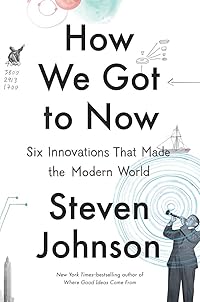
How We Got to Now: Six Innovations That Made the Modern World
by Steven Johnson
On This Page
Description
"From the New York Times-bestselling author of Where Good Ideas Come From and Everything Bad Is Good for You, a new look at the power and legacy of great ideas. In this illustrated volume, Steven Johnson explores the history of innovation over centuries, tracing facets of modern life (refrigeration, clocks, and eyeglass lenses, to name a few) from their creation by hobbyists, amateurs, and entrepreneurs to their unintended historical consequences. Filled with surprising stories of accidental show more genius and brilliant mistakes-from the French publisher who invented the phonograph before Edison but forgot to include playback, to the Hollywood movie star who helped invent the technology behind Wi-Fi and Bluetooth-How We Got to Now investigates the secret history behind the everyday objects of contemporary life. In his trademark style, Johnson examines unexpected connections between seemingly unrelated fields: how the invention of air-conditioning enabled the largest migration of human beings in the history of the species-to cities such as Dubai or Phoenix, which would otherwise be virtually uninhabitable; how pendulum clocks helped trigger the industrial revolution; and how clean water made it possible to manufacture computer chips. Accompanied by a major six-part television series on PBS, How We Got to Now is the story of collaborative networks building the modern world, written in the provocative, informative, and engaging style that has earned Johnson fans around the globe. "-- show lessTags
Recommendations









Member Recommendations
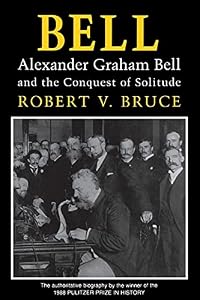
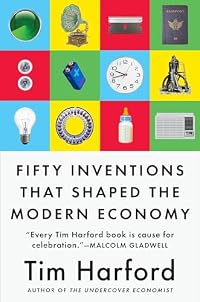
cbl_tn Both books address some of the same technological advances, such as refrigeration and electricity and artificial light, for a popular audience.
Member Reviews
Steven Johnson looks at the history of six different kinds of technologies that have been instrumental in shaping the world we live in today: glassworking, refrigeration, sound transmission and recording, sewers and hygiene improvements, timekeeping, and artificial light. But he's not simply telling us the backstories of these technologies we've come to take for granted. He also talks a bit about how innovations happen, including what it means to be an idea whose time has come (although he doesn't use that particular phrase) and how inventions like the light bulb are almost always messy endeavors involving lots of people working independently, not the lone genius eureka moments we like to imagine. (This, by the way, is a subject he goes show more on about at much greater length in his earlier book, Where Good Ideas Come From.)
More than that, though, he shows how inventions designed solely to solve one particular limited problem can have direct but unexpected consequences that lead not just to the development of still further technological developments, but also to influences on society, history, and art. To me, this weird, tangled web of causality and influence Johnson illuminates is by far the most fascinating thing about the book, whether he's drawing a direct line from Clarence Birdseye ice-fishing with Inuits to the existence of sperm banks, or outlining how the invention of the laser led to the growth and expansion of big-box retail stores.
It reminds me a little of James Burke's TV show/ book Connections and its follow-up, The Pinball Effect, but where Burke is random and rambly, Johnson is more focused and concise. Each of the chapters here is short, and the entire book is only about 200 pages. Meaning this isn't the book you want if you're looking for a really detailed and in-depth history of any of the topics it covers. But Johnson does manage to pack a lot of worthwhile thought and information into such a small amount of space, and he does it in his usual zippy, highly readable style.
I'd actually already read a fair bit about most of these subjects, and wondered going in if I were going to find some of the chapters a bit boring since they were talking about things I already knew, but Johnson includes so many odd and interesting little details that I'd either forgotten or never heard of, and he provides so many new perspectives and draws so many surprising connections between things that I never felt the least bit bored.
Rating: 4.5/5. If only just for including so many little things that made me go, "Oh, neat!" show less
More than that, though, he shows how inventions designed solely to solve one particular limited problem can have direct but unexpected consequences that lead not just to the development of still further technological developments, but also to influences on society, history, and art. To me, this weird, tangled web of causality and influence Johnson illuminates is by far the most fascinating thing about the book, whether he's drawing a direct line from Clarence Birdseye ice-fishing with Inuits to the existence of sperm banks, or outlining how the invention of the laser led to the growth and expansion of big-box retail stores.
It reminds me a little of James Burke's TV show/ book Connections and its follow-up, The Pinball Effect, but where Burke is random and rambly, Johnson is more focused and concise. Each of the chapters here is short, and the entire book is only about 200 pages. Meaning this isn't the book you want if you're looking for a really detailed and in-depth history of any of the topics it covers. But Johnson does manage to pack a lot of worthwhile thought and information into such a small amount of space, and he does it in his usual zippy, highly readable style.
I'd actually already read a fair bit about most of these subjects, and wondered going in if I were going to find some of the chapters a bit boring since they were talking about things I already knew, but Johnson includes so many odd and interesting little details that I'd either forgotten or never heard of, and he provides so many new perspectives and draws so many surprising connections between things that I never felt the least bit bored.
Rating: 4.5/5. If only just for including so many little things that made me go, "Oh, neat!" show less
This book functions as a companion to the six-part PBS series, "How We Got To Now." I highly recommend watching that. The book is good too, though there's something impressive about actually watching the author explain his research. He's very engaging, and clearly an enthusiast for learning. Yay for PBS!
This book/series will almost certainly reveal things that the reader didn't know, untold stories behind basic innovations that make modern life possible, in these categories: glass, sound, light, time, clean, and cold.
Johnson introduced me to an interesting phrase, "the adjacent possible." It means that inventors and visionaries have to work with the tools and concepts that are already available to them, meaning that innovation happens, show more not in a lightbulb moment or with a huge jump forward, but only after a lot of other people have worked in related fields first. For instance, in the mid-1800s, ultrasound was not part of the adjacent possible. But transcription of sound waves (albeit without playback) was. Smaller developments expand the adjacent possible until you get to the memorable, world-changing inventions.
Johnson also acknowledges that the development of technology almost always leads to unforeseen uses. On the same subject of sound waves, he highlights that ultrasound is responsible for saving millions of lives in ships on the ocean, but it has also enabled millions of gender-based abortions in China.
This is a particularly somber example of the connections Johnson makes, but the book is not heavy or depressing at all. It is interesting and sometimes very unexpected, even funny!
I enjoyed the conclusion where he talks about Ada Lovelace. I knew something about her, as her story has gained a bit more notoriety in recent years, but the details were super interesting. She was the daughter of the scandalous Lord Byron, the man who was labeled "mad, bad, and dangerous to know." (A phrase that has stuck in my mind for years!) To counteract her father's profligate "romantic" influence, Ada's mother insisted she study mathematics. She had a genius aptitude for it, and when Victorian wifehood and motherhood began to pall, she made her skills available to the inventor of an "analytical engine" and basically became the world's first software programmer. The fascinating part is that the machine that could read such code wouldn't be actually built for another century. As Johnson says, it was "trying to build a digital-age computer with industrial-age mechanical parts." Like Leonardo da Vinci designing a helicopter. Not in the realm of the adjacent possible. But brilliant anyway.
Took me a while to settle into "nonfiction mode," but once I did the pages flew by. I finished four of the six sections in one day. show less
This book/series will almost certainly reveal things that the reader didn't know, untold stories behind basic innovations that make modern life possible, in these categories: glass, sound, light, time, clean, and cold.
Johnson introduced me to an interesting phrase, "the adjacent possible." It means that inventors and visionaries have to work with the tools and concepts that are already available to them, meaning that innovation happens, show more not in a lightbulb moment or with a huge jump forward, but only after a lot of other people have worked in related fields first. For instance, in the mid-1800s, ultrasound was not part of the adjacent possible. But transcription of sound waves (albeit without playback) was. Smaller developments expand the adjacent possible until you get to the memorable, world-changing inventions.
Johnson also acknowledges that the development of technology almost always leads to unforeseen uses. On the same subject of sound waves, he highlights that ultrasound is responsible for saving millions of lives in ships on the ocean, but it has also enabled millions of gender-based abortions in China.
This is a particularly somber example of the connections Johnson makes, but the book is not heavy or depressing at all. It is interesting and sometimes very unexpected, even funny!
I enjoyed the conclusion where he talks about Ada Lovelace. I knew something about her, as her story has gained a bit more notoriety in recent years, but the details were super interesting. She was the daughter of the scandalous Lord Byron, the man who was labeled "mad, bad, and dangerous to know." (A phrase that has stuck in my mind for years!) To counteract her father's profligate "romantic" influence, Ada's mother insisted she study mathematics. She had a genius aptitude for it, and when Victorian wifehood and motherhood began to pall, she made her skills available to the inventor of an "analytical engine" and basically became the world's first software programmer. The fascinating part is that the machine that could read such code wouldn't be actually built for another century. As Johnson says, it was "trying to build a digital-age computer with industrial-age mechanical parts." Like Leonardo da Vinci designing a helicopter. Not in the realm of the adjacent possible. But brilliant anyway.
Took me a while to settle into "nonfiction mode," but once I did the pages flew by. I finished four of the six sections in one day. show less
Through the history of Glass, Cold, Sound, Clean, Time and Light, the author helps us to see behind our everyday conveniences. He used the history of these things to show how ideas take root and how they lead to products and inventions never dreamed of by the original inventor. I found this a very interesting read, tracing the history of things we take for granted now and finding the little threads of ideas which brought us to where we are.
"You don't need to know any of these things to tell the time now, but that's the way progress works; the more we build up these vast repositories of scientific and technological understanding, the more we conceal them. Your mind is silently assisted by all that knowledge each time you check your phone show more to see what time it is, but the knowledge itself is hidden."
I think that is a very important statement of the human experience and how much our future is determined by the past. In addition to making me say, "Wow!" this book also led me to think and ponder on the human condition without leading me to conclusions, something I always enjoy. show less
"You don't need to know any of these things to tell the time now, but that's the way progress works; the more we build up these vast repositories of scientific and technological understanding, the more we conceal them. Your mind is silently assisted by all that knowledge each time you check your phone show more to see what time it is, but the knowledge itself is hidden."
I think that is a very important statement of the human experience and how much our future is determined by the past. In addition to making me say, "Wow!" this book also led me to think and ponder on the human condition without leading me to conclusions, something I always enjoy. show less
This was a fascinating look at innovation and discovery. Concentrating on just six areas – glass, cold, sound, clean, time, light – and using what he calls the “hummingbird effect,” the author demonstrates how discoveries build upon one another and bring about changes in seemingly unrelated areas, leading us in directions we never imagined.
For example, glass: before the 15th century, most people were farsighted and never knew it; most couldn’t read and had no need to see tiny shapes formed into words. Therefore, spectacles remained rare and expensive items. The invention of the printing press changed that when it brought the written word to the masses, creating a market for spectacles. People began experimenting with lenses; show more microscopes, telescopes, and cameras were invented, creating a multitude of new discoveries in the sciences as a result.
The author discounts the lone genius theory where one person magically came up with an idea and “invented” it. He demonstrates how most innovations were collaborations. An example was the light bulb: multiple individuals were working on developing a light bulb, and many “invented” it, but the person known for the light bulb was the one whose bulb outperformed the others and was most successful in bringing it to market. And that was Thomas Edison.
I could babble on a lot about this book and how much I enjoyed it. But instead I’m going to encourage you to give this a read or a listen and have fun learning about how all the things we take for granted became part of our daily lives. And no, you do not need to know one bit about science to enjoy this – just curiosity about the world around us.
Audio production:
I can be a bit of a science nerd and once I started reading this I didn’t want to stop and switched between audio and print so I could keep going. The audio was competently read by George Newbern in a very listenable but documentary-like style. For those who prefer the visual, there were some very cool drawings, photos, and illustrations that make having a print copy worth while. But in either format it was an enjoyable read. show less
For example, glass: before the 15th century, most people were farsighted and never knew it; most couldn’t read and had no need to see tiny shapes formed into words. Therefore, spectacles remained rare and expensive items. The invention of the printing press changed that when it brought the written word to the masses, creating a market for spectacles. People began experimenting with lenses; show more microscopes, telescopes, and cameras were invented, creating a multitude of new discoveries in the sciences as a result.
The author discounts the lone genius theory where one person magically came up with an idea and “invented” it. He demonstrates how most innovations were collaborations. An example was the light bulb: multiple individuals were working on developing a light bulb, and many “invented” it, but the person known for the light bulb was the one whose bulb outperformed the others and was most successful in bringing it to market. And that was Thomas Edison.
I could babble on a lot about this book and how much I enjoyed it. But instead I’m going to encourage you to give this a read or a listen and have fun learning about how all the things we take for granted became part of our daily lives. And no, you do not need to know one bit about science to enjoy this – just curiosity about the world around us.
Audio production:
I can be a bit of a science nerd and once I started reading this I didn’t want to stop and switched between audio and print so I could keep going. The audio was competently read by George Newbern in a very listenable but documentary-like style. For those who prefer the visual, there were some very cool drawings, photos, and illustrations that make having a print copy worth while. But in either format it was an enjoyable read. show less
I obviously didn't pick the most favourable way to encounter Johnson. As the tie-in book of a TV series, this is obviously limited by the need to comply with all the structural clichés of 45-minute documentary episodes, and you don't get the same sort of freedom to explore ideas in depth that you would in something written purely as a book. And the publishers don't see why any sane person would listen to the audiobook rather than watching the original show, so they make that in the cheapest way possible. The reading is so dry that I assumed "George Newbern" must be a conventional alias publishers use for a text-to-speech engine, but it turns out that he's a well-known voice actor with a Wikipedia page and everything. Who must have done show more so many audiobooks that he can read them without engaging with the text in any way at all...
So much for the form. As to the content, it's fairly unobjectionable. Some of the science is simplified to the point where it's borderline misleading, and some of the leaps he makes are too extreme, for instance in the chapter on Time, where he jumps straight from the 16th century to the 19th, leaving the naive reader with the impression that it must have been Galileo's pendulum clock that enabled ships to determine longitude. But those are constraints due to the need to fit everything in to a TV show. The producer obviously told him they could shoot on location in Pisa or Greenwich, but not both...
Obviously, this isn't a book that's addressed at readers who already know a little bit about the history of technology: most of the stories he tells here are very familiar ones, and there was very little that I hadn't already met many times in other places. After six chapters I caught myself thinking that we'd had just about all the usual suspects except Albert Einstein and Ada Lovelace - imagine my surprise when Ada turned up in the Conclusion after all! Johnson's discussion of how innovation comes about is rather more interesting than the actual examples he brings in, but it's all very anecdotal and not developed enough here to be really worth reading this book for. He has written another book devoted to that topic, of course. The other inevitable topic in books about the history of technology is "unintended nasty consequences of progress" - that's something Johnson touches on a few times here and there, but again he doesn't really get the chance to develop it. show less
So much for the form. As to the content, it's fairly unobjectionable. Some of the science is simplified to the point where it's borderline misleading, and some of the leaps he makes are too extreme, for instance in the chapter on Time, where he jumps straight from the 16th century to the 19th, leaving the naive reader with the impression that it must have been Galileo's pendulum clock that enabled ships to determine longitude. But those are constraints due to the need to fit everything in to a TV show. The producer obviously told him they could shoot on location in Pisa or Greenwich, but not both...
Obviously, this isn't a book that's addressed at readers who already know a little bit about the history of technology: most of the stories he tells here are very familiar ones, and there was very little that I hadn't already met many times in other places. After six chapters I caught myself thinking that we'd had just about all the usual suspects except Albert Einstein and Ada Lovelace - imagine my surprise when Ada turned up in the Conclusion after all! Johnson's discussion of how innovation comes about is rather more interesting than the actual examples he brings in, but it's all very anecdotal and not developed enough here to be really worth reading this book for. He has written another book devoted to that topic, of course. The other inevitable topic in books about the history of technology is "unintended nasty consequences of progress" - that's something Johnson touches on a few times here and there, but again he doesn't really get the chance to develop it. show less
I really love the history of science and technology and I especially appreciate an author who can make technical information understandable to a general audience. Fortunately, this book checked both of those boxes. The author explored innovations that you would and wouldn't think of (light, cold, glass, etc) that make our world what it is today. He traces the history of these innovations and their impacts, showing how even small things can have wide-ranging effects. This is a highly readable book and highly recommended to anyone with an interest in science and technology.
The book is organized into six broad chapters, each of which is an elaborate timeline that connects various innovations in a branch of human endeavor e.g. cleanliness and timekeeping. This is Steven Johnson's specialty. He has a unique ability to weave narratives that bring a sort of logical coherence to the messy history of technology. I certainly walked away from this book with some fascinating anecdotes about the origin of modern practices. For example, John Leal, the (mad?) doctor who hit upon the idea of chlorinating drinking water, unilaterally decided to try his experimental treatment on the entire population of Jersey City. It makes me wonder, would the rapid pace of change around the turn of the 20th century been possible show more without this cowboy approach to science?
That said, I've enjoyed Johnson's previous books like "Where Good Ideas Come From" and "The Ghost Map" much more than "How We Got to Now". The former contains a more nuanced description of the 'adjacent possible' idea, which is I think more substantive than the 'hummingbird effect' described here. The latter dives deeper into the fascinating story of cholera and public health, which receives but a few pages of treatment in the 'Clean' chapter. As we're shuttled from anecdote to anecdote, there's a sense that any one could spawn its own Steven Johnson bestseller. In the acknowledgements, he notes that the book was "developed" simultaneously with the television series, and I think it shows. I'm sure the series is wonderfully informative, though, and perhaps it's worth exposing a broader audience to Johnson's storytelling. show less
That said, I've enjoyed Johnson's previous books like "Where Good Ideas Come From" and "The Ghost Map" much more than "How We Got to Now". The former contains a more nuanced description of the 'adjacent possible' idea, which is I think more substantive than the 'hummingbird effect' described here. The latter dives deeper into the fascinating story of cholera and public health, which receives but a few pages of treatment in the 'Clean' chapter. As we're shuttled from anecdote to anecdote, there's a sense that any one could spawn its own Steven Johnson bestseller. In the acknowledgements, he notes that the book was "developed" simultaneously with the television series, and I think it shows. I'm sure the series is wonderfully informative, though, and perhaps it's worth exposing a broader audience to Johnson's storytelling. show less
Members
- Recently Added By
Published Reviews
ThingScore 100
While we appreciate it in the abstract, few of us pause to grasp the miracles of modern life, from artificial light to air conditioning, as Steven Johnson puts it in the excellent How We Got to Now: Six Innovations That Made the Modern World, “how amazing it is that we drink water from a tap and never once worry about dying forty-eight hours later from cholera.” Understanding how these show more everyday marvels first came to be, then came to be taken for granted, not only allows us to see our familiar world with new eyes — something we are wired not to do — but also lets us appreciate the remarkable creative lineage behind even the most mundane of technologies underpinning modern life. show less
added by tim.taylor
Lists

Book Club List
8 works; 1 member

Books Read in 2016
4,666 works; 197 members

read in 2024
21 works; 1 member

The War on Cars podcast
108 works; 1 member
Author Information

19+ Works 16,019 Members
Awards and Honors
Awards
Distinctions
Work Relationships
Common Knowledge
- Canonical title
- How We Got to Now: Six Innovations That Made the Modern World
Classifications
Statistics
- Members
- 1,258
- Popularity
- 19,394
- Reviews
- 52
- Rating
- (3.97)
- Languages
- 5 — English, German, Polish, Portuguese, Spanish
- Media
- Paper, Audiobook, Ebook
- ISBNs
- 30
- UPCs
- 1
- ASINs
- 10