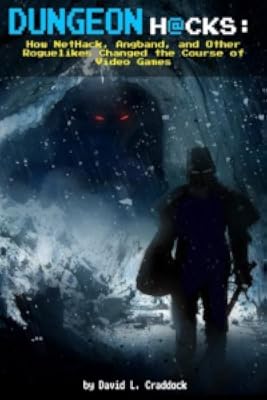
Dungeon Hacks: How NetHack, Angband, and Other Roguelikes Changed the Course of Video Games
by David L. Craddock
On This Page
Description
In 1980, computers were instruments of science and mathematics, military secrets and academia. Stern administrators lorded over sterile university laboratories and stressed one point to the wide-eyed students privileged enough to set foot within them: Computers were not toys. Defying authority, hackers seized control of monolithic mainframes to create a new breed of computer game: the roguelike, cryptic and tough-as-nails adventures drawn from text-based symbols instead of state-of-the-art show more 3D graphics. Despite their visual simplicity, roguelike games captivate thousands of players around the world. From the author of the bestselling Stay Awhile and Listen series, Dungeon Hacks: How NetHack, Angband, and Other Roguelikes Changed the Course of Video Games introduces you to the visionaries behind some of the most popular roguelikes of all time and shows how their creations paved the way for the blockbuster videogames of today--and beyond. show lessTags
Recommendations
























Member Reviews
The "roguelike" genre described in this book (for me, nethack, angband, and especially ADOM) are some of my favorite video games -- I first discovered them in the early 1990s on shared UNIX systems and have played off and on over the years. They're amazing because they somehow manage to tell great stories, and have high replay value, while being very simple in UI and in particular being largely procedurally generated (thus different every time).
This book describes several of the most important games, what makes them unique, and includes background/biography on the developers.
This book describes several of the most important games, what makes them unique, and includes background/biography on the developers.
Note: This review originally appeared on my blog - https://countzeroor.com/2018/05/12/book-review-dungeon-hacks/
Procedural content, permadeath, and extremely punishing difficulty has become more and more of a thing in game design. So, that fact, combined by my affinity for the history of technology from a social, technological, and scientific perspective, lead me to this book about the history of roguelikes. It makes for a good portrait of the development of four games, and getting briefly into some of the ways roguelikes have spread into wider gaming culture, though what could be a good look at the larger gaming picture is sadly limited.
Dungeon Hacks is, ultimately, the story of six games - Beneath Apple Manor (BAM), Rogue, NetHack, show more Moria & Angband together, and Ancient Domains of Mystery. Beneath Apple Manor is set up as being what Rogue could have been - the Roguelike that predates Rogue, but which failed to get the level of penetration that Rogue did.
Rogue and Nethack probably get the most time each, with the discussion of Rogue getting into how the game came about, along with it's cultural permutation through its initial distribution in BSD Unix. The discussion of Nethack gets into the concept of the Nethack "Dev Team" along with how distributed development for the game was handled.
Moria and Angband, and Ancient Domains of Mystery get the least time of the main roguelikes. In part, that's because Moria & Angband were basically designed as a response to the fact that NetHack's tone is pretty much all over the place, with tongue-in-cheek classes (like "Tourist") and joke monsters (like the actual Three Stooges). Ancient Domains of Mystery mostly stands out because it's pretty much the main focus of one developer, and with a much larger scope than any of the other Roguelike games.
The book concludes a discussion of "Rogue-like-likes" - in particular FTL and the original Diablo. This part is probably the most disappointing part of the book - mainly because of the limited scope - and particular what this section overlooks. In particular, the book basically takes the tack that the mainstream popularity of the roguelike is a modern western thing. This is unfortunate and wrong - in both respects. Home consoles got roguelikes, either as straight-up roguelikes like Fatal Labyrinth on the Genesis, or as "Roguelike-lites" like the Mystery Dungeon series and the Shiren the Wanderer series. They may not have gotten the same degree of penetration here that they did in Japan - but it is still important to mention - they got an incredible amount of cultural penetration in Japan, at at time where they had no penetration whatsoever in the US. show less
Procedural content, permadeath, and extremely punishing difficulty has become more and more of a thing in game design. So, that fact, combined by my affinity for the history of technology from a social, technological, and scientific perspective, lead me to this book about the history of roguelikes. It makes for a good portrait of the development of four games, and getting briefly into some of the ways roguelikes have spread into wider gaming culture, though what could be a good look at the larger gaming picture is sadly limited.
Dungeon Hacks is, ultimately, the story of six games - Beneath Apple Manor (BAM), Rogue, NetHack, show more Moria & Angband together, and Ancient Domains of Mystery. Beneath Apple Manor is set up as being what Rogue could have been - the Roguelike that predates Rogue, but which failed to get the level of penetration that Rogue did.
Rogue and Nethack probably get the most time each, with the discussion of Rogue getting into how the game came about, along with it's cultural permutation through its initial distribution in BSD Unix. The discussion of Nethack gets into the concept of the Nethack "Dev Team" along with how distributed development for the game was handled.
Moria and Angband, and Ancient Domains of Mystery get the least time of the main roguelikes. In part, that's because Moria & Angband were basically designed as a response to the fact that NetHack's tone is pretty much all over the place, with tongue-in-cheek classes (like "Tourist") and joke monsters (like the actual Three Stooges). Ancient Domains of Mystery mostly stands out because it's pretty much the main focus of one developer, and with a much larger scope than any of the other Roguelike games.
The book concludes a discussion of "Rogue-like-likes" - in particular FTL and the original Diablo. This part is probably the most disappointing part of the book - mainly because of the limited scope - and particular what this section overlooks. In particular, the book basically takes the tack that the mainstream popularity of the roguelike is a modern western thing. This is unfortunate and wrong - in both respects. Home consoles got roguelikes, either as straight-up roguelikes like Fatal Labyrinth on the Genesis, or as "Roguelike-lites" like the Mystery Dungeon series and the Shiren the Wanderer series. They may not have gotten the same degree of penetration here that they did in Japan - but it is still important to mention - they got an incredible amount of cultural penetration in Japan, at at time where they had no penetration whatsoever in the US. show less
I was lucky enough to pick this up in a Humble Audiobook Bundle for $1 and boy was it worth it. I've been a fan of roguelikes since getting my first computer in the 1980's. It's really something that every game is completely different, and when I die, I'm dead, forced to start again. The book is also something of a history book of early computing. I'd highly recommend this to any videogamer looking for a good read or computer science student looking for a history of early game development.
Ratings
Members
- Recently Added By
Author Information
27+ Works 243 Members
David L. Craddock writes fiction, nonfiction, and grocery lists. He is the author of over a dozen nonfiction books about videogame development and culture, including the bestselling Stay Awhile and Listen series. Arcade Perfect: How Pac-Man, Mortal Kombat, and Other Coin-Op Classics Invaded the Living Room, and fiction for young adults including show more The Dumpster Club and Heritage: Book One of the Gairden Chronicles Find him online @davidlcraddock on Twitter. show less
Some Editions
Classifications
- Genres
- Nonfiction, Technology, General Nonfiction, History
- DDC/MDS
- 794.8 — Arts & recreation Recreation, sports, and performing arts Chess, Computer Games / Card Games Electronic games
- LCC
- GV1469.3 .C73 — Geography, Anthropology and Recreation Recreation. Leisure Recreation. Leisure Games and amusements Indoor games and amusements Board games. Move games
- BISAC
Statistics
- Members
- 57
- Popularity
- 537,068
- Reviews
- 3
- Rating
- (3.91)
- Languages
- English
- Media
- Paper, Audiobook, Ebook
- ISBNs
- 9
- ASINs
- 3