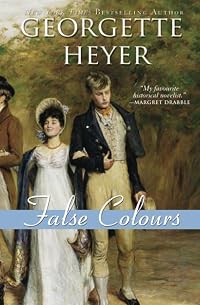
False Colours
by Georgette Heyer
On This Page
Description
The Queen of Regency Romance, bestselling author Georgette Heyer, charms readers with this delightful romp of mistaken identity.A missing twin
Something is very wrong, and the Honourable Christopher "Kit" Fancot can sense it. Kit returns to London on leave from the diplomatic service to find that his twin brother Evelyn has disappeared and his extravagant mother's debts have mounted alarmingly.
A quick-minded heiress
The Fancot family's fortunes are riding on Evelyn's marriage to the show more self-possessed Cressy Stavely, and her formidable grandmother's approval of the match. If Evelyn fails to meet the Dowager Lady Stavely in a few days as planned, the betrothal could be off.
A fortune in the balance
When the incorrigible Lady Fancot persuades her son to impersonate his twin (just for one night, she promises) the masquerade sets off a tangled sequence of events that engage Kit's heart far more deeply than he'd ever anticipated with his brother's fiancée—who might know much more about what's going on than she cares to reveal...
Praise for Georgette Heyer:
"A writer of great wit and style... I've read her books to ragged shreds."—Kate Fenton, Daily Telegraph
"Reading Georgette Heyer is the next best thing to reading Jane Austen."—Publishers Weekly
. show less
Tags
Recommendations






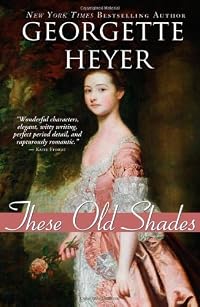








Member Reviews
Late one evening, Kit Fancot returns from Vienna, arriving at his twin brother Evelyn's London house. Kit's twintuition tells him that some accident has befallen Evelyn, and sure enough, his mother informs him that Evelyn is several days late returning from a trip. Normally, this wouldn't be a matter of much concern, but Evelyn is supposed to dine with his future in-laws the next day. Sure that Evelyn has not suffered a serious hurt, Kit jokes that, if Evelyn doesn't turn up, Kit will have to take his place -- but his flighty mother decides that his joking solution is just the thing, and cajoles him into filling in for his brother for just one evening. What Kit doesn't know is that this minor imposture will embroil him in a lengthy show more charade -- or that he's likely to fall in love with his brother's fiancée!
Heyer is always good fun, and this may be one of my favorites so far. show less
Heyer is always good fun, and this may be one of my favorites so far. show less
False Colours by Georgette Heyer was a slow moving but intriguing historical romance story that pulled me in from the beginning. The extravagant, excitable and most charming Dowager Lady Denville is a spend-thrift without equal and has managed to accumulate humongous debts. Her twin sons, Evelyn and Christopher who love her to bits want to help her clear her debts but the family fortune is tied up in a trust that the elder twin cannot break until he marries. He therefore is courting the sensible and well admired Cressida but when Evelyn goes missing, his twin, Kit, on leave from the foreign service, steps in and masquerades as his brother. Of course Kit and Cressy fall in love but society is expecting the lasting commitment to be that show more of Evelyn and Cressida.
This twin-swapping masquerade was a fun read, and the author uses plenty of humour and sparking banter to liven things up. She also wisely provides a cast of characters that are fun to read about, as well as a family that cares deeply for one another. And there is the mystery of where Evelyn could be and what is keeping him away from his family.
The author’s careful plotting kept False Colours moving forward slowly although the developing romance was very much on the back burner for most of the book. Even so, I thoroughly enjoyed the story, but would hesitate to recommend it to anyone who is not already familiar with the author as this is a much quieter book than her usual fare. show less
This twin-swapping masquerade was a fun read, and the author uses plenty of humour and sparking banter to liven things up. She also wisely provides a cast of characters that are fun to read about, as well as a family that cares deeply for one another. And there is the mystery of where Evelyn could be and what is keeping him away from his family.
The author’s careful plotting kept False Colours moving forward slowly although the developing romance was very much on the back burner for most of the book. Even so, I thoroughly enjoyed the story, but would hesitate to recommend it to anyone who is not already familiar with the author as this is a much quieter book than her usual fare. show less
Let me start by being honest - now matter how cheesy, how fantastic, how predictable, I love Georgette Heyer. She just makes me happy. I love that the characters are so much fun, that they are all smart or beautiful or witty or rich or all of these things and more, that everything works out at the end, that there are funny spots, I just love it all.
For the plot though -
Kit and Evelyn are twins. Kit arrives home from his service with the Diplomatic Corps in Vienna to find that Evelyn has disappeared, on the night before he was going to meet his fiancee's family. Kit's mother, who is a beautiful featherhead, convinces him to impersonate the missing twin. Against his better judgment, Kit agrees. And so all the trouble ensues. Kit falls in show more love with Evelyn's fiancee, he and his mother go to an amazing amount of trouble to keep up with the deception, but naturally, it all comes out. Everything wraps up neatly at the end.
Cressida is not my favorite Heyer heroine, but then, she is not the main character. Kit is, and I like him. Lady Denville and her large, good-humored suitor Sir Bonamy are also a lot of fun. It made me smile and it *almost* made me forget my back pain. Just what I needed. show less
For the plot though -
Kit and Evelyn are twins. Kit arrives home from his service with the Diplomatic Corps in Vienna to find that Evelyn has disappeared, on the night before he was going to meet his fiancee's family. Kit's mother, who is a beautiful featherhead, convinces him to impersonate the missing twin. Against his better judgment, Kit agrees. And so all the trouble ensues. Kit falls in show more love with Evelyn's fiancee, he and his mother go to an amazing amount of trouble to keep up with the deception, but naturally, it all comes out. Everything wraps up neatly at the end.
Cressida is not my favorite Heyer heroine, but then, she is not the main character. Kit is, and I like him. Lady Denville and her large, good-humored suitor Sir Bonamy are also a lot of fun. It made me smile and it *almost* made me forget my back pain. Just what I needed. show less
I have been reading romances since I was 10 or 12 years old. I fell in love with Jane Austen the first time I opened the pages of Pride and Prejudice. And yet, it wasn’t until recently that I opened, read, and enjoyed my first Georgette Heyer novel, despite the fact that Heyer is widely considered a worthy successor to Austen. But after my first Heyer, I was glad to know I hadn’t yet read much of her works because it meant that I still had that much enjoyment ahead of me. False Colours is the third work I’ve read and although it didn’t entertain me as much as my previous two novels did, it still had the authenticity, attention to detail, and that indefinable something that characterizes Heyer’s works.
Borrowing a successful show more plot contrivance from great writers before her, False Colours has a masquerade or false identity plot. Kit and Evelyn are twins and as close to physically identical as can be. So when Evelyn is missing on the very eve of a party to introduce him to the family of the woman he hopes to marry, Kit reluctantly gives in to his flighty and charmingly capricious mother’s insistence that he impersonate his elder brother, the Earl of Denville. After all, the masquerade is only to last one evening and only for the purpose of convincing Cressy’s intimidating and opinionated grandmother to give her blessing to their marriage. But Evelyn doesn’t return the following day and despite Kit’s best efforts to remain out of Cressy and her grandmother’s way so that they don’t discover the hoax pulled over on them, his mother agrees to host them at a small house party on Evelyn’s country estate. Kit and Cressy are thrown together with great regularity and start building a happy rapport. Yet Kit cannot tell her his real identity and so things bumble along in an almost Shakespearean comedy sort of way towards the denouement.
While the depiction of the times and social mores is as perfect as ever, the language, even for a reader familiar with much Regency-set fiction, is rife with unfamiliar slang and coloquiallisms. This might not be as large a problem as it is except that the bulk of the book is dialogue between Kit and Lady Denville, robbing the reader of many context clues. Lady Denville, Kit’s mother, as a character, is absurd and cheerily profligate, even in the face of ruin. She is depicted as a doting mother and yet she is unconcerned that her debts, the ones she is doing her utmost to ignore or forget, are going to force her eldest son into a loveless marriage of convenience so that he can end the trust in which his fortune is held. And she is unbothered by the tenuous, rather dicey situation in which she’s placed Kit, the potential heartbreak which it will cause both Kit and Cressy. It’s an inconsistency of character that Heyer doesn’t generally make. The plot is rather more drawn out than it needs to be and it is lacking in the tension that would keep the reader eagerly turning the pages given that both Kit and Lady Denville are spectacularly unconcerned by Evelyn’s prolonged and continued absence. There are moments of humor here but the weakness of the story otherwise overshadows them. This is not a bad book, it just isn’t everything Heyer is capable of and readers unfamiliar with her oeuvre might want to start elsewhere, perhaps with the enchanting caper that is The Grand Sophy (my own personal favorite so far). show less
Borrowing a successful show more plot contrivance from great writers before her, False Colours has a masquerade or false identity plot. Kit and Evelyn are twins and as close to physically identical as can be. So when Evelyn is missing on the very eve of a party to introduce him to the family of the woman he hopes to marry, Kit reluctantly gives in to his flighty and charmingly capricious mother’s insistence that he impersonate his elder brother, the Earl of Denville. After all, the masquerade is only to last one evening and only for the purpose of convincing Cressy’s intimidating and opinionated grandmother to give her blessing to their marriage. But Evelyn doesn’t return the following day and despite Kit’s best efforts to remain out of Cressy and her grandmother’s way so that they don’t discover the hoax pulled over on them, his mother agrees to host them at a small house party on Evelyn’s country estate. Kit and Cressy are thrown together with great regularity and start building a happy rapport. Yet Kit cannot tell her his real identity and so things bumble along in an almost Shakespearean comedy sort of way towards the denouement.
While the depiction of the times and social mores is as perfect as ever, the language, even for a reader familiar with much Regency-set fiction, is rife with unfamiliar slang and coloquiallisms. This might not be as large a problem as it is except that the bulk of the book is dialogue between Kit and Lady Denville, robbing the reader of many context clues. Lady Denville, Kit’s mother, as a character, is absurd and cheerily profligate, even in the face of ruin. She is depicted as a doting mother and yet she is unconcerned that her debts, the ones she is doing her utmost to ignore or forget, are going to force her eldest son into a loveless marriage of convenience so that he can end the trust in which his fortune is held. And she is unbothered by the tenuous, rather dicey situation in which she’s placed Kit, the potential heartbreak which it will cause both Kit and Cressy. It’s an inconsistency of character that Heyer doesn’t generally make. The plot is rather more drawn out than it needs to be and it is lacking in the tension that would keep the reader eagerly turning the pages given that both Kit and Lady Denville are spectacularly unconcerned by Evelyn’s prolonged and continued absence. There are moments of humor here but the weakness of the story otherwise overshadows them. This is not a bad book, it just isn’t everything Heyer is capable of and readers unfamiliar with her oeuvre might want to start elsewhere, perhaps with the enchanting caper that is The Grand Sophy (my own personal favorite so far). show less
Kit & Evelyn are twins, Evelyn being the elder and now Lord Denville. Kit is away in Vienna with the army and diplomatic corps. We start this with Kit coming home and finding Evelyn has vanished and is persuaded by his somewhat dotty Mama to take Evelyn's place at a dinner with his intended's family. So Kit meets Evelyn's intended and can't see that they'd make a match of it. To avoid getting caught out in the deception, Kit retreats to the country house, only Clarissa's overbearing grandmother invites the pair there. As you can expect Kit & Clarissa fall for each other, but society is expecting her to become engaged to Evelyn. About half way through the book, Evelyn finally turns up with a tale to tell and, this being a romance, has show more lost his heart elsewhere. It takes a feat of subterfuge to unravel the mess. While it is terribly silly, and the outcome is not a surprise, the journey is well worth it. show less
Prompted by a vague sense of disquiet, Christopher Fancot returns to his home in England, discovering upon his arrival that his identical twin brother Evelyn, the Earl of Denville, has gone missing. Entering into what he believes is a short-term impersonation at the behest of his mother, Kit soon finds himself drawn into a more lengthy masquerade - a deception made all the more perilous when he begins to fall in love with his brother's new fiancée, Miss Cressida Stavely. Now Kit must use all his considerable skill to extricate himself from this imbroglio without creating a scandal, or breaking any hearts...
Although a fan of Georgette Heyer's work, I had never before read False Colours, and approached it with some curiosity, as two of show more my online friends have such different opinions of it. I can certainly understand why someone might find it cliched, as the characters and situations sometimes have the feel of "types" - the flighty beauty with no sense of economy, the portly and convivial suitor, etc. As it happens, the whole "impersonation/love triangle" plot put me strongly in mind of Hope's The Prisoner of Zenda, which I also recently had the pleasure of reading. But though her narrative is none-too original, and her characters not quite as winning as those in some of her other novels, Heyer writes with her usual wit and charm, and I was entertained. My verdict: well worth a read, especially if one is a Heyer devotee. show less
Although a fan of Georgette Heyer's work, I had never before read False Colours, and approached it with some curiosity, as two of show more my online friends have such different opinions of it. I can certainly understand why someone might find it cliched, as the characters and situations sometimes have the feel of "types" - the flighty beauty with no sense of economy, the portly and convivial suitor, etc. As it happens, the whole "impersonation/love triangle" plot put me strongly in mind of Hope's The Prisoner of Zenda, which I also recently had the pleasure of reading. But though her narrative is none-too original, and her characters not quite as winning as those in some of her other novels, Heyer writes with her usual wit and charm, and I was entertained. My verdict: well worth a read, especially if one is a Heyer devotee. show less
False Colours is another Regency romp with the ever-entertaining Georgette Heyer. This time the plot revolves around identical twin brothers Kit and Evelyn Denville and the biggest scrape they've ever managed to get themselves into. Kit, the younger of the two and a diplomat by profession, has just returned from the continent to learn that his brother has most unaccountably disappeared—and at the most inconvenient moment, too. For Evelyn, long chafing at the restrictions which his father set on his inheritance, is about to contract an engagement with a most eligible young lady, Miss Cressida Stavely. And his presence is expected at a party at her house that very week.
Evelyn had always been more dashing and daring as a "man about show more town," so this proposed match perplexes Kit until he learns of his mother's money troubles. The charming and beautiful Lady Denville, married very young to a reserved older man, has never been able to manage her affairs with any kind of economy. Her mounting debts have become such that Evelyn must lay his hands on his inheritance at once in order to settle with her creditors—thus the engagement to Miss Stavely. And so of course in his brother's absence, Kit must play the part of Evelyn to Cressy and all her relatives, until the real Lord Denville can be found. This proves to be an inconveniently long time... and, naturally in such stories as these, Kit finds himself falling in love with the woman he is courting under false pretenses.
How it all plays out, where Evelyn was for all that time, how Lady Denville's woes (both with finances and with having to become a dowager) are alleviated, and how to win over a most ornery aunt of your intended bride are all satisfactorily solved at the end. Frothy fun, not overloaded with moral lessons but certainly clean reading compared to many contemporary romances set in this period. Literature is not poorly provided with tales of identical twins taking one another's place, so this isn't the most original and inventive of Heyer's stories. But it's still quite a fun read. show less
Evelyn had always been more dashing and daring as a "man about show more town," so this proposed match perplexes Kit until he learns of his mother's money troubles. The charming and beautiful Lady Denville, married very young to a reserved older man, has never been able to manage her affairs with any kind of economy. Her mounting debts have become such that Evelyn must lay his hands on his inheritance at once in order to settle with her creditors—thus the engagement to Miss Stavely. And so of course in his brother's absence, Kit must play the part of Evelyn to Cressy and all her relatives, until the real Lord Denville can be found. This proves to be an inconveniently long time... and, naturally in such stories as these, Kit finds himself falling in love with the woman he is courting under false pretenses.
How it all plays out, where Evelyn was for all that time, how Lady Denville's woes (both with finances and with having to become a dowager) are alleviated, and how to win over a most ornery aunt of your intended bride are all satisfactorily solved at the end. Frothy fun, not overloaded with moral lessons but certainly clean reading compared to many contemporary romances set in this period. Literature is not poorly provided with tales of identical twins taking one another's place, so this isn't the most original and inventive of Heyer's stories. But it's still quite a fun read. show less
Members
- Recently Added By
Lists

Favorite Georgette Heyer Novels, Ranked
49 works; 29 members

Books I've Read More Than Once
602 works; 49 members
Comfort Reads
221 works; 40 members

Books Set in Great Britain
191 works; 13 members

Books Read in 2016
4,666 works; 197 members

Books Read in 2017
4,249 works; 130 members

Novels featuring siblings
133 works; 8 members

unread and uncatalogued
48 works; 1 member

Books Read in 2021
5,361 works; 113 members

Books Read in 2025
4,091 works; 97 members
Author Information

127+ Works 78,018 Members
Georgette Heyer was born on August 16, 1902 at Wimbledon, London. She wrote The Black Moth as a story for her brother Boris. Her father, impressed with his daughter's imagination, suggested that she prepare it to be published, which it was by Constable in 1921. Having scored an instant success with The Black Moth at the age of nineteen under her show more own name, Georgette Heyer, she experimented with a pseudonym, Stella Martin, for her third book, published by Mills & Boon. She continued writing and in 1925 she married Ronald Rougier, a mining engineer. After reasonable but not spectacular sales from her first few books the instant success of These Old Shades in 1926 brought her a solid source of income which was very necessary at the time since the family relied to a large extent on the income from Georgette Heyer's writing. She wrote over fifty books during her lifetime and created the Regency England genre of romance novels. She died on July 4, 1974 at the age of 71. (Bowker Author Biography) show less
Some Editions
Series
Belongs to Publisher Series
Work Relationships
Is contained in
Common Knowledge
- Canonical title*
- Under falsk flagg
- Original title
- False Colours
- Original publication date
- 1963
- People/Characters
- Christopher "Kit" Fancot; Cressida Staveley; Lady Amabel, Dowager Countess of Denville; Lord Evelyn Fancot, Earl of Denville; Lord Brumby; Sir Bonamy Ripple (show all 7); Lady Stavely
- Important places
- England, UK
- Dedication
- For Susie
- First words
- It was past two o’clock when the job-chaise turned into Hill Street; and, as the watchman wending his way round Berkeley Square monotonously announced, a fine night.
- Last words
- (Click to show. Warning: May contain spoilers.)'Devilish tiring!' instantly responded his twin.
- Original language
- English
*Some information comes from Common Knowledge in other languages. Click "Edit" for more information.
Classifications
Statistics
- Members
- 1,585
- Popularity
- 14,275
- Reviews
- 50
- Rating
- (3.87)
- Languages
- 5 — English, French, German, Italian, Swedish
- Media
- Paper, Audiobook, Ebook
- ISBNs
- 40
- UPCs
- 1
- ASINs
- 35