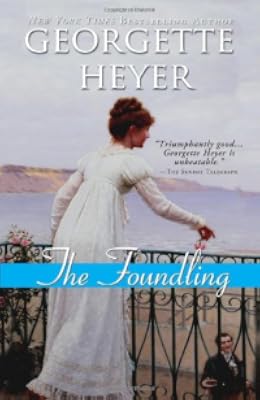
The Foundling
by Georgette Heyer
On This Page
Description
The Queen of Regency Romance, Georgette Heyer, delights readers with a charming tale of a duke who is tired of playing by the rules.The Duke of Sale is out to prove himself
The shy, young Duke of Sale has never known his parents. Instead, his Grace Adolphus Gillespie Vernon Ware, Gilly for short, has endured twenty-four years of rigorous mollycoddling from his uncle and valet. But his natural diffidence conceals a rebellious spirit.
A mysterious beauty provides the perfect opportunity
When show more Gilly hears of Belinda, the beautiful foundling who appears to be blackmailing his cousin, he escapes with glee. But he has no sooner entered this new and dangerous world than he is plunged into a frenzy of intrigue, kidnapping, adventure, and surprises at every turn.
Praise for Georgette Heyer and The Foundling:
"What happens when a many-titled Duke decides to play hooky from his suffocating dignity..."—Kirkus Reviews
"Reading Georgette Heyer is the next best thing to reading Jane Austen."—Publishers Weekly
. show less
Tags
Recommendations






















Member Reviews
Gilly, the meek Duke of Sale, decides to temporarily ditch his nagging household in exchange for a few days of peace as an anonymous Everyman. Instead, he spends his holiday foiling blackmailers, escaping kidnappers, and rescuing two feckless children.
Gilly makes an amazingly sweet protagonist. His adventures are rollicking, and his broadly drawn household provides the signature Heyer humor. The one false note is probably Belinda, the eponymous foundling, who is less a character and more a punchline. On the other hand, nobody reads Georgette Heyer for her multi-dimensional characters.
(As a side note, Gilly has a cousin, Gideon, who is tall, dark, and handsome. Gideon calls Gilly his "little one." Gideon flies into passionate rages when show more Gilly's life is threatened. Gideon has no apparent female associates. In another author, I think I would suspect a subtext.) show less
Gilly makes an amazingly sweet protagonist. His adventures are rollicking, and his broadly drawn household provides the signature Heyer humor. The one false note is probably Belinda, the eponymous foundling, who is less a character and more a punchline. On the other hand, nobody reads Georgette Heyer for her multi-dimensional characters.
(As a side note, Gilly has a cousin, Gideon, who is tall, dark, and handsome. Gideon calls Gilly his "little one." Gideon flies into passionate rages when show more Gilly's life is threatened. Gideon has no apparent female associates. In another author, I think I would suspect a subtext.) show less
If Heyer's books are all even half this good, I'm in for a rare old treat as I read my way through the library shelves.
This is more a coming of age tale, combined with a comedy of errors than it is a romance. Gilly is our hero (although he's far more Buttons than he is Prince Charming), and while he is Duke of Sale, he is cossetted, protected and smothered by his servants and his uncle such that he feels completely useless and unable to assert himself. To test his wings, he decides to head off on his own (actually to solve cousin Matthew's problem of breach of trust and a blackmailer). All in all he manages tolerably well, coping with the trials of a blackmailer, a stagecoach, an inn and acquiring a small ruffian (who has also run away show more from his overprotective father and an overbearing tutor) along the way. However at that point it all starts to go a little less swimmingly. Gilly also acquires the beautiful but empty headed Belinda (the foundling of the title) and gets himself into a far more dangerous scrape with a top notch rogue. All the while his servants and family are in uproar, trying to find him and thinking this all very out of character. It turns out to be the making of him.
This is such great fun. The story bowls along merrily, and there is an air of pantomime about this (that's not meant to be derogatory). Gilly is more Buttons than Charming, Gideon would be Charming (although he doesn't get the girl). For rogues we have Liversedge (boo) a highly personable rogue, but we also have Uncle Lionel, who could certainly be viewed as trying to suppress Gilly and keep him in the comfortable box of boy, not man.
I'm usually quite sparing with my stars, but this gets 5. It manages to be great fun and not leave you feeling that it's full of plot holes or daft writing.
This stands up on a re-read as well. Nothing wrong with spending a few hours with this one. show less
This is more a coming of age tale, combined with a comedy of errors than it is a romance. Gilly is our hero (although he's far more Buttons than he is Prince Charming), and while he is Duke of Sale, he is cossetted, protected and smothered by his servants and his uncle such that he feels completely useless and unable to assert himself. To test his wings, he decides to head off on his own (actually to solve cousin Matthew's problem of breach of trust and a blackmailer). All in all he manages tolerably well, coping with the trials of a blackmailer, a stagecoach, an inn and acquiring a small ruffian (who has also run away show more from his overprotective father and an overbearing tutor) along the way. However at that point it all starts to go a little less swimmingly. Gilly also acquires the beautiful but empty headed Belinda (the foundling of the title) and gets himself into a far more dangerous scrape with a top notch rogue. All the while his servants and family are in uproar, trying to find him and thinking this all very out of character. It turns out to be the making of him.
This is such great fun. The story bowls along merrily, and there is an air of pantomime about this (that's not meant to be derogatory). Gilly is more Buttons than Charming, Gideon would be Charming (although he doesn't get the girl). For rogues we have Liversedge (boo) a highly personable rogue, but we also have Uncle Lionel, who could certainly be viewed as trying to suppress Gilly and keep him in the comfortable box of boy, not man.
I'm usually quite sparing with my stars, but this gets 5. It manages to be great fun and not leave you feeling that it's full of plot holes or daft writing.
This stands up on a re-read as well. Nothing wrong with spending a few hours with this one. show less
Adolphus Gillespie Vernon Ware, the young Duke of Sale, had grown tired of being surrounded by his army of devoted and overprotective servants, his overbearing guardian uncle, and his well-meaning but stifling friends and family. He'd grown tired in fact, of being the Duke of Sale, and longed to experience life as "Mr. Dash, of Nowhere in Particular." When opportunity presented itself, in the form of a young cousin in trouble, Gilly set out on an adventure, and soon found himself entangled with an impetuous young runaway, a beautiful but very naive "foundling," and a kidnapping villain of great sensibility...
Despite its similarity (in parts) to some of Heyer's other novels - Sprig Muslin and Charity Girl in particular - The Foundling show more provided a quick, entertaining read, with a gentle charm of its own. Gilly may have been somewhat too mild, but his rebellion against the strictures placed upon him, and his gradual transformation from boy to man, made for an engaging coming-of-age tale. His romance with Lady Harriet was somewhat less appealing, and had the feel of an afterthought. One has to wonder, moreover, at the similar names that Heyer gives all these trustworthy "older" female friends, who always stand ready to assist her heroes with the young runaways they have undertaken to help: Lady Harriet, Lady Hester, and Henrietta... An unconscious acknowledgment on the author's part that they are essentially all the same character? One has to wonder... show less
Despite its similarity (in parts) to some of Heyer's other novels - Sprig Muslin and Charity Girl in particular - The Foundling show more provided a quick, entertaining read, with a gentle charm of its own. Gilly may have been somewhat too mild, but his rebellion against the strictures placed upon him, and his gradual transformation from boy to man, made for an engaging coming-of-age tale. His romance with Lady Harriet was somewhat less appealing, and had the feel of an afterthought. One has to wonder, moreover, at the similar names that Heyer gives all these trustworthy "older" female friends, who always stand ready to assist her heroes with the young runaways they have undertaken to help: Lady Harriet, Lady Hester, and Henrietta... An unconscious acknowledgment on the author's part that they are essentially all the same character? One has to wonder... show less
I don't really know what to say about this book. The writing is superb; really just near perfect. The dialog is crafted so well it just trips off the tongue, even though it's a speech pattern that's hardly common today.
And I genuinely liked Lord Sale and his cousin Gideon (him best of all, I think); I even didn't mind the pompous uncle and Tom was moderately amusing. I should give Heyer a fourth star just for that story about the two donkeys, a horse and a cow. But as for the rest...
Lord Sale's staff were insufferable. Heyer meant them to be, of course; that's a big point of the plot from the beginning, but she did her job so well it was tedious to endure the reading of it.
Liversedge was probably brilliant and towards the end even I show more thought the situation was hilarious, but the first half of the book his character was just smarmy.
But the character I save most of my ire for is Belinda. It was coincidence that I was reading this book the same time I was reading Grey Mask by Patricia Wentworth, but it was also perhaps karma having a go at me: I claimed nobody could be as stupid as Margot in Grey Mask and so the fates brought Belinda into my reading life. Belinda makes Margot look like a genius; Belinda makes air look literate. Belinda, in short, should have been institutionalised. Nobody – nobody – could be that vacuous and still show signs of life.
If this book failed at all it was with Heyer's decision to make Belinda too stupid to be believed. I could not be sympathetic to her story at any point because she was not even believable as an automaton. And because she played such a huge part in the middle of the book, the story dragged dangerously midway through and at one point, I just didn't want to finish it. Fortunately, the POV shifted to Gideon, and the story picked up pace considerably. The last half of the book was great, in fact: even though Belinda got to let her stupid shine to the very end, there was a lot less of her and the story focused on the characters that were interesting - the sentient ones.
The moral of this story: stupid people can ruin even the best story. show less
And I genuinely liked Lord Sale and his cousin Gideon (him best of all, I think); I even didn't mind the pompous uncle and Tom was moderately amusing. I should give Heyer a fourth star just for that story about the two donkeys, a horse and a cow. But as for the rest...
Lord Sale's staff were insufferable. Heyer meant them to be, of course; that's a big point of the plot from the beginning, but she did her job so well it was tedious to endure the reading of it.
Liversedge was probably brilliant and towards the end even I show more thought the situation was hilarious, but the first half of the book his character was just smarmy.
But the character I save most of my ire for is Belinda. It was coincidence that I was reading this book the same time I was reading Grey Mask by Patricia Wentworth, but it was also perhaps karma having a go at me: I claimed nobody could be as stupid as Margot in Grey Mask and so the fates brought Belinda into my reading life. Belinda makes Margot look like a genius; Belinda makes air look literate. Belinda, in short, should have been institutionalised. Nobody – nobody – could be that vacuous and still show signs of life.
If this book failed at all it was with Heyer's decision to make Belinda too stupid to be believed. I could not be sympathetic to her story at any point because she was not even believable as an automaton. And because she played such a huge part in the middle of the book, the story dragged dangerously midway through and at one point, I just didn't want to finish it. Fortunately, the POV shifted to Gideon, and the story picked up pace considerably. The last half of the book was great, in fact: even though Belinda got to let her stupid shine to the very end, there was a lot less of her and the story focused on the characters that were interesting - the sentient ones.
The moral of this story: stupid people can ruin even the best story. show less
Georgette Heyer's Regency romances never fail to entertain. In this romp, His Grace the Duke of Sale can't so much as sneeze without arousing a well-intentioned but smothering amount of cosseting and care. He has been raised by his uncle Lord Lionel and a large group of loving retainers, as his father died before he was born and his mother died giving birth to him. Now, at twenty-four years old, Adolphus Gillespie Vernon Ware decides to give them all the slip and handle his cousin's latest romantic debacle without their interference. It will be great fun, he decides, to be Mr Dash of Nowhere in Particular rather than His Grace the fantastically wealthy Duke. But he didn't reckon on meeting up with an incorrigible and mischievous young show more runaway — or a beautiful young foundling. It's a pity that she "hasn't two thoughts in her head to rub together"!
Once again Heyer creates believable characters who have more depth than their stock roles might imply. Gilly is naturally diffident and must learn to stand up not only to the swindling rogues he encounters, but also to his loving family and servants. Lord Lionel is the overbearing uncle, but he really does love his nephew and has no thought of doing away with him so that his own son, Gideon, might succeed his estates. Gideon is quite fun as the big-brotherly, confident captain who has far more faith in his little cousin Gilly's abilities than does anyone else. Even our scoundrel, the redoubtable Swithin Liversedge, does more than merely amuse with his rascally ways. He reminded me forcibly of Captain Wragge in Wilkie Collins' No Name; both are heartless swindlers that the reader can't help but like a little.
(And Heyer's names are so fun. I just love Gilly's valet's name — Nettlebed!)
The social commentary is not as sharp in this novel as in some of Heyer's others, though we do return to the idea — pressed upon Gilly and his betrothed Lady Harriet by their respective guardians — that it is quite normal and acceptable for both men and women in their high position to keep other lovers. According to this outlook, the best they must look for in their conjugal relations is complaisance. It's lovely to watch both of them get past this idea and realize that their marriage actually could be one of mutual love and respect. I would have liked to see a bit more of Harriet, but the adventure really is Gilly's and Harriet does play her part admirably at the end.
As this is Heyer, I need not say that the dialogue is wonderful, heavily peppered with Regency slang. I don't have to mention that the historical details are spot-on. Nor need I tell any Heyer fan how engaging (pun intended) the plot is. It is needless to reiterate how humorous the tangles get, or to state that the denouément is a satisfying one. Heyer fans already know all this, and readers new to Heyer will soon learn it. Great fun! show less
Once again Heyer creates believable characters who have more depth than their stock roles might imply. Gilly is naturally diffident and must learn to stand up not only to the swindling rogues he encounters, but also to his loving family and servants. Lord Lionel is the overbearing uncle, but he really does love his nephew and has no thought of doing away with him so that his own son, Gideon, might succeed his estates. Gideon is quite fun as the big-brotherly, confident captain who has far more faith in his little cousin Gilly's abilities than does anyone else. Even our scoundrel, the redoubtable Swithin Liversedge, does more than merely amuse with his rascally ways. He reminded me forcibly of Captain Wragge in Wilkie Collins' No Name; both are heartless swindlers that the reader can't help but like a little.
(And Heyer's names are so fun. I just love Gilly's valet's name — Nettlebed!)
The social commentary is not as sharp in this novel as in some of Heyer's others, though we do return to the idea — pressed upon Gilly and his betrothed Lady Harriet by their respective guardians — that it is quite normal and acceptable for both men and women in their high position to keep other lovers. According to this outlook, the best they must look for in their conjugal relations is complaisance. It's lovely to watch both of them get past this idea and realize that their marriage actually could be one of mutual love and respect. I would have liked to see a bit more of Harriet, but the adventure really is Gilly's and Harriet does play her part admirably at the end.
As this is Heyer, I need not say that the dialogue is wonderful, heavily peppered with Regency slang. I don't have to mention that the historical details are spot-on. Nor need I tell any Heyer fan how engaging (pun intended) the plot is. It is needless to reiterate how humorous the tangles get, or to state that the denouément is a satisfying one. Heyer fans already know all this, and readers new to Heyer will soon learn it. Great fun! show less
The Foundling by Georgette Heyer is less of a historical romance and much more of a comedy of errors with foundlings, runaway schoolboys, an incognito duke, kidnappers and assorted ruffians and more that a few concerned relatives charging about. The Duke of Sale has been cosseted and looked after by servants and family for his whole life. He is now coming into his majority and instead of handing the reins to him, everyone still seems to feel the need to protect him. His future wife has been picked out for him, and even though he has always been very fond of Harriet, he doesn’t feel great love for her. Breaking free of his traces, the duke goes off as a plain Mr. Rufford, on a quest to help a cousin out of a fix. Amid much mayhem and show more confusion, the duke learns not only to assert himself but that there are times when it is advantageous to be the Duke of Sale and to have a loving family to surround him. Most importantly of all, he and Harriet discover that love is blossoming between them and that they are meant to be together.
Georgette Heyer fills this book with some great characters that were a lot of fun to read about. From school boy Tom who finds trouble wherever he goes, to the totally empty-headed Belinda, even the villain of the piece, Mr. Liversedge was an interesting, full drawn rogue. The relationship between the duke and his betrothed was mature, believable and, I found, quite heart warming.
A coming-of-age story that is full of humor and adventure, Georgette Heyer has another winner with The Foundling. show less
Georgette Heyer fills this book with some great characters that were a lot of fun to read about. From school boy Tom who finds trouble wherever he goes, to the totally empty-headed Belinda, even the villain of the piece, Mr. Liversedge was an interesting, full drawn rogue. The relationship between the duke and his betrothed was mature, believable and, I found, quite heart warming.
A coming-of-age story that is full of humor and adventure, Georgette Heyer has another winner with The Foundling. show less
It has been so long since I have dipped into many of the books in my Georgette Heyer collection that reading them is like discovering the story for the first time. The Foundling is the story of the Duke of Sale who is so coddled by his retainers that he is unable to do anything for himself. When his young cousin confides his troubles to the Duke, Sale seizes on the excuse of helping his cousin and sets out on what he thinks will be a short adventure away from his retinue. Of course, nothing is that simple and he soon finds himself taking responsibility for a youth and then a strikingly lovely young woman, the foundling.
Once again I was charmed by Heyer’s tale and wit. I eagerly read the book from cover to cover in a very short time.
Once again I was charmed by Heyer’s tale and wit. I eagerly read the book from cover to cover in a very short time.
Members
- Recently Added By
Lists

Favorite Georgette Heyer Novels, Ranked
49 works; 29 members

Best Historical Fiction
620 works; 261 members

Books Read in 2021
5,361 works; 114 members

Books Read in 2023
5,638 works; 147 members

Books Read in 2017
4,249 works; 130 members
Author Information

125+ Works 78,174 Members
Georgette Heyer was born on August 16, 1902 at Wimbledon, London. She wrote The Black Moth as a story for her brother Boris. Her father, impressed with his daughter's imagination, suggested that she prepare it to be published, which it was by Constable in 1921. Having scored an instant success with The Black Moth at the age of nineteen under her show more own name, Georgette Heyer, she experimented with a pseudonym, Stella Martin, for her third book, published by Mills & Boon. She continued writing and in 1925 she married Ronald Rougier, a mining engineer. After reasonable but not spectacular sales from her first few books the instant success of These Old Shades in 1926 brought her a solid source of income which was very necessary at the time since the family relied to a large extent on the income from Georgette Heyer's writing. She wrote over fifty books during her lifetime and created the Regency England genre of romance novels. She died on July 4, 1974 at the age of 71. (Bowker Author Biography) show less
Some Editions
Series
Belongs to Publisher Series
rororo (1837)
Work Relationships
Common Knowledge
- Canonical title
- The Foundling
- Original publication date
- 1948; 1982 (Germany) (Germany)
- People/Characters
- Lord Adolphus Gillespie Vernon Ware, 7th Duke of Sale; Lady Harriet Presteigne; Samuel "Swithin" Liversedge; Belinda; Matthew Ware; Lord Lionel Ware (show all 20); Gideon Ware (Captain); Thomas "Tom" Mamble; Joseph Mimms; Nathaniel "Nat" Shifnal; Nettlebed; Lord Charles Gaywood; Mr Mamble; Mr Snape; Mrs Appleby; Captain Belper; Mr Moffat; Mrs Mudgley; Jasper Mudgley; The Dowager Lady Ampleforth
- Important places
- England, UK
- First words
- When the young gentleman strolling through the park with his gun on his shoulder and an elderly spaniel at his heels came within sight of the house it occurred to him that the hour must be further advanced than he had suppose... (show all)d, for the sun had sunk below the great stone pile, and an autumnal mist was already creeping over the ground.
- Quotations
- "That's the barber," he said cheerfully. "I thought you was backed at one time, guv'nor, but there's nothing like a real rum bub for a cull as has been greased. Not but what you didn't have no more than a lick, but I doubt it... (show all) done you good. I got some cat-lap here for you, seeing as how you was as sick as a cushion and maybe used to pap. If you was to sit up you could sup it down, couldn't you?"
- Last words
- (Click to show. Warning: May contain spoilers.)"Adolphus, my little one, I salute you!"
- Original language
- English
Classifications
Statistics
- Members
- 1,524
- Popularity
- 15,136
- Reviews
- 40
- Rating
- (3.79)
- Languages
- English, German, Italian
- Media
- Paper, Audiobook, Ebook
- ISBNs
- 36
- UPCs
- 2
- ASINs
- 36