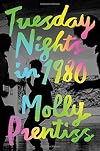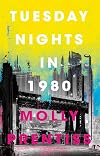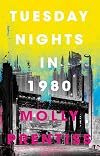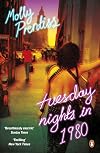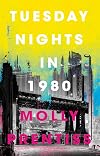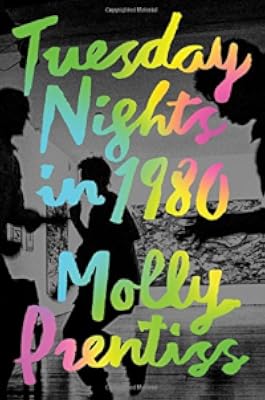
Tuesday Nights in 1980
by Molly Prentiss
On This Page
Description
Welcome to SoHo at the onset of the eighties: a gritty, not-yet-gentrified playground for artists and writers looking to make it in the big city. Among them: James Bennett, a synesthetic art critic for The New York Times whose unlikely condition enables him to describe art in profound, magical ways, and Raul Engales, an exiled Argentinian painter running from his past and the Dirty War that has enveloped his country. As the two men ascend in the downtown arts scene, dual tragedies strike, show more and each is faced with a loss that acutely affects his relationship to life and to art. It is not until they are inadvertently brought together by Lucy Olliason-- a small town beauty and Raul's muse-- and a young orphan boy sent mysteriously from Buenos Aires, that James and Raul are able to rediscover some semblance of what they've lost. show lessTags
Recommendations








Member Reviews
Spend enough time with New Yorkers and you'll get an earful about gentrification and Disneyfied Times Square. If you, too, reminisce about a grittier and more authentic NYC, you will enjoy Tuesday Nights in 1980. Time: The dawn of the '80's, the age of disco, women's lib, and just before AIDS, when everything felt wild and excessive. Setting: The arts scene of high end dealers, top auction houses, galleries in abandoned factories, and artist studios in rundown squats. The players: Raul, talented, broke painter on the cusp of notoriety and fame with a mystical connection to a sister left behind in dictatorial Argentina. Young, fresh-faced Lucy, newly arrived from the Midwest and ready to start life and adventure. Peculiar James, who show more turns his synesthesia into success as a top art critic. From disparate backgrounds, the three each find a way into the edgy art world and connect in ways surprising, erotic, and tragic. Each sustains a loss which may jeopardize their place in this rarified world.
I enjoyed learning about synesthesia, a condition in which the senses overlap. James can look at art and experience sounds, smells and flavors. Numbers and people take on explosive colors. Prentiss uses his unique experiences to make the art exciting, fresh and palpable. The narrative gained an immediacy by being always in the present -- one character picks up at exactly the point where another left off. I was rapt until the end and quite satisfied with the ending.
The publisher provided a copy of this book in exchange for an honest review. show less
I enjoyed learning about synesthesia, a condition in which the senses overlap. James can look at art and experience sounds, smells and flavors. Numbers and people take on explosive colors. Prentiss uses his unique experiences to make the art exciting, fresh and palpable. The narrative gained an immediacy by being always in the present -- one character picks up at exactly the point where another left off. I was rapt until the end and quite satisfied with the ending.
The publisher provided a copy of this book in exchange for an honest review. show less
The Short of It:
If a book can give you “feels” then this is the one to do it.
The Rest of It:
Synethesia: the production of a sense impression relating to one sense or part of the body by stimulation of another sense or part of the body.
James Bennett is an art critic but one unlike the ones you’ve read about in the past. James is synesthetic. He might experience a “taste” while looking at a painting, or he might “hear” a color, instead of just simply seeing a color. This gives him an edge in the art world but it also creates problems for him and his wife, as his obsession with certain pieces take over their lives.
This was such an interesting, and absorbing read. There are dual story lines in this novel and it is done so show more beautifully. It took me forever to read this one because nearly every other sentence was worthy of being highlighted. Prentiss does an amazing job capturing the New York art scene. It’s so vivid and full of life. Pulsing, really. There’s tragedy and hope and longing and it’s all so perfectly imperfect, if that makes any sense at all.
I adored this book. I need to own a copy in print just so I can hold it because fondling my Kindle copy is just not acceptable.
For more reviews, visit my blog: Book Chatter. show less
If a book can give you “feels” then this is the one to do it.
The Rest of It:
Synethesia: the production of a sense impression relating to one sense or part of the body by stimulation of another sense or part of the body.
James Bennett is an art critic but one unlike the ones you’ve read about in the past. James is synesthetic. He might experience a “taste” while looking at a painting, or he might “hear” a color, instead of just simply seeing a color. This gives him an edge in the art world but it also creates problems for him and his wife, as his obsession with certain pieces take over their lives.
This was such an interesting, and absorbing read. There are dual story lines in this novel and it is done so show more beautifully. It took me forever to read this one because nearly every other sentence was worthy of being highlighted. Prentiss does an amazing job capturing the New York art scene. It’s so vivid and full of life. Pulsing, really. There’s tragedy and hope and longing and it’s all so perfectly imperfect, if that makes any sense at all.
I adored this book. I need to own a copy in print just so I can hold it because fondling my Kindle copy is just not acceptable.
For more reviews, visit my blog: Book Chatter. show less
Set in the arts community of New York City in 1980, this book weaves together the events in the lives of three characters. James Bennett is an art critic who was treated as an outcast in his youth. Raul Engales is an orphaned immigrant artist whose sister still resides in Argentina. Lucy Olliason has just moved to the big city from her small town to get away from her parents and seek her own path. They are tied together by their love of art and a desire to escape the past.
I have mixed feelings about this book. I liked the character-driven storyline, but it gets a little predictable and melodramatic when a love triangle develops. I generally enjoy books that feature art, but the connection between art and the artist is missing here. show more Art, though purportedly central to their lives, seems more like a plot device, as does the child who appears toward the end. show less
I have mixed feelings about this book. I liked the character-driven storyline, but it gets a little predictable and melodramatic when a love triangle develops. I generally enjoy books that feature art, but the connection between art and the artist is missing here. show more Art, though purportedly central to their lives, seems more like a plot device, as does the child who appears toward the end. show less
The nostalgia factor here was a lot of fun—I arrived in downtown NYC in 1981, with the ink on my high school diploma not yet dry, and Prentiss's portrait of the Soho/E. Village arts community on the cusp of becoming the Next Big Thing, still energetic and dirty, was enjoyable. But the characters fell a bit flat for me—for all the narrative of their inner lives, I never engaged with them completely.
And there was an underlying sense of research, as opposed to experience—obviously the author would have to be in her 50s now to have been there, and that's not her fault, but the grit and the discomfort that accompanied all that glamour didn't quite make it off the page. Also a few factual errors that probably wouldn't have thrown me show more except for a passing mention of seeing what Prentiss clearly intended to be AIDS patients in a hospital—not in 1980, no; that would be a year later at the earliest. Anyway, that's a quibble. More important, it's hard to write about art and art-making (and art reviewing), and I didn't feel the power here. But it was a good first novel, and I look forward to seeing whatever she takes on next. show less
And there was an underlying sense of research, as opposed to experience—obviously the author would have to be in her 50s now to have been there, and that's not her fault, but the grit and the discomfort that accompanied all that glamour didn't quite make it off the page. Also a few factual errors that probably wouldn't have thrown me show more except for a passing mention of seeing what Prentiss clearly intended to be AIDS patients in a hospital—not in 1980, no; that would be a year later at the earliest. Anyway, that's a quibble. More important, it's hard to write about art and art-making (and art reviewing), and I didn't feel the power here. But it was a good first novel, and I look forward to seeing whatever she takes on next. show less
James is an art critic with synesthesia - a neurological phenomenon that crosses sensory pathways, allowing him to see sounds, hear colours - an ability that allows him to become one of the top art critics for the New York Times. A personal loss on New Years Eve of 1980, temporarily robs him of this ability and his career is sent spiralling downward. Raul is an artist with a connection to a sister left behind in politically unstable Argentina - an artist who, in James' opinion, is 'the next big thing'. Raul, too, suffers a tragic loss in 1980 - a loss that will forever impact his life as an artist. Lucy is a small town Midwest girl who moves to New York to experience life.
Over the course of one year, as the art world faces an show more unprecedented swell of commercialization, these three people connect and remake each other. James, Raul, and Lucy encounter the depths of fame, humanity, and loss, and are forced to redefine their relationship to art, beauty, and life.
I would assume that this is a reasonably accurate picture of the art world of New York in 1980 - my only experience into this world was taking a bus trip to the Museum of Modern Art to see the Picasso exhibit - hardly enough for me to know for certain. However, the book drew me in and I felt, just for those few hours while I read, that I was part of it. show less
Over the course of one year, as the art world faces an show more unprecedented swell of commercialization, these three people connect and remake each other. James, Raul, and Lucy encounter the depths of fame, humanity, and loss, and are forced to redefine their relationship to art, beauty, and life.
I would assume that this is a reasonably accurate picture of the art world of New York in 1980 - my only experience into this world was taking a bus trip to the Museum of Modern Art to see the Picasso exhibit - hardly enough for me to know for certain. However, the book drew me in and I felt, just for those few hours while I read, that I was part of it. show less
I could not pinpoint what exactly I loved about this book but I was so sad to finish it because I didn't want it to end. The story is a series of interconnected experience about a handful of people whose paths cross in 1980 in New York. The format works better than so many that attempt this type of thing. The alternating perspectives never overlap, so where one leaves off, another picks up. It gives you such a well rounded view of all of the people in the story. It was moving, it was interesting, and the writing about the art was so much fun! So glad I picked this one up.
“He loved the flaws; they were invariably the most interesting parts of people's faces and bodies, the parts that held the straightest lines, the most beautiful shadows".
― Molly Prentiss, Tuesday Nights in 1980
This book was gritty and dark and complex and touching and yet for some reason I could not get involved with it. I really don’t know why and usually with books that I am not drawn into there is a solid reason.
I think in the case of this book ,I have read lately, a lot of books on friends and cliques with many inter weaving stories so it’s possible that I am just burned out on the subject.
I also do not know much about art and I think the the more you know, the more interested in the story one might be.
What I did like very show more much was the depiction of life in New York City in the Eighties. I am a child of that time period so nothing makes me happier than reading books about it.
I would not call this by any means a bad book and I think most people would enjoy it but it wasn’t the right book for me at that time show less
― Molly Prentiss, Tuesday Nights in 1980
This book was gritty and dark and complex and touching and yet for some reason I could not get involved with it. I really don’t know why and usually with books that I am not drawn into there is a solid reason.
I think in the case of this book ,I have read lately, a lot of books on friends and cliques with many inter weaving stories so it’s possible that I am just burned out on the subject.
I also do not know much about art and I think the the more you know, the more interested in the story one might be.
What I did like very show more much was the depiction of life in New York City in the Eighties. I am a child of that time period so nothing makes me happier than reading books about it.
I would not call this by any means a bad book and I think most people would enjoy it but it wasn’t the right book for me at that time show less
Members
- Recently Added By
Lists

Kirkus Starred Fiction Reviews of Books Published in 2016
63 works; 3 members

Books Read in 2022
5,168 works; 114 members
Author Information

3 Works 392 Members
Molly Prentiss was born and raised in Santa. Cruz, California, and holds an MFA in Creative Writing from the California College of the Arts. She currently lives, writes, and walks around in Brooklyn, New York.
Awards and Honors
Common Knowledge
- Canonical title
- Tuesday Nights in 1980
- Original title
- Tuesday Nights in 1980
- Important places
- New York, New York, USA
Classifications
Statistics
- Members
- 310
- Popularity
- 103,168
- Reviews
- 19
- Rating
- (3.72)
- Languages
- 5 — Dutch, English, French, German, Portuguese (Portugal)
- Media
- Paper, Audiobook, Ebook
- ISBNs
- 16
- ASINs
- 4