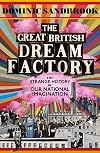
The Great British Dream Factory: The Strange History of Our National Imagination
by Dominic Sandbrook
On This Page
Description
Britain's empire has gone. Our manufacturing base is a shadow of its former self; the Royal Navy has been reduced to a skeleton. In military, diplomatic and economic terms, we no longer matter as we once did. And yet there is still one area in which we can legitimately claim superpower status: our popular culture. It is extraordinary to think that one British writer, J K Rowling, has sold more than 400 million books; that Doctor Who is watched in almost every developed country in the world; show more that James Bond has been the central character in the longest-running film series in history; that The Lord of the Rings is the second best-selling novel ever written (behind only A Tale of Two Cities); that the Beatles are still the best-selling musical group of all time; and that only Shakespeare and the Bible have sold more books than Agatha Christie. To put it simply, no country on earth, relative to its size, has contributed more to the modern imagination. This is a book about the success and the meaning of Britain's modern popular culture, from Bond and the Beatles to heavy metal and Coronation Street, from the Angry Young Men to Harry Potter, from Damien Hirst to The X Factor. show lessTags
Recommendations










Member Reviews
I thought that this book would be brilliant. I thought that it would be a treasure for the lovers of ALL THINGS BRITISH, like yours trully. Yeeeees...not quite...next time I'll take a moment to think again. I gave up at 40% annoyed and frustrated to the high heavens!
I don't know what the writer wanted to achieve. Was it a book about the history of British culture? Was it a chance to reminisce of the golden days? Was it simply to make fun- no, to ridicule- the Beatles, the Rolling Stones, Heavy Metal, J.K. Rowling, the Queen (the band, not the sovereign who seems to be the only one escaping his ''critic talons). Whatever his intentions were, he produced an utter failure. Chapters packed with information unrelated to his themes, although show more I failed to see what the themes were. Poor attempts to appear light-hearted and full of humour. Sarcasm with a good dose of unashamed elitism towards the cultural offerings that A) were not to his liking, or B) that were the products of other countries. Verbose style used to support his personal opinions, more like prejudices really. Downright racist comments over the origins of John Lennon or Mick Jagger or the members of Black Sabbath, sexist remarks regarding J.K. Rowling and other women artists. These are not the elements that should consist an adequate book about the British culture. The part of the world that helped in shaping so many images in so many expressions of Art deserves a much better account that this poorly executed, chauvinistic, full of prejudices creation. show less
I don't know what the writer wanted to achieve. Was it a book about the history of British culture? Was it a chance to reminisce of the golden days? Was it simply to make fun- no, to ridicule- the Beatles, the Rolling Stones, Heavy Metal, J.K. Rowling, the Queen (the band, not the sovereign who seems to be the only one escaping his ''critic talons). Whatever his intentions were, he produced an utter failure. Chapters packed with information unrelated to his themes, although show more I failed to see what the themes were. Poor attempts to appear light-hearted and full of humour. Sarcasm with a good dose of unashamed elitism towards the cultural offerings that A) were not to his liking, or B) that were the products of other countries. Verbose style used to support his personal opinions, more like prejudices really. Downright racist comments over the origins of John Lennon or Mick Jagger or the members of Black Sabbath, sexist remarks regarding J.K. Rowling and other women artists. These are not the elements that should consist an adequate book about the British culture. The part of the world that helped in shaping so many images in so many expressions of Art deserves a much better account that this poorly executed, chauvinistic, full of prejudices creation. show less
Dominic Sandbrook has certainly proved his credentials as a sound compiler of contemporary history. This book is an enjoyable departure from his narratives of recent British history. The book started out as a 'book of the TV series' to accompany yet another BBC documentary from Mr Sandbrook, however he has really gone the extra mile in producing a 688 page thumper of a volume.
Sandbrook either saw this book as a more informal volume (hopefully) or his Daily Mail column writing is making him a bit overconfident in presenting his own opinions. The personal voice is certainly strong, however it makes for a good read in what is a bit of a less serious history. Those who criticise the book should read the preface where Sandbrook promises that show more conehead cultural historians will "search in vain for the opaque theoretical discussions, invented abstract nouns and interminable references to obscure Continental theorists". The book also has no intention of being encyclopedic. The focus is set very much on the popular and middle of the road. This is an interesting decision as a pure celebration of cultural output and the "national imagination" isn't automatically going to focus on 'low brow' output. Sandbrook in his preface narrows his interest to 'popular culture' although isn't interested in endlessly complex definitions of this term. He quotes United States Supreme Court justice Potter Stewart's definition of pornography: "you know it when you see it". In Sandbrook's case you'll find the Beatles, Agatha Christie and Doctor Who but no Harrison Birtwistle (a modernist classical composer that I admit I had to look up).
The focus on the popular would be justified by the hint in the title that part of his argument is that the 'cultural industry' has indeed been seen as a replacement for the mass production of British industry up until the mid-twentieth century. Sandbrook makes surprisingly little of the argument that Britain's "punching above its weight" culturally has been a compensation for the loss of empire and industrial supremacy.
He is more interested in the considerable amount of continuity between the Victorian era and today.
This well written book is an enjoyable meander through very popular culture. The structure is pretty loose - or a jigsaw puzzle in the author’s words. Part One generally explores the transition from making things to telling stories. Part Two contends that popular culture generally supports the established order, examples ranging from sections on 1960s stars like the Rolling Stones buying country homes (I was never quite sure how this section really fit in although it was interesting) to Harry Potter as a derivation from the traditional nineteenth century school story. Part Three continues in a similar theme in a sense, exploring cultural artefacts ranging from Doctor Who to Lord of the Flies, and how they derive from Dickens and Welles. The fourth part looks at the cult of the individual which Sandbrook traces back to Self Help by Samuel Smiles.
The book is deliberately provocative in places. Sandbrook rehabilitates Catherine Cookson for example, commending her raw and real portrayal of the struggles of working class life despite her lack of popularity with intellectual critics, who were outraged at her portrayal. The section which seems to have garnered the most furious responses online however is that dealing with John Lennon. Sandbrook pulls no punches: “Whatever you think of Lennon’s talent, his sheer narcissism is hard to overstate”. His coverage has attracted cries of being “hateful trash”. Yet while I would say that as elsewhere Sandbrook is writing with verve and attitude to entertain to some extent, everything he says is verifiable. He does point out that “far more than any other rock star of his generation, and more even than his fellow Beatles, John Lennon is a figure of colossal symbolic importance”. Also despite Lennon’s motivations often being driven by a desire to be rich and notorious, he does acknowledge that there is a reason for his success - his undeniable talent. I strongly disagree with his assessment of Imagine - it might be hypocritical but as Sandbrook states elsewhere, the public have voted repeatedly in the charts and polls. Its a great song!
That said Sandbrook deserves plenty of credit for this book. Much more than a book of the TV series, this is a well researched and informative wander through the pleasures of British popular culture.
PS: I really wish Dominic Sandbrook would stop referring to Margaret Thatcher as "Mrs Thatcher". He doesn't call Edward Heath "Mr Heath" etc. It seems very partisan show less
Sandbrook either saw this book as a more informal volume (hopefully) or his Daily Mail column writing is making him a bit overconfident in presenting his own opinions. The personal voice is certainly strong, however it makes for a good read in what is a bit of a less serious history. Those who criticise the book should read the preface where Sandbrook promises that show more conehead cultural historians will "search in vain for the opaque theoretical discussions, invented abstract nouns and interminable references to obscure Continental theorists". The book also has no intention of being encyclopedic. The focus is set very much on the popular and middle of the road. This is an interesting decision as a pure celebration of cultural output and the "national imagination" isn't automatically going to focus on 'low brow' output. Sandbrook in his preface narrows his interest to 'popular culture' although isn't interested in endlessly complex definitions of this term. He quotes United States Supreme Court justice Potter Stewart's definition of pornography: "you know it when you see it". In Sandbrook's case you'll find the Beatles, Agatha Christie and Doctor Who but no Harrison Birtwistle (a modernist classical composer that I admit I had to look up).
The focus on the popular would be justified by the hint in the title that part of his argument is that the 'cultural industry' has indeed been seen as a replacement for the mass production of British industry up until the mid-twentieth century. Sandbrook makes surprisingly little of the argument that Britain's "punching above its weight" culturally has been a compensation for the loss of empire and industrial supremacy.
He is more interested in the considerable amount of continuity between the Victorian era and today.
This well written book is an enjoyable meander through very popular culture. The structure is pretty loose - or a jigsaw puzzle in the author’s words. Part One generally explores the transition from making things to telling stories. Part Two contends that popular culture generally supports the established order, examples ranging from sections on 1960s stars like the Rolling Stones buying country homes (I was never quite sure how this section really fit in although it was interesting) to Harry Potter as a derivation from the traditional nineteenth century school story. Part Three continues in a similar theme in a sense, exploring cultural artefacts ranging from Doctor Who to Lord of the Flies, and how they derive from Dickens and Welles. The fourth part looks at the cult of the individual which Sandbrook traces back to Self Help by Samuel Smiles.
The book is deliberately provocative in places. Sandbrook rehabilitates Catherine Cookson for example, commending her raw and real portrayal of the struggles of working class life despite her lack of popularity with intellectual critics, who were outraged at her portrayal. The section which seems to have garnered the most furious responses online however is that dealing with John Lennon. Sandbrook pulls no punches: “Whatever you think of Lennon’s talent, his sheer narcissism is hard to overstate”. His coverage has attracted cries of being “hateful trash”. Yet while I would say that as elsewhere Sandbrook is writing with verve and attitude to entertain to some extent, everything he says is verifiable. He does point out that “far more than any other rock star of his generation, and more even than his fellow Beatles, John Lennon is a figure of colossal symbolic importance”. Also despite Lennon’s motivations often being driven by a desire to be rich and notorious, he does acknowledge that there is a reason for his success - his undeniable talent. I strongly disagree with his assessment of Imagine - it might be hypocritical but as Sandbrook states elsewhere, the public have voted repeatedly in the charts and polls. Its a great song!
That said Sandbrook deserves plenty of credit for this book. Much more than a book of the TV series, this is a well researched and informative wander through the pleasures of British popular culture.
PS: I really wish Dominic Sandbrook would stop referring to Margaret Thatcher as "Mrs Thatcher". He doesn't call Edward Heath "Mr Heath" etc. It seems very partisan show less
As a district reporter for the BBC in Lincolnshire, I was once asked to put together an obit for Bernie Taupin, Elton John’s lyricist, who grew up just outside Sleaford. I dutifully flew a Taupin expert in from the US, and spent a week driving round the Wolds and interviewing him in various country pubs like the Aston Arms in Market Rasen, the suspiciously calm birthplace of ‘Saturday Night’s Alright (For Fighting)’. It was strange to realise that when you listen to those early albums you’re hearing about the landscape of rural Lincolnshire; it was Bernie, not Elton, who grew up on a farm and fantasised about ‘going back to my plough’.
The funny thing was that I had never thought of those songs as being very British. In a show more way they’re not (Taupin was always obsessed with Americana, and tended to write in a bland transatlantic patois), but this was also part of a familiar process by which it was brought home to me that cultural entities I vaguely knew about – Alfred Hitchcock, say, or Charlie Chaplin – were somehow a part of my own background or environment. I found such experiences coming back to me as I bombed through this cheerful primer on modern British culture, which ranges from the origins of heavy metal in the steel mills of the West Midlands, to the unexpected consonance between Billy Elliot and Thatcherism.
Surveys like this are necessarily selective, but the particular joy of Sandbrook’s approach is his relentless attention to populism: this is an account of what British people have actually been interested in, rather than what books like this usually give you, which is what people were supposed to have been interested in. So Elton John is pored over at the expense of contemporaries like David Bowie (dismissed as appealing mainly to ‘university-educated males’); instead of Oscar Wilde, David Lean and Salman Rushdie, we get Catherine Cookson, Andrew Lloyd Webber and Coronation Street.
That’s not to say Sandbrook considers these things to have comparable artistic merit – quite often he doesn’t (and he can be quite scathing about it. The trite moral messages of the Harry Potter books, for instance – it takes courage to stand up to your enemies, Harry, but even greater courage to stand up to your friends etc. – are described as being like ‘the kind of thing Tony Blair might once have told his party conference’). But looking at these things gives him all kinds of new avenues into the national mindset; friends and followers who enjoy seeing ‘low’ culture picked apart with the tools of ‘high’ culture should find a lot to enjoy here.
Not the least of the pleasures on offer is Sandbrook’s delight in deriding all the high-minded critics who have pooh-poohed his case studies; some of these are fairly predictable (the Daily Mail in 1956 on rock ‘n’ roll: ‘It is deplorable. It is tribal. And it is from America’), but others come as a bit of a surprise (Clancy Sigal’s conclusion in The New Statesman that ‘Coronation Street gently rapes you’).
It’s rather debatable whether he actually reaches any meaningful conclusions, beyond some fairly uncontroversial maxims about how youth culture is more conservative than everyone thinks it is, but the route taken is so unexpected that I never felt hard done by. And sometimes, as with Sandbrook’s relation of the almost unbelievably grim and upsetting childhood of Catherine Cookson, I felt I was getting something that no other book of this sort would bother to go within a hundred yards of.
Bernie Taupin, by the way, is still alive and well on his Californian ranch and my film is still languishing in the Look North archives. Though 2016 still has a few days to go yet. show less
The funny thing was that I had never thought of those songs as being very British. In a show more way they’re not (Taupin was always obsessed with Americana, and tended to write in a bland transatlantic patois), but this was also part of a familiar process by which it was brought home to me that cultural entities I vaguely knew about – Alfred Hitchcock, say, or Charlie Chaplin – were somehow a part of my own background or environment. I found such experiences coming back to me as I bombed through this cheerful primer on modern British culture, which ranges from the origins of heavy metal in the steel mills of the West Midlands, to the unexpected consonance between Billy Elliot and Thatcherism.
Surveys like this are necessarily selective, but the particular joy of Sandbrook’s approach is his relentless attention to populism: this is an account of what British people have actually been interested in, rather than what books like this usually give you, which is what people were supposed to have been interested in. So Elton John is pored over at the expense of contemporaries like David Bowie (dismissed as appealing mainly to ‘university-educated males’); instead of Oscar Wilde, David Lean and Salman Rushdie, we get Catherine Cookson, Andrew Lloyd Webber and Coronation Street.
That’s not to say Sandbrook considers these things to have comparable artistic merit – quite often he doesn’t (and he can be quite scathing about it. The trite moral messages of the Harry Potter books, for instance – it takes courage to stand up to your enemies, Harry, but even greater courage to stand up to your friends etc. – are described as being like ‘the kind of thing Tony Blair might once have told his party conference’). But looking at these things gives him all kinds of new avenues into the national mindset; friends and followers who enjoy seeing ‘low’ culture picked apart with the tools of ‘high’ culture should find a lot to enjoy here.
Not the least of the pleasures on offer is Sandbrook’s delight in deriding all the high-minded critics who have pooh-poohed his case studies; some of these are fairly predictable (the Daily Mail in 1956 on rock ‘n’ roll: ‘It is deplorable. It is tribal. And it is from America’), but others come as a bit of a surprise (Clancy Sigal’s conclusion in The New Statesman that ‘Coronation Street gently rapes you’).
It’s rather debatable whether he actually reaches any meaningful conclusions, beyond some fairly uncontroversial maxims about how youth culture is more conservative than everyone thinks it is, but the route taken is so unexpected that I never felt hard done by. And sometimes, as with Sandbrook’s relation of the almost unbelievably grim and upsetting childhood of Catherine Cookson, I felt I was getting something that no other book of this sort would bother to go within a hundred yards of.
Bernie Taupin, by the way, is still alive and well on his Californian ranch and my film is still languishing in the Look North archives. Though 2016 still has a few days to go yet. show less
I’m not at my best right now thanks to a respiratory virus, so found this book intermittently heavy going. It’s a history of Britain’s cultural impact on the world, told through a series of case studies, including the Beatles, Catherine Cookson, and Doctor Who. Inevitably, the appeal of each is coloured both by the writer and reader’s respective opinion of them. Thus I was most interested in the chapters on Agatha Christie (having devoured most of her books when I was 12), novels about country houses (although there were no especially memorable insights there), and science fiction (well, H G Wells and John Wyndham). I had less interest in detailed analysis of Coronation Street (never watched), Tom Brown’s Schooldays (never show more read), and Grand Theft Auto (never played). This is not to say that I don’t care about aspects of pop culture unless they already interest me; it's interesting to examine what has significant popular impact. However, I found the analysis here rather superficial, so it wasn’t much fun to read unless something I actually cared about was under discussion. For instance, James Bond is obviously examined in some detail, without any new insights. Yes, he harks back to an Imperial Britain that no longer existed once he became popular. He's a male power fantasy on an individual and national level, that's not a groundbreaking concept.
The main thesis of the book is that Britain is mired in nostalgia, which is being commoditised by the cultural and arts sector of the economy. Our popular culture is pervaded with fear of the present and future, leading to an idealisation of the past. This theme is covered in a much more incisive and acerbic fashion by Owen Hatherley in [b:The Ministry of Nostalgia|25430804|The Ministry of Nostalgia|Owen Hatherley|http://images.gr-assets.com/books/1442379863s/25430804.jpg|45191299]. There is a lot of fascinating class stuff involved, which ‘The Great British Dream Factory’ only touches on anecdotally. That’s why I didn’t enjoy the book more, I think. It’s too anecdotal and all those factoids didn’t seem to add up to a huge amount for a 650 page book. show less
The main thesis of the book is that Britain is mired in nostalgia, which is being commoditised by the cultural and arts sector of the economy. Our popular culture is pervaded with fear of the present and future, leading to an idealisation of the past. This theme is covered in a much more incisive and acerbic fashion by Owen Hatherley in [b:The Ministry of Nostalgia|25430804|The Ministry of Nostalgia|Owen Hatherley|http://images.gr-assets.com/books/1442379863s/25430804.jpg|45191299]. There is a lot of fascinating class stuff involved, which ‘The Great British Dream Factory’ only touches on anecdotally. That’s why I didn’t enjoy the book more, I think. It’s too anecdotal and all those factoids didn’t seem to add up to a huge amount for a 650 page book. show less
A fairly exhaustive, run through topics of particular, British culture and imagination, essentially over the last 50 years with some allegory is to previous cultural phenomena. This is interesting, fun, time is humorous, and interesting reading. For those with an interest in social commentary, social studies, cultural studies, history of British television, and film, actors and actresses then this is for you! I think that not only is the narrator excellent as a voice actor, but I think Dominic Sam Brooks chatty style does well to draw you in. Well recommended.
Entertaining history, a look inside British cultural influence from various fictions, films, and music; with references to political incidences at the time. The book mainly focused on literature, and contained synopses of many major and some minor works. Enjoyable and enlightening.
Geschenk von Merle
Jul 3, 2025German
Members
- Recently Added By
Author Information

38+ Works 1,809 Members
Awards and Honors
Distinctions
The Guardian Book of the Day (2015-09-21)
Common Knowledge
- Canonical title
- The Great British Dream Factory: The Strange History of Our National Imagination
- Original publication date
- 2015-10-01
- People/Characters
- Monica Ali; Kingsley Amis; King Arthur; Arnold Bennett; Chris Blackwell; James Bond (show all 76); David Bowie; John Braine; Benjamin Britten; Tom Brown; Anthony Buckeridge; Billy Bunter; Agatha Christie; Sean Connery; Catherine Cookson; Charles Dickens; Jim Dixon; The Doctor; Elizabeth II, Queen of the United Kingdom; Julian Fellowes; Bryan Ferry; Harry Flashman; Ian Fleming; William Golding; Gollum; Lew Grade; Peter Grimes; Lee Hall; Charles Hamilton (Frank Richards); George Harrison; Damien Hirst; Thomas Hughes; Tony Iommi; Mick Jagger; J. C. T. Jennings; Elton John; Brian Jones; Hanif Kureishi; Verity Lambert; Joe Lampton; John Lennon; Andrew Lloyd Webber; Boby Marley; Jane Marple; Paul McCartney; Patrick McGoohan; John Everett Millais; Sydney Newman; Yoko Ono; George Orwell; Harry Palmer; Mervyn Peake; Hercule Poirot; Harry James Potter; David Puttnam; J. Arthur Rank; Keith Richards; Diana Rigg; J. K. Rowling; Charles Saatchi; Ridley Scott; Number Six; Millie Small; Samuel Smiles; Chris Smith; Ringo Starr; Margaret Thatcher; J. R. R. Tolkien; Tony Warren; Charlie Watts; Evelyn Waugh; C. E. Webber; H. G. Wells; T. H. White; P. G. Wodehouse; Bill Wyman
- Important places
- Birmingham, England, UK; Coronation Street, Weatherfield, England, UK; Easington, County Durham, England, UK; Jamaica; Jarrow, Tyne and Wear, England, UK; London, England, UK (show all 7); The Village
- Important events
- World War I (1914 | 1918); World War II (1939 | 1945); Miners' Strike
- Original language
- English
Classifications
- Genres
- Nonfiction, History, General Nonfiction, Literature Studies and Criticism, Art & Design
- DDC/MDS
- 306.0941 — Society, government, & culture Social sciences, sociology & anthropology Social Behavior - Dating, Marriage, Divorce Social history Europe British Isles
- LCC
- HN385.5 .S25 — Social sciences Social history and conditions. Social problems. Social reform Social history and conditions. Social problems. By region or country
- BISAC
Statistics
- Members
- 110
- Popularity
- 295,561
- Reviews
- 7
- Rating
- (4.33)
- Languages
- English
- Media
- Paper, Audiobook, Ebook
- ISBNs
- 4
- ASINs
- 2