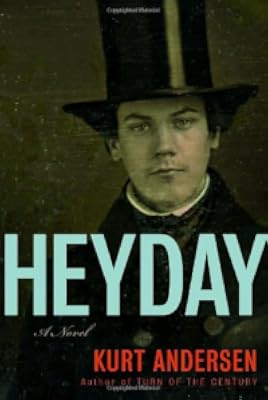
Heyday
by Kurt Andersen
On This Page
Description
Englishman Benjamin Knowles heads for America to build a new life and joins up with three young Americans--journalist Timothy Skaggs, war veteran Duff Lucking, and Duff's actress sister, Polly--to seek their fortunes in the gold fields of California.Tags
Recommendations









Member Reviews
"Heyday" may not be the ultimate novel of 19th century America, but it's certainly worthy of consideration. This is a sweeping, epic book; it takes up certain prominent personalities and events from the time. The Mexican War, the Gold Rush, the health and medical fads of the time, the sweep of revolution in Europe in 1848.
Although the surviving couple, Ben and Polly, absorb and merit the lion's share of our sympathy, perhaps the most intriguing character is the doomed Duff Lucking. A deserter during the Mexican War, he left the army for humanitarian purposes. He ends keeping to his ideals, but committing a long series of crimes, murder and arson, according to his reading of his principles. A devout Catholic, he understands the show more similarities between the Gospels and the teachings of the Maidu, the Indian tribe he joins at the end of the book.
Against the large canvas of pioneering across America, the sweeping events take place. We have cameos by Charles Darwin, Franklin Pierce, Abraham Lincoln, John C. Fremont - all at least tangentially involved in the unfolding story.
I enjoyed this book thoroughly. It's epic, and thought-provoking, personal in focus, and national in scale. Pick it up, take a deep breath, and plunge in!
http://bassoprofundo1.blogspot.com/2010/07/black-robe-by-brian-moore.html show less
Although the surviving couple, Ben and Polly, absorb and merit the lion's share of our sympathy, perhaps the most intriguing character is the doomed Duff Lucking. A deserter during the Mexican War, he left the army for humanitarian purposes. He ends keeping to his ideals, but committing a long series of crimes, murder and arson, according to his reading of his principles. A devout Catholic, he understands the show more similarities between the Gospels and the teachings of the Maidu, the Indian tribe he joins at the end of the book.
Against the large canvas of pioneering across America, the sweeping events take place. We have cameos by Charles Darwin, Franklin Pierce, Abraham Lincoln, John C. Fremont - all at least tangentially involved in the unfolding story.
I enjoyed this book thoroughly. It's epic, and thought-provoking, personal in focus, and national in scale. Pick it up, take a deep breath, and plunge in!
http://bassoprofundo1.blogspot.com/2010/07/black-robe-by-brian-moore.html show less
Let me begin by saying that after I had read the first chapter or so, I thought "oh no! Is this what all of the noise about this book is about?" and nearly, yes, nearly put it down. But I was all alone and already curled up under the covers and didn't feel like getting up for another book, so I kept on. And I kept on, and I kept on, and soon it was 3 a.m and I was on page 489, with an alarm clock set to go off at 7 a.m. so I made myself put the book down & go to sleep. This morning, after everything I had to do was taken care of, I went back to it, and sat on my patio until I had finished every page. I wanted more more more!!!!!!!!!!! I LOVED this book. Absolutely. No question. It is hands down one of the best I've read this year. I show more VERY HIGHLY recommend it to anyone who loves a good romp through history, complete with satire and a bit of comedy. I don't know if the author's intention was to make a parody from similar types of novels, but it was really a bit over the top, but not in a bad way at all. Do yourself a favor & pick this one up.
I can't really offer much of a synopsis this time; this is one of those books that defy summarizing; you've simply got to read it for yourself.
The year is 1848, a very busy one throughout Europe and in the United States. Englishman Benjamin Knowles has come to America via London just after the 1848 revolution in France (see this link if you're interested in the history of the 1848 Revolution in France) and is seized with excitement about being on the forefront of the changes that mankind is about to experience. He is a friend and fan of Charles Darwin and is ready to put Darwin's ideas to the test in what he sees as a new day for humankind. As the story progresses, Benjamin meets with a group of people who are somewhat like-minded, and as one thing leads to the next, they find themselves leaving New York behind and heading out west, and it's one adventure after the other until they reach the goldfields of California. It's like the author tried to catch the essence of what it meant to be alive in the year 1848, and he succeeds. There is every bit the anti-war sentiment, the issue of slavery and race, what "progress" means and above all, the idea that although we're currently sitting in the 21st century, things at some levels haven't really changed not only in America, or the world, but for mankind as well. On pages 616 and 617 three of the main characters are discussing the Buddhist belief that the "world and the universe have been destroyed and remade over and over again," and that "everything repeats, perpetually." One of the characters notes that rather than the cycles of creation and destruction (another one of the main themes here) coming in circular patterns, she thinks that they should be thought of as being in a "spiral, where nature an mankind changes and improves a little each time. Inches upward."
What makes this book are the characters, of which the year 1848 is just as much personified with as much realism and life as the people. You can just feel the change in the air as you read this book; it is one of those rare books where you can sense things coming to life as you read through it. I feel badly that I cannot summarize it and do it any justice, but trust me; you're going to love it. You've heard the term "sweeping" in relation to novels before, and this one defines it. And not only that, but it's actually FUN to read. I can't recommend this one highly enough. It is truly one of those books you have to experience. show less
I can't really offer much of a synopsis this time; this is one of those books that defy summarizing; you've simply got to read it for yourself.
The year is 1848, a very busy one throughout Europe and in the United States. Englishman Benjamin Knowles has come to America via London just after the 1848 revolution in France (see this link if you're interested in the history of the 1848 Revolution in France) and is seized with excitement about being on the forefront of the changes that mankind is about to experience. He is a friend and fan of Charles Darwin and is ready to put Darwin's ideas to the test in what he sees as a new day for humankind. As the story progresses, Benjamin meets with a group of people who are somewhat like-minded, and as one thing leads to the next, they find themselves leaving New York behind and heading out west, and it's one adventure after the other until they reach the goldfields of California. It's like the author tried to catch the essence of what it meant to be alive in the year 1848, and he succeeds. There is every bit the anti-war sentiment, the issue of slavery and race, what "progress" means and above all, the idea that although we're currently sitting in the 21st century, things at some levels haven't really changed not only in America, or the world, but for mankind as well. On pages 616 and 617 three of the main characters are discussing the Buddhist belief that the "world and the universe have been destroyed and remade over and over again," and that "everything repeats, perpetually." One of the characters notes that rather than the cycles of creation and destruction (another one of the main themes here) coming in circular patterns, she thinks that they should be thought of as being in a "spiral, where nature an mankind changes and improves a little each time. Inches upward."
What makes this book are the characters, of which the year 1848 is just as much personified with as much realism and life as the people. You can just feel the change in the air as you read this book; it is one of those rare books where you can sense things coming to life as you read through it. I feel badly that I cannot summarize it and do it any justice, but trust me; you're going to love it. You've heard the term "sweeping" in relation to novels before, and this one defines it. And not only that, but it's actually FUN to read. I can't recommend this one highly enough. It is truly one of those books you have to experience. show less
If you're in need of a nice long historical fiction novel to read over your holiday break, I can do little more than to recommend Kurt Andersen's Heyday (Random House, 2007). It's a sprawling, adventuresome look at American culture of the late 1840s, with its utopian communities, growing cities, racial and social tensions, and endless temptations.
Andersen's major characters - memorable all - include erstwhile English émigré Benjamin Knowles, freethinking actress Polly Lucking and her former soldier brother Duff (whose troubles neither began nor ended with traumas sustained during the war with Mexico), plus the carousing Timothy Skaggs, a fascinating writer/photographer/astronomer (whose earlier adventures would make a delightful show more prequel, should Andersen feel up for it). This quartet, once united, find themselves caught up in a series of cross-continental adventures which, improbable as they may be, make for a fun read (after a rather slow start to the book, it picks up pace quickly).
I enjoyed the cameo appearances by various historical figures (including Poe, Darwin, Pinkerton, Tocqueville, and Lincoln's law partner James Herndon, among others), although as they kept happening the effect wore a little thin. I do wish that Andersen had included a note about his research (obviously extensive) and how he incorporated the historical details into his story.
All in all, an absorbing and detailed book, which I enjoyed a great deal.
http://philobiblos.blogspot.com/2008/12/book-review-heyday.html show less
Andersen's major characters - memorable all - include erstwhile English émigré Benjamin Knowles, freethinking actress Polly Lucking and her former soldier brother Duff (whose troubles neither began nor ended with traumas sustained during the war with Mexico), plus the carousing Timothy Skaggs, a fascinating writer/photographer/astronomer (whose earlier adventures would make a delightful show more prequel, should Andersen feel up for it). This quartet, once united, find themselves caught up in a series of cross-continental adventures which, improbable as they may be, make for a fun read (after a rather slow start to the book, it picks up pace quickly).
I enjoyed the cameo appearances by various historical figures (including Poe, Darwin, Pinkerton, Tocqueville, and Lincoln's law partner James Herndon, among others), although as they kept happening the effect wore a little thin. I do wish that Andersen had included a note about his research (obviously extensive) and how he incorporated the historical details into his story.
All in all, an absorbing and detailed book, which I enjoyed a great deal.
http://philobiblos.blogspot.com/2008/12/book-review-heyday.html show less
Heyday follows the story of four young Americans during the tumultuous years of 1848-9. The novel opens in Paris in February 1948, when the aristocratic Englishman Ben Knowles witnesses an uprising. Eventually, he escapes to the United States, where he quickly befriends Polly and Duff Lucking, and Timothy Skaggs. They’re each of them unique, quirky characters, and I enjoyed reading about them as they make a transcontinental voyage to California followed by a Frenchman in search of vengeance. It’s a journey that’s at once exciting and full of danger.
I had mixed feelings about Heyday. I’ve been reading reviews about the book on Amazon.com, and my grumblings about the novel are pretty much the same as theirs are. The four main show more characters become involved—accidentally or no—with nearly every moment of historical significance in 1848 and -9. However, despite all the change that surrounds them, Ben, Polly, Duff, and Skaggs don’t really seem to change that much themselves. I like to see characters grow and expand in a novel, not remain static. They also seemed like 21st-century people who just happened to drop in on the 1840s. Sometimes the dialogue and events didn’t ring true to me. And I thought that Ben and Polly’s relationship could have been fleshed out a bit.
Another complaint I have about the book is the fact that Andersen name-drops a lot. It seems that the four main characters run into every real person of significance of the period. I’m all for historical veracity, but not if it’s going to be superfluous. Along the way, for example, we meet Charles Darwin, Walt Whitman, Horace Greely, and hear from Brigham Young. But none of those characters plays significantly in the narrative. Rather, all the name dropping detracts from the story.
All that said, however, Andersen did a terrific amount of research, the kind you don’t nearly run into in novels of this caliber. The overarching theme of the book is that life is in the timing. It’s only coincidence that these four idiosyncratic characters live in this particular period and witness and do all that they do. It’s a completely fantastic historical backdrop and one that I enjoyed reading about. show less
I had mixed feelings about Heyday. I’ve been reading reviews about the book on Amazon.com, and my grumblings about the novel are pretty much the same as theirs are. The four main show more characters become involved—accidentally or no—with nearly every moment of historical significance in 1848 and -9. However, despite all the change that surrounds them, Ben, Polly, Duff, and Skaggs don’t really seem to change that much themselves. I like to see characters grow and expand in a novel, not remain static. They also seemed like 21st-century people who just happened to drop in on the 1840s. Sometimes the dialogue and events didn’t ring true to me. And I thought that Ben and Polly’s relationship could have been fleshed out a bit.
Another complaint I have about the book is the fact that Andersen name-drops a lot. It seems that the four main characters run into every real person of significance of the period. I’m all for historical veracity, but not if it’s going to be superfluous. Along the way, for example, we meet Charles Darwin, Walt Whitman, Horace Greely, and hear from Brigham Young. But none of those characters plays significantly in the narrative. Rather, all the name dropping detracts from the story.
All that said, however, Andersen did a terrific amount of research, the kind you don’t nearly run into in novels of this caliber. The overarching theme of the book is that life is in the timing. It’s only coincidence that these four idiosyncratic characters live in this particular period and witness and do all that they do. It’s a completely fantastic historical backdrop and one that I enjoyed reading about. show less
A historical novel with lots of attention to detail and character development. The first third lulls but the story picks up considerably when everyone heads out west towards a climax in the crazy first days of the California Gold Rush.
A dramatic story of America in the late 1840s (including episodes related to the French revolution, the California gold rush, the invention of the telegraph, etc.). Reads more like a history with characters thrown in--a medium for historical tidbits. Anderson seems to include every bit of research he conducted, which I found tiresome. And the prose is nothing to write home about--very straight-forwardly told.
"Raucous fecundity" seems a bit overstated. How about "the stagy picaresque"? 'Heyday' could make a great silent movie, with parts of the film run at double speed.
Members
- Recently Added By
Lists

Novels of Great Adventures
34 works; 6 members
Author Information

14+ Works 2,990 Members
Kurt Anderson is an American author, born in Nebraska in 1954. He is a graduate of Harvard College and was an editor of The Harvard Lampoon. He is the host and co-creator of the radio show and podcast, Studio 360 for which he won a Peabody Award. He is a co-founder of Spy Magazine. He has also worked as editor-in-chief for New York, and a cultural show more columnist and critic for Time magazine and New Yorker. He writes for television, film and stage. His most recent book is entitled, Fantasyland: How America Went Haywire: A 500-Year History. (Bowker Author Biography) show less
Awards and Honors
Distinctions
Notable Lists
Common Knowledge
- Canonical title
- Heyday
- Original publication date
- 2007
- People/Characters
- Benjamin Knowles; Timothy Skaggs; Duff Lucking; Polly Lucking
- Important places
- California, USA; New York, New York, USA
- Important events
- California Gold Rush (1848–1855)
Classifications
Statistics
- Members
- 589
- Popularity
- 49,933
- Reviews
- 16
- Rating
- (3.66)
- Languages
- English, German
- Media
- Paper, Audiobook, Ebook
- ISBNs
- 9
- ASINs
- 5