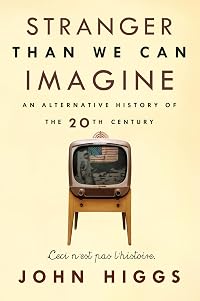
Stranger Than We Can Imagine: Making Sense of the Twentieth Century
by John Higgs
On This Page
Description
"In Stranger Than We Can Imagine, John Higgs argues that before 1900, history seemed to make sense. We can understand innovations like electricity, agriculture and democracy. The twentieth century, in contrast, gave us relativity, cubism, quantum mechanics, the id, existentialism, Stalin, psychedelics, chaos mathematics, climate change and postmodernism. In order to understand such a disorienting barrage of unfamiliar and knotty ideas, Higgs shows us, we need to shift the framework of our show more interpretation and view these concepts within the context of a new kind of historical narrative. Instead of looking at it as another step forward in a stable path, we need to look at the twentieth century as a chaotic seismic shift, upending all linear narratives. Higgs invites us along as he journeys across a century "about which we know too much" in order to grant us a new perspective on it. He brings a refreshingly non-academic, eclectic and infectiously energetic approach to his subjects as well as a unique ability to explain how complex ideas connect and intersect-whether he's discussing Einstein's theories of relativity, the Beat poets' interest in Eastern thought or the bright spots and pitfalls of the American Dream"-- show lessTags
Recommendations
















Member Reviews
Aquí John Higgs abre del todo el cajón del que tiró ligeramente en su libro sobre la KLF, y consigue explicar (a grandes rasgos, es difícil contener 100 años en 300 páginas) cómo el siglo XX funciona de transición entre la época de los imperios y la del individualismo. Obviamente, es muy deprimente, pero es lo que hay, aunque al final deja la cortina de la esperanza algo abierta.
Es de esos libros que podría haber tenido cinco mil páginas más y lo hubiera seguido disfrutando. El sentido del humor del autor se deja ver continuamente en sus sarcásticos comentarios y sus analogías medio surrealistas (no tengo claro que el canguro de Putin sea mejor que el gato de Schrödinger, pero es definitivamente más divertido). show more Seguramente expertos en historia y/o ciencia le pondrán más pegas que yo, pero para mí es más que suficiente como resumen de ese siglo tan loco. show less
Es de esos libros que podría haber tenido cinco mil páginas más y lo hubiera seguido disfrutando. El sentido del humor del autor se deja ver continuamente en sus sarcásticos comentarios y sus analogías medio surrealistas (no tengo claro que el canguro de Putin sea mejor que el gato de Schrödinger, pero es definitivamente más divertido). show more Seguramente expertos en historia y/o ciencia le pondrán más pegas que yo, pero para mí es más que suficiente como resumen de ese siglo tan loco. show less
One of the more original history books you can read. Not the classic tale on the 20th century going from WWI to WWII and all the way to the crisis of the 80's but from Einstein over cubism, individuality, nihilims, popart, Super Mario and the network we are all part of today, like here on Librarything.
Higgs is an artist, one that has done a lot of research, but still an artist in my opinion. The way he composes the book, the links between chapters that look unlinked at the start, the very educational (without becoming preachy) style in situating the origin of a phenomenon, explaining it and then giving the effects of the phenomenon provide real insight.
Sometimes easy to recognise, sometimes you need a second look, but always clear, show more always part of the composition that this book is. It is not 15 stand alone chapters on 15 different things, by coincidence all happening in the 20th century. It is a piece of art, a cubistic one, that gives you the time to reflect on yourself, on the world, on society's past and future.
And it has a positive end. Brace yourself.
Thank you for this wonderful book, Mr. Higgs. show less
Higgs is an artist, one that has done a lot of research, but still an artist in my opinion. The way he composes the book, the links between chapters that look unlinked at the start, the very educational (without becoming preachy) style in situating the origin of a phenomenon, explaining it and then giving the effects of the phenomenon provide real insight.
Sometimes easy to recognise, sometimes you need a second look, but always clear, show more always part of the composition that this book is. It is not 15 stand alone chapters on 15 different things, by coincidence all happening in the 20th century. It is a piece of art, a cubistic one, that gives you the time to reflect on yourself, on the world, on society's past and future.
And it has a positive end. Brace yourself.
Thank you for this wonderful book, Mr. Higgs. show less
This is an interesting book, but it is in no way a history of the Twentieth Century: it picks up a number of important themes and looks at them from a number of non-standard angles but it is a connected set of essays and lacks a great deal which would be required to make it "a history of the twentieth century"
Just how non-standard may be judged by the fact that it cites Greg Hill (i.e. Malaclypse the Younger) on Emperor Norton and later on in the book drags in the I Ching's Breaking Apart pattern (23); although it contains no reference to giant yellow submarines or golden apples, it does include Illuminatus! in its bibliography.
I would hand this to somebody who was starting out in modern history as a useful primer in themes to be on the show more lookout for in detailed study, but it told me little I didn't already know (aside from some interesting bits about the genesis of Super Mario). show less
Just how non-standard may be judged by the fact that it cites Greg Hill (i.e. Malaclypse the Younger) on Emperor Norton and later on in the book drags in the I Ching's Breaking Apart pattern (23); although it contains no reference to giant yellow submarines or golden apples, it does include Illuminatus! in its bibliography.
I would hand this to somebody who was starting out in modern history as a useful primer in themes to be on the show more lookout for in detailed study, but it told me little I didn't already know (aside from some interesting bits about the genesis of Super Mario). show less
This is a pretty accessible take on a pretty complex topic. The history of the 20th century is fascinating, and this book brings some very disparate elements together to illustrate some themes that end up being quite pervasive. Perhaps the one word that can be found through all chapters (each of which explores a Big Idea) is Individualism. The rise of the individual is what characterizes most of the developments of the 20th century, what has created the world we live in today (for better or for worse). Parts of this book are dreadfully pessimistic (though sadly realistic) but for the most part it is a celebration of the achievements of humankind. I only hope that in positioning ourselves so, we have not also doomed ourselves for show more inevitable catastrophe. show less
I really expected more from this book, and quite enjoyed parts of it, but just can't rate it any higher.
The author puts a lot of emphasis on artists and philosophers as having a huge influence. Rather more influence than I would have thought, but it is an entertaining way of looking at things, and besides I'm a tech-head so what do I know about arts stuff.
On the other hand, his tech-oriented stuff was interesting but tended to be superficial. Which is fair enough for a general audience I suppose, but took a bit of the wind out of his arguments as far as I was concerned.
Then in Chapter 13 he discuses the book 'The Limits to Growth' as if it were a fantastic and eye-opening revelation. He states that no-one disagreed with the data, only show more the conclusions. Gotta call BULLSHIT on that one. I'm old enough to have read it when that book was new, and there were a *lot* of technical critiques around. Those critiques ignored the conclusions and focused on the numerous flaws in the model and the way it was done. The model, although interesting, turned out to be so full of flaws that it was useless ... and any conclusions based on the model had to be suspect to the point of being discredited. Besides, the people who payed for the study, the Club of Rome, were a bunch of very rich people who were basically telling everyone else to make do with less. Somehow Mr. Higgs left that part out of the book.
In spite of the books limitations and flaws, I think it is an interesting way of looking at the history of the last century. I'm just disappointed because it could have been better. show less
The author puts a lot of emphasis on artists and philosophers as having a huge influence. Rather more influence than I would have thought, but it is an entertaining way of looking at things, and besides I'm a tech-head so what do I know about arts stuff.
On the other hand, his tech-oriented stuff was interesting but tended to be superficial. Which is fair enough for a general audience I suppose, but took a bit of the wind out of his arguments as far as I was concerned.
Then in Chapter 13 he discuses the book 'The Limits to Growth' as if it were a fantastic and eye-opening revelation. He states that no-one disagreed with the data, only show more the conclusions. Gotta call BULLSHIT on that one. I'm old enough to have read it when that book was new, and there were a *lot* of technical critiques around. Those critiques ignored the conclusions and focused on the numerous flaws in the model and the way it was done. The model, although interesting, turned out to be so full of flaws that it was useless ... and any conclusions based on the model had to be suspect to the point of being discredited. Besides, the people who payed for the study, the Club of Rome, were a bunch of very rich people who were basically telling everyone else to make do with less. Somehow Mr. Higgs left that part out of the book.
In spite of the books limitations and flaws, I think it is an interesting way of looking at the history of the last century. I'm just disappointed because it could have been better. show less
Fascinating and frightening book. Ends on a slightly positive note but not enough to wipe out the Butterfly chapter on how the corporations get away with murder and cannot be touched legally, how they control governments and therefore climate change will never be addressed until it is too late and .......partner that with the current news and Trump`s actions and as a pessimist...the end of the world is coming is the feeling I finished with.
This books is fun, broad and provides an important insightful theme to what the 20th century has enacted on all our pillars of certainty. This is a MUST READ for anyone interested in the current Zeitgeist of uncertainty.
Members
- Recently Added By
Lists

Books Read in 2018
4,360 works; 110 members
Author Information

14 Works 973 Members
Common Knowledge
- Canonical title*
- Vreemder dan je je kunt voorstellen een alternatieve geschiedenis van de twintigste eeuw
- Original title
- Stranger than We Can Imagine: Making Sense of the Twentieth Century
- Original publication date
- 2015
- People/Characters
- Buzz Aldrin; Neil Armstrong; Julian Assange; Samuel Beckett; William Blake; Humphrey Bogart (show all 111); Niels Bohr; Martial Bourdin; Georges Braque; Wernher von Braun; Luis Buñuel; Joseph Campbell; Albert Camus; Kurt Cobain; Michael Collins, astronaut; Joseph Conrad; Aleister Crowley; Salvador Dalí; Richard Dawkins; Jacques Derrida; Sergei Diaghilev; Charles Dickens; Marcel Duchamp; Arthur Eddington; Albert Einstein; Dwight D. Eisenhower; Sergei Eisenstein; T. S. Eliot; Hugh Everett, III; F. Scott Fitzgerald; Peter Fonda; Sigmund Freud; Elsa von Freytag-Loringhoven; Betty Friedan; Francis Fukuyama; Yuri Gagarin; Paul Gauguin; Allen Ginsberg; Kurt Gödel; Germaine Greer; George Gurdjieff; Werner Heisenberg; Fred Hoyle; Mick Jagger; Alejandro Jodorowsky; James Joyce; Carl Jung; Theodore von Kármán; John F. Kennedy; Jack Kerouac; Nikita Khrushchev; Sergei Korolev; Alfred Korzybski; Fritz Lang; Philip Larkin; Anton LaVey; D. H. Lawrence; Timothy Leary; John Lennon; Little Richard; Edward Lorenz; James Lovelock; George Lucas; Benoit Mandelbrot; Mileva Marić; Henry Miller; Shigeru Miyamoto; Alan Moore; Benito Mussolini; Napoleon Bonaparte; John von Neumann; Isaac Newton; Richard M. Nixon; Joshua Abraham Norton (Norton I, Emperor of the United States); Barack Obama; Emmeline Pankhurst; Jack Parsons; Alex Pentland; Pablo Picasso; Max Planck; Ezra Pound; Elvis Presley; Marcel Proust; Vladimir Putin; Man Ray; William Rees-Mogg; Erich Maria Remarque; Keith Richards; Gene Roddenberry; Bertrand Russell; Jean-Paul Sartre; Siegfried Sassoon; Arnold Schoenberg; Erwin Schrödinger; William Shakespeare; Mary Shelley; Adam Smith; Alan Sokal; Joseph Stalin; Charlotte Carmichael Stopes; Henry Stopes; Marie Stopes; Igor Stravinsky; Halliday Sutherland; Margaret Thatcher; Alexander Trocchi; Jules Verne; Andy Warhol; Charles Erwin Wilson; Colin Wilson; Virginia Woolf
- Important places
- Cairo, Egypt; London, England, UK; Greenwich Meridian; Mars; The Moon; Mercury (show all 7); San Francisco, California, USA
- Important events
- American Civil War; Apollo program; World War I; World War II; Attack on Pearl Harbor
- Epigraph
- ‘We needed to do what we needed to do’ Keith Richards
- First words
- In 2010, the Tate Modern gallery in London staged a retrospective of the work of the French post-impressionist painter Paul Gauguin.
- Last words
- (Click to show. Warning: May contain spoilers.)Hold tight.
- Blurbers
- Ince, Robin; Moore, Alan
- Original language
- English
*Some information comes from Common Knowledge in other languages. Click "Edit" for more information.
Classifications
Statistics
- Members
- 287
- Popularity
- 112,315
- Reviews
- 8
- Rating
- (4.11)
- Languages
- Dutch, English, German, Spanish
- Media
- Paper, Audiobook, Ebook
- ISBNs
- 19
- ASINs
- 5