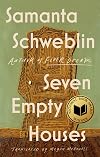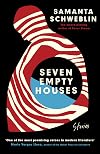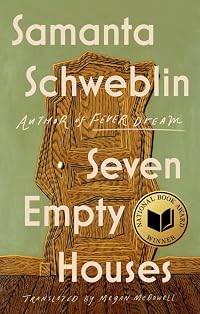
Seven Empty Houses
by Samanta Schweblin
On This Page
Description
The seven houses in these seven stories are empty. Some are devoid of love or life or furniture, of people or the truth or of memories. But in Samanta Schweblin's tense, visionary tales, something always creeps back in: a ghost, a fight, trespassers, a list of things to do before you die, a child's first encounter with a dark choice or the fallibility of parents. This was the collection that established Samanta Schweblin at the forefront of a new generation of Latin American writers. And now show more in English it will push her cult status to new heights. Seven Empty Houses is an entrypoint into a fiercely original mind, and a slingshot into Schweblin's destablising, exhilarating literary world. In each story, the twists and turns will unnerve and surprise: Schweblin never takes the expected path and instead digs under the skin and reveals uncomfortable truths about our sense of home, of belonging, and of the fragility of our connections with others. This is a masterwork from one of our most brilliant writers. show lessTags
Recommendations



























Member Reviews
Houses are our shelter. The space where memories are created. The places where we develop our personalities, where we are raised, where we raise our families years and years later. Our houses are places of love and death. In the seven stories of the collection, the houses become caskets of isolation and despair, of emptiness and threat.
Women obsessed with ‘’fixing’’ other people’s houses, relatives that succumb to madness, mothers and wives unable to escape a traumatic past and a terrifying present, children who endanger themselves for a few hours of the attention that has been denied them by negligent parents. People who leave their houses wearing bath robes to lose themselves in the heart of the metropolis.
None of That: show more I’ve always loved walking in the evening streets, watching the windows being lit one by one to drive the darkness away, trying to imagine the residents’ lives based on their curtains, walls, shelves, whatever little I was able to glimpse in seconds. However, the mother in this story elevates the ‘’watching houses’’ habit to a stratospheric level. She doesn’t limit herself to just observing. She fixes whatever strikes her as odd or improper. Yes, it is as paranoid as it sounds and she’s a real piece of work…
My Parents and My Children: In a story that balances the ridiculous/grotesque and the menacing, two siblings follow the example set by their utterly problematic grandparents.
It Happens All the Time in This House: A woman tries to comfort a father who has lost his son in a story that hides so many secrets in a few pages. Who is bereaved? Who is the one suffering? What do we all hide behind our closed doors?
Breath from the Depths: The longest story in the collection is one of the most cryptic, ‘’what was THAT’’ stories I’ve ever read, a mayhem of isolation, threatening cupboards and fridges, lists, boxes, ringing bells, death and the question of a futile existence.
Two Square Feet: A woman tries to find an open drugstore to buy aspirins for her mother-in-law whose story causes her to think of her own isolation while living in the heart of Buenos Aires.
An Unlucky Man: I cannot claim to understand what this story tried to convey but it made me feel extremely uncomfortable…
Out: A woman and a man meet in an elevator. Moments later, they find themselves wandering in the streets of Buenos Aires, both burdened by dysfunctional marriages and the need to find an exit from a stagnant present. But change is the most unattainable thing in the world…
Uncertainty, eerieness, terror. There is no light in any of these stories. The houses are empty and dark.
My reviews can also be found on https://theopinionatedreaderblog.wordpress.com/ show less
Women obsessed with ‘’fixing’’ other people’s houses, relatives that succumb to madness, mothers and wives unable to escape a traumatic past and a terrifying present, children who endanger themselves for a few hours of the attention that has been denied them by negligent parents. People who leave their houses wearing bath robes to lose themselves in the heart of the metropolis.
None of That: show more I’ve always loved walking in the evening streets, watching the windows being lit one by one to drive the darkness away, trying to imagine the residents’ lives based on their curtains, walls, shelves, whatever little I was able to glimpse in seconds. However, the mother in this story elevates the ‘’watching houses’’ habit to a stratospheric level. She doesn’t limit herself to just observing. She fixes whatever strikes her as odd or improper. Yes, it is as paranoid as it sounds and she’s a real piece of work…
My Parents and My Children: In a story that balances the ridiculous/grotesque and the menacing, two siblings follow the example set by their utterly problematic grandparents.
It Happens All the Time in This House: A woman tries to comfort a father who has lost his son in a story that hides so many secrets in a few pages. Who is bereaved? Who is the one suffering? What do we all hide behind our closed doors?
Breath from the Depths: The longest story in the collection is one of the most cryptic, ‘’what was THAT’’ stories I’ve ever read, a mayhem of isolation, threatening cupboards and fridges, lists, boxes, ringing bells, death and the question of a futile existence.
Two Square Feet: A woman tries to find an open drugstore to buy aspirins for her mother-in-law whose story causes her to think of her own isolation while living in the heart of Buenos Aires.
An Unlucky Man: I cannot claim to understand what this story tried to convey but it made me feel extremely uncomfortable…
Out: A woman and a man meet in an elevator. Moments later, they find themselves wandering in the streets of Buenos Aires, both burdened by dysfunctional marriages and the need to find an exit from a stagnant present. But change is the most unattainable thing in the world…
Uncertainty, eerieness, terror. There is no light in any of these stories. The houses are empty and dark.
My reviews can also be found on https://theopinionatedreaderblog.wordpress.com/ show less
This is a short, sharp, and immersive collection of seven stories.
Schweblin takes the home as a starting point; what is commonly seen as simple, prosaic, and safe she spins off its axis ever so slightly. She tilts the angle of our lens just enough to make these spaces feel off-balance, peculiar, and vulnerable.
In doing so she illuminates the truth that no matter how picturesque the view is from the street, behind every closed door is a microcosmic world full of emotions and traumas that only the inhabitants know. The grief, loss, confusion, desperation is palpable; it fogs the air and envelops the reader.
In these stories we find a daughter accompanying her mother as she scouts out upscale homes that are in need of her surreptitious show more aesthetic fixes, a search for children who have gone missing with their grandparents last seen joyously dancing naked in the backyard, a woman who walks out of her home in the middle of a difficult conversation clad only in slippers and a robe, and an elderly woman trying to exert some control as she is dealing with the deterioration of her mind and body, among others.
Despite the brevity of most of these stories, the characters are full, well-defined, and knowable. They take up space and they are begging to be seen.
Honestly, I was blown away by this collection. It's not horror, these aren't scary stories in a traditional sense but they destabilise and stir. I immediately wanted to read more by this author and happily there's more to read. show less
Schweblin takes the home as a starting point; what is commonly seen as simple, prosaic, and safe she spins off its axis ever so slightly. She tilts the angle of our lens just enough to make these spaces feel off-balance, peculiar, and vulnerable.
In doing so she illuminates the truth that no matter how picturesque the view is from the street, behind every closed door is a microcosmic world full of emotions and traumas that only the inhabitants know. The grief, loss, confusion, desperation is palpable; it fogs the air and envelops the reader.
In these stories we find a daughter accompanying her mother as she scouts out upscale homes that are in need of her surreptitious show more aesthetic fixes, a search for children who have gone missing with their grandparents last seen joyously dancing naked in the backyard, a woman who walks out of her home in the middle of a difficult conversation clad only in slippers and a robe, and an elderly woman trying to exert some control as she is dealing with the deterioration of her mind and body, among others.
Despite the brevity of most of these stories, the characters are full, well-defined, and knowable. They take up space and they are begging to be seen.
Honestly, I was blown away by this collection. It's not horror, these aren't scary stories in a traditional sense but they destabilise and stir. I immediately wanted to read more by this author and happily there's more to read. show less
WOW! nothing is supernatural in these stories, but uncanny behavior is a common thread. unsettling, but compelling stories that show the unsavory parts of being human. this collection looks at loss and what it means to be empty inside or feel surrounded by emptiness in some capacity. the characters in these stories strive to control their lives while giving in to the reality of existence—whether by organizing all the items in their houses or stealing stuff from others' homes. big themes throughout these stories: dementia/memory loss (though never explicitly stated), identity via our possessions (especially clothing), and personal space (both literal and figurative). after reading each story the images and characters stick with you and show more all the stories together work really well with each other show less
Argentine author Samanta Schweblin is one of a new wave of Latin American writers of weird and speculative fiction. Seven Empty Houses is her latest book to be translated into English (by Megan McDowell). It is a slim volume of seven short stories, all of which rework the Gothic trope of the “empty” or “abandoned” house.
In traditional horror fiction, the empty house is “shunned”, because more often than not, it is “haunted” by ghosts, demons or by memories of violence and grief. The image of the “haunted house” is powerful precisely because it turns on its head our expectation that houses should be safe havens of domesticity. None of the houses in Schweblin’s collection are literally vacant or haunted. Their show more “emptiness” is figurative, in the sense that the houses are marked by or tainted with a sense of loss – whether loss of memory and reason (as in the longest story “Breath from the Depths”) , or loss of innocence, or simply an absence which turns safe spaces into dangerous ones.
Schweblin manages to create a sense of unease using the simplest of means. Take the opening story, “None of That”. A mother and her daughter end up in the house of a young family. The mother takes over the house, rearranging things, behaving as if the house is hers, and finally making off with a sugar bowl. Retold in a few words, the premise seems downright banal. But the story effectively conveys an escalating feeling of panic. What would you do if a stranger invades your house and doesn’t want to leave? Those who like their horror gory and melodramatic will need to look elsewhere. Lovers of the unheimlich will be delighted.
3.5* show less
In traditional horror fiction, the empty house is “shunned”, because more often than not, it is “haunted” by ghosts, demons or by memories of violence and grief. The image of the “haunted house” is powerful precisely because it turns on its head our expectation that houses should be safe havens of domesticity. None of the houses in Schweblin’s collection are literally vacant or haunted. Their show more “emptiness” is figurative, in the sense that the houses are marked by or tainted with a sense of loss – whether loss of memory and reason (as in the longest story “Breath from the Depths”) , or loss of innocence, or simply an absence which turns safe spaces into dangerous ones.
Schweblin manages to create a sense of unease using the simplest of means. Take the opening story, “None of That”. A mother and her daughter end up in the house of a young family. The mother takes over the house, rearranging things, behaving as if the house is hers, and finally making off with a sugar bowl. Retold in a few words, the premise seems downright banal. But the story effectively conveys an escalating feeling of panic. What would you do if a stranger invades your house and doesn’t want to leave? Those who like their horror gory and melodramatic will need to look elsewhere. Lovers of the unheimlich will be delighted.
3.5* show less
In the seven stories featured in this collection, it is not the houses that are empty, it is their occupants who are. Each of the main characters featured, almost all of them women, have suffered a trauma which has left an absence in themselves that they are struggling to fill. Sometimes it is the loss of a son or a daughter, a divorce, or an event that continues to haunt them. These stories depict a reality that has become off-kilter, in which the secrets the houses contain cannot be buried forever.
Originally published in 2015 in Spanish by Argentine author Samanta Schweblin, the book’s debut in English was a finalist in the 2022 National Book Award for Translated Literature. While I acknowledge Schweblin’s gifts in crafting these show more unique stories, unfortunately, I never felt at home in them. However, for those who enjoy fiction that explores the borderland between reality and mental breakdown, this collection will be of interest. show less
Originally published in 2015 in Spanish by Argentine author Samanta Schweblin, the book’s debut in English was a finalist in the 2022 National Book Award for Translated Literature. While I acknowledge Schweblin’s gifts in crafting these show more unique stories, unfortunately, I never felt at home in them. However, for those who enjoy fiction that explores the borderland between reality and mental breakdown, this collection will be of interest. show less
I was immediately interested in each of these seven stories even though they were fleeting moments of complicated lives. This National Book Award winner, translated from Spanish, depicts families in predicaments, homes in transition . Perhaps I needed the after reading research to get a better understanding of the author’s intent, like the Nyt note “Arranged as peepholes into the private lives of others, each of these seven stories centers on a domestic dwelling, exploring how the things that constitute our most intimate spaces are relational and interconnected, and therefore in many ways the most unstable….. The juxtaposition of this clutter with Schweblin’s minimalist approach to storytelling creates a disquieting unease. “ show more But in the end all that matters is that I was interested in these snippets of lives in turmoil. The characters are vividly real, wrestling with uncertainty, anxiety and mental infirmity.
Recommend and would be interested in checking out the author’s other work.
Lines
He had died long before. In spite of everything that can be given and lost for a child, in spite of the world and all there is on the world’s surface, in spite of her having thrown the crystal glasses from the cabinets to the floor and stepped on them barefoot and bloodied everything on the way to the bathroom, and from the bathroom to the kitchen, and from the kitchen to the bathroom, and so on until he arrived and managed to calm her.
Lola was starting to fear the worst: that death required an effort she could no longer make.
They carried their things in bags, in purses, under an arm, hanging from their hands, resting on the ground between their feet
With resentful clarity, she understood that this would keep her alive forever. That he had died right under her nose, without any effort, and he’d left her alone with the house and the boxes. He had abandoned her forever, after all she had done for him. He’d said that thing about the boy and then gone to the grave with everything inside. Now she didn’t even have anyone to die for.
“When I ask God for something I do it like this: ‘God, do the best you can,’ ” and she gave a long sigh. “Really, I don’t ask for anything specific. I’ve listened to people enough to know they don’t always ask for what’s best for them.” show less
Recommend and would be interested in checking out the author’s other work.
Lines
He had died long before. In spite of everything that can be given and lost for a child, in spite of the world and all there is on the world’s surface, in spite of her having thrown the crystal glasses from the cabinets to the floor and stepped on them barefoot and bloodied everything on the way to the bathroom, and from the bathroom to the kitchen, and from the kitchen to the bathroom, and so on until he arrived and managed to calm her.
Lola was starting to fear the worst: that death required an effort she could no longer make.
They carried their things in bags, in purses, under an arm, hanging from their hands, resting on the ground between their feet
With resentful clarity, she understood that this would keep her alive forever. That he had died right under her nose, without any effort, and he’d left her alone with the house and the boxes. He had abandoned her forever, after all she had done for him. He’d said that thing about the boy and then gone to the grave with everything inside. Now she didn’t even have anyone to die for.
“When I ask God for something I do it like this: ‘God, do the best you can,’ ” and she gave a long sigh. “Really, I don’t ask for anything specific. I’ve listened to people enough to know they don’t always ask for what’s best for them.” show less
This book comprises seven short stories. The common element is a house that is “empty” in some way – not literally but figuratively. These tales are unsettling or disturbing. They contain people acting in unexpected ways that go against what we would typically expect. For example, in the first story, a woman will not leave the house of a stranger and she starts taking things, claiming them as her own, when it is obvious that these are not her possessions. I kept wondering if these people were mentally unstable or perhaps it is just the author challenging our assumptions about “normal” behavior.
3.5
3.5
Members
- Recently Added By
Lists

Books Read in 2023
5,547 works; 145 members

National Book Awards 2022 Longlist
50 works; 1 member

Books Read in 2022
5,166 works; 114 members

National Book Award Finalists - Fiction
377 works; 12 members
Author Information

36+ Works 3,795 Members
Some Editions
Awards and Honors
Awards
Distinctions
The Guardian Book of the Day (2022-12-09)
Common Knowledge
- Canonical title
- Seven Empty Houses
- Original title
- Siete casas vacías
- Original publication date
- 2015
- Epigraph
- Before his five-year-old daughter
got lost between the dining room and the kitchen,
he had warned her: ”This house is neither large nor small,
but make the least mistake and the road signs will disappear,
and of... (show all) this lifetime at last, you will have lost all hope.”
—Juan Luis Martínez, ”The Disappearance of a Family”
A: I like your apartment.
B: It's nice, but it's only big enough for one person—or two people who are very close.
A: You know two people who are very close?
—Andy Warhol, The Philosophy of Andy Warhol - Dedication
- To Liliana and Pablo, my parents
- Canonical DDC/MDS
- 863.64
- Canonical LCC
- PQ7798.29.C5388
Classifications
- Genres
- Fiction and Literature, General Fiction, Horror
- DDC/MDS
- 863.64 — Literature & rhetoric Spanish Literature Spanish fiction 20th Century 1945-2000
- LCC
- PQ7798.29 .C5388 — Language and Literature French, Italian, Spanish and Portuguese literatures Spanish literature Provincial, local, colonial, etc. Spanish America
- BISAC
Statistics
- Members
- 441
- Popularity
- 69,337
- Reviews
- 17
- Rating
- (3.61)
- Languages
- 10 — English, French, German, Greek, Italian, Portuguese, Romanian, Spanish, Swedish, Turkish
- Media
- Paper, Audiobook, Ebook
- ISBNs
- 28
- ASINs
- 6