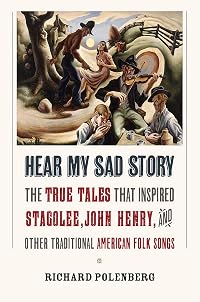
Hear My Sad Story: The True Tales That Inspired "Stagolee," "John Henry," and Other Traditional American Folk Songs
by Richard Polenberg
On This Page
Description
"In Hear My Sad Story, Richard Polenberg describes the historical events that led to the writing of many famous American folk songs that served as touchstones for generations of American musicians, lyricists, and folklorists. Those events, which took place from the early nineteenth to the mid-twentieth centuries, often involved tragic occurrences: murders, sometimes resulting from love affairs gone wrong; desperate acts borne out of poverty and unbearable working conditions; and calamities show more such as railroad crashes, shipwrecks, and natural disasters. All of Polenberg's accounts of the songs in the book are grounded in historical fact and illuminate the social history of the times. Reading these tales of sorrow, misfortune, and regret puts us in touch with the dark but terribly familiar side of American history." show lessTags
Recommendations














Member Reviews
Our songs are our history. Our history as seen by those who sang them, anyway.
This book takes a number of well-known American folk songs about historical events and sums up the history behind them. It's not trying to tell the full history of America, or the full history of the songs for that matter, but it gives a nice overview for most of the songs and lists additional references.
For the most part, the songs are well-chosen and widely known, and the historical summaries both interesting and concise. I can't recall ever seeing a book that gives a better feeling for the sort of material that becomes the subject of folk song; neither have I seen a book that covers so many of the best-known songs.
I do have to point out that the first and show more last songs, "St. Louis Blues" and Woody Guthrie's song "Sacco and Vanzetti" are not folk songs (that is, they have not been found in oral tradition). That's a nitpick, since you still have two dozen genuine folk songs in this book to study -- more, really, since there are two songs about Naomi Wise, and more than that about Pearl Bryan, and more than a dozen on the Titanic (although only a few of those are mentioned, and somewhat mixed up).
The only down side -- the reason I give four stars instead of five -- is that the facts are occasionally a little off. For example, the Titanic did not sink "four hundred miles southeast of Iceland" (p. 223) -- the closest land was Newfoundland. I found some similar minor errors in other entries. For those who just want a general overview, this won't matter much, and there really is no other book like it. By all means read it, although be sure to check the facts before depending on them entirely. show less
This book takes a number of well-known American folk songs about historical events and sums up the history behind them. It's not trying to tell the full history of America, or the full history of the songs for that matter, but it gives a nice overview for most of the songs and lists additional references.
For the most part, the songs are well-chosen and widely known, and the historical summaries both interesting and concise. I can't recall ever seeing a book that gives a better feeling for the sort of material that becomes the subject of folk song; neither have I seen a book that covers so many of the best-known songs.
I do have to point out that the first and show more last songs, "St. Louis Blues" and Woody Guthrie's song "Sacco and Vanzetti" are not folk songs (that is, they have not been found in oral tradition). That's a nitpick, since you still have two dozen genuine folk songs in this book to study -- more, really, since there are two songs about Naomi Wise, and more than that about Pearl Bryan, and more than a dozen on the Titanic (although only a few of those are mentioned, and somewhat mixed up).
The only down side -- the reason I give four stars instead of five -- is that the facts are occasionally a little off. For example, the Titanic did not sink "four hundred miles southeast of Iceland" (p. 223) -- the closest land was Newfoundland. I found some similar minor errors in other entries. For those who just want a general overview, this won't matter much, and there really is no other book like it. By all means read it, although be sure to check the facts before depending on them entirely. show less
This book is a combination of history, sociology, true crime, and, of course, music. I was fascinated by it all.
The author clearly did extensive research, not just regarding the history of the songs, but also the circumstances surrounding the events. With each song discussed, Polenberg places us right in the midst of these people's lives. We're part of the society in which they live. We feel the struggle to survive, the racism, the sorrow, and the pride. We see the truth behind the people immortalized in song, and how those songs evolved over time.
I wish this book had an accompanying soundtrack. While I knew many of the songs, there were some I'd never heard of, and it would be ideal to have them all available to listen to as we read. show more Polenberg does share snippets of each song's lyrics as we go along. None of the song lyrics are shared in their entirety, which is a bit of a disappointment but also understandable. Many of these sounds went through dozens, if not hundreds, of changes over time.
A foreknowledge of these folk songs is absolutely not required in order to enjoy this book. The stories stand on their own, with or without having heard the songs.
This book is a profound look at early American culture, and should appeal to readers looking to experience a piece of that history.
*I received an ebook copy from the publisher, via NetGalley, in exchange for my honest review.* show less
The author clearly did extensive research, not just regarding the history of the songs, but also the circumstances surrounding the events. With each song discussed, Polenberg places us right in the midst of these people's lives. We're part of the society in which they live. We feel the struggle to survive, the racism, the sorrow, and the pride. We see the truth behind the people immortalized in song, and how those songs evolved over time.
I wish this book had an accompanying soundtrack. While I knew many of the songs, there were some I'd never heard of, and it would be ideal to have them all available to listen to as we read. show more Polenberg does share snippets of each song's lyrics as we go along. None of the song lyrics are shared in their entirety, which is a bit of a disappointment but also understandable. Many of these sounds went through dozens, if not hundreds, of changes over time.
A foreknowledge of these folk songs is absolutely not required in order to enjoy this book. The stories stand on their own, with or without having heard the songs.
This book is a profound look at early American culture, and should appeal to readers looking to experience a piece of that history.
*I received an ebook copy from the publisher, via NetGalley, in exchange for my honest review.* show less
Polenberg’s bare recitation of the backstories to some American folk songs omits the music and musicians. Seems like he could have said more about folk culture, aesthetics, or the social function of songs about outlaws, trains, natural disasters and crimes of passion.
A wonderful book on the origins of American folk songs and ballads of the early 20th. Century and their influence on the singers of today.
I was given a digital copy of this book by the publisher via Netgalley in return for an honest unbiased review.
I was given a digital copy of this book by the publisher via Netgalley in return for an honest unbiased review.
Ratings
Members
- Recently Added By
Author Information
13+ Works 404 Members
Richard D. Polenberg is Goldwin Smith Professor of American History at Cornell University, where he has received the Clark Distinguished Teaching Award. He has been a Fulbright Visiting Professor at Hebrew University in Jerusalem.
Awards and Honors
Common Knowledge
- Original publication date
- 2015
- People/Characters
- John A. Lomax; Stagolee; Naomi Wise; Frankie Silvers; Tom Dooley; Laura Foster (show all 16); Ellen Smith; Pearl Bryan; Delia Holmes; Cole Younger; Jesse James; John Hardy; Railroad Bill; John Henry; Casey Jones; Joe Hill
- Dedication
- For Margo, Nina, Mia, and Leo
- First words
- PROLOGUE
The Streets of Laredo
"I can see by your outfit that you are a cowboy,"
These words he did say as I boldly walked by
"Come sit down beside me an' hear my sad story,
I'm shot in ... (show all)the breast an' I know I must die"
In the winter of 1875-1876, young man named Francis Henry (Frank) Maynard, only twenty-one years of age, was working as a cowboy near Medicine Lodge, a tiny village in southern Kansas. - Last words
- (Click to show. Warning: May contain spoilers.)Songs not only enable us to learn more about the past: they also allow us to learn about ourselves.
- Blurbers
- Wald, Elijah; Cohen, Ronald D.; Winkler, Allan M
Classifications
- Genres
- Music, Nonfiction, History
- DDC/MDS
- 782.42162 — Arts & recreation Music Vocal music Secular forms of vocal music Songs General principles and musical forms Traditions of secular songs {genres} Folk songs
- LCC
- ML3551 .P65 — Music Literature on music Literature on music History and criticism Folk, national, and ethnic music
- BISAC
Statistics
- Members
- 26
- Popularity
- 1,040,761
- Reviews
- 4
- Rating
- (4.30)
- Languages
- English
- Media
- Paper, Ebook
- ISBNs
- 3
- ASINs
- 1