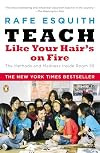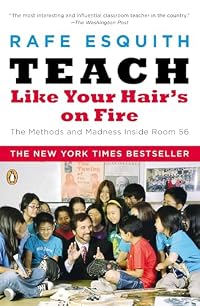
Teach Like Your Hair's on Fire: The Methods and Madness Inside Room 56
by Rafe Esquith
On This Page
Description
In a Los Angeles neighborhood plagued by guns, gangs, and drugs, there is a classroom known as Room 56. The fifth graders inside are first-generation immigrants who live in poverty and speak English as a second language. They also play Vivaldi, perform Shakespeare, score in the top 1% on standardized tests, and go on to attend Ivy League universities. Rafe Esquith is the teacher responsible for these accomplishments. Here, he reveals his techniques. The classroom's mottoes are "Be nice, work show more hard," and "There are no shortcuts." His students voluntarily come to school at 6:30 in the morning and work until 5:00 in the afternoon. They pair Hamlet with rock and roll, learn to handle money responsibly, tackle algebra, and travel the country to study history. This is an inspiring road map for parents, teachers, and anyone who cares about the future success of our nation's children.--From publisher description. show lessTags
Recommendations

Member Reviews
This was pretty much a There Are No Shortcuts Part II...which I certainly welcomed, and Esquith goes into more detail about his unique and exhausting teaching methods. My only hesitation after reading the two books and watching The Hobart Shakespeareans is that he, at times, makes petty comments about his colleagues who fail where he succeeds. He seems to want to give his students this "I'm the only person who will care about you" mentality. Maybe it's just me (I'm often prone to conspiracy theory interpretations)--I can see where this may come from, but it seems like he could be a bit more diplomatic, rise above it a little better than the people he appears to put down. Looking past this, Esquith's efforts nevertheless prove as an show more example of how creative the classroom can be if we, as teachers, are willing to take it there. show less
I found this book easy to read and it definitely made me think about the value of trust and building strong character in our students, not just strong academics. He is a very dedicated teacher and I admire him for putting his students first. I appreciated all of the positive exemplars that Rafe Esquith shared to show how he creates students with both strong values and academics; however, I would have preferred that the non-exemplars were left out, unless they were his own. We should always assume that all teachers work with best intentions and I grew tired of his criticism of his colleagues and administration. There are many excellent teachers out there, with different beliefs and approaches to learning.
This book will draw strong feelings on all sides. It is a written by a teacher in Los Angeles detailing his success with teaching 5th graders. He is not shy about touting his program, his methods. But, hey- if it works, why not? He is out spoken, critical and opinionated. Again- why not? Over bearing, self righteous and condemning. It may not sit well with all readers, especially some educators. But he puts his time, effort and heart into his career. He includes "A Day in the Life" as Appendix D- his daily school schedule which starts at 6:30 am and ends after 6 pm. Any teacher who is that dedicated to his students deserves to brag. He is best known for creating The Hobart Shakespeareans, his students who put on uncondensed plays of show more Shakespeare that include music they chose and perform themselves.
The strength of the book is the inclusion of concrete teaching ideas that are practical and replicable in any classroom. While many of his activities (field trips to Washington DC for example) are not going to be as applicable to the average classroom teacher (yes, he does describe the how and why they should be) Part Two "The Method" does have many excellent lesson ideas. This book should be read by all teachers, to show the possibilities out there, outside the box, beyond the usual and the mundane. It belongs on all educational bookshelves. I know I already took it to school to share with others. He also blasts (as well he should) the ridiculous lengths the standardized testing craze of NCLB has caused. He is not loathe to point out what is not working in current educational methodology.
He brags, boasts and crows his success. But he also gives the facts that support his claims. I would not want to be the teacher who works in the classroom down the hall from him but I would be pleased to have him as a consultant in my classroom. show less
The strength of the book is the inclusion of concrete teaching ideas that are practical and replicable in any classroom. While many of his activities (field trips to Washington DC for example) are not going to be as applicable to the average classroom teacher (yes, he does describe the how and why they should be) Part Two "The Method" does have many excellent lesson ideas. This book should be read by all teachers, to show the possibilities out there, outside the box, beyond the usual and the mundane. It belongs on all educational bookshelves. I know I already took it to school to share with others. He also blasts (as well he should) the ridiculous lengths the standardized testing craze of NCLB has caused. He is not loathe to point out what is not working in current educational methodology.
He brags, boasts and crows his success. But he also gives the facts that support his claims. I would not want to be the teacher who works in the classroom down the hall from him but I would be pleased to have him as a consultant in my classroom. show less
I picked this up because of its intriguing title. The author teaches fifth grade in an inner-city Los Angeles school. He has won numerous accolades and awards for the (mostly extra-curricular) activities he exposes he provides for his students, all of whom are impoverished and ESL. This is his second book, and it purports to give the specifics of his instructional “genius.” (Yes, those quotation marks signify my disdain…).
This man is very dedicated to his students, but has not a good word for any other member of the teaching profession, and even less that is positive to say about administrators. Moreover, he has an ego the size of mainland China that completely obliterates the message he thinks he is sending. He spends A LOT of show more print talking about teaching humility in his classroom, but his boasting and bragging contradict the very definition of the word.
He is known and appears on T.V. for the extra time he puts in with his students. His fifth graders perform Shakespeare plays (in their entirety) set to rock music (performed by students) each year. He spends hours before and after school helping these students with extra math, music, and the lessons needed for fifth graders to comprehend Shakespeare. He takes his students on frequent road trips that we all wish we could afford (without chaperones—how does he get away with that????). I can’t fault his dedication, in spite of his self-promotion, but all of this good stuff is done BEFORE and AFTER school, and during vacations.
And the grand revelations that make him the world’s greatest classroom teacher: ho hum….1. Start the day with grammar warm-ups right away, because “We do not waste time in Room 56.” Um…walk around most schools each morning and you’ll find much the same in the upper level rooms. 2. He uses Novel Ties for students to respond to literature. So did my teaching team—until we created something better than canned questions. (also—why are fifth graders reading To Kill a Mockingbird and other high school level texts when there is SO much great literature aimed at younger readers? TKaMockingbird is probably my favorite book, but would not have meant so much to me at 10!) 3. Here’s a newsflash for you: Science instruction should be HANDS ON!!!!!! Wow—I wish someone would have told me that years ago!
This book would have been so much more effective with more details on what goes on during the SCHOOL day, and without the condescending attitude toward the rest of the education profession, who are by and large, dedicated and hardworking. show less
This man is very dedicated to his students, but has not a good word for any other member of the teaching profession, and even less that is positive to say about administrators. Moreover, he has an ego the size of mainland China that completely obliterates the message he thinks he is sending. He spends A LOT of show more print talking about teaching humility in his classroom, but his boasting and bragging contradict the very definition of the word.
He is known and appears on T.V. for the extra time he puts in with his students. His fifth graders perform Shakespeare plays (in their entirety) set to rock music (performed by students) each year. He spends hours before and after school helping these students with extra math, music, and the lessons needed for fifth graders to comprehend Shakespeare. He takes his students on frequent road trips that we all wish we could afford (without chaperones—how does he get away with that????). I can’t fault his dedication, in spite of his self-promotion, but all of this good stuff is done BEFORE and AFTER school, and during vacations.
And the grand revelations that make him the world’s greatest classroom teacher: ho hum….1. Start the day with grammar warm-ups right away, because “We do not waste time in Room 56.” Um…walk around most schools each morning and you’ll find much the same in the upper level rooms. 2. He uses Novel Ties for students to respond to literature. So did my teaching team—until we created something better than canned questions. (also—why are fifth graders reading To Kill a Mockingbird and other high school level texts when there is SO much great literature aimed at younger readers? TKaMockingbird is probably my favorite book, but would not have meant so much to me at 10!) 3. Here’s a newsflash for you: Science instruction should be HANDS ON!!!!!! Wow—I wish someone would have told me that years ago!
This book would have been so much more effective with more details on what goes on during the SCHOOL day, and without the condescending attitude toward the rest of the education profession, who are by and large, dedicated and hardworking. show less
Rafe's got plently of good ideas, but is unbearably arrogant. Every chapter he manages to talk shit on "other teachers" and "other classes." He does not say one good thing about any educator other than himself in this book. I doubt this guy is too popular among his peers.
“It’s a thankless job. It’s hard to find a reason to believe,” states author Rafe Esquith.
He continues, “It’s thankless and it doesn’t get easier. When you glance at your mental ledger, the red ink completely dominates the black. For every reason to believe, for every child you may help, there are dozens who make you want to give up. Most of the kids who walk into our classrooms do not even begin to comprehend how education can help them improve their lives.”
In Esquith’s 242-page book titled, Teach like your Hair is on Fire, these are the only words he allows himself to write which convey empathy towards his fellow teachers. Otherwise, the man generalizes the heck out of over-worked, over-wrought, show more just-teaching-for-the-test colleagues and it makes me mad.
How could anyone work around this egotistical know-it-all as he insinuates every teacher he comes in contact with is bad, lazy and/or ineffective? No wonder he loathes staff meetings where he must face those very teachers he has been so unkind to. Matter of fact, go back and reread his words in the second paragraph, replacing the words you, your, and our with I, me, and my, and this is Esquith’s personality in a nutshell.
Otherwise, I found his book to be inspiring and thought provoking. Between the self-congratulatory stories, there is a wealth of ideas from which to utilize. Esquith teaches the basics to fifth graders who consider English a second language in Los Angeles, California. A fact he says places them at a disadvantage when it comes to learning.
Okay, I can agree with this statement, but I think Esquith has an advantage Mississippi teachers do not. His kids are motivated to learn. His kids accompanied family members to the United States in order to pursue the American Dream. Most of our kids no longer harbor that hope and are generally less motivated.
Here’s my suggestion for reading this book. Skip over the first two chapters and concentrate on the specific subjects, such as reading, writing, and arithmetic, he covers per chapters three through eleven. Incorporate these ideas into your class, if you haven’t already, and then tackle chapters 12 through 17 as extracurricular activities.
Teaching is a hard enough profession without the constant negatives from self-anointed professionals. There is no need to put-down others, let the accomplishments do the talking. show less
He continues, “It’s thankless and it doesn’t get easier. When you glance at your mental ledger, the red ink completely dominates the black. For every reason to believe, for every child you may help, there are dozens who make you want to give up. Most of the kids who walk into our classrooms do not even begin to comprehend how education can help them improve their lives.”
In Esquith’s 242-page book titled, Teach like your Hair is on Fire, these are the only words he allows himself to write which convey empathy towards his fellow teachers. Otherwise, the man generalizes the heck out of over-worked, over-wrought, show more just-teaching-for-the-test colleagues and it makes me mad.
How could anyone work around this egotistical know-it-all as he insinuates every teacher he comes in contact with is bad, lazy and/or ineffective? No wonder he loathes staff meetings where he must face those very teachers he has been so unkind to. Matter of fact, go back and reread his words in the second paragraph, replacing the words you, your, and our with I, me, and my, and this is Esquith’s personality in a nutshell.
Otherwise, I found his book to be inspiring and thought provoking. Between the self-congratulatory stories, there is a wealth of ideas from which to utilize. Esquith teaches the basics to fifth graders who consider English a second language in Los Angeles, California. A fact he says places them at a disadvantage when it comes to learning.
Okay, I can agree with this statement, but I think Esquith has an advantage Mississippi teachers do not. His kids are motivated to learn. His kids accompanied family members to the United States in order to pursue the American Dream. Most of our kids no longer harbor that hope and are generally less motivated.
Here’s my suggestion for reading this book. Skip over the first two chapters and concentrate on the specific subjects, such as reading, writing, and arithmetic, he covers per chapters three through eleven. Incorporate these ideas into your class, if you haven’t already, and then tackle chapters 12 through 17 as extracurricular activities.
Teaching is a hard enough profession without the constant negatives from self-anointed professionals. There is no need to put-down others, let the accomplishments do the talking. show less
I'm not sure I even know where to begin. Rafe Esquith is a remarkable teacher, one who devotes at least 12 hours a day, often 6 days a week, to his class of 5th graders. This book is inspiring proof that if you are willing to put the time into something, almost anything can be acheived.
Is his method sustainable for most people? I'm not sure. It's not really reasonable to expect most teachers to put in the amount of time and effort. But it's best to dream big, and I would be very surprised if anyone could read this book and not come away with ideas of how to make classroom education better.
What is truly remarkable is how much time Rafe (as his students call him) spends on teaching life skills like balancing a checkbook or even how to fly show more on an airplane. He is not just preparing his students for a test, or even for high school -- he is preparing them to go on to college (for many, the first in their family to do so) and become productive adults. show less
Is his method sustainable for most people? I'm not sure. It's not really reasonable to expect most teachers to put in the amount of time and effort. But it's best to dream big, and I would be very surprised if anyone could read this book and not come away with ideas of how to make classroom education better.
What is truly remarkable is how much time Rafe (as his students call him) spends on teaching life skills like balancing a checkbook or even how to fly show more on an airplane. He is not just preparing his students for a test, or even for high school -- he is preparing them to go on to college (for many, the first in their family to do so) and become productive adults. show less
Members
- Recently Added By
Author Information

5 Works 1,370 Members
Awards and Honors
Distinctions
Common Knowledge
- Important places
- Los Angeles, California, USA
- Dedication
- For the Hobart Shakespeareans, who have been my best teachers . . . and for Barbara
Classifications
Statistics
- Members
- 849
- Popularity
- 32,069
- Reviews
- 24
- Rating
- (3.96)
- Languages
- English
- Media
- Paper, Audiobook, Ebook
- ISBNs
- 8
- UPCs
- 1
- ASINs
- 2