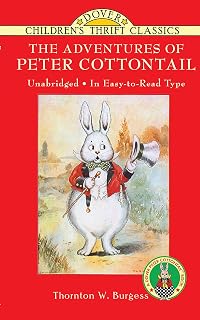
The Adventures of Peter Cottontail
by Thornton W. Burgess
Bedtime Story Books (3), Chronological list of Thornton W. Burgess’s Works (1914)
On This Page
Description
Unhappy with his name and his house, Peter Rabbit learns to appreciate himself and his world with the help of his friends.Tags
Recommendations


Member Reviews
While words like "beloved" and "delightful" characterise the Amazon descriptions, with some apology, here is a more jaundiced view. As in most stories for children, the animals are anthropomorphic, but this 1914 book takes it to extremes. What's more, while herbivory and insectivory are deemed perfectly acceptable, carnivory is apparently bad -- all the animals take delight in seeing Reddy Fox unable to find anything to eat day after day, and when they fool him into getting stung by hornets so badly that his eye swells shut, much hilarity ensues. We're never told that Billy Possum, Bobby Coon, and Jimmy Skunk likely eat animal protein as well, and that Ol' Mistah Buzzard has dietary tastes that are especially dubious. Of course this show more isn't meant to be a biology schoolbook, but it's too bad we can't let the kiddies know that for animals, specialized diets are lifestyles dictated by anatomy and evolution, not a matters of moral choice. show less
Peter discovers the folly of changing his name, outwits the ever-hungry Reddy Fox, manages a number of hare's-breadth escapes and finally makes an ill-advised decision to hibernate - as Johnny Chuck and other woodland creatures do. The silliness of trying to do what nature never intended is one of the gentle morals of these adventures that combine the fun of a good story with little lessons about wildlife, the environment and being true to one's self.
This little book has three storylines. In the first two chapters, Peter Rabbit decides he doesn't like his name and is going to go by Peter Cottontail. Which is silly, because it's not that different from his current name. Even sillier is that he puts on airs to seem like someone different, and refuses to answer to his old name. His friends soon use this to play a trick on him, which makes Peter realize it was a mistake and drop the name change.
Then for many chapters Peter, some of the other little animals and Reddy Fox repeatedly pull pranks on each other, some just for laughs, and others to get even with those who had tricked them. Not sure that exactly sends a good message! A big part of this is Reddy trying to catch Peter so his show more sick Granny Fox can eat a rabbit dinner. Of course he doesn't, because none of the named characters in the books ever do get eaten- although Reddy eats unnamed chickens, mice, etc in other stories. So you know well he's a predator but the banter between him and Peter Rabbit make it seem half in jest. The fox gets frustrated after trying many different methods to catch Peter and finally gets the weasel to help him out, but even though the weasel can fit into Peter's narrow paths among the brambles, he too gets foiled and Peter stays safe. In another part the fox runs into a wasp nest, gets stung and his face swells up. He plasters it with mud and the other animals make fun of him, but then become bold around the fox, seeing that he's hurt. Reddy then tries to pretend he's still disabled after feeling better so he can catch someone, to no avail.
The final part of the book has Peter puzzled at the actions of some of his friends, who are preparing for the winter- squirrels burying nuts, the woodchuck absolutely stuffing his face, and he is astonished when he sees Grandfather Frog bury himself in the mud. He doesn't seem to know anything about how other animals hibernate or migrate to avoid the winter cold. When someone clues him in that his friends the skunk, raccoon and others sleep most of the winter, Peter thinks this is a fine idea and determines to try it himself. Of course it doesn't work, and when the others realize what he's doing, they play another trick on him.
Not quite as engaging as some of the other Burgess I've read, but still a fun little book. I must also reply to danielx below- would like to point out that one of the Burgess books is about Ol' Mistah Buzzard and makes it very clear that he eats carrion. It's explained by the buzzard himself to other characters in the story.
from the Dogear Diary show less
Then for many chapters Peter, some of the other little animals and Reddy Fox repeatedly pull pranks on each other, some just for laughs, and others to get even with those who had tricked them. Not sure that exactly sends a good message! A big part of this is Reddy trying to catch Peter so his show more sick Granny Fox can eat a rabbit dinner. Of course he doesn't, because none of the named characters in the books ever do get eaten- although Reddy eats unnamed chickens, mice, etc in other stories. So you know well he's a predator but the banter between him and Peter Rabbit make it seem half in jest. The fox gets frustrated after trying many different methods to catch Peter and finally gets the weasel to help him out, but even though the weasel can fit into Peter's narrow paths among the brambles, he too gets foiled and Peter stays safe. In another part the fox runs into a wasp nest, gets stung and his face swells up. He plasters it with mud and the other animals make fun of him, but then become bold around the fox, seeing that he's hurt. Reddy then tries to pretend he's still disabled after feeling better so he can catch someone, to no avail.
The final part of the book has Peter puzzled at the actions of some of his friends, who are preparing for the winter- squirrels burying nuts, the woodchuck absolutely stuffing his face, and he is astonished when he sees Grandfather Frog bury himself in the mud. He doesn't seem to know anything about how other animals hibernate or migrate to avoid the winter cold. When someone clues him in that his friends the skunk, raccoon and others sleep most of the winter, Peter thinks this is a fine idea and determines to try it himself. Of course it doesn't work, and when the others realize what he's doing, they play another trick on him.
Not quite as engaging as some of the other Burgess I've read, but still a fun little book. I must also reply to danielx below- would like to point out that one of the Burgess books is about Ol' Mistah Buzzard and makes it very clear that he eats carrion. It's explained by the buzzard himself to other characters in the story.
from the Dogear Diary show less
I liked the Burgess stories that my library had when I was a child, but this one just didn't do much for me or my inner child. And I really can't imagine a modern child being the least bit interested; they're just too old-fashioned. Yes there's some mischief, and even a bit of nature study, but fortunately kids have other choices now. Recommended for scholars and those feeling nostalgic only.
See full review @ The Indigo Quill
A special thank you to NetGalley and Dover Publications for providing a copy of this book in exchange for an honest review.
This new edition of Thorton W. Burgess' beloved tales is an unabridged republication of three books: The Adventures of Reddy Fox, The Adventures of Peter Cottontail, and The Adventures of Grandfather Frog. Originally published by Little, Brown, and Company in 1913-1915, these stories that have followed us through generations have been resurrected in a fresh compilation that you can read consecutively to your child or young class for maximum readability.
Thorton W. Burgess was born native of Massachusetts and began writing children's books in 1910. Ever since he was young, Burgess show more had a deep appreciation for nature and the endless possibilities it offered. This is reflected in his work and is shared across generations. He brought both children and adults to nature through an array of stories, especially his most famous character, Peter Rabbit. His legacy and philosophies live on through the Thorton W. Burgess Society, who operates the Green Briar Nature Center, Thorton W. Burgess Museum in Sandwich, MA, and inspires environmental education through several other mediums. I would highly suggest checking it out.
The Adventures of Peter Cottontail and His Green Forest Friends is the perfect book for any child's library. They will be entertained by the human-like critters and their many adventures. Any child will enjoy the many escapes into nature and the lives of Burgess' forest friends. The stories and chapters are short for the active reader, and there are plenty of pictures to help them visualize the stories and keep their attention.
One thing I love about this edition is that it includes all the original illustrations from Harrison Cady. They are very simple and clear so they are very easy on the young eye. There is also a list of the illustrations after the contents, so if you want to simply refer to the images, you have the opportunity to do that.
I would definitely recommend this as a staple piece to any children's library. If I were to change one thing about it, I would say that it would be beneficial to add some kind of educational tool like questions about the characters or nature at the end. Other than that, I really enjoyed this book! show less
A special thank you to NetGalley and Dover Publications for providing a copy of this book in exchange for an honest review.
This new edition of Thorton W. Burgess' beloved tales is an unabridged republication of three books: The Adventures of Reddy Fox, The Adventures of Peter Cottontail, and The Adventures of Grandfather Frog. Originally published by Little, Brown, and Company in 1913-1915, these stories that have followed us through generations have been resurrected in a fresh compilation that you can read consecutively to your child or young class for maximum readability.
Thorton W. Burgess was born native of Massachusetts and began writing children's books in 1910. Ever since he was young, Burgess show more had a deep appreciation for nature and the endless possibilities it offered. This is reflected in his work and is shared across generations. He brought both children and adults to nature through an array of stories, especially his most famous character, Peter Rabbit. His legacy and philosophies live on through the Thorton W. Burgess Society, who operates the Green Briar Nature Center, Thorton W. Burgess Museum in Sandwich, MA, and inspires environmental education through several other mediums. I would highly suggest checking it out.
The Adventures of Peter Cottontail and His Green Forest Friends is the perfect book for any child's library. They will be entertained by the human-like critters and their many adventures. Any child will enjoy the many escapes into nature and the lives of Burgess' forest friends. The stories and chapters are short for the active reader, and there are plenty of pictures to help them visualize the stories and keep their attention.
One thing I love about this edition is that it includes all the original illustrations from Harrison Cady. They are very simple and clear so they are very easy on the young eye. There is also a list of the illustrations after the contents, so if you want to simply refer to the images, you have the opportunity to do that.
I would definitely recommend this as a staple piece to any children's library. If I were to change one thing about it, I would say that it would be beneficial to add some kind of educational tool like questions about the characters or nature at the end. Other than that, I really enjoyed this book! show less
In response to Danielx's review:
There are plenty of examples in Burgess where Reddy and other predators catch and eat prey. Of course, they never catch *named* animals; they only catch faceless, generic ones. But even the named animals are often depicted fleeing in terror from Reddy or another predator, and barely escaping. This happens all the time in Burgess; you cannot read much of Burgess and imagine otherwise. In fact, the first edition of Tommy and the Wishing Stone (1915, Century), has an *illustration* of Reddy sitting down to eat a chicken he has caught and killed. It's on page 188. That illustration might only be in the Century edition, which has twice as many illustrations as the Little, Brown and Grosset & Dunlap editions. show more But whether or not the other editions have the ilustration, they still have the text it illustrates (but the episode might be in a different Tommy title, as some editions split the single original 1915 Century book into three books).
On a lighter note, one of my favorite illustrations in Burgess is of Old Mr. Toad, startled by the sudden appearance of Mr. Blacksnake and leaping in slapstick terror. The caption is, "But poor Old Mr. Toad didn't say Good Morning."
And yes, we are told in Burgess, quite often, that Unc' Billy Possum, Jimmy Skunk, et. al. often enjoy protein themselves; they are always stealing eggs. There is much discussion in Burgess about how predators must eat other animals, and that it is not wrong for them to do so.
I see that Danialx's review has 5 "Likes". Anyone who shares his views of Burgess cannot possibly have read much of it. show less
There are plenty of examples in Burgess where Reddy and other predators catch and eat prey. Of course, they never catch *named* animals; they only catch faceless, generic ones. But even the named animals are often depicted fleeing in terror from Reddy or another predator, and barely escaping. This happens all the time in Burgess; you cannot read much of Burgess and imagine otherwise. In fact, the first edition of Tommy and the Wishing Stone (1915, Century), has an *illustration* of Reddy sitting down to eat a chicken he has caught and killed. It's on page 188. That illustration might only be in the Century edition, which has twice as many illustrations as the Little, Brown and Grosset & Dunlap editions. show more But whether or not the other editions have the ilustration, they still have the text it illustrates (but the episode might be in a different Tommy title, as some editions split the single original 1915 Century book into three books).
On a lighter note, one of my favorite illustrations in Burgess is of Old Mr. Toad, startled by the sudden appearance of Mr. Blacksnake and leaping in slapstick terror. The caption is, "But poor Old Mr. Toad didn't say Good Morning."
And yes, we are told in Burgess, quite often, that Unc' Billy Possum, Jimmy Skunk, et. al. often enjoy protein themselves; they are always stealing eggs. There is much discussion in Burgess about how predators must eat other animals, and that it is not wrong for them to do so.
I see that Danialx's review has 5 "Likes". Anyone who shares his views of Burgess cannot possibly have read much of it. show less
Ratings
Members
- Recently Added By
Lists

Favorite Childhood Books
1,646 works; 518 members

Rabbit and Fox Story Books For Children
139 works; 7 members

Thornton W. Burgess’s Works
129 works; 3 members

Recommended Nature Writing
346 works; 180 members

Children's Literature 1900 - 1950 in order
413 works; 8 members
Author Information

344+ Works 29,339 Members
Thornton Waldo Burgess was born in Sandwich on January 14, 1874. Burgess graduated from Sandwich High School in 1891, and went on to attend a Business College in Boston from 1892-93. At the age of 17, Burgess briefly lived in Boston and then moved to Springfield, Massachusetts. He bought a place in Hampden, Massachusetts in 1925 and made it his show more permanent home in 1957. He published his first book, Old Mother West Wind, in 1910 Burgess was a naturalist and conservationist, and loved loved nature and its living creatures so much that he wrote about them for 50 years. By the time he retired, he had written more than 170 books and 15,000 stories for daily columns in newspapers. Burgess was also actively involved with conservation efforts. Some of his projects over his lifetime included: The Green Meadow Club for land conservation programs. The Bedtime Stories Club for wildlife protection programs, the Happy Jack Squirrel Saving Club for War Savings Stamps & Bonds, the Radio Nature League broadcast from WBZA Springfield, MA., as well as helping to pass laws protecting migrant wildlife. For his efforts, an Honorary Literary Degree was bestowed upon Burgess in 1938 from Northeastern University. The Boston Museum of Science awarded him a gold medal for "leading children down the path to the wide wonderful world of the outdoors." He was also awarded the distinguished Service Medal of the Permanent Wildlife Protection Fund. In 1960, Burgess published his last book, Now I Remember, an autobiography. That same year, Burgess at the age of 83, had published his 15,000th story. From 1912 to 1960, without interruption, Burgess wrote a syndicated daily newspaper column titled "Bedtime Stories". Thornton Burgess died June 5, 1965, at the age of 91. The Thornton W. Burgess Society was incorporated in 1976. (Bowker Author Biography) show less
Some Editions
Series


Work Relationships
Common Knowledge
- Canonical title
- The Adventures of Peter Cottontail
- Original title
- The Adventures of Peter Cottontail
- Original publication date
- 1914
- People/Characters
- Peter Cottontail
Classifications
- Genres
- Children's Books, Fiction and Literature
- DDC/MDS
- 823.914 — Literature & rhetoric English & Old English literatures English fiction 1900- 1901-1999 1945-1999
- LCC
- PZ7 .B917 .A — Language and Literature Fiction and juvenile belles lettres Fiction and juvenile belles lettres Juvenile belles lettres
- BISAC
Statistics
- Members
- 1,312
- Popularity
- 18,400
- Reviews
- 6
- Rating
- (3.97)
- Languages
- English, French
- Media
- Paper, Audiobook, Ebook
- ISBNs
- 39
- UPCs
- 1
- ASINs
- 33