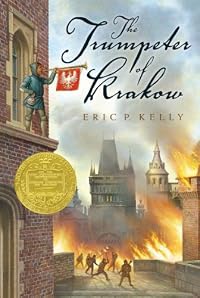
The Trumpeter of Krakow
by Eric P. Kelly
On This Page
Description
A Polish family in the Middle Ages guards a great secret treasure and a boy's memory of an earlier trumpeter of Krakow makes it possible for him to save his father.Tags
Recommendations






Member Reviews
I read this for the first time since I was in my teens. It is very much a book of the period it was written, being the 1920s. The villains are all disabled and/or disfigured, the women and girls shallow props to bolster the roles of the valiant leading males. That said, the voice of the book is eloquent and beautiful, and the author's deep love of the city of Krakow is evident on most every page. It's easy to see why this was the Newberry Award winner in 1929.
The adventure story is a rollicking one, cozy in its predictability, but hey--sometimes it's nice to know the bad guys are certain to know justice, with the good guys eventually rewarded for their stalwart suffering. This isn't a book I would re-read because it is so painfully show more dated, but it made for an interesting choice for my classic book for the month. show less
The adventure story is a rollicking one, cozy in its predictability, but hey--sometimes it's nice to know the bad guys are certain to know justice, with the good guys eventually rewarded for their stalwart suffering. This isn't a book I would re-read because it is so painfully show more dated, but it made for an interesting choice for my classic book for the month. show less
Set in the chaotic world of medieval Poland, Eric P. Kelly's The Trumpeter of Krakow is an exciting tale of adventure and intrigue for young readers, following the fortunes of the Charnetski family, as they struggle to fulfill a vow made generations before, by one of their ancestors. Fleeing from the raiding Tatars who attacked their estate in the Ukraine, Pan Andrew Charnetski, his wife, and his fifteen-year-old son, Joseph, seek refuge in the city of Krakow. Here, finding their relations absent, and an audience with the king impossible, the family settle, assisted by the kind monk and scholar, Jan Kanty, and living under an assumed name. But their enemies have not given up, and soon they find themselves threatened once show more again...
Originally published in 1928, and awarded the Newbery Medal, Kelly's debut novel is an engaging blend of historical fiction and fantastic adventure, incorporating both historical figures - King Jagiello, good Jan Kanty - and legendary ones, like the city's dragon-fighting founder, King Krakus. The widespread belief in magic and alchemy in fifteenth-century Poland (as seen in such magical folktales as The Magician of Cracow), proves crucial to the story, which revolves around the fate of the Great Tarnov Crystal - a priceless jewel with strange properties.
I enjoyed The Trumpeter of Krakow, from the prologue explaining the origin of the broken heynal, to the concluding passages, in which Kelly wraps up his story, and tells the reader what happened afterward. Well-written and entertaining, it flowed nicely and kept my attention - I enjoyed learning a little more about Polish history and folklore. Definitely one of the better Newbery Medal titles from the 1920s, I would recommend it to young readers with a taste for historical fiction. show less
Originally published in 1928, and awarded the Newbery Medal, Kelly's debut novel is an engaging blend of historical fiction and fantastic adventure, incorporating both historical figures - King Jagiello, good Jan Kanty - and legendary ones, like the city's dragon-fighting founder, King Krakus. The widespread belief in magic and alchemy in fifteenth-century Poland (as seen in such magical folktales as The Magician of Cracow), proves crucial to the story, which revolves around the fate of the Great Tarnov Crystal - a priceless jewel with strange properties.
I enjoyed The Trumpeter of Krakow, from the prologue explaining the origin of the broken heynal, to the concluding passages, in which Kelly wraps up his story, and tells the reader what happened afterward. Well-written and entertaining, it flowed nicely and kept my attention - I enjoyed learning a little more about Polish history and folklore. Definitely one of the better Newbery Medal titles from the 1920s, I would recommend it to young readers with a taste for historical fiction. show less
This one threw me a bit. I found it a bit boring at first, and then the introduction of magic and other seemingly random elements was unexpected and kind of crazy. It seemed to spiral to strange places. Like, did the author have everything planned, or did he just write as his whimsy directed? Either way, I liked it. I think.
I did really like whole ‘unfinished note’ aspect, and how that played out (my puns need work). The trumpeter scenes were the most charming parts of the trumpeter book, go figure, but they seemed to begging for a larger role. Overall, it's worth a read.
I did really like whole ‘unfinished note’ aspect, and how that played out (my puns need work). The trumpeter scenes were the most charming parts of the trumpeter book, go figure, but they seemed to begging for a larger role. Overall, it's worth a read.
In medieval Poland, a mysterious jewel is stolen, a family is displaced, and an alchemist seeks the secret of transmuting base metals to gold. This book won the Newbery back in 1929, and I do see some distinguished elements -- the writing is good, though a little more flowery than is common these days, and there's an interesting plot if you can get through all of the descriptive bits. The characters aren't particularly fleshed out (the alchemist, a secondary character, was probably the most interesting to me). I had a hard time staying engaged with the narrative, so it took me several days to get through this book. Would I recommend it to kids today? Probably only if I had one who was really fascinated with medieval stories.
There is something about the Great Tarnov Crystal... Wise men speak of it in hushed tones. Others are ready to kill for it. And now a murderous Tartar chief is bent on possessing it. But despite this, Joseph Charnetski is bound by an ancient oath to protect the jewel at all costs.
When Joseph and his family seek refuge in medieval Krakow (1461), they are caught up in the plots and intrigues of alchemists, hypnotists, and a dark messenger of evil. Will Joseph be able to protect the crystal - and the city - from the plundering Tartars?
When Joseph and his family seek refuge in medieval Krakow (1461), they are caught up in the plots and intrigues of alchemists, hypnotists, and a dark messenger of evil. Will Joseph be able to protect the crystal - and the city - from the plundering Tartars?
A thrilling tale, if you can get past the stilted language and wooden characters. (I couldn't.) I also wanted an explanation for the presence of a pumpkin as a key part of the plot set in Poland in 1461, since pumpkins are native to America, and would not have reached Europe until years later.
Winning the 1929 Newbery Medal, The Trumpeter of Krakow remains a delightful read. The base of the story is a tradition, still observed, at the tower of Our Lady Mary's Church, now a Basilica, in Krakow, Poland. At the top of the hour around the clock, a trumpeter plays the Heynal and in the middle of one of the notes, the music abruptly ends.
I wondered about this tradition and, with the internet and the wonders of YouTube, I was able to find a video of the trumpet call in Krakow. And it is clear the playing ends mid-note and is just eerie even when you are expecting it.
The Great Tarnov Crystal, on the other hand, is created in this book and does not exist in real life. But my curiosity of locations in this book still held my show more attention.
The next source I explored was Google Earth and there I found the locations for St. Mary's Basilica, the Cloth Hall, Wawel Royal Castle, Kazimierz and St. Florian's Gate. Through the 3d feature, I could get a sense of the beauty and wonder of these locations and with the Street View, I could get a sense of walking around and through them. What a wonderful way for a fun book to become magical! show less
I wondered about this tradition and, with the internet and the wonders of YouTube, I was able to find a video of the trumpet call in Krakow. And it is clear the playing ends mid-note and is just eerie even when you are expecting it.
The Great Tarnov Crystal, on the other hand, is created in this book and does not exist in real life. But my curiosity of locations in this book still held my show more attention.
The next source I explored was Google Earth and there I found the locations for St. Mary's Basilica, the Cloth Hall, Wawel Royal Castle, Kazimierz and St. Florian's Gate. Through the 3d feature, I could get a sense of the beauty and wonder of these locations and with the Street View, I could get a sense of walking around and through them. What a wonderful way for a fun book to become magical! show less
Members
- Recently Added By
Published Reviews
Recorded Books (Recorded Books, LLC.)
It is late July in 1461 when young Joseph Charnetski and his family arrive in the great city of Krakow, with its glorious church towers and lively marketplace. The Charnetskis have come to Krakow to seek refuge with their relatives. What they find is more danger and adventure than a simple farm boy like Joseph could ever have imagined. First, a menacing show more stranger tries to take their pumpkin at sword point. Then a beautiful girl and her black-robed uncle befriend Joseph. Soon he and his family are caught up in the plots of alchemists, hypnotists, and a dark messenger of evil. This distinguished contribution to children’s literature carries listeners to a medieval Poland shimmering with folklore and fantasy. Rich in language and detail, it is a classic adventure story that begs to be read aloud. With narrator Ron Keith’s expressive, resonant voice, the effect is as stirring as the haunting hymn the trumpeter plays from the church tower. n.d., Recorded Books, Unabridged Cassette - Library Edition; 95834, $51.75. Ages 10 to 14. show less
It is late July in 1461 when young Joseph Charnetski and his family arrive in the great city of Krakow, with its glorious church towers and lively marketplace. The Charnetskis have come to Krakow to seek refuge with their relatives. What they find is more danger and adventure than a simple farm boy like Joseph could ever have imagined. First, a menacing show more stranger tries to take their pumpkin at sword point. Then a beautiful girl and her black-robed uncle befriend Joseph. Soon he and his family are caught up in the plots of alchemists, hypnotists, and a dark messenger of evil. This distinguished contribution to children’s literature carries listeners to a medieval Poland shimmering with folklore and fantasy. Rich in language and detail, it is a classic adventure story that begs to be read aloud. With narrator Ron Keith’s expressive, resonant voice, the effect is as stirring as the haunting hymn the trumpeter plays from the church tower. n.d., Recorded Books, Unabridged Cassette - Library Edition; 95834, $51.75. Ages 10 to 14. show less
added by kthomp25
Lists

Best Newbery Medal Winners
94 works; 53 members

Favorite Childhood Books
1,602 works; 516 members

Best Books About Journeys and Quests
117 works; 30 members

Sonlight Books
1,487 works; 25 members

Newbery Medal Winners - By Year
105 works; 7 members
Honey For a Child's Heart
1,152 works; 25 members

Necessary & Exquisite
30 works; 4 members

Romalda Spalding's Writing Road To Reading
213 works; 3 members

A Child's Book Tour of Poland
35 works; 4 members

CCE 1000 Good Books List
1,033 works; 12 members

Books Read in 2015
3,298 works; 126 members

Beautiful Feet Books
304 works; 7 members

1970s
657 works; 23 members

EGBERTINA'S List of childhood books worthy of merit or unspeakable delight
155 works; 6 members
Author Information

19+ Works 2,412 Members
Eric P. Kelly, a student of Slavic culture for most of his life, wrote The Trumpeter of Krakow while teaching and studying at the University of Krakow
Some Editions
Awards and Honors
Common Knowledge
- Original publication date
- 1928
- People/Characters
- Joseph Charnetski; Peter of the Button Face; Tarnov crystal; Nicholas Kreutz (alchemist); Elżbietka (Kreutz's niece); Jan Kanty (priest) (show all 8); Johann Tring (student); King Kazimír Jagiełło
- Important places
- Krakow, Poland; Church of Our Lady St. Mary
- Dedication
- Edward Lowell Kelly and Louville Howard Merrill
- First words
- It was in the Spring of the year 1241 that rumours began to travel along the highroad from Kiev in the land of Rus that the Tartars of the East were again upon the march.
- Original language
- English
Classifications
Statistics
- Members
- 2,297
- Popularity
- 8,579
- Reviews
- 23
- Rating
- (3.62)
- Languages
- Chinese, English
- Media
- Paper, Audiobook, Ebook
- ISBNs
- 27
- ASINs
- 33